How to Build an App Like SpotHero (USA)


Create engaging, high-performance mobile applications tailored to your business needs. We craft future-ready apps that offer smooth user experiences on all devices.
Build robust and scalable websites and CMS platforms that help you manage content effortlessly. Our development ensures a seamless digital presence.
Launch secure, feature-rich online stores with intuitive shopping experiences. We build tailored eCommerce platforms designed for growth.
Design captivating games with immersive gameplay and stunning graphics. From concept to launch, we build engaging experiences that players love.
Enhance your customer relationships with customized Salesforce implementations. Drive growth and efficiency with smarter CRM solutions.
Harness artificial intelligence and machine learning to automate workflows and gain actionable insights. Our AI transforms data into smart decisions.
Accelerate your software delivery lifecycle with continuous integration, delivery, and infrastructure automation to boost efficiency.
Hire app developers ready to turn your ideas into sleek, high-performing mobile apps for any platform.
Bring in frontend pros who craft smooth, beautiful, and user-friendly interfaces that your visitors will love.
Get backend developers who build fast, secure, and reliable systems to keep everything running behind the scenes.
Hire eCommerce developers who build secure, scalable online stores designed to offer seamless shopping and grow your sales.
Get dedicated developers committed to your projects, delivering consistent quality and speed as an extension of your team.
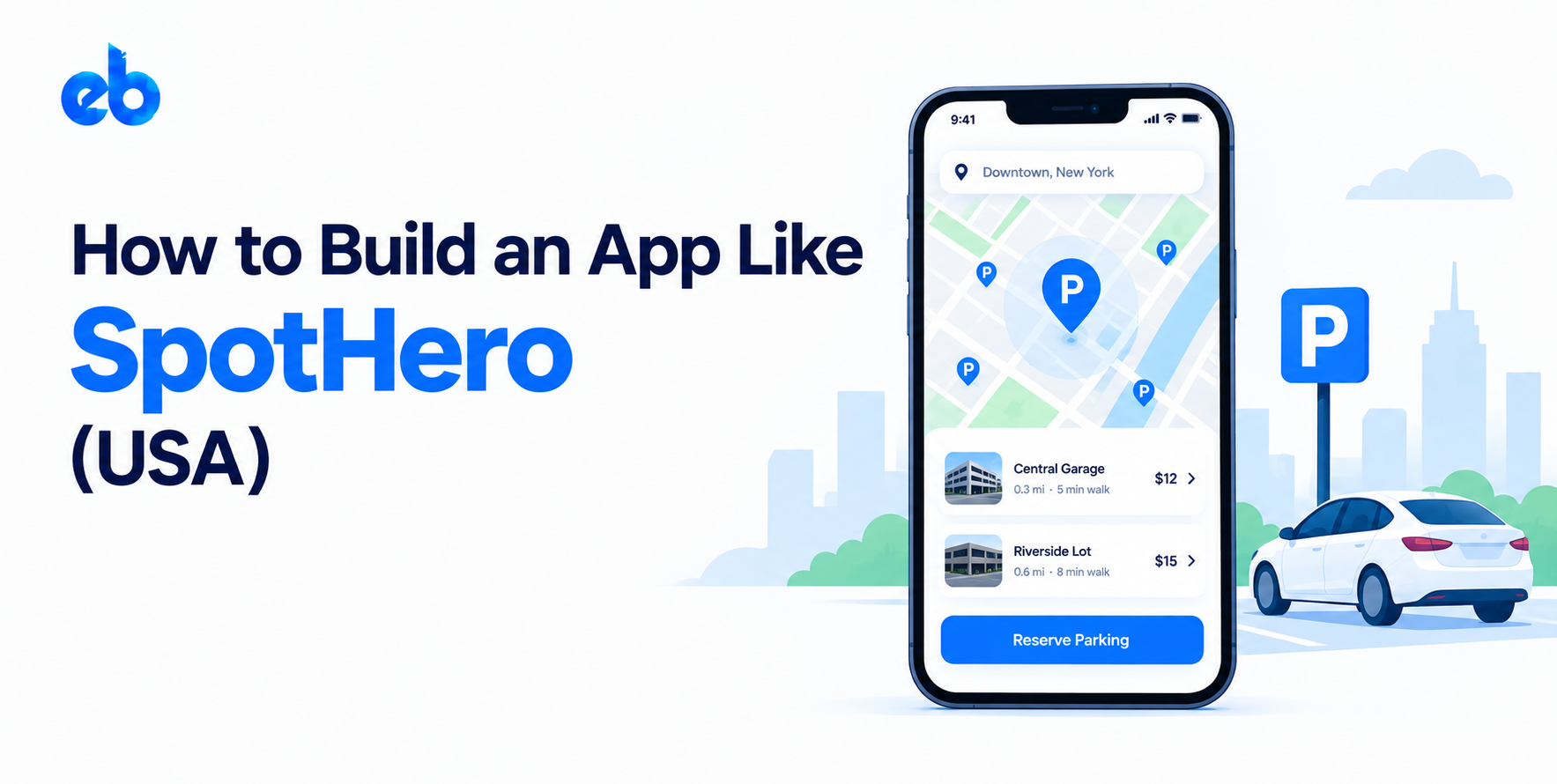
A driver in downtown Chicago often spends longer hunting for a garage than driving to it. That frustration is the entire business model.
SpotHero turned it into a habit. Search, prepay, drive in, scan a pass at the gate. Clean on screen, messy underneath.
The moment you promise someone a guaranteed spot, you own the cost of being wrong. That promise is what makes the product hard to copy well.
This guide covers what it really takes to build an app like SpotHero in the US market.
The short version: a live inventory engine, a supply network of garages, a rate and availability system, secure payments, and gate access integration.
To build an app like SpotHero, you also need a credible supply story. An empty marketplace is a dead marketplace, no matter how good the interface looks.
Most founders overbuild the driver experience and underbuild the operator side. That is backwards. Operators control the inventory, and inventory is the product.
This sits squarely in on-demand app development, where matching supply to demand in real time is the whole engineering challenge.
Yes, and the timing favors new entrants with better operator tooling. The global smart parking systems market sits at around USD 12.3 billion in 2026 and is projected to reach USD 53.4 billion by 2033, growing at a 23.3% CAGR (Grand View Research).
Growth is coming from cities digitizing curb space, EV charging bays needing reservations, and garages replacing paper tickets. Each of those creates inventory that someone has to sell online.
Parking inventory is perishable. A 2 PM spot that goes unsold at 2 PM is gone forever, like an airline seat.
It is also sold in overlapping time windows. Three drivers booking 9 to 11, 10 to 1, and 12 to 4 all touch the same physical bay. Your engine has to reason about intervals, not counts.
Then there is the ugly part. Many US garages still run legacy PARCS hardware with no public API. Some push availability by nightly CSV. Some update nothing at all and rely on a manual buffer set by the operator.
So your system needs three inventory modes: real-time API, scheduled sync, and manually managed allocation. Build all three or you will lose half your supply pipeline.
Arrival detection matters too, and geofencing is what triggers the pass, the gate code, and the no-show clock.
Three products, one shared backend. Here is what each one owns.
Entrance photos matter more than founders expect. Drivers panic at the wrong gate, and a single photo cuts support tickets sharply.
This is where retention lives. Operators need self-serve control over rates, blackout dates, allocation caps, and hourly rules.
Give them daily revenue reports, payout statements, scan logs, and a way to flag a bay as out of service in seconds. Treat it with the same seriousness you would give any online service marketplace supply dashboard.
Your internal team needs override powers. Oversell recovery, manual refunds, fraud flags, operator onboarding, and pricing experiments all run from here.
Build the oversell recovery workflow before launch. It will be used in week one.
Do not launch nationwide. Pick one dense metro and one inventory type, usually daily garage parking near a demand magnet like a stadium or airport.
Sign 15 to 30 garages before writing production code. Their systems dictate your integration architecture, not the other way around.
Founders who build an app like SpotHero without signed operators end up rewriting the inventory layer twice. Map each garage’s tech reality first: API, file drop, or fully manual. That single spreadsheet shapes your entire backend.
Model bookings as time intervals against bay pools, not as simple counters. Every query becomes an overlap check across a window.
Decide your oversell policy now. Most marketplaces hold a small buffer per garage and honor a guarantee when a driver is turned away.
Choose your build approach here too, since native or cross platform affects map performance and background location accuracy. For a first US launch, one shared codebase usually wins on speed and cost.
Parking has awkward money flows. You charge the driver upfront, hold funds, then settle with the operator on a weekly or monthly cycle.
You also need partial refunds, no-show rules, cancellation windows, and dispute handling. Choose a payment gateway that supports split payouts and stored credentials from day one.
Sales tax on parking varies by city and sometimes by facility. Bake tax rules into pricing config instead of hardcoding rates, or accounting becomes a monthly fire.
Entry is where the experience is won or lost. Your options are QR and barcode scanning, license plate recognition, gate vend via operator hardware, or attendant validation.
Each garage may support only one. Build an abstraction layer so the driver app shows a single pass type while the backend routes to whatever that facility runs. Solid API development work here saves months later, because you will keep adding new PARCS vendors as supply grows.
Static rates leave money on the table. Event nights, weekday commuter peaks, and airport holiday traffic all deserve different pricing.
Start with rule-based pricing by time block and event calendar. Layer models later once you have booking history worth learning from.
Teams that build an app like SpotHero properly use predictive analytics to forecast fill rates per garage, then adjust rates and inventory release ahead of demand spikes rather than after them.
Run a closed pilot with real drivers in a small radius. Track four numbers: search to booking rate, arrival success rate, support contacts per booking, and operator payout accuracy.
Arrival success is the one that matters most. If drivers get turned away or cannot find the entrance, nothing else saves you.
Fix the top three failure reasons before adding a second city. Expansion multiplies problems you never solved in the first market.
Availability lookups are read-heavy and latency-sensitive, so cloud scalability planning belongs in the first architecture conversation. Map screens also need real performance optimization, since drivers often search on weak downtown signal.
| Component | Estimated cost |
| Driver app (iOS and Android) | $25,000 to $50,000 |
| Inventory and reservation engine | $15,000 to $35,000 |
| Operator portal | $12,000 to $25,000 |
| Payments, wallet, and payouts | $8,000 to $18,000 |
| Access integration (QR, LPR, gate) | $6,000 to $20,000 |
| Admin, analytics, support tooling | $8,000 to $15,000 |
A focused launch version lands between $60,000 and $180,000 over 4 to 7 months. Costs climb with every extra PARCS vendor you integrate.
Rates vary widely by team location, so it helps to compare against typical mobile app development cost in the USA before you sign anything. Launching as an MVP for the US market keeps the first spend closer to the lower end.
Parking is a marketplace product wearing a maps costume. The engineering work sits in inventory accuracy, payouts, and hardware integration, not in the visual design.
EngineerBabu has built on-demand and marketplace platforms with exactly those mechanics, including work covered in our guide on building an app like Uber. The team runs on a CMMI Level 5 process, has supported 200+ VC-funded products, and works with four unicorn clients.
If you are weighing whether to staff this internally, it is worth comparing that against hiring mobile app developers in the USA at local rates.
Ready to scope your parking marketplace? Talk to EngineerBabu about your build.
A launch-ready US version typically runs $60,000 to $180,000. Driver app, reservation engine, and operator portal account for most of it. Costs rise with each additional garage hardware system you integrate.
Plan on 4 to 7 months for a single-city launch. Operator onboarding often runs in parallel with development and can become the real bottleneck if partnerships start late.
Mostly through a commission on each booking, usually a percentage of the parking rate. Additional revenue comes from monthly parking subscriptions, event packages, and promoted placement for operators.
Yes. Signed operators determine your integration architecture and prove demand is fillable. Building first and selling later almost always forces an expensive backend rewrite.
Keeping availability accurate across garages that use different systems. Interval-based booking logic, sync jobs, and oversell recovery are where most engineering time actually goes.