Wearable Device Integration in Healthcare Apps


Create engaging, high-performance mobile applications tailored to your business needs. We craft future-ready apps that offer smooth user experiences on all devices.
Build robust and scalable websites and CMS platforms that help you manage content effortlessly. Our development ensures a seamless digital presence.
Launch secure, feature-rich online stores with intuitive shopping experiences. We build tailored eCommerce platforms designed for growth.
Design captivating games with immersive gameplay and stunning graphics. From concept to launch, we build engaging experiences that players love.
Enhance your customer relationships with customized Salesforce implementations. Drive growth and efficiency with smarter CRM solutions.
Harness artificial intelligence and machine learning to automate workflows and gain actionable insights. Our AI transforms data into smart decisions.
Accelerate your software delivery lifecycle with continuous integration, delivery, and infrastructure automation to boost efficiency.
Hire app developers ready to turn your ideas into sleek, high-performing mobile apps for any platform.
Bring in frontend pros who craft smooth, beautiful, and user-friendly interfaces that your visitors will love.
Get backend developers who build fast, secure, and reliable systems to keep everything running behind the scenes.
Hire eCommerce developers who build secure, scalable online stores designed to offer seamless shopping and grow your sales.
Get dedicated developers committed to your projects, delivering consistent quality and speed as an extension of your team.
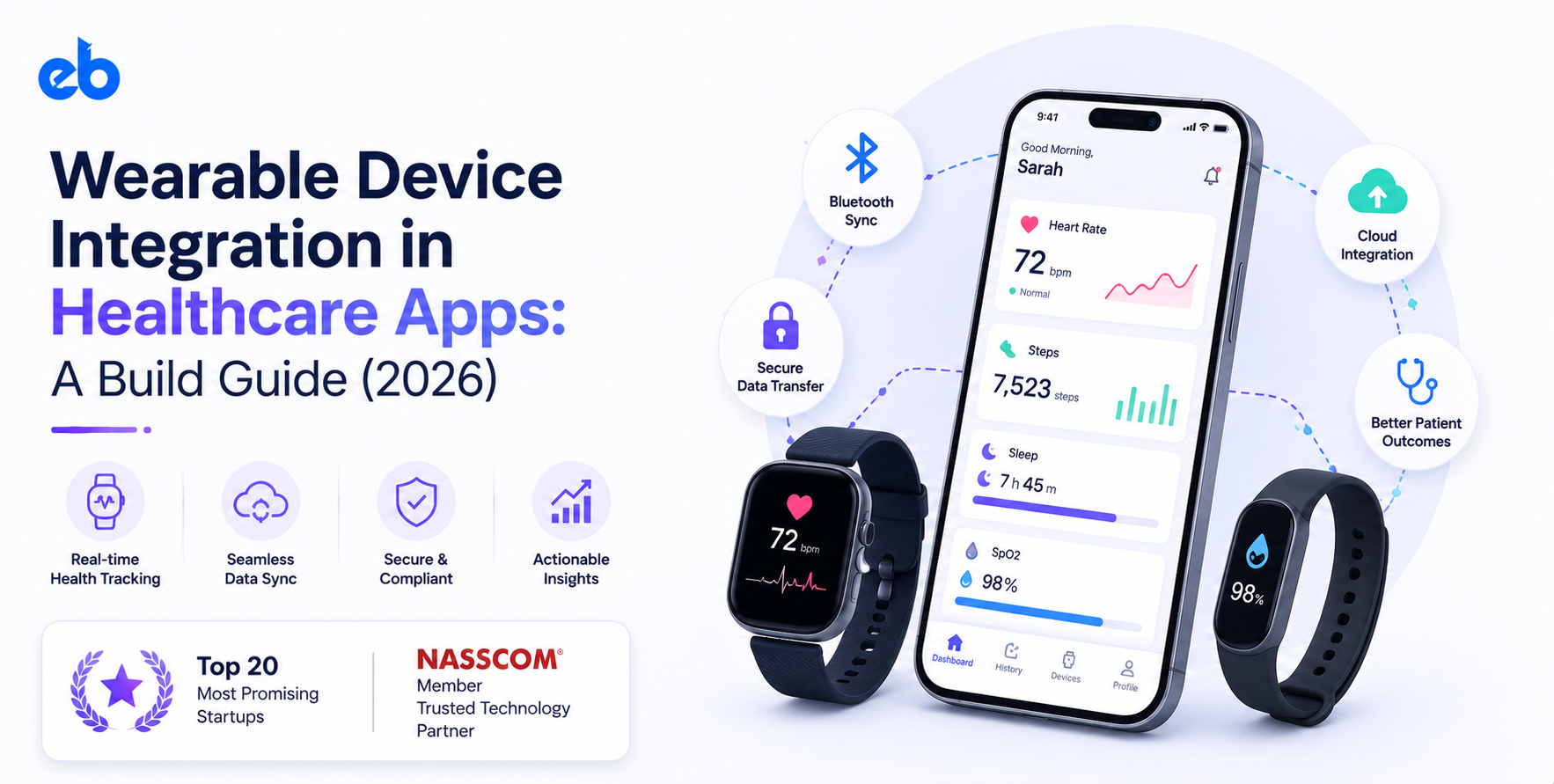
As wearable health technology becomes more common, healthcare apps are expected to do more than simply collect data.
Wearable Device Integration in Healthcare Apps connects information from smartwatches, fitness trackers, glucose monitors, and other connected devices with clinical workflows.
This helps providers and patients turn continuous health data into timely, actionable insights. For healthcare organizations, the focus is increasingly on secure interoperability, data accuracy, patient consent, and integration with existing systems such as EHRs.
Adoption is not the bottleneck anymore. A 2026 JAMA Network Open study found wearable use among US adults rose from 30.2% in 2020 to 41.1% in 2024. Yet the share of users who actually shared that data with a clinician stayed stuck between 14.2% and 19.2%.
Read that again. Four in ten people wear a sensor. Fewer than one in five ever gets it to a doctor.
Every point of that gap is a product problem, not a hardware problem. Patients have no path to send data. Clinicians have no view that makes it usable.
Wearable Device Integration in Healthcare exists to close that loop, and it is exactly what serious remote patient monitoring app development is built around.
Wearable Device Integration in Healthcare handles three very different data types. Sorting them early saves you months.
Step counts, sleep stages, resting heart rate, HRV, SpO2, workout sessions, and skin temperature. These come from Apple Watch, Fitbit, Oura, Garmin, and Whoop.
They are directionally useful and terrible as single readings. Trend lines matter here, not any one number.
Continuous glucose readings from Dexcom or Abbott, single-lead ECGs, cuff blood pressure, and pulse oximeters cleared for clinical use. These carry validated accuracy claims and different regulatory weight.
Fall detections, afib notifications, and hypoglycemia alerts. These are time-sensitive and need a defined human on the other end. Ingesting an urgent alert with nobody assigned to act on it creates liability, not value.
Every Wearable Device Integration in Healthcare build starts here. Your ingestion path shapes cost, latency, and how many devices you can support later.
Apple HealthKit and Android Health Connect read data the device already wrote locally. Coverage is broad, the user grants permission once, and you avoid per-vendor contracts. The catch is that data only syncs when the app is open or a background task fires.
Fitbit Web API, Oura API, Garmin Health API, and Dexcom API push data server to server. You get webhooks, backfill, and reliable delivery without the phone in the loop. Each one needs its own auth flow, rate-limit handling, and schema mapping, so budget real API development time per integration.
Terra, Validic, and Vital normalize dozens of devices behind one API. You trade per-record cost for speed. For most teams shipping Wearable Device Integration in Healthcare on a deadline, one aggregator plus HealthKit covers the majority of users.
Pick the single decision the data should change. Post-discharge heart failure readmission risk. Titrating insulin. Flagging hypertension between visits. Write it down as a sentence before anyone picks a device.
That sentence tells you which metrics matter, how fresh they need to be, and who reviews them. Teams that skip this ingest everything and surface nothing useful. Scoping it as a focused MVP development effort keeps the first release shippable in weeks instead of quarters.
Map your target users to devices before you write code. If 70% wear an Apple Watch, HealthKit gets you live fastest. If your cohort is diabetic, a direct Dexcom connection is non-negotiable.
Decide on push versus pull now. Webhooks give you near real-time delivery and lower infrastructure cost. Polling is simpler to build but multiplies API calls as you grow. Also confirm backfill limits, because most vendors cap historical data at 30 to 90 days.
Every vendor sends different units, timestamps, and sleep definitions. Store the raw payload once for audit purposes, then transform into one internal schema. Timestamps are the usual trap, so keep everything in UTC while preserving the device’s original offset.
Map that schema to FHIR Observation resources with proper LOINC codes. This is the step that makes your data readable by an EHR later instead of trapped in your database forever. Planning FHIR R4 integration upfront costs a week and saves a rewrite.
Raw thresholds create alert fatigue within days. A resting heart rate of 105 means nothing without that patient’s baseline.
Use rolling personal baselines, require sustained deviation across multiple readings, and suppress duplicates inside a defined window.
Every alert needs a named recipient, an escalation path, and a timeout. Log who saw it and when. Clinicians abandon dashboards that cry wolf, and you rarely get a second chance at their trust.
Wearable data collection needs explicit, granular, revocable consent. Users should see which metrics you read and be able to disconnect a device in two taps.
Revocation must actually stop ingestion and be logged with a timestamp. Build data retention rules into the schema from day one rather than bolting them on before an audit. Sync tokens expire, and users change phones, so plan graceful reconnection prompts instead of silent failures.
Once wearable readings touch a care decision, they become PHI. Wearable Device Integration in Healthcare then inherits every rule clinical data carries, and that changes the architecture, not just the paperwork.
HIPAA applies to your storage, transport, access logs, and every vendor in the chain. Any aggregator holding identified data needs a signed BAA before go-live, which is a core part of building a HIPAA compliant app.
Watch the software function line too. Displaying trends is generally low risk. Interpreting a signal and recommending clinical action can pull your product into device territory under FDA medical device software regulations. Know which side you are on before launch, not after.
For US reimbursement, CMS RPM codes require 16 days of readings in a 30-day period. That single rule should shape your sync reliability targets and your patient nudge design.
Wearable Device Integration in Healthcare produces continuous sensor data, and that is where models genuinely outperform static rules. Deterioration signals often appear days before a patient reports symptoms.
Applied AI development work here usually means anomaly detection on personal baselines, not another chatbot. A model trained on a patient’s own HRV and sleep patterns catches drift a population threshold misses entirely.
Custom ML development also handles the unglamorous half: filtering artifacts from motion, gaps, and poor sensor contact. Clean signal beats clever prediction every time. Keep clinicians in the loop on every output that drives an intervention.
Wearable Device Integration in Healthcare is not a feature you add in a sprint. It is a data pipeline with clinical consequences attached to both ends.
Get the narrow version right first. One cohort, one decision, one reliable device path, one clinician who actually uses the output. Expand from there.
If you are scoping this now, working with a partner experienced in HIPAA-aligned mobile app development makes the compliance and integration decisions far less expensive to reverse later.
It is the process of pulling data from consumer or medical wearables into a healthcare app, normalizing it, and making it usable for patients and clinicians. It covers ingestion, storage, FHIR mapping, alerting, and consent.
Apple Watch through HealthKit and Fitbit through its Web API are the most common starting points. Dexcom is essential for diabetes-focused products despite a stricter approval process.
Once it is linked to an identified patient and used in care delivery, yes. HIPAA safeguards, access logging, and BAAs with every data vendor apply from that point on.
A focused single-device integration with a clinician dashboard typically takes 8 to 14 weeks. Multi-vendor support, FHIR mapping, and RPM billing logic extend that timeline.
It depends on function. Displaying and trending data usually does not require clearance. Interpreting signals and recommending treatment often does, so get a regulatory read early.