Remote Patient Monitoring Software Development: Billing, Devices, Architecture and Cost


Create engaging, high-performance mobile applications tailored to your business needs. We craft future-ready apps that offer smooth user experiences on all devices.
Build robust and scalable websites and CMS platforms that help you manage content effortlessly. Our development ensures a seamless digital presence.
Launch secure, feature-rich online stores with intuitive shopping experiences. We build tailored eCommerce platforms designed for growth.
Design captivating games with immersive gameplay and stunning graphics. From concept to launch, we build engaging experiences that players love.
Enhance your customer relationships with customized Salesforce implementations. Drive growth and efficiency with smarter CRM solutions.
Harness artificial intelligence and machine learning to automate workflows and gain actionable insights. Our AI transforms data into smart decisions.
Accelerate your software delivery lifecycle with continuous integration, delivery, and infrastructure automation to boost efficiency.

TL;DR
Most RPM platforms that fail do not fail technically. They fail at billing, usually eight months after launch, when the denials have already stacked up.
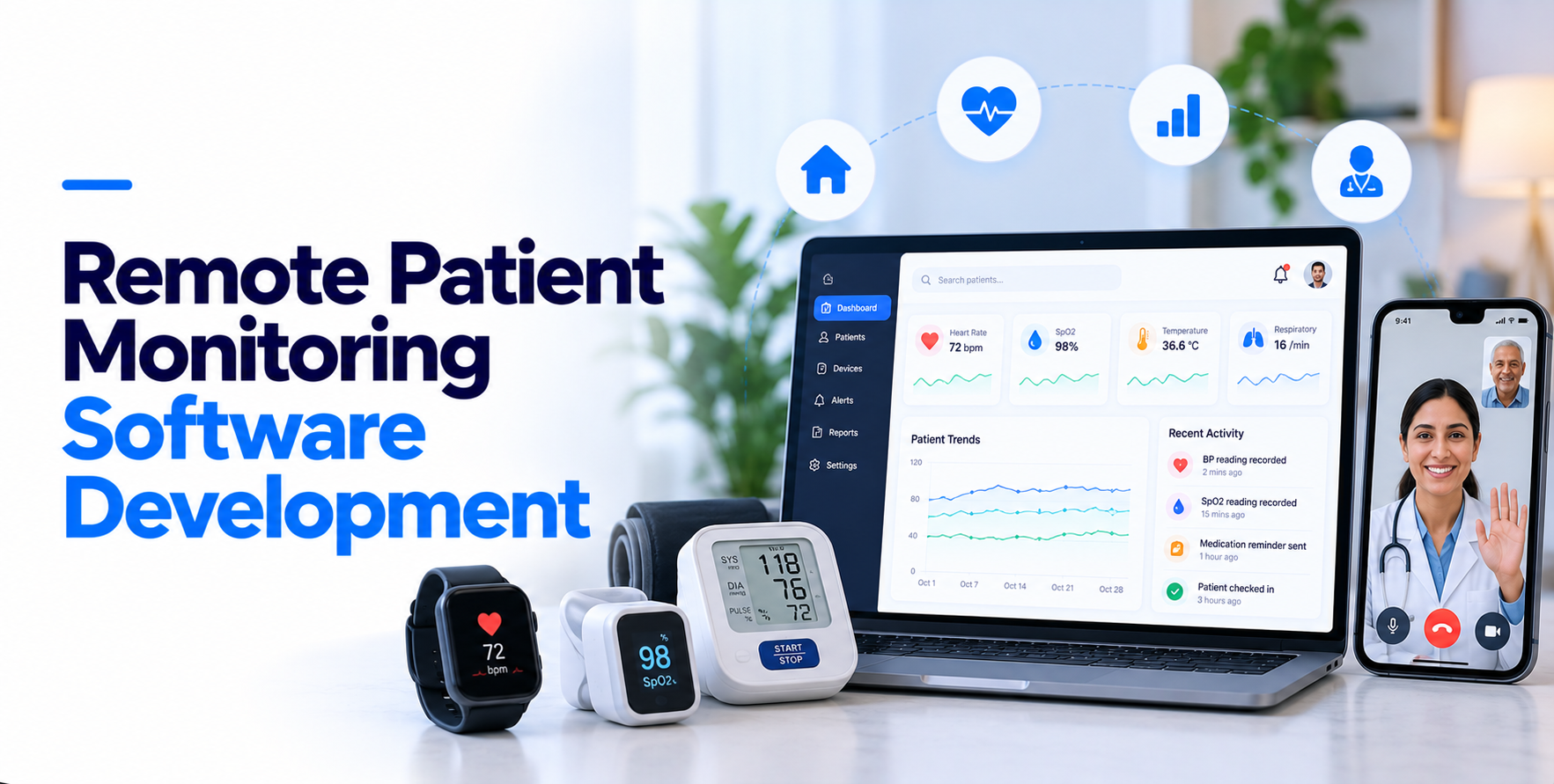
Remote patient monitoring software development means building the system that collects physiologic data from FDA-cleared devices, moves it securely to clinicians, and produces the documentation CMS requires to pay for it. Three layers have to work together: device connectivity, time-series data infrastructure, and billing compliance.
Most teams build the first two well. They discover the third after the first claims come back denied. That ordering explains why RPM products fail commercially while working perfectly as software. A platform can stream vitals flawlessly and still be unbillable, because nobody counted transmission days correctly or logged clinical time against the right code.
This guide covers the full build for the US market, assuming you intend to bill Medicare.
Four product categories get called RPM. Only some are billable, and the regulatory requirements differ sharply across them.
Get precise about your category before scoping. The device list, billing architecture and clinical workflow all change with it.
This is the section most RPM products get wrong. Not because the codes are complex, but because implementing them correctly requires your data model, documentation workflow and claim logic to be built around each code’s specific requirements.
CMS expanded the code set in the CY2026 Physician Fee Schedule. The old model paid at only two thresholds, which left shorter monitoring periods and briefer clinical interactions uncompensated. Two new codes closed those gaps.
| Code | Covers | Threshold | Frequency |
| 99453 | Device setup and patient education | First transmission, not delivery | Once per device per episode |
| 99454 | Device supply and transmission | 16+ transmission days in 30 days | Monthly |
| 99445 | Device supply and transmission | 2 to 15 transmission days | Monthly, new in 2026 |
| 99457 | Treatment management, first 20 minutes | 20+ minutes with interactive communication | Monthly |
| 99470 | Treatment management, shorter interval | 10 to 20 minutes with interactive communication | Monthly, new in 2026 |
| 99458 | Each additional 20 minutes | Beyond the first 20 | Typically twice monthly max |
| 99091 | Physician data interpretation | 30 minutes QHP time | Monthly, not alongside 99457 |
Published 2026 rate estimates for the new codes vary between roughly $26 and $47 for 99445, so confirm every figure against the current CMS Physician Fee Schedule before modeling revenue.
Across RPM products EngineerBabu has shipped, platforms with a correctly implemented billing engine captured an average of 94% of eligible CPT revenue in year one. Platforms relying on manual workflows or repurposed billing modules captured 61%.
The dashboard is the interface. The revenue layer is the care management workflow that produces billable 99457 and 99470 time: the task queue, the interaction timer, the documentation template and the attestation flow.
“We support any device” is not scope. Every manufacturer has a different protocol, API architecture and data format. Scope your integrations explicitly in discovery.
The management codes require interactive communication with the patient or caregiver. Alerts and notifications do not count. Every RPM product needs a clinical operations layer, in-house, outsourced or built in as a managed service.
Medicare Advantage plans set their own policies. Medicaid varies by state. Commercial payers often require prior authorization. Know your payer mix before architecting the billing engine.
You are the HIPAA business associate for data your platform receives. Any manufacturer whose cloud holds identified patient data is one too. Confirm BAA availability before you build the integration, not after.
They are architectural constraints on your data model, documentation and claim logic. Build the billing engine as a configurable rules engine so adding a payer is a configuration change, not a sprint.
All physiologic data moving through the platform is ePHI, so the Privacy, Security and Breach Notification Rules apply.
Cellular carriers are generally not business associates because they transmit without accessing content, though confirm that for your architecture. Standard healthcare data security best practices apply across the stack.
Services must be ordered by a physician or qualified professional before monitoring begins. Consent must be obtained and documented beforehand, and verbal consent is acceptable.
The device must be medical-grade and transmit automatically. A glucometer requiring the patient to type in a reading does not qualify. The monitoring period is a calendar month, not a rolling 30 days from enrollment.
Devices used in clinical RPM are typically Class II with 510(k) clearance. Your platform is usually not a device if it only transmits and displays. If your alert logic performs clinical decision support, such as predicting a cardiac event from reading patterns, the SaMD development classification question applies and should be settled early.
RPM is generally treated as telehealth. Coverage parity laws exist in most states but parity does not mean every payer reimburses. State Medicaid programs set their own determinations.
Before any stack choice, answer one question. How fresh does the data need to be? That requirement drives infrastructure, cost and timeline more than anything else.
A periodic-sync MVP typically costs 30 to 40% less and ships 6 to 8 weeks earlier than the real-time equivalent. Retrofitting streaming onto a polling architecture has forced backend rebuilds of roughly 40% on projects we have reviewed. Pick the lowest tier your clinical protocol genuinely tolerates.
Device integration is where RPM builds break most often. There is no universal RPM device API.
Withings offers a REST API with OAuth 2.0 and a BAA under its Health Institutions program, making it the most developer-friendly blood pressure integration available.
Omron Connect is less friendly, though its cellular models transmit without phone pairing, which helps adherence in elderly populations. A&D Medical runs cellular-first with proprietary cloud transmission.
On glucose, Dexcom has one of the cleanest APIs in the market with a BAA available for clinical partners, while Abbott’s LibreView is harder to work with. For pulse oximetry, Masimo and Nonin are the medical-grade options.
The same constraints govern wearable device integration in healthcare generally.
Cellular devices transmit straight to the manufacturer cloud with no pairing, no app install and no phone dependency. Adherence is higher and support tickets are lower, at $20 to $50 more per unit. For Medicare-target programs with elderly patients, this is usually the right call.
Bluetooth devices cost less but introduce pairing friction, which is the single largest source of patient support requests in RPM programs.
Point-to-point integrations become a maintenance problem fast. Build an adapter framework instead: one standardized internal reading model, one adapter per manufacturer, plus polling and webhook handling, device status monitoring and reading validation. Adding a device then takes days rather than weeks.
Budget a dedicated 3 to 4 week sprint for the framework and first device, run on its own rather than alongside feature work.
For programs that supply hardware, you need inventory tracking, device-to-patient assignment by serial number, shipping and return integration, reconditioning workflow and transmission monitoring. A device that stops transmitting means missed threshold days, which means lost revenue. Return rates run 8 to 15% per year on blood pressure monitors.
Remote patient monitoring software development data is time-series data at volume, and the patterns that work for clinical notes fail here.
Store readings at the reading level with patient ID, device ID, device type, reading timestamp, transmission timestamp, values, unit, status, transmission method and data source. The two timestamps are separate fields and both must be retained. An auditor reviewing a 99454 claim will ask when each reading was taken and when it was transmitted. A model storing only transmission time cannot answer the first question.
Use a time-series database. PostgreSQL with TimescaleDB handles most platforms under 50,000 patients and scales to tens of millions of readings. InfluxDB or Amazon Timestream suit higher volumes. A generic relational readings table degrades badly on exactly the queries RPM needs.
Configure alert thresholds at three levels: platform defaults, practice overrides and patient overrides. Store them so historical queries work, because “what was this patient’s threshold on that date” matters in audits. Log every alert with event, timestamp, channel, recipient and acknowledgment.
Run a nightly threshold calculation service that counts transmission days per patient per device per month, sums documented interaction time, and flags patients drifting below a billing threshold while there is still time to act.
Retain for seven years, the longer of HIPAA’s six-year rule and Medicare’s audit lookback. Archive to cold storage after two years to control cost, which is straightforward once HIPAA compliant cloud storage is configured correctly.
Revenue is generated or lost here. A solid integration and a clean dashboard produce nothing if clinical staff cannot deliver and document the required minutes each month.
The patient-side scope sits alongside this, and the full must-have features of an RPM app go deeper on engagement than workflow planning covers.
EHR integration is the most common late-stage failure in remote patient monitoring software development. Teams treat it as an API task and discover it is a vendor approval process.
The modern standard is HL7 FHIR R4 with SMART on FHIR for authentication. Epic and Cerner both expose FHIR APIs, but access is heavily sandboxed and Epic FHIR integration approval alone runs 8 to 16 weeks.
Mapping the Observation and Device resources correctly needs real clinical informatics knowledge. Legacy paths such as HL7 v2 over MLLP and Mirth Connect middleware are still common and harder to work with.
Practices will not adopt a platform that forces double entry. You need demographics pull, order sync, note push and medication list access.
Common targets are Epic and Oracle Health in large systems, with Athenahealth, eClinicalWorks, NextGen and Tebra across independent practices. Teams building their own record layer face a different problem set under custom EHR software development.
Three rules keep this from wrecking the launch date. Name the target EHR on day one. Join its sandbox program immediately, since approval queues run in parallel with engineering. Then run integration as a separate workstream with a 12 to 16 week runway.
Not every Remote patient monitoring software development should be built from scratch. Mature white-label platforms include Current Health, Biofourmis, Health Recovery Solutions and TytoCare.
When you need a device or protocol the platforms do not support, you are solving for a specific disease state, you need to own data for research or licensing, or the technology itself is the differentiator.
When your differentiation is the clinical program, you must be in market within six months, patient volume does not justify custom infrastructure, or you are a health system rather than a health-tech company.
When neither fits. Build your clinical workflow layer against an FDA-cleared platform’s APIs. You inherit their clearance and device library while owning the experience. This path is underused and is often correct for provider organizations.
The honest test is whether a buyer would choose you for your software or your care model.
Two cost models circulate, and both are right because they describe different products.
| Module | Range |
| Device integration, 10 device types | $10,000 – $20,000 |
| Time-series database and pipeline | $6,000 – $12,000 |
| Real-time alert engine | $8,000 – $15,000 |
| Alert fatigue prevention, ML baselines | $8,000 – $15,000 |
| CMS billing compliance engine | $10,000 – $18,000 |
| Claims generation and clearinghouse | $6,000 – $12,000 |
| Patient app, iOS and Android | $10,000 – $18,000 |
| Provider dashboard and coordinator tools | $8,000 – $15,000 |
| EHR integration, FHIR R4 | $6,000 – $12,000 |
| HIPAA infrastructure, IoT security, VAPT | $8,000 – $15,000 |
| Total | $80,000 – $152,000 |
| Tier | Scope | Timeline | Cost |
| Lean MVP | One condition, 2 device types, one EHR integration | 14 – 18 weeks | $110,000 – $175,000 |
| Full platform | Multi-condition, 4+ devices, multi-payer billing, fleet management | 20 – 28 weeks | $185,000 – $290,000 |
| AI-native | Predictive alerts, trend analysis, care gap detection | 22 – 30 weeks | $210,000 – $330,000 |
Costs outside engineering. SOC 2 Type II audit runs $45,000 to $95,000, with compliance tooling at $12,000 to $36,000 annually and penetration testing at $8,000 to $22,000.
Cellular blood pressure monitors cost $45 to $85 per unit, medical-grade pulse oximeters $150 to $300, and reconditioning $8 to $20 per returned device. Clearinghouse connections run $0.10 to $0.30 per claim, and an RCM partner takes 4 to 8% of collections.
A care manager costs $55,000 to $80,000 annually and sustains roughly 200 patients.
Weighed against remote patient monitoring software development ROI at realistic enrollment, the billing engine pays for itself fastest.
For pre-Series A teams, a single condition, two device types, Medicare FFS only and outsourced clinical operations brings engineering to $120,000 to $165,000. Validate first, add complexity at Series A, which is the same logic behind MVP development for healthcare startups in other regulated categories.
Confirm the target condition and device list. Produce an ePHI data classification map down to the reading level. Run BAA analysis for every manufacturer API. Confirm EHR scope and payer strategy.
Map each CPT code’s documentation requirements to data model requirements, then design the billing engine around them. Provision HIPAA-eligible infrastructure with encryption at rest, TLS 1.2 or higher, audit logging and a CI/CD pipeline with static analysis. Skipping this phase is what produces the rebuilds described earlier.
Build the device adapter framework first, then the highest-priority integration against it. Add reading validation and device status monitoring. Build physician order creation and storage, patient enrollment with timestamped consent capture, and device assignment by serial number.
Then build the threshold calculation service covering transmission days per device per month and cumulative interaction time per patient. Surface that status live on the clinical dashboard so staff can act before a billing window closes.
Build threshold configuration at platform, practice and patient levels, with multi-channel delivery and acknowledgment tracking. Build the interaction timer and documentation template capturing date, duration, nature, actions and credentials, plus the attestation workflow.
Then build claim generation for each code, clearinghouse integration, remittance processing and denial management. Add the second device integration and the EHR connection, tested in sandbox. This phase carries the most billing risk, so budget QA time inside it.
Test every billing edge case explicitly: exactly 16 transmission days, 15 days, interaction time landing between thresholds, and readings arriving in the final week of a month. Run a third-party penetration test.
Have a healthcare billing specialist review the engine against the current fee schedule, since this is domain review rather than engineering review. Remediate critical findings, connect the SOC 2 platform, deliver the handover pack, then onboard the first practice and ship devices.
Predictive deterioration alerts identify patients whose reading patterns suggest decline before any single reading crosses a threshold. A blood pressure trending up 3 mmHg daily for a week may still be under the critical line while heading over it within 72 hours. These models run nightly on active patients, with predictions stored separately from threshold alerts.
Validation is not optional. One deployment we reviewed launched at a 34% false positive rate, staff stopped trusting the alerts entirely, and retraining with six more months of outcome data brought it to 11%. Only then did admissions in that panel drop 18%.
Automated monthly summaries cut the physician attestation burden by presenting averages, trends, threshold events and interaction history instead of raw readings.
NLP on recorded interactions drafts documentation and saves 3 to 5 minutes per call, which matters at 200-patient caseloads. Recordings are ePHI, so the transcription and model providers both need BAAs, and the wider rules for HIPAA compliant AI in healthcare apply to every inference step.
Care gap detection flags patients whose declining engagement predicts dropout, before they miss a threshold.
Across RPM products we have shipped, first-year collection rates ran 84% on Medicare FFS, 71% on Medicare Advantage and 62% on commercial. Architect for the payer mix you will actually face.
EngineerBabu built Somnoware, an RPM platform for ResMed’s connected CPAP and BiPAP network, which ResMed later acquired.
The problems it solved are the ones every RPM platform hits. Device protocols had to be normalized across hardware that reported differently. Alerts had to stay clinically useful without burying coordinators.
Compliance tracking had to survive billing scrutiny. Three components carry into current work: the device abstraction layer, the alert fatigue model built on per-patient baselines, and the billing engine. That is why new builds start at module integration rather than architecture.
An India-based engineering partner is wrong for your build if your escalation protocols require real-time clinical design decisions throughout the US business day,
if you are building custom hardware rather than integrating commercial devices, or if a health system customer contractually requires development inside the continental US.
For most teams building software that integrates with commercial devices and bills through existing payer channels, none of those apply.
Score each row 0 for absent, 1 for partial, 2 for complete. Items marked 2x are billing-critical and double-weighted.
| # | Criterion | Weight |
| 1 | Reading and transmission timestamps stored separately | 2x |
| 2 | Transmission days counted from qualifying readings, not device activity | 2x |
| 3 | 99453 triggered by first transmission, not delivery | 2x |
| 4 | Interaction-level documentation with date, duration, nature, credentials | 2x |
| 5 | 99445 and 99470 supported alongside 99454 and 99457 | 2x |
| 6 | Physician order workflow built and stored | 2x |
| 7 | Timestamped consent with staff name and method | 2x |
| 8 | BAA confirmed with every manufacturer API in use | 2x |
| 9 | EHR integration for the target practice system | 2x |
| 10 | Denial management with code capture and resubmission tracking | 2x |
| 11 | Device adapter framework rather than point-to-point builds | 1x |
| 12 | Time-series database for reading storage | 1x |
| 13 | Payer rules engine, configurable rather than hardcoded | 1x |
| 14 | Seven-year retention implemented | 1x |
Maximum score is 48. Above 38 means you are ready to bill and sell into practices. Between 28 and 38, remediate the double-weighted gaps first. Below 28, do not submit claims with real patients until the gaps close.
Remote patient monitoring software development rewards teams who design around reimbursement first and features second.
The billing engine is not a back-office module added at the end. It is the schema constraint shaping your reading table, your interaction log and your alerting logic from the first commit.
Decide your data freshness tier, confirm which codes your clinical protocol can realistically support under the 2026 rules, and name your target EHR before engineering starts. Those three answers determine most of your budget.
Teams scoping a full build can start with our remote patient monitoring software development in the USA practice, or scope the wider healthcare software development program around it.
Yes. RPM and CCM are separately billable when the time counted toward each does not overlap. Each needs its own documented minutes and its own interaction log.
RPM covers physiologic data such as blood pressure and glucose. RTM covers therapeutic data such as medication adherence, pain levels and respiratory system status, and uses the 98975 to 98978 code family.
Clinical staff, physicians or other qualified professionals working under general supervision. The supervising provider need not be present for each interaction but must review and attest to the service.
Yes. RPM is subject to standard Medicare Part B cost sharing, typically 20% after the deductible. Patients must be informed of their cost responsibility before enrollment begins.
Yes. CMS confirmed that federally qualified health centers and rural health clinics can bill the new shorter-duration device supply code in 2026, expanding RPM access in underserved areas.
Transmission days accrued before admission still count toward the supply code. Clinical management time during an inpatient stay is generally not separately billable under RPM.
Device supply codes are billable per device type when each independently meets its transmission threshold. A patient using a blood pressure monitor and a glucometer can support two separate claims.
Insufficient transmission days, missing interactive communication records, absent consent documentation, and clinical time logged without timestamps. Nearly all denials trace to documentation gaps rather than clinical problems.
Yes, with tenant isolation at the data layer, per-organization billing configuration and separate audit trails. Multi-tenancy retrofitted later costs substantially more than multi-tenancy designed in.
Yes. CMS requires an existing patient relationship before RPM begins, established through a prior evaluation and management visit or an equivalent qualifying encounter with the ordering provider.