What is the Cost To Build Fitness App Like Garmin Connect in 2027


Create engaging, high-performance mobile applications tailored to your business needs. We craft future-ready apps that offer smooth user experiences on all devices.
Build robust and scalable websites and CMS platforms that help you manage content effortlessly. Our development ensures a seamless digital presence.
Launch secure, feature-rich online stores with intuitive shopping experiences. We build tailored eCommerce platforms designed for growth.
Design captivating games with immersive gameplay and stunning graphics. From concept to launch, we build engaging experiences that players love.
Enhance your customer relationships with customized Salesforce implementations. Drive growth and efficiency with smarter CRM solutions.
Harness artificial intelligence and machine learning to automate workflows and gain actionable insights. Our AI transforms data into smart decisions.
Accelerate your software delivery lifecycle with continuous integration, delivery, and infrastructure automation to boost efficiency.
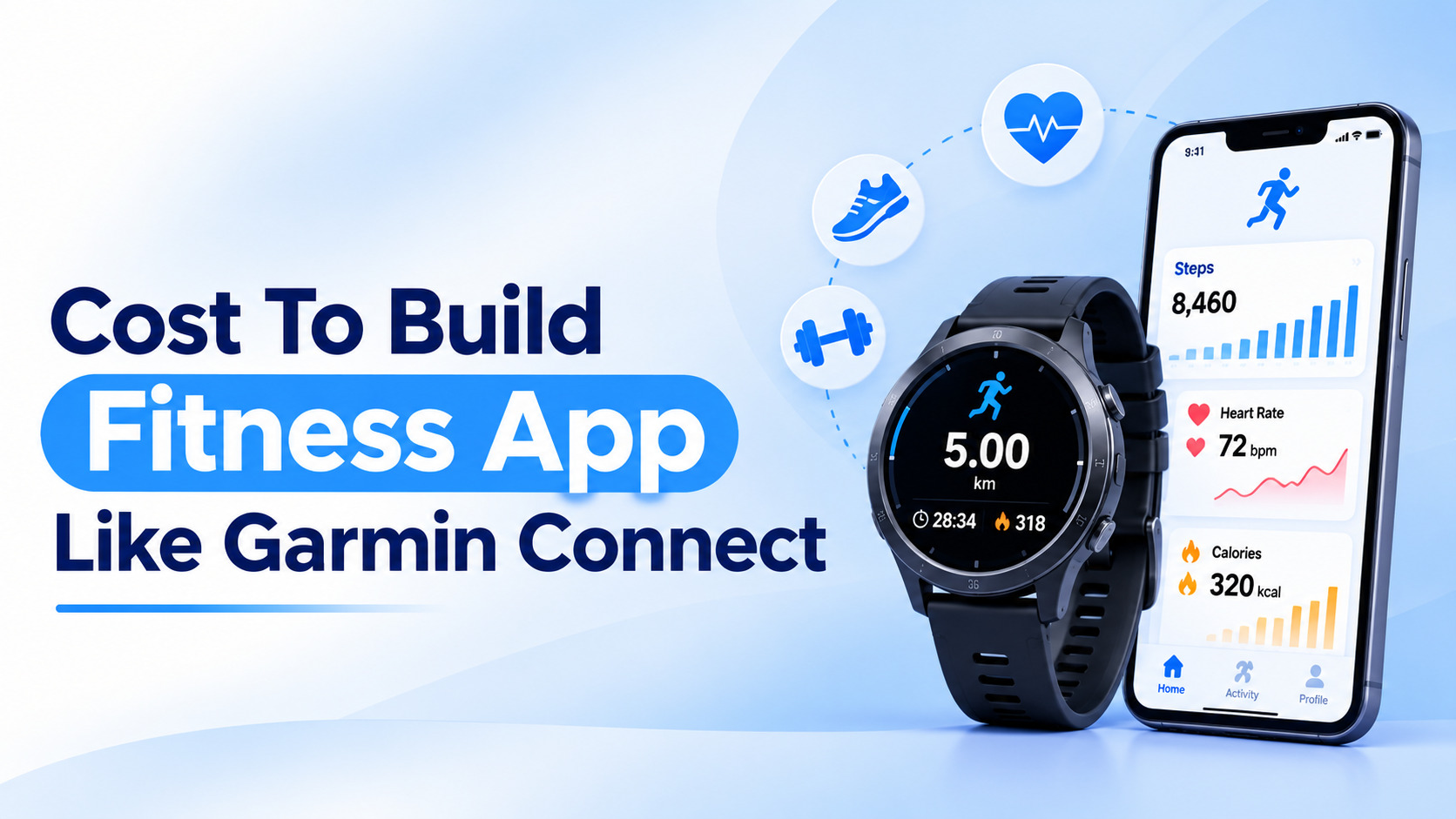
Garmin Connect is not a step counter with a pretty dashboard. It is a sync layer, a time-series data engine, and a social platform stitched into one product. That is exactly why the cost to build fitness app like Garmin Connect rarely matches the quotes founders expect.
A basic tracker ships for under $50,000. A platform that ingests sensor data from multiple devices, scores recovery, and never drops a workout sits in a very different bracket.
This guide breaks the number down by feature, by stage, and by the decisions that quietly inflate it.
This section explains where the engineering weight actually sits in a Garmin-style product. Each part below maps to a real line item in your quote. Understanding them first makes every cost estimate later in this guide easier to read.
Garmin Connect pulls data from watches, bike computers, scales, and chest straps. Each device sends a different payload at a different interval. Your backend has to accept all of it, deduplicate overlapping sessions, and reconcile offline workouts synced days later.
Reliable wearable device integration usually takes four to eight weeks on its own. Miss this and users see duplicated runs or missing sleep data, which is the fastest way to lose a fitness audience.
A single tracked run produces thousands of GPS, heart rate, and cadence points. Store that in a standard relational table and queries slow down badly within months. Garmin-class apps use time-series databases, batched writes, and pre-computed aggregates for weekly and monthly views.
Your API development work also has to handle Apple Health, Health Connect, and Strava exchanges. This layer typically absorbs 25 to 30 percent of the total engineering budget.
Nobody opens Garmin Connect to see raw numbers. They open it for training readiness, VO2 max estimates, and recovery scores. Those outputs come from tuned algorithms validated against real physiological data, not from simple averages.
Building and testing a credible scoring engine takes a data scientist alongside your app team. This is the single feature that separates a tracker from a platform people pay for.
The honest range for the cost to build fitness app like Garmin Connect is $55,000 to $450,000 or more. Where you land depends on how many device families you support and how deep your analytics go.
The table below reflects current market rates for experienced offshore teams, which is where most fitness app development budgets are spent today.
| Build type | What you get | Timeline | Cost range |
| Lean MVP | Manual logging, one wearable, basic charts | 10 to 14 weeks | $55,000 to $85,000 |
| Mid-tier app | Two to three device integrations, social feed, goals | 4 to 6 months | $110,000 to $190,000 |
| Garmin-class platform | Multi-device sync, training analytics, coaching, web portal | 8 to 12 months | $250,000 to $450,000+ |
These brackets sit noticeably above a general mobile app development cost estimate for the same timeline. Sensor data and hardware integration are the reasons.
Costs make far more sense per feature than per app. This section attaches a realistic range to each major module you would build. Use it to decide what belongs in version one and what can wait.
| Feature module | Engineering effort | Cost estimate |
| Onboarding, profiles, goal setup | 2 to 3 weeks | $6,000 to $11,000 |
| Activity tracking with live GPS | 4 to 6 weeks | $18,000 to $32,000 |
| Wearable sync for one device family | 3 to 5 weeks | $14,000 to $26,000 |
| Sleep and recovery scoring | 5 to 7 weeks | $25,000 to $45,000 |
| Training plans and coaching logic | 6 to 8 weeks | $30,000 to $55,000 |
| Social feed, challenges, leaderboards | 4 to 5 weeks | $16,000 to $28,000 |
| Companion web dashboard | 5 to 6 weeks | $20,000 to $38,000 |
Interface work deserves its own note here. A fitness app lives or dies on chart readability during a workout, so serious UI/UX design usually claims 15 to 18 percent of the build. Infrastructure is the other quiet line item, since the role of cloud computing in app scalability decides whether sync holds up at 100,000 users.
Four decisions move your quote more than anything else on the feature list. Each one is made early, usually in the first two weeks. Getting them right is cheaper than correcting them in month six.
Supporting Garmin, Polar, Apple Watch, Whoop, and Fitbit means five separate SDKs, five test matrices, and five sets of firmware quirks. Every additional family adds roughly $12,000 to $22,000 and two to four weeks of QA. Most successful apps launch with one or two and expand after retention data proves demand.
Continuous background GPS and Bluetooth sensor streaming behave differently on iOS and Android. Choosing between native vs cross platform development changes your cost by 25 to 35 percent. Cross-platform works well for the dashboard and social layers. Deep sensor access still benefits from native modules, so most Garmin-style apps end up hybrid by design.
The moment you store heart rate, sleep, or menstrual data, privacy regulation enters your scope. HIPAA, GDPR, and consent management add encryption, audit logging, and data residency work. Budget $15,000 to $35,000 for this layer, and never treat it as a launch-week add-on.
Rates swing more than feature counts do. A US agency bills $120 to $200 per hour, while senior teams in India bill $25 to $50. This is why outsourcing software development to India still cuts the same scope by 50 to 60 percent without thinning the engineering bench.
Discovery and architecture take 8 to 10 percent of the total. For a sensor-heavy product, skipping it is the most expensive shortcut available, because data model mistakes surface only after months of synced history exist. Design claims 15 to 18 percent, covering wireframes, chart systems, and watch-face companion screens.
Core development absorbs 45 to 55 percent, split between mobile clients, backend services, and the analytics engine. If you are layering AI in mobile app development for adaptive training plans, add 20 to 30 percent on top of that stage. QA and launch take the remaining 12 to 15 percent, and it runs longer here than in most apps.
You are testing across devices, firmware versions, poor connectivity, and multi-hour sessions. Security review belongs in this window too, where healthcare data security best practices get validated before real user data arrives.
There are four reliable ways to cut this budget without producing a weak product. None of them involve hiring cheaper engineers. Each step below is something teams apply before writing a single line of code.
Pick the wearable your target users already own and integrate only that one. A runner-focused app may only need Garmin. A general wellness app may only need Apple Watch. This single decision removes $30,000 to $70,000 from your first release and shortens QA by weeks.
Treat the launch as MVP development and let real retention data decide which family you add second. Teams that integrate four devices upfront usually find that two of them carry almost no active users.
Custom recovery and readiness scoring is the most expensive module on the list. Licensed physiological algorithms and open scientific models get you a credible version one for a fraction of the cost. Validate that users actually act on the score before investing in proprietary research.
Many apps discover that a simple, well-explained readiness number drives the same engagement as a complex one. You can always upgrade the engine once subscription revenue justifies a data science hire.
Your dashboard, feed, profile, and settings screens behave identically on both platforms. Building them once with Flutter development services saves roughly 30 percent of frontend hours.
Keep native modules only for background location, Bluetooth streaming, and health framework access. This hybrid split is how most well-funded fitness apps actually ship today. It protects sensor reliability while keeping the rest of the product fast to build and cheap to iterate.
Ship with analytics on every screen and every sync event from day one. Within eight weeks you will know which features people open and which ones they ignore. That data turns your roadmap into a set of funded decisions instead of guesses.
Most teams find that two or three planned features can be cut entirely. Doing this early is the difference between a focused version two and an expensive one nobody asked for.
The build budget is not the full number. Plan for 18 to 25 percent of your development cost every year in ongoing mobile app maintenance and support. Wearable firmware updates break integrations regularly, and iOS and Android health framework changes arrive annually.
Cloud costs scale with sync volume rather than user count. Expect $800 to $4,000 monthly once you pass 50,000 active users, since each one may push thousands of data points daily.
Third-party services add more, including map tiles, push infrastructure, and any licensed algorithms. App store commissions take 15 to 30 percent of subscription revenue. Founders who plan these numbers early can reduce mobile app development costs across year one by sizing infrastructure to real usage instead of projected hockey sticks.
The market supports the investment. Fortune Business Insights values the global fitness app market at $13.94 billion in 2026 and projects $38.71 billion by 2034, a 13.62 percent CAGR.
EngineerBabu builds sensor-driven health and fitness platforms end to end, from device integration through analytics and cloud architecture. The team operates on a CMMI Level 5 delivery framework, which matters most on products where a data model decision made in week two determines whether sync holds at scale.
Engineering is architecture first, so your backend is designed for years of time-series history rather than the first thousand users.
Work spans custom iOS and Android development, backend and API engineering, AI and ML, cloud, and DevOps. You can engage a full build team or hire dedicated development team India to extend your own engineers.
As a mobile app development company working across healthtech and fintech, EngineerBabu gives you a stage-by-stage cost breakdown before a line of code is written.
The cost to build fitness app like Garmin Connect is not a single number you can look up once. It moves with device coverage, analytics depth, and compliance scope, and those three choices are yours to control.
Founders who scope version one narrowly and expand on real usage data consistently spend less and ship better products. Start by naming the one wearable and the one insight your users genuinely want. Everything else in the budget follows from that.
Yes. Most fitness platforms integrate with existing wearables through their SDKs and APIs. Hardware only becomes necessary if you want proprietary sensor data competitors cannot access or replicate.
A focused MVP takes 10 to 14 weeks. A full platform with multi-device sync, training analytics, and a web dashboard realistically takes 8 to 12 months with a dedicated team.
Yes. Garmin offers Health and Activity APIs through its developer program. Access requires an application and approval, and usage terms differ for consumer apps versus enterprise wellness platforms.
Not necessary, but it is the dominant model. Subscriptions fund the ongoing cloud and maintenance costs that sensor-heavy apps carry, which one-time purchase pricing rarely covers long term.
Expect six to nine people. That typically means two mobile engineers, two backend engineers, a data specialist, a designer, a QA engineer, and a project manager across the core build.
The analytics engine. App screens follow known patterns, while recovery and readiness scoring needs physiological validation, tuning against real user data, and ongoing refinement after launch.