How to Build a Healthcare Revenue Cycle Management Platform - Claims, Denial Management, ERA Processing 2026


Create engaging, high-performance mobile applications tailored to your business needs. We craft future-ready apps that offer smooth user experiences on all devices.
Build robust and scalable websites and CMS platforms that help you manage content effortlessly. Our development ensures a seamless digital presence.
Launch secure, feature-rich online stores with intuitive shopping experiences. We build tailored eCommerce platforms designed for growth.
Design captivating games with immersive gameplay and stunning graphics. From concept to launch, we build engaging experiences that players love.
Enhance your customer relationships with customized Salesforce implementations. Drive growth and efficiency with smarter CRM solutions.
Harness artificial intelligence and machine learning to automate workflows and gain actionable insights. Our AI transforms data into smart decisions.
Accelerate your software delivery lifecycle with continuous integration, delivery, and infrastructure automation to boost efficiency.
Hire app developers ready to turn your ideas into sleek, high-performing mobile apps for any platform.
Bring in frontend pros who craft smooth, beautiful, and user-friendly interfaces that your visitors will love.
Get backend developers who build fast, secure, and reliable systems to keep everything running behind the scenes.
Hire eCommerce developers who build secure, scalable online stores designed to offer seamless shopping and grow your sales.
Get dedicated developers committed to your projects, delivering consistent quality and speed as an extension of your team.
The global RCM market was estimated at $306.8 billion and is projected to grow at 11.39% CAGR through 2030. Claim denial rates average 5 to 10% across the industry. Reworking a single denied claim costs $25 to $117. A hospital billing department spending 20% of staff time on manual denial management is a common reality. Which makes it the best time for healthcare RCM software development.
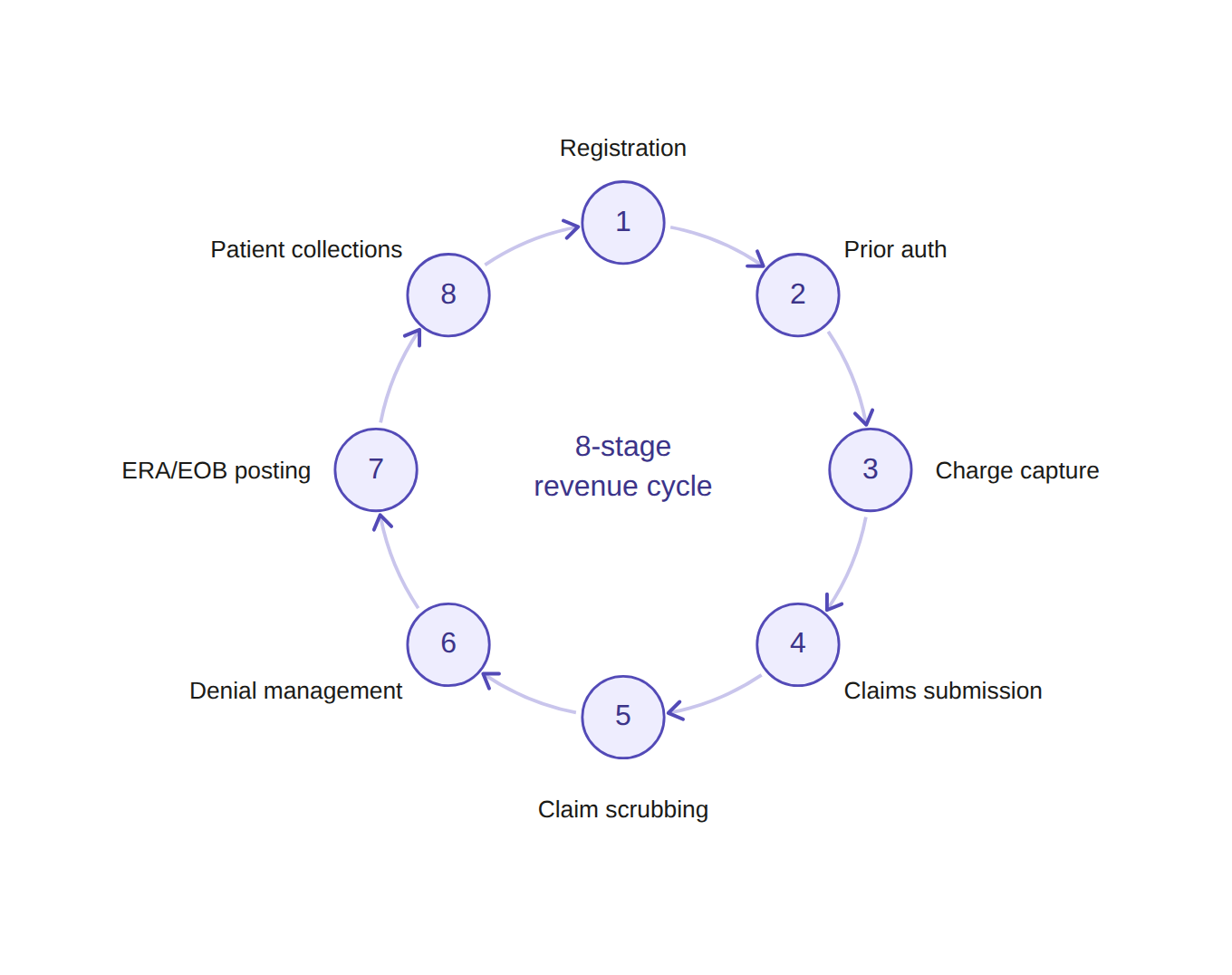
The revenue cycle starts before the patient arrives and ends when the last dollar is collected. Every step is a potential revenue leak.
The complete revenue cycle – 8 stages:
| Stage | Revenue Risk If Broken |
| 1. Patient registration | Wrong insurance = uncollectable claim |
| 2. Prior authorisation | No auth = automatic denial |
| 3. Charge capture | Undercoding = lost revenue |
| 4. Claims submission | Errors = delay |
| 5. Claim scrubbing | Unscrubbed = high denial rate |
| 6. Denial management | Unworked = permanent revenue loss |
| 7. ERA/EOB posting | Manual posting = lag and errors |
| 8. Patient collections | Poor UX = low patient payment rate |
23% of claim denials trace back to eligibility errors. All catchable before the patient walks out.
Three-stage verification:
| Trigger | Check Run |
| Appointment scheduled | Initial eligibility, confirms coverage is active |
| 48 hours before | Re-verification, catches coverage changes |
| Day of service | Final check, catches last-minute lapses |
What the eligibility check returns:
Integration via clearinghouse (Availity, Change Healthcare/Optum, Waystar) connecting to 900+ payers. Response time: under 3 seconds.
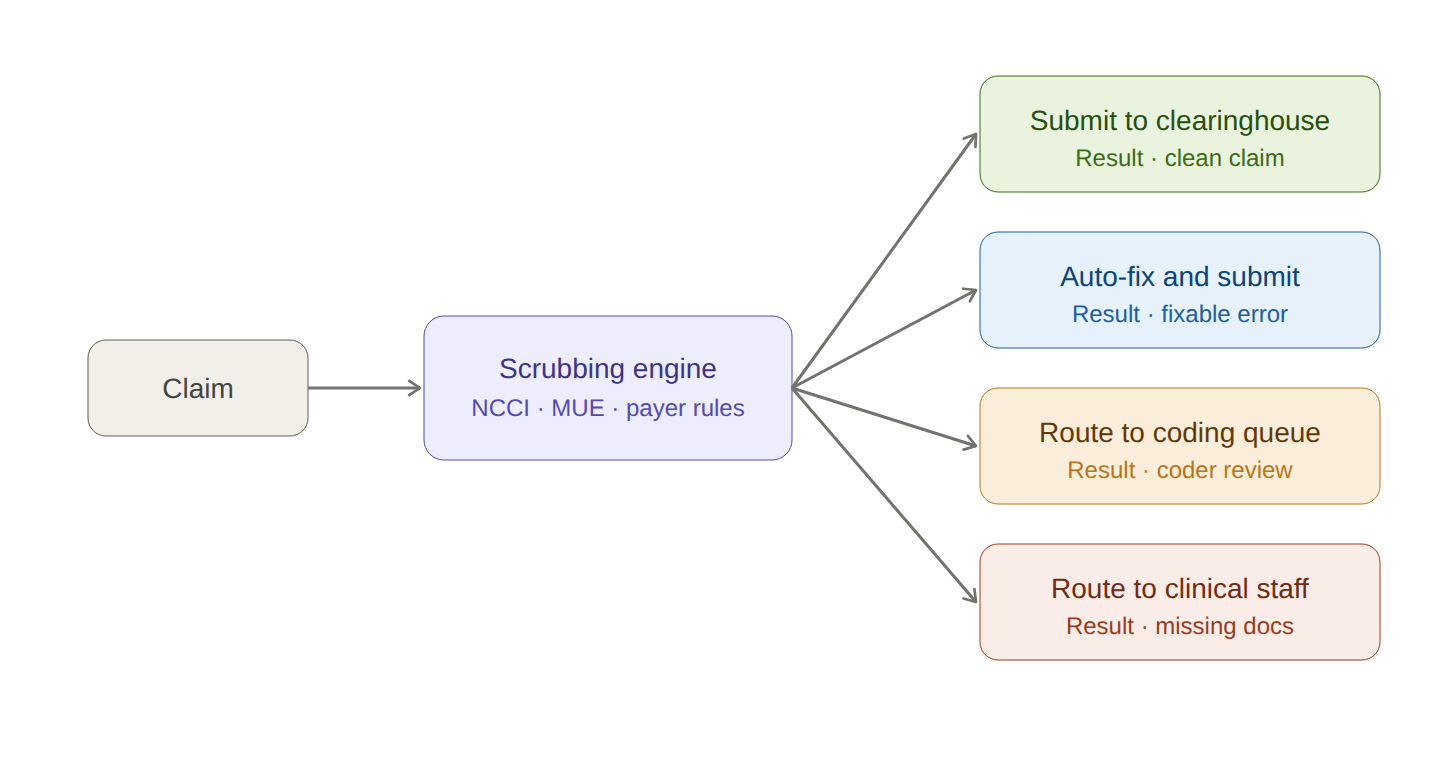
This is the most important module for healthcare RCM software development. Every claim is validated before leaving the system.
What the scrubbing engine checks:
| Check | What It Catches |
| NCCI edits | CPT code pairs that cannot be billed together |
| Medically unlikely edits (MUEs) | Units exceeding CMS maximums |
| Payer-specific rules | Each payer’s proprietary rules beyond CMS |
| ICD-10/CPT linkage | Diagnosis must support the procedure billed |
| Place of service codes | Service must match location billed |
| Modifier validation | Modifier appropriate for the CPT and place |
| Duplicate claim detection | Same patient, date, CPT |
The payer rules database:
CMS publishes national coding guidelines. But United Healthcare, Aetna, BCBS, and every regional Medicaid plan publish rules that override CMS standards. The scrubbing engine maintains a payer-specific rules database, updated monthly from payer policy publications and denial pattern analysis.
Scrubbing result routing:
| Result | Action |
| Clean claim | Submit to clearinghouse |
| Error, auto-fixable | System applies fix, documents change |
| Error, coder review needed | Routed to coding queue |
| Error, missing documentation | Routed to clinical staff |
Every denied claim in a prioritised work queue sorted by:
| Analytics View | Business Question |
| Denial rate by payer | Which payer has worst denial behaviour? |
| Denial rate by CPT code | Which procedures generate most denials? |
| Denial rate by provider | Which providers have coding problems? |
| Denial rate by denial reason | Which categories are recurring? |
| Appeal overturn rate | Which appeal strategies succeed? |
Every payer response includes CARC (Claim Adjustment Reason Codes) and RARC (Remittance Advice Remark Codes). The platform maps these to human-readable denial categories and links each to the recommended appeal strategy.
LLM-assisted appeal letter generation, pulling relevant clinical documentation, citing medical necessity guidelines, and drafting a complete appeal letter in under 2 minutes.
The automated posting workflow:
| Step | What Happens |
| ERA 835 file received | File ingested in real time |
| Line-item parsing | Every service line read – paid, allowed, patient responsibility, adjustment |
| Payment matching | Each payment matched to corresponding claim |
| Contractual adjustment posting | Expected write-offs applied per payer contract |
| Underpayment detection | Actual payment vs contracted rate – flags variances |
| Denial identification | Zero-payment lines with CARC codes → denial worklist |
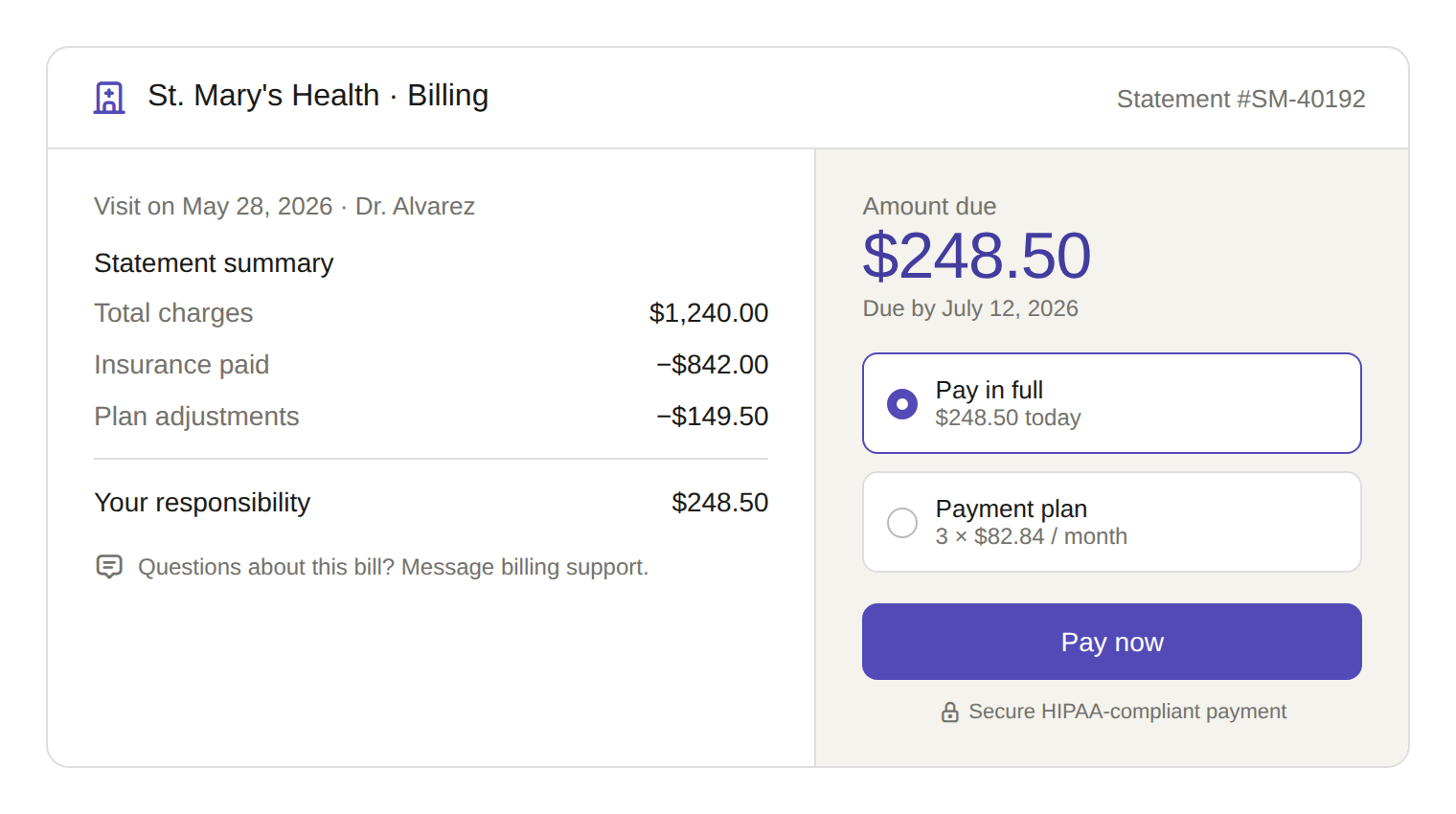
| Patient balance calculation | Remaining balance after insurance |
| Account update | No manual entry required |
The underpayment detection layer:
If a payer contract says $850 for a procedure and the payer pays $720, the platform flags the $130 underpayment and generates a balance claim. The platform maintains payer contract fee schedules per CPT code, updated when contracts are renegotiated.
FHIR R4 data flows:
| Data | Direction | Purpose |
| Patient demographics | EHR → RCM | Claim header |
| Diagnosis codes (ICD-10) | EHR → RCM | Claim diagnosis fields |
| Procedure codes (CPT) | EHR → RCM | Charge capture |
| Clinical documentation | EHR → RCM | Medical necessity support |
| Payment posting summary | RCM → EHR | Patient balance in patient portal |
AI medical coding:
| Function | How It Works |
| CPT suggestion | Reads clinical note, suggests appropriate CPT |
| ICD-10 suggestion | Maps documented diagnoses to correct ICD-10 |
| Modifier recommendation | Identifies when modifiers (25, 59, 76) are required |
| E/M level calculation | Calculates correct E/M level based on MDM or time |
| Undercoding detection | Identifies documented services not captured in charge |
| Module | Cost Range (USD) | Notes |
| Eligibility verification + clearinghouse | $8K – $15K | 900+ payer connectivity |
| Claims scrubbing + payer rules database | $12K – $22K | NCCI + MUE + payer-specific |
| Denial management – worklist + analytics | $10K – $18K | CARC/RARC mapping |
| AI-assisted appeal drafting | $6K – $12K | LLM integration |
| ERA/EOB auto-posting + underpayment detection | $10K – $18K | Contract rate comparison |
| FHIR R4 EHR integration (per EHR) | $8K – $15K | SMART on FHIR |
| AI-assisted medical coding | $10K – $18K | CPT/ICD-10 NLP model |
| Patient billing + payment portal | $6K – $12K | |
| Admin analytics dashboard | $5K – $10K | |
| AWS HIPAA + SOC 2 + VAPT | $8K – $15K | |
| Total | $83K – $155K | Full RCM platform |
Contact: mayank@engineerbabu.com
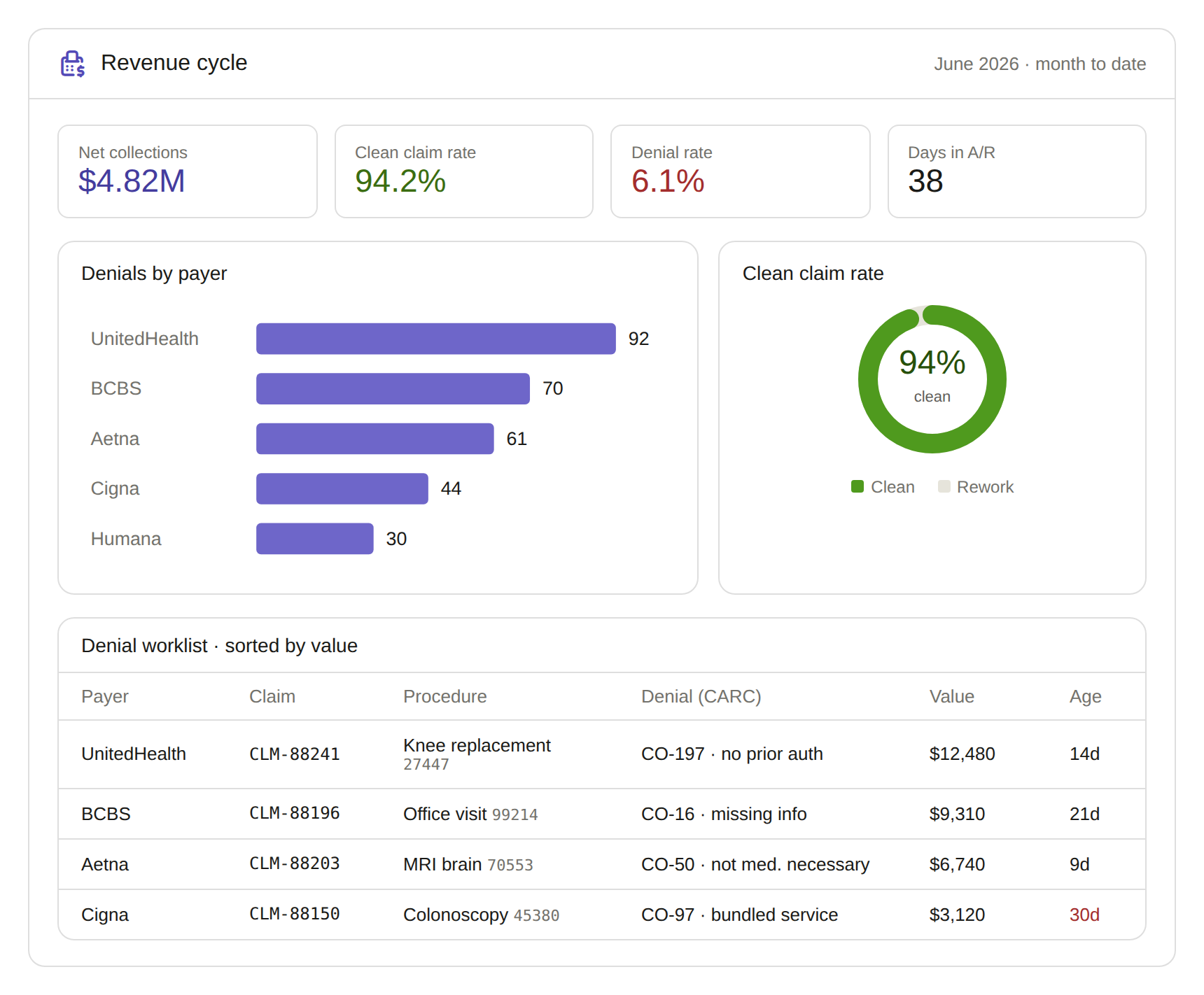
ERA (Electronic Remittance Advice) is the electronic file a payer sends detailing how it processed and paid a claim. Auto-posting reads the ERA file and automatically applies payments, contractual adjustments, and patient balances to the correct accounts without manual data entry. A billing team processing $5M/month in payments that auto-posts 85% of remittances saves approximately 200 staff hours per month. The financial impact compounds when auto-posting includes underpayment detection, flagging every payment below the contracted rate and generating a balance claim immediately, before the filing deadline.
AI reduces denials through three mechanisms: predictive scrubbing identifies claims likely to be denied before submission based on historical patterns at the specific payer and routes them for correction; ML-based prior authorisation flags procedures requiring authorisation before they are scheduled; and clinical NLP coding assistance catches underdocumented services and incorrect ICD-10 linkages before the claim is generated. Implementations combining predictive scrubbing with AI coding assistance typically achieve 20 to 40% denial rate reduction within 6 months.