How to Build an App Like Co-Star: Engine, Stack & Cost (2026)


Create engaging, high-performance mobile applications tailored to your business needs. We craft future-ready apps that offer smooth user experiences on all devices.
Build robust and scalable websites and CMS platforms that help you manage content effortlessly. Our development ensures a seamless digital presence.
Launch secure, feature-rich online stores with intuitive shopping experiences. We build tailored eCommerce platforms designed for growth.
Design captivating games with immersive gameplay and stunning graphics. From concept to launch, we build engaging experiences that players love.
Enhance your customer relationships with customized Salesforce implementations. Drive growth and efficiency with smarter CRM solutions.
Harness artificial intelligence and machine learning to automate workflows and gain actionable insights. Our AI transforms data into smart decisions.
Accelerate your software delivery lifecycle with continuous integration, delivery, and infrastructure automation to boost efficiency.
Hire app developers ready to turn your ideas into sleek, high-performing mobile apps for any platform.
Bring in frontend pros who craft smooth, beautiful, and user-friendly interfaces that your visitors will love.
Get backend developers who build fast, secure, and reliable systems to keep everything running behind the scenes.
Hire eCommerce developers who build secure, scalable online stores designed to offer seamless shopping and grow your sales.
Get dedicated developers committed to your projects, delivering consistent quality and speed as an extension of your team.
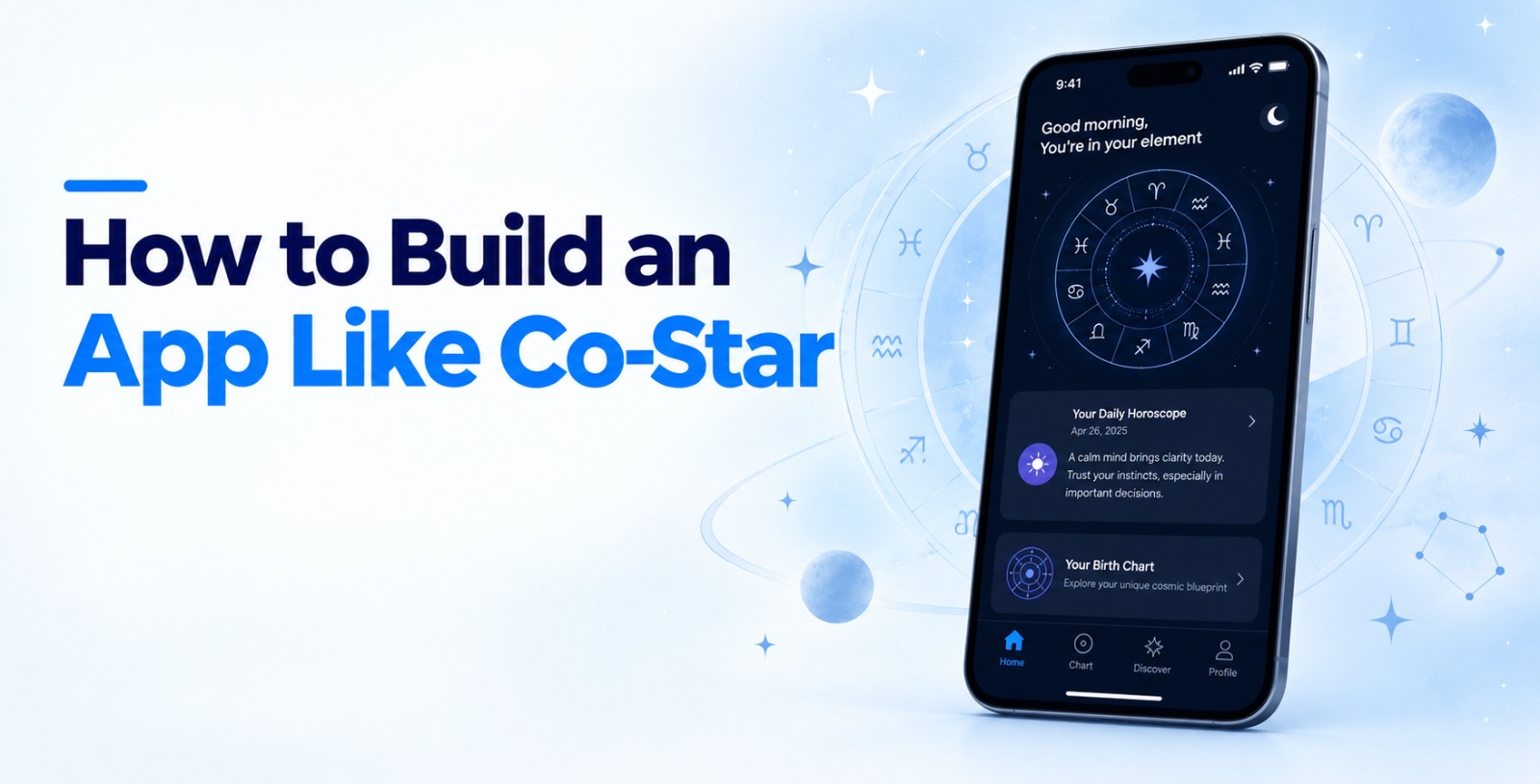
Co-Star notifications read like texts from someone who has been going through your drawers. “You are not as subtle as you think.” Nobody wrote that line for you that morning. Software assembled it from planetary coordinates in under a second.
That is the actual product. Users think they bought astrology. What they bought is a machine that turns sky positions into sentences about their personal life.
TL;DR
To build an app like Co-Star, you need four working parts. An astronomical data source, a chart engine that converts birth time and place into planetary placements, an interpretation layer that maps those placements to copy, and a social graph for friend compatibility.
The minimalist black and white design gets all the attention. It is the least expensive thing in the build.
The market is paying attention too. The astrology app sector is projected to grow from $5.69 billion in 2026 to $11.71 billion by 2030, according to The Business Research Company, at a compound rate close to 20%.
Co-Star pulls planetary positions from NASA JPL ephemeris data. This is not a stylistic choice, it is a credibility claim the brand repeats constantly.
You will work with an ephemeris library such as Swiss Ephemeris, or a licensed equivalent, exposed through your own service.
Birth date, exact birth time, and birth coordinates go in. Planetary longitudes, house cusps, aspects, and retrograde flags come out.
Timezone history is where most teams break. A 1987 birth in Indiana needs the timezone rules that existed then, not today’s.
Each placement maps to a meaning fragment. Mars in the third house means one thing, Mars in the third house during a Saturn transit means something sharper.
Co-Star combines these fragments, then runs them through language generation so output reads like a person wrote it.
Friends connect, charts get compared, and the app surfaces where two people clash. This is the retention engine, and it quietly turns a solo app into a network.
Those features need a front end that stays out of the way, which is why the UI/UX design work on apps like this stays deliberately sparse.
Pick your ephemeris before anything else, because every downstream feature depends on it. Swiss Ephemeris is the practical default, with licensing terms you should read closely for commercial use.
Validate output against a known reference for at least 50 test charts across different decades, hemispheres, and timezone edge cases. Any drift here poisons every reading the app ever produces. Astrology users are unusually good at spotting a wrong Moon sign, and they say so publicly in app reviews.
Keep calculation separate from your app logic. A standalone service accepts birth data and returns a structured chart object, which your apps and future products can both consume.
Cache aggressively. A natal chart never changes, so compute once and store it. Transits change daily and can run as a scheduled job rather than on demand.
This separation pays off later when you add web, wearables, or partner access through API development without rewriting your core.
Build a structured content library first. Every planet, sign, house, and major aspect gets a written meaning block, authored by someone who actually knows astrology.
This library is your intellectual property and your quality floor. Skipping it produces generic output that sounds like every other horoscope app on the store.
Tag each block by tone, intensity, and life area. Those tags become the control inputs your generation layer uses, which is what keeps output on brand.
Now the generative work begins. Your model receives structured chart context plus interpretation blocks, and returns short copy in a fixed voice.
Constrain it hard. Set length limits, banned topics, and a tone specification, then run output through a safety filter before delivery.
Teams that build an app like Co-Star without guardrails end up shipping advice about health, money, or relationships that nobody approved. Careful generative AI development means reviewing a sample of production output every single week.
Add friend connections through contacts or invite links, then build the comparison view. Show two charts, highlight the three sharpest aspects between them, and write one honest line about each.
Privacy matters more here than in most apps. Birth time is sensitive, so let users hide it from friends while still allowing comparison.
Notifications tied to a friend’s transit, not just the user’s own, consistently drive the strongest re-opens in this category.
Pick one city or one campus and launch there. Astrology apps spread through friend groups, so density beats reach early on.
Watch day 7 and day 30 retention above everything else. If day 30 sits under 20%, your copy is the problem, not your marketing budget.
Iterate on the writing weekly. The teams that win this category treat copy as a product surface, and ship ongoing app maintenance and support as a permanent function.
| Layer | Practical choice |
| Mobile | Swift for iOS, Kotlin for Android, or React Native for one team |
| Chart service | Python or Rust with Swiss Ephemeris bindings |
| Backend | Node.js or Go, PostgreSQL for user and chart data |
| Generation | Hosted LLM with a prompt and rules layer you control |
| Jobs | Redis queues for nightly transit computation |
| Push | Firebase Cloud Messaging with per user send windows |
Native matters more here than usual, because typography and animation carry the brand. If budget forces one codebase, compare options properly using this breakdown of the best cross-platform app frameworks before committing.
| Scope | Range | Timeline |
| MVP: chart engine, daily cards, basic push | $45,000 to $70,000 | 4 to 5 months |
| Standard: add friends, compatibility, payments | $70,000 to $120,000 | 6 to 8 months |
| Full product: deep AI personalization, web, analytics | $140,000 to $220,000 | 9 to 12 months |
Where the money actually goes surprises most founders. The chart engine and content library together eat 30 to 40% of an MVP budget, while the visible app absorbs the rest.
US based teams quote two to three times these numbers, which is why most funded startups split the work.
Co-Star keeps the core free and sells depth. Credits unlock one off readings, compatibility reports, and specific questions.
Subscriptions work too, but only after retention proves out. Selling a plan to users who churn in week two just raises your refund rate.
Ads do not belong in this category. The product’s entire appeal rests on feeling private, and a banner breaks that instantly.
Astrology is the surface. The reason to build an app like Co-Star is that it is a personalization engine wearing an unusual costume, and personalization is what keeps people opening apps.
Get the math right, write the content yourself, and keep the AI on a short leash. The rest is product discipline.
If you want this built by a team that has shipped AI heavy consumer products at scale, talk to EngineerBabu about scoping your chart engine and MVP.
EngineerBabu is a technology development company building products across fintech, healthtech, and AI, from MVPs to scaled, production-ready platforms.
It holds a CMMI Level 5 rating, has worked with 4 unicorn clients, and has supported 200+ VC-funded products. The company is backed by Vijay Shekhar Sharma.
Founded by Mayank Pratap (Co-founder) · mayank@engineerbabu.com
A functional MVP with a chart engine, daily cards, and push notifications takes four to five months. Adding friend compatibility, payments, and refined AI copy extends the build to six or eight months.
You need ephemeris data for accurate planetary positions. Swiss Ephemeris is the common commercial choice, with NASA JPL data sitting underneath most reliable libraries.
Yes. The interpretation library defines your product quality, and developers cannot write it credibly. One experienced astrologer working with a copywriter is usually enough.
Not safely on its own. Unconstrained models produce inconsistent tone and occasional advice you do not want attached to your brand. Use structured inputs, strict prompts, and human review.
Expect $45,000 to $90,000 for an MVP built offshore, and $140,000 upward for a full product with deep personalization, web access, and analytics.