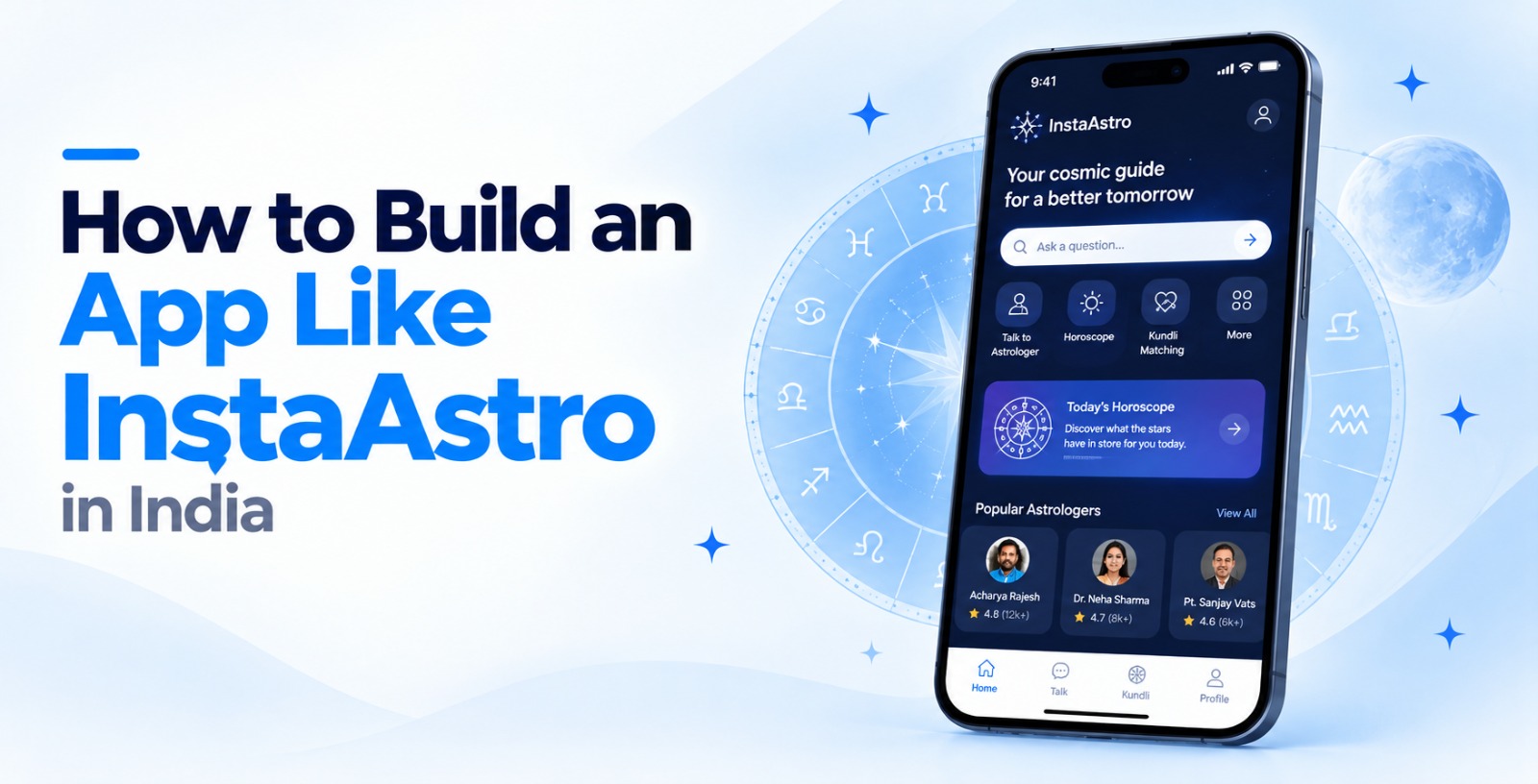
How to Build an App Like InstaAstro in India: Cost, Features, Stack


Create engaging, high-performance mobile applications tailored to your business needs. We craft future-ready apps that offer smooth user experiences on all devices.
Build robust and scalable websites and CMS platforms that help you manage content effortlessly. Our development ensures a seamless digital presence.
Launch secure, feature-rich online stores with intuitive shopping experiences. We build tailored eCommerce platforms designed for growth.
Design captivating games with immersive gameplay and stunning graphics. From concept to launch, we build engaging experiences that players love.
Enhance your customer relationships with customized Salesforce implementations. Drive growth and efficiency with smarter CRM solutions.
Harness artificial intelligence and machine learning to automate workflows and gain actionable insights. Our AI transforms data into smart decisions.
Accelerate your software delivery lifecycle with continuous integration, delivery, and infrastructure automation to boost efficiency.
Hire app developers ready to turn your ideas into sleek, high-performing mobile apps for any platform.
Bring in frontend pros who craft smooth, beautiful, and user-friendly interfaces that your visitors will love.
Get backend developers who build fast, secure, and reliable systems to keep everything running behind the scenes.
Hire eCommerce developers who build secure, scalable online stores designed to offer seamless shopping and grow your sales.
Get dedicated developers committed to your projects, delivering consistent quality and speed as an extension of your team.
A woman in Nagpur opens an app at 11:40 PM, taps a button, and is on a voice call with a verified astrologer in under 30 seconds. She pays ₹19 per minute from a prepaid wallet. She talks for 22 minutes.
That call, repeated millions of times across Tier II and Tier III India, is the business. Not the horoscope. The call.
TL;DR
To build an app like InstaAstro, start by accepting that astrology content is the hook, not the revenue. Revenue comes from paid minutes spent talking to a human.
InstaAstro itself has grown from one consultation app into a full spiritual commerce platform with thousands of verified experts. Free kundli and horoscopes bring users in, and consultations convert them.
The opportunity is real and still early. MarkNtel Advisors projects India’s astrology app market to reach $1,797 million by 2030, growing at a 49.19% CAGR, with Tier II and Tier III cities driving most of the volume.
Discovery, free tools, wallet recharge, and live consultation. This is where design effort concentrates, and where Hindi and regional language support is non-negotiable.
Availability toggle, incoming request queue, call and chat interface, earnings dashboard, and withdrawal requests. Astrologers are your supply, and a bad experience here drains them to a competitor within weeks.
Astrologer verification, commission settings, per-minute rate control, dispute handling, payout approvals, and content management. Weak admin tooling means your operations team manually fixing things in a database at midnight.
| Module | What it includes | Priority |
| Free tools | Kundli, matchmaking, daily horoscope, panchang | Launch |
| Astrologer discovery | Filters by skill, language, price, rating, online status | Launch |
| Wallet | Recharge, balance, per-minute deduction, low balance alerts | Launch |
| Live chat and call | Queueing, masked numbers, session timer, auto cut-off | Launch |
| Reviews | Post-session rating, written feedback | Launch |
| First chat free | Time limited trial to convert new users | Launch |
| Payouts | Commission split, TDS handling, scheduled settlement | Launch |
| Spiritual commerce | Pooja booking, gemstones, remedies | Phase two |
| Reports | Paid PDF kundli and career or marriage reports | Phase two |
The commerce and booking side borrows heavily from standard marketplace patterns.
Everything in this app depends on money moving correctly by the second. Define recharge flow, deduction interval, minimum balance to start a session, and the auto cut-off rule when funds run out.
Store every transaction immutably with a session reference. Disputes are frequent in this category, and a clean ledger settles them in seconds instead of hours.
Decide your commission split upfront, typically 60 to 75% to the platform on first sessions. Wallet design shapes your margins more than any other decision in the build.
Kundli generation, dasha periods, and matchmaking need accurate Vedic calculations. Swiss Ephemeris with sidereal settings and Lahiri ayanamsa is the standard approach for Indian astrology.
Expose this as an internal service that both apps consume. Cache generated kundlis, since they never change once birth data is confirmed.
Support both North and South Indian chart styles, because regional preference is strong and users notice immediately when their familiar format is missing.
Chat runs on sockets with persistent history. Calls use masked number connectivity so neither party sees the other’s real number.
Build a request queue with timeout. If an astrologer does not accept within 30 seconds, route to the next available expert in the same language and category.
Run the session timer server side, never on the device. Client side timers get manipulated, and your margins disappear quietly when that happens.
Hindi, Marathi, Bengali, Tamil, Telugu, and Kannada cover most of your addressable market. Language is also an astrologer matching filter, not just an interface setting.
Externalize all strings and design layouts for longer Devanagari text. Retrofitting languages later means reworking screens you already shipped.
Voice matters too. Many users in smaller cities prefer calling over typing, so make the call button the most prominent action on an astrologer profile.
Recruit and verify 60 to 100 astrologers before launch. Check credentials, run trial consultations, and grade them on response quality.
Nothing kills a marketplace faster than a user who taps consult and finds nobody online at 10 PM. Stagger availability schedules deliberately across late evening and early morning.
Pay weekly and pay on time. Astrologer retention in India is driven by payout reliability far more than by headline commission rates.
Track four numbers from launch day. Free tool to first chat rate, first chat to recharge rate, average session minutes, and 30-day repeat rate.
The free first chat is your conversion engine, so test its length carefully. Three minutes often converts better than five, because the conversation ends mid-insight.
Push notifications tied to transits and festivals outperform generic reminders. Keep performance tight as traffic grows using various mobile app performance optimization strategies.
| Layer | Recommendation |
| Mobile app | Flutter for one codebase, Android prioritized |
| Backend | Node.js with Socket.IO, or Go for higher concurrency |
| Database | PostgreSQL for transactions, MongoDB for chat history |
| Calls | Masked calling provider such as Exotel or Twilio |
| Payments | Razorpay or Cashfree with UPI as primary rail |
| Astrology | Swiss Ephemeris, sidereal configuration |
| Push | Firebase Cloud Messaging |
Flutter is the sensible default here because budgets are tighter and the interface is largely standard. Teams scaling quickly often hire Flutter developers on a dedicated model rather than staffing permanently.
Your wallet is a closed prepaid instrument, which keeps you outside full PPI licensing as long as balances cannot be cashed out. Never allow wallet to bank withdrawals for users.
Astrologer payouts need PAN collection, TDS deduction under section 194J where applicable, and GST invoicing above thresholds. Build this into the payout engine instead of handling it in spreadsheets.
Add clear entertainment purpose disclaimers. Avoid any medical, legal, or guaranteed outcome claims in astrologer scripts or app copy.
| Scope | Cost (INR) | Cost (USD) | Timeline |
| MVP: user app, wallet, chat, basic admin | ₹18 to ₹28 lakh | $21,000 to $33,000 | 4 months |
| Standard: add calls, astrologer app, payouts, 6 languages | ₹30 to ₹45 lakh | $35,000 to $53,000 | 6 months |
| Full platform: commerce, reports, AI matching, analytics | ₹50 to ₹80 lakh | $59,000 to $95,000 | 8 to 10 months |
Call infrastructure is your biggest recurring cost after launch, running roughly ₹0.40 to ₹0.80 per minute. Model that into pricing before setting per-minute rates.
Teams comparing in-house hiring against agency delivery should look at current software developer hiring costs in India before deciding.
A typical paid session runs 12 to 18 minutes at ₹15 to ₹35 per minute. Platform commission of 65% on a 15-minute session at ₹20 returns about ₹195 in gross margin.
Acquisition cost through performance marketing sits between ₹60 and ₹180 per installed user in this category. Payback therefore depends almost entirely on repeat consultations.
Repeat rate is the whole game. Users who return for a third session usually become monthly consumers worth several thousand rupees a year.
The decision to build an app like InstaAstro is a marketplace decision wearing spiritual clothing. Supply quality, billing accuracy, and payout reliability decide whether it works.
Build the wallet properly, recruit astrologers before users, and launch in the languages your market actually speaks. The astrology engine is the easy part.
If you want a partner who has shipped on-demand marketplace platforms with live billing and real-time communication at scale, EngineerBabu can scope the build with you.
EngineerBabu is a technology development company building products across fintech, healthtech, and AI, from MVPs to scaled, production-ready platforms.
It holds a CMMI Level 5 rating, has worked with 4 unicorn clients, and has supported 200+ VC-funded products. The company is backed by Vijay Shekhar Sharma.
Founded by Mayank Pratap (Co-founder) · mayank@engineerbabu.com
MVP development with wallet and chat runs ₹18 to ₹28 lakh. A complete platform with calls, the astrologer app, payouts, and multiple languages costs ₹30 to ₹45 lakh.
Yes. Astrologers need availability controls, a request queue, session tools, and earnings visibility. Forcing them into the user app causes drop-off on the supply side.
A prepaid closed wallet funded through UPI, cards, and net banking, using Razorpay or Cashfree. Keep wallet balances non-withdrawable to avoid PPI licensing complexity.
At least 60 to 100, scheduled so coverage holds through late evening and early morning when demand peaks.
Four months for an MVP, and six to seven months for a full two-sided platform with calls, payouts, and multilingual support.