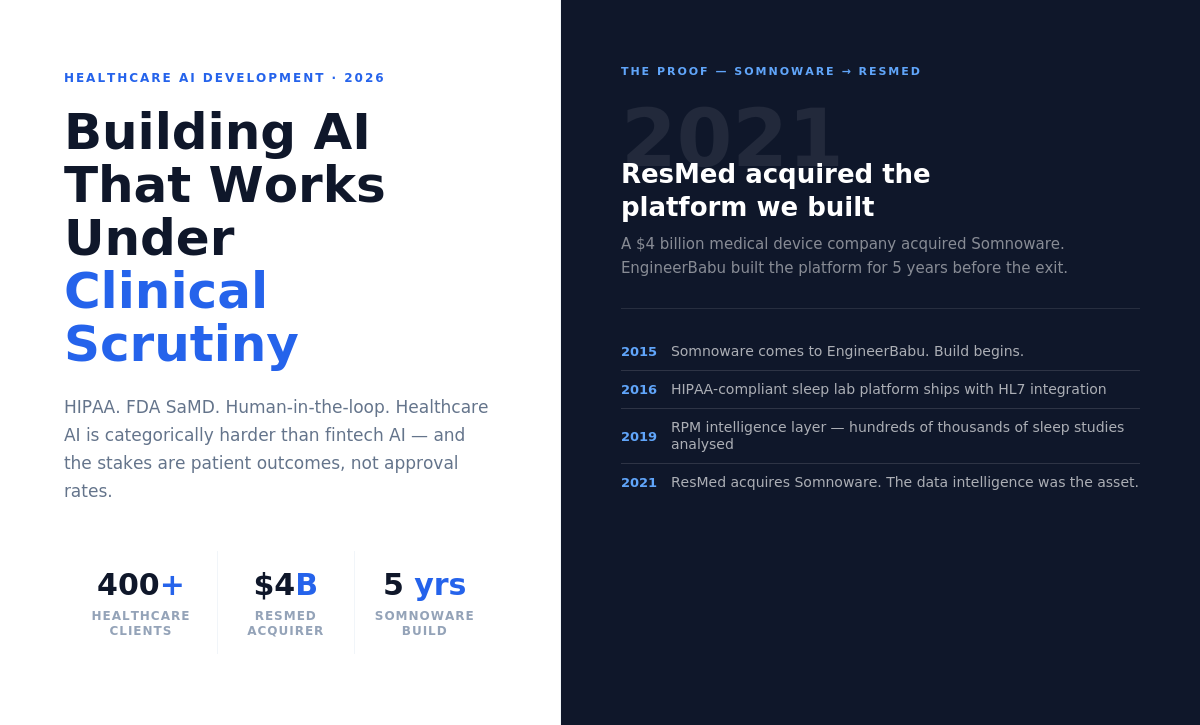
In 2015, a US-based sleep diagnostics company called Somnoware came to EngineerBabu.
They needed to build a cloud-based sleep lab management platform, connecting sleep physicians, home sleep testing devices, patients, and payer billing in a single digital workflow. The workflows were complex. The compliance requirements were significant. HIPAA. HL7 integration with EHR systems. FDA Software as a Medical Device (SaMD) considerations for any decision-support features.
The team built it. Then built it further. For five years, the engineering partnership continued as Somnoware’s platform evolved from a sleep lab workflow tool into a data platform analysing hundreds of thousands of sleep study results, surfacing population-level insights for respiratory care management, and integrating with remote patient monitoring devices.
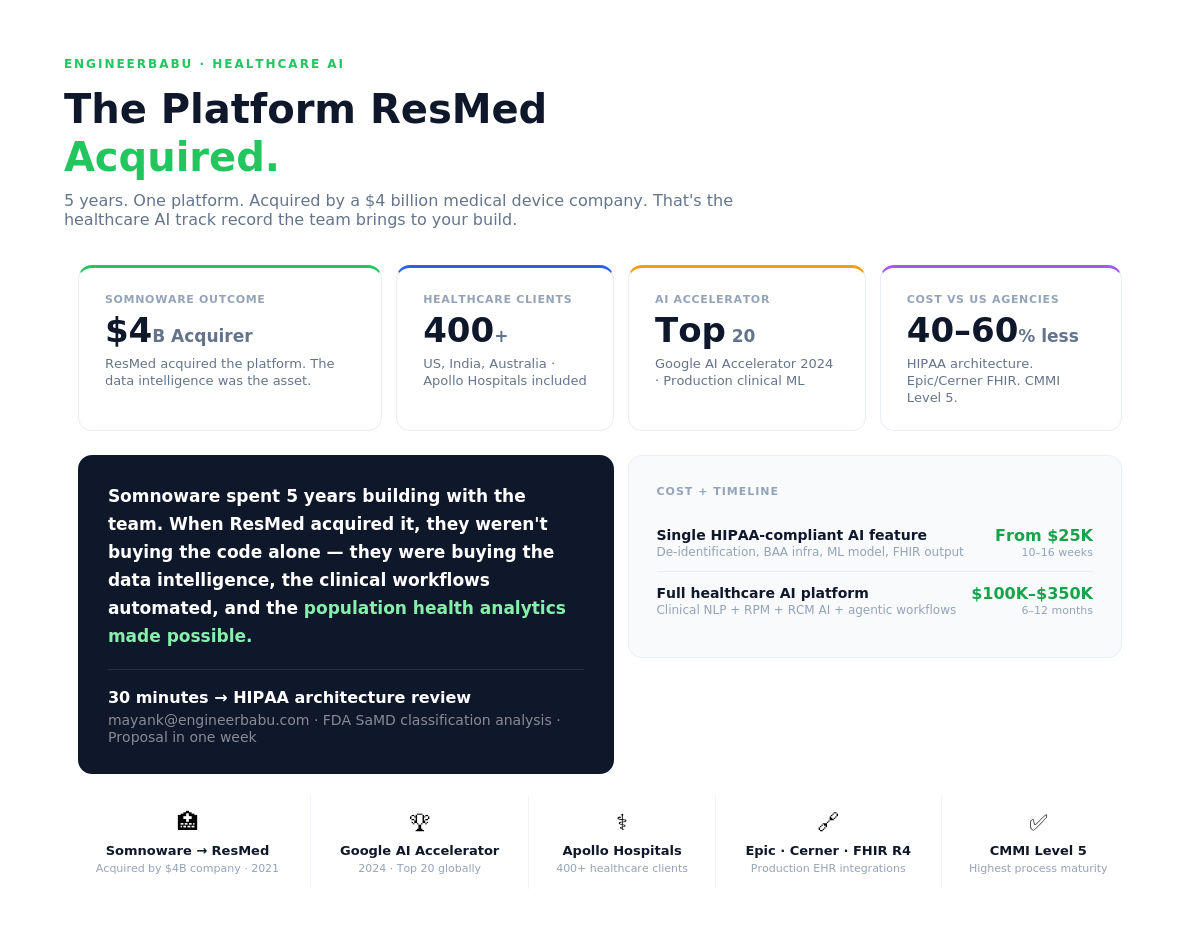
In 2021, ResMed, one of the world’s largest medical device and digital health companies, with $4 billion in annual revenue, acquired Somnoware.
The platform EngineerBabu built was the asset ResMed acquired.
This is not the only healthcare client. Apollo Hospitals. 400+ healthcare clients across the US, India, and Australia. The team has shipped FHIR integrations, HL7 v2 interfaces, HIPAA-compliant AI in Healthcare Software Development and diagnostic support tools across the full spectrum of US healthcare technology.
Google AI Accelerator 2024, top 20 globally reflects production ML capabilities that clinical AI requires: real data, real validation, real deployment in regulated environments.
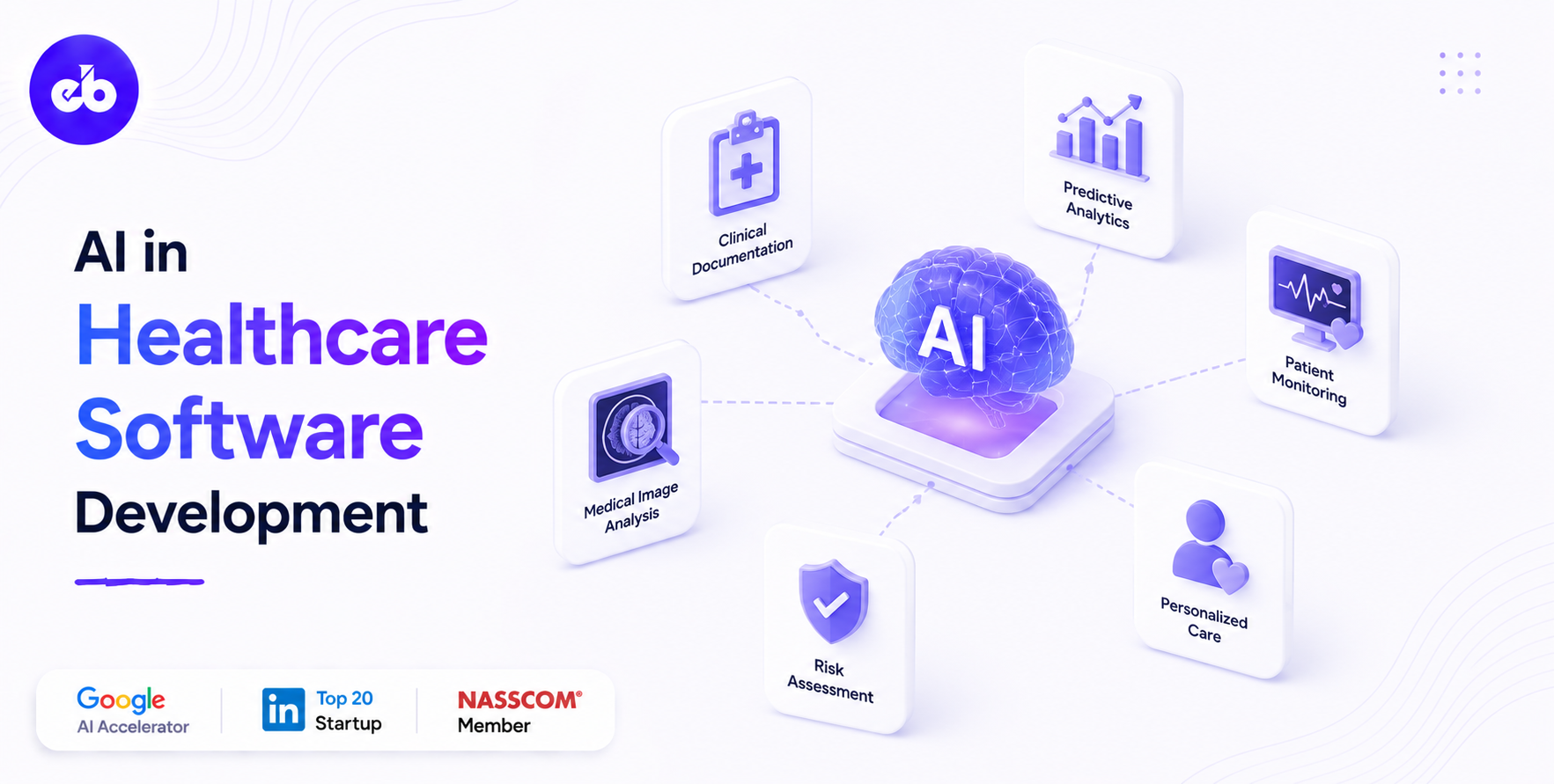
This guide is about building AI in Healthcare Software Development that works under clinical scrutiny.
Email mayank@engineerbabu.com for your healthcare AI architecture conversation.
Why AI in Healthcare Software Development Is Harder Than Fintech AI
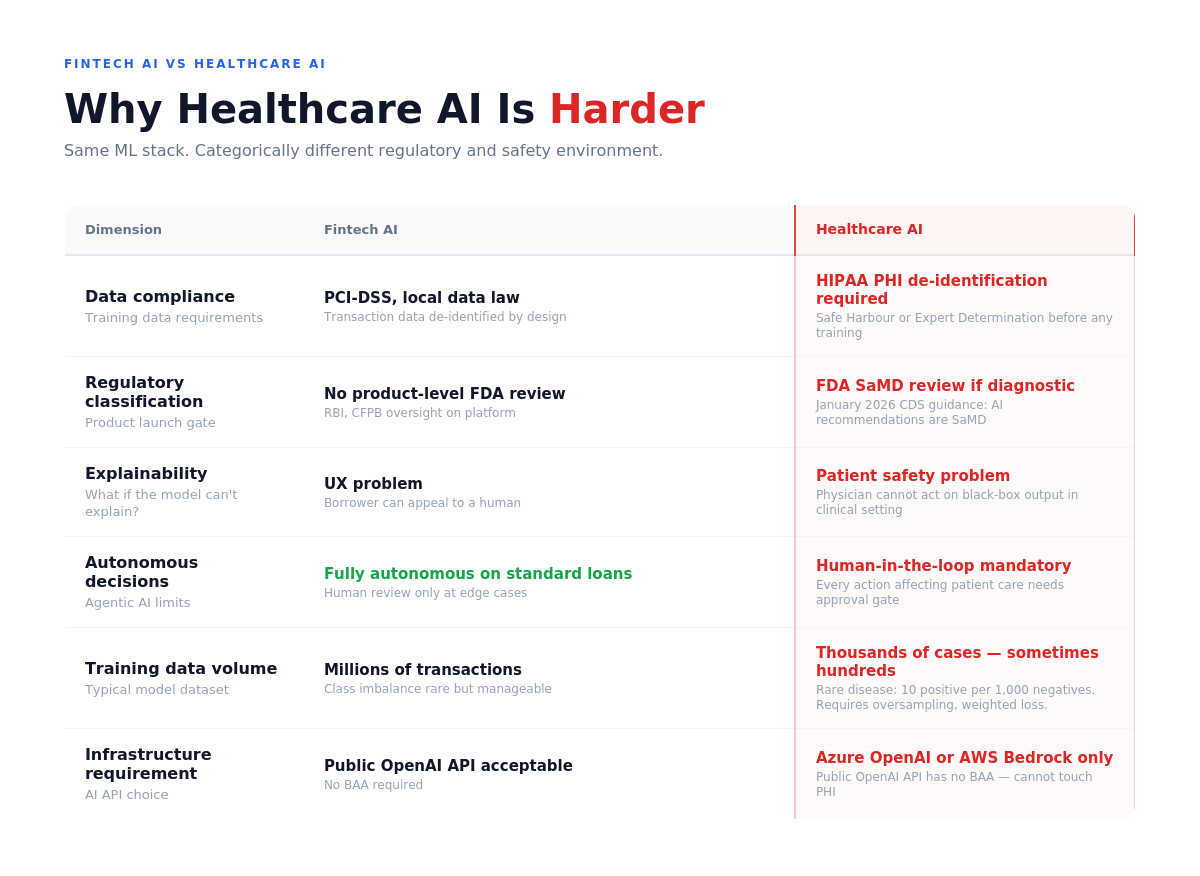
The technical architecture of healthcare AI shares elements with fintech AI. The regulatory and safety environment is categorically different.
- HIPAA: Protected Health Information (PHI) cannot be used for training AI models without de-identification under the Safe Harbour or Expert Determination methods. The de-identification pipeline is itself an engineering challenge. PHI that leaks into a training dataset is a HIPAA violation, even in a development environment.
- FDA SaMD classification: The FDA’s January 2026 Clinical Decision Support Software guidance clarifies: AI software that analyses patient data and generates diagnostic recommendations is Software as a Medical Device (SaMD) subject to regulatory review. The clinical decision support exemption applies only when the software provides information a clinician can independently review and is not the sole basis for a clinical decision. Getting this classification wrong has product launch consequences that fintech compliance issues don’t have.
- Explainability as a clinical requirement: An AI fraud model that can’t explain its decision is a UX problem. An AI diagnostic tool that can’t explain its recommendation is a patient safety problem. A physician cannot act on a black-box output in a clinical setting. Every healthcare AI model the team builds has explainability as a design constraint, not a post-launch feature.
- Human-in-the-loop mandate: In fintech, agentic systems can autonomously approve and disburse standard loans. In healthcare, autonomous clinical decisions require human oversight at defined confidence thresholds. The architecture must implement human-in-the-loop gates for every action that could affect patient care.
- Data scarcity and class imbalance: Fraud models train on millions of transactions. Clinical AI models often train on thousands of cases, sometimes hundreds for rare conditions. Class imbalance (10 positive cases per 1,000 negatives in a rare disease classifier) requires careful handling: oversampling, weighted loss functions, threshold calibration. Under-represented classes produce models that appear accurate on aggregate metrics but perform poorly on the cases that matter most.
The 6 Applications Transforming AI in Healthcare Software Development in 2026
1. Clinical Natural Language Processing (NLP)
Clinical documentation is the largest unstructured data source in healthcare. Physician notes, discharge summaries, radiology reports, pathology findings, all text, all carrying clinically significant information, none of it structured for computational analysis.
Clinical NLP extracts structured clinical intelligence from unstructured text:
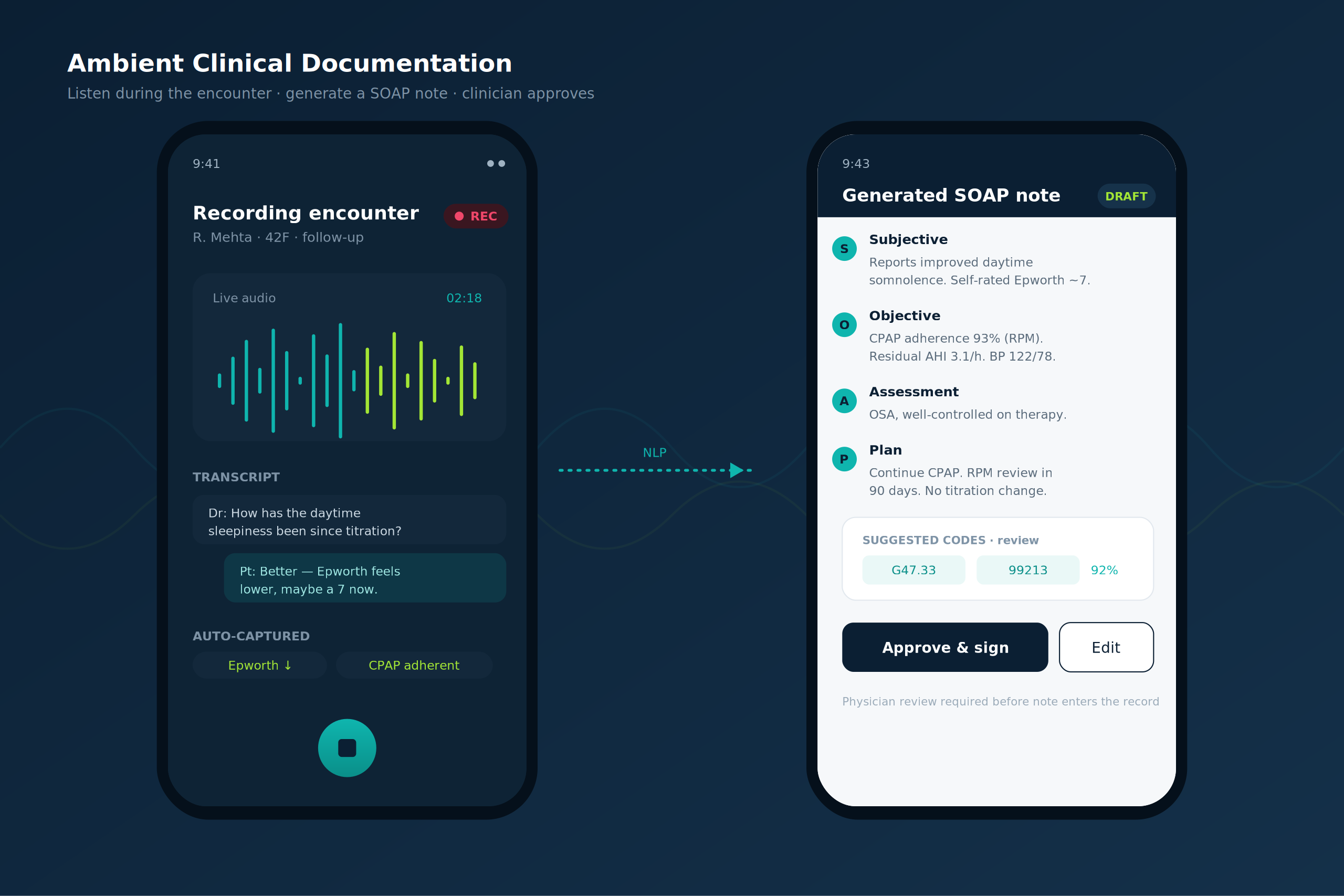
- Ambient documentation: AI listens to a physician-patient conversation during a clinical encounter and generates a structured clinical note (SOAP format: Subjective, Objective, Assessment, Plan) in real time. The physician reviews and approves rather than dictates. Studies show ambient documentation reduces documentation time by 72% and physician burnout rates correlated with documentation burden.
- Prior authorisation automation: The most commercially valuable near-term healthcare AI application in the US market. Prior auth requires matching the patient’s clinical documentation against the payer’s medical necessity criteria, a text-matching problem that currently takes clinical staff 20–30 minutes per request manually. AI reduces this to under 2 minutes by parsing the clinical note, extracting the relevant clinical indicators, and generating the prior auth request in the payer’s required format.
- Clinical coding assistance: ICD-10 and CPT code assignment from clinical documentation. Medical coders review and approve AI suggestions rather than coding from scratch. AI coding accuracy on well-documented encounters exceeds 92%, significantly above average human coder accuracy on complex cases.
- Discharge summary analysis: AI in healthcare software development identifies readmission risk signals in discharge summaries: incomplete follow-up instructions, unresolved clinical problems at discharge, high medication complexity. Readmission risk scores generated automatically at discharge for care coordination intervention.
- The Somnoware connection: the sleep study analysis layer the team built used NLP to extract clinical findings from polysomnography reports, parsing free-text physician interpretations into structured data fields that could feed population analytics. The same NLP engineering discipline, building models that parse clinical language accurately enough for clinical decision support, applied to the broader healthcare AI stack.
2. Diagnostic AI and Clinical Decision Support
AI diagnostic tools in 2026 are moving from research settings into production clinical applications across several domains:
- Medical imaging AI: Computer vision models trained on radiology images (X-ray, CT, MRI) to flag findings for radiologist review. The FDA’s 2026 CDS guidance makes clear: these systems support the radiologist’s decision, they do not replace it. The human-in-the-loop architecture is not optional.
- Vital sign anomaly detection: In ICU and telemetry settings, AI in healthcare software development monitor continuous vital sign streams and alert clinical staff when patient deterioration is detected before it becomes critical. The challenge: alert fatigue. Models calibrated too sensitively generate constant alerts that clinical staff learn to ignore. Calibration for clinical utility requires extensive validation against historical deterioration events.
- Sepsis prediction: ML models trained on EHR data to identify sepsis risk 6–12 hours before clinical presentation. Early sepsis detection reduces mortality by up to 20% in published studies. The engineering challenge: EHR data quality varies enormously across institutions. A model trained at one hospital system may perform poorly at another due to documentation practice differences.
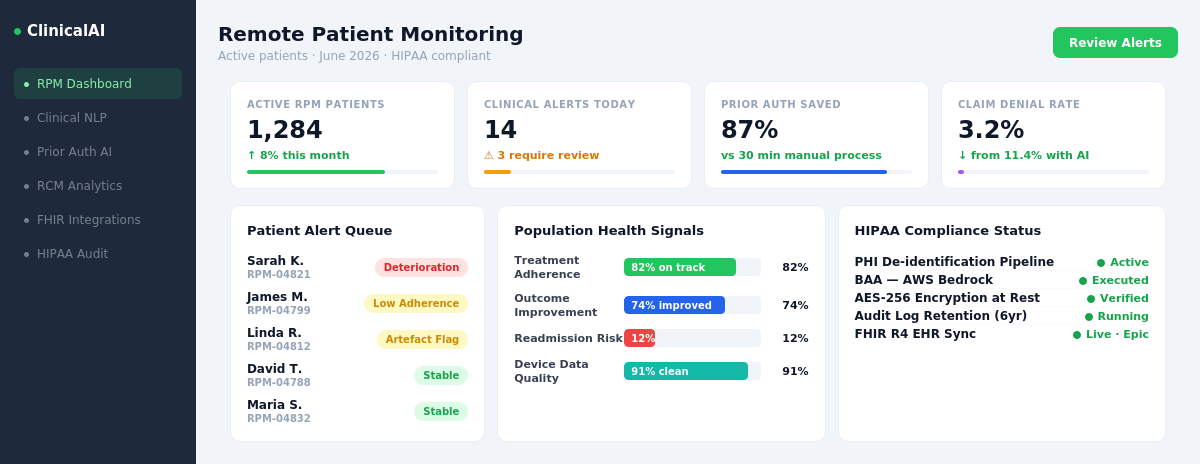
- Remote patient monitoring (RPM) intelligence: The core of what the team built for Somnoware. Devices generating continuous data streams (blood oxygen, respiratory effort, glucose, blood pressure) connected to an AI layer that identifies patterns requiring clinical intervention. The Somnoware platform processed hundreds of thousands of sleep studies, extracting population-level insights on treatment adherence and outcome patterns that ResMed acquired as a data asset.
3. AI for Revenue Cycle Management (RCM)
The US healthcare system wastes $250 billion annually in administrative costs, a significant portion from claim denials and prior authorisation delays. AI is the most impactful intervention in the RCM workflow:
- Denial prediction: ML model trained on 12–24 months of historical claims and denial data. Features: procedure code, diagnosis code, payer, plan type, prior auth status, place of service, provider NPI. Denial prediction accuracy of 85–92% in production systems. Claims predicted to be denied are flagged for pre-submission review, the most cost-effective point in the revenue cycle to fix documentation gaps.
- AI-powered claim scrubbing: NLP analysis of clinical documentation against payer medical necessity criteria before submission. Identifies documentation gaps, incorrect diagnosis coding, missing supporting documentation. The team’s claim denial AI blog covers this in depth.
- Eligibility verification automation: Real-time eligibility verification at the point of appointment scheduling rather than 24 hours before service. AI agents that query payer APIs, interpret eligibility responses, and surface coverage gaps for staff resolution before the patient arrives.
4. Remote Patient Monitoring (RPM) Platform Intelligence
The Somnoware platform is the team’s deepest production healthcare AI experience, and it is directly relevant to the fastest-growing segment of US digital health: remote patient monitoring.
The engineering challenge unique to RPM AI: Continuous device data streams are noisy. A home blood pressure device worn incorrectly produces wildly incorrect readings. A sleep study device with a loose sensor produces artefact data that looks like a pathological finding. The AI layer must distinguish genuine clinical signals from device noise and the boundary between them is not clean.
- Artefact detection: ML model trained to identify data quality issues in device readings. Sensor displacement, patient motion, connectivity dropouts, device calibration errors. Artefact-contaminated readings are excluded from clinical analysis and flagged for the care coordinator to contact the patient.
- Adherence prediction: Which patients are at risk of stopping device use before their treatment programme is complete? Adherence models trained on device connectivity patterns (frequency of sync, days without readings), patient demographics, and clinical characteristics. Proactive care coordinator outreach to low-adherence-risk patients before they disengage.
- Outcome intelligence: Population-level analysis of treatment outcomes across cohorts. Which patient characteristics predict better outcomes on which treatment protocols? This was the data asset that made Somnoware valuable to ResMed not just the workflow platform, but the intelligence layer built on top of the data the platform generated.
5. AI for Patient Engagement and Access
- Symptom assessment chatbots: Conversational AI in healthcare software development that guides patients through symptom assessment, provides triage recommendations (self-care, urgent care, emergency), and schedules appointments with the appropriate care type. Clinical NLP required for symptom parsing. The FDA SaMD framework applies if the chatbot’s recommendations could be acted upon without physician review.
- Appointment no-show prediction: ML model predicting which appointments are at risk of no-show. Features: appointment type, day of week, time of day, patient distance from clinic, patient history of prior no-shows, appointment lead time. Predicted no-shows are filled from a waitlist automatically, reducing revenue loss from unfilled slots by 15–25%.
- Personalised care plan adherence: AI analysis of patient engagement with digital care plan content (which modules were completed, which were skipped) to predict adherence risk and trigger care coordinator outreach for patients showing disengagement signals.
6. AI for Interoperability and Data Exchange
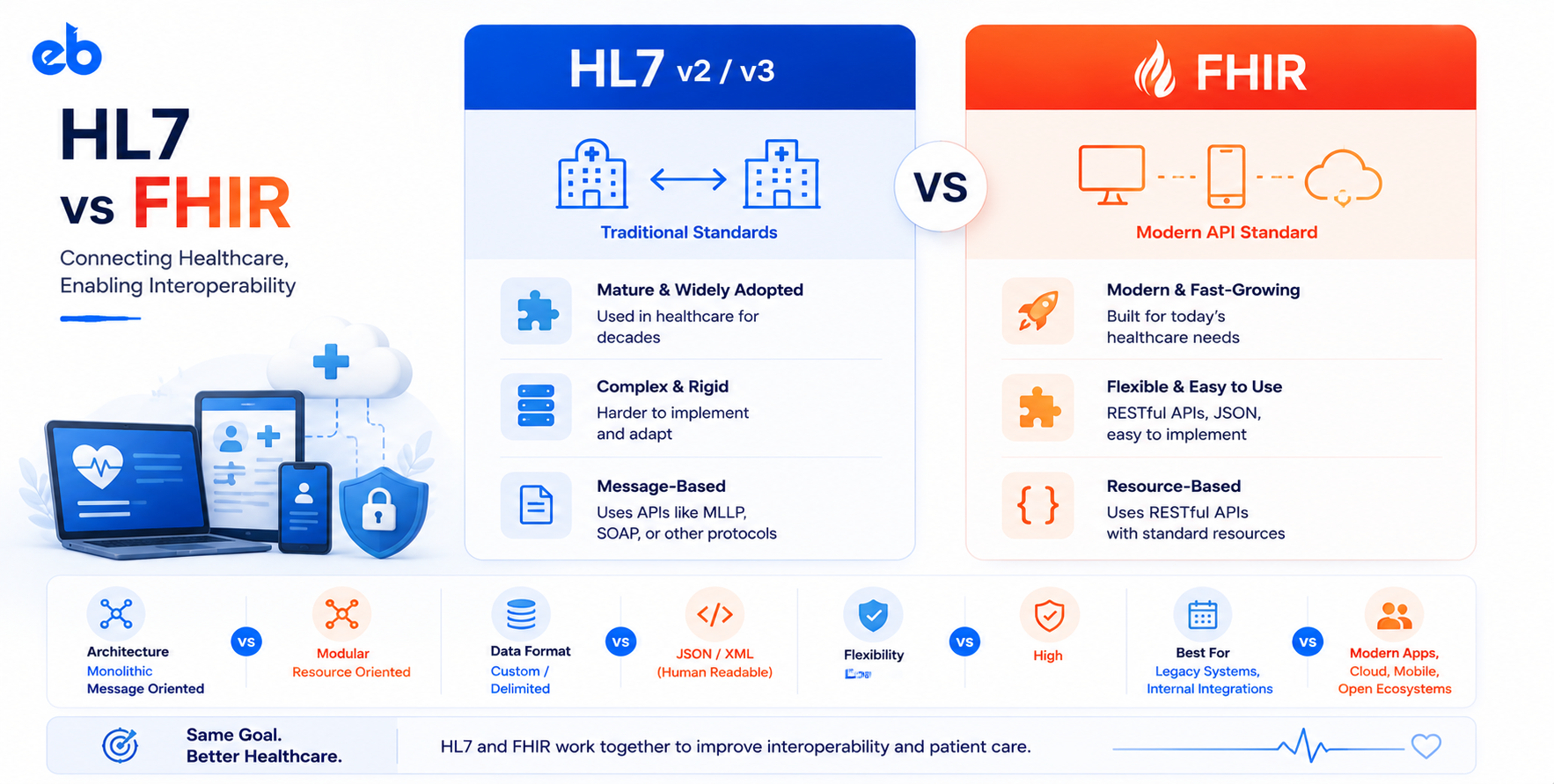
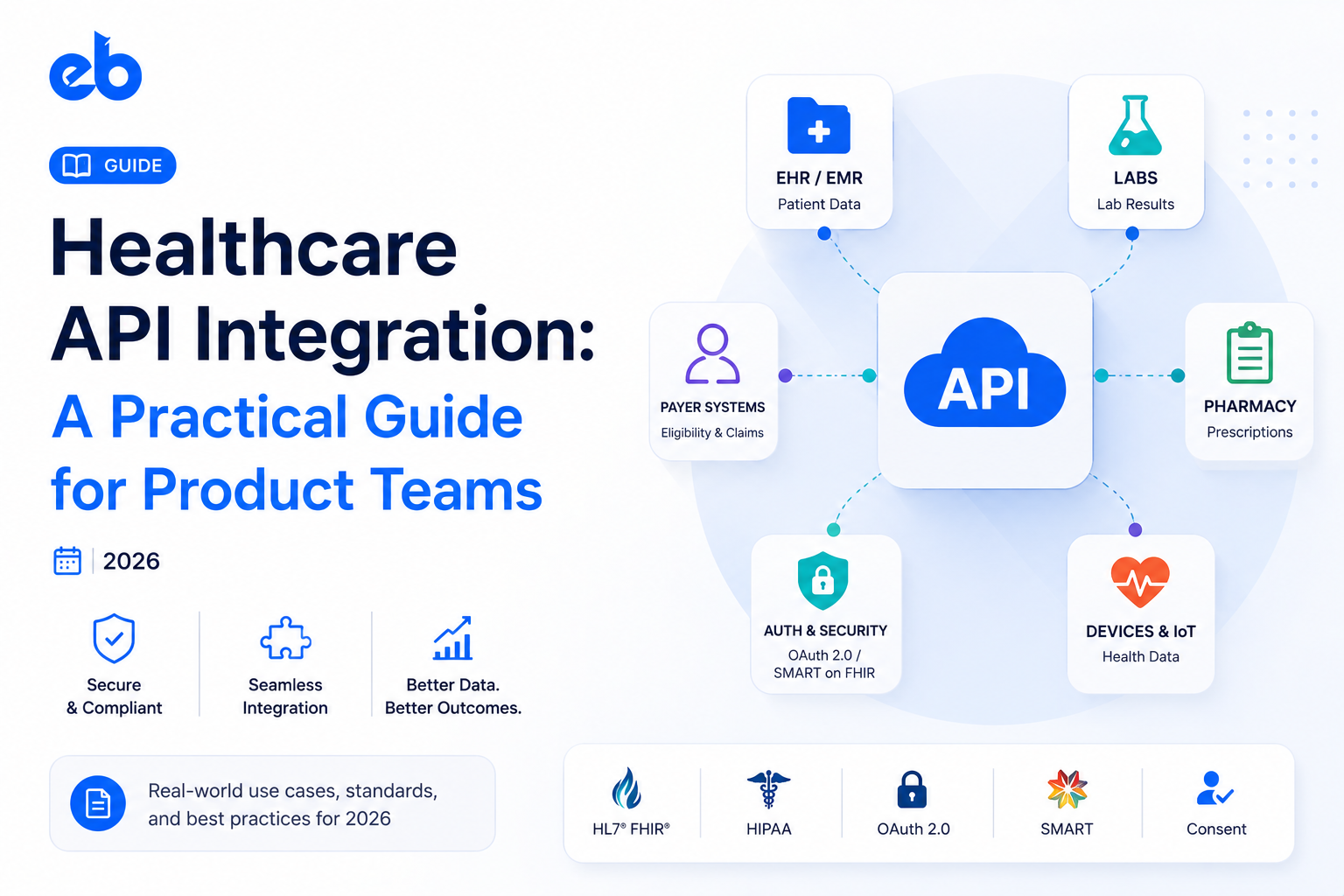
The US healthcare interoperability landscape is governed by the 21st Century Cures Act, the CMS Interoperability Rule, and the USCDI (US Core Data for Interoperability) standard. Healthcare AI that cannot integrate with EHR systems via FHIR R4 APIs cannot access the patient data it needs.
- FHIR-native AI: The team has shipped FHIR R4 integrations with Epic, Cerner, and Athenahealth for AI feature extraction and AI output write-back. The AI model reads FHIR resources (Patient, Observation, Condition, MedicationRequest) as input and writes FHIR resources (RiskAssessment, Flag, CarePlan) as output. This is the architecture that makes healthcare AI interoperable across the fragmented US provider landscape.
What Agentic AI Makes Possible in Healthcare
Healthcare is where agentic AI in healthcare software development creates the most value and requires the most careful governance. The opportunity: healthcare administrative workflows are high-volume, rule-based, and expensive. The constraint: anything touching clinical decision-making requires human oversight.
- Agent 1 – Prior Authorization Agent: Receives a prior auth request trigger from the EHR. Pulls the relevant clinical documentation via FHIR. Parses the clinical notes using NLP. Matches clinical indicators against the payer’s medical necessity criteria. Generates the prior auth request in the payer’s format. Submits via the payer’s API. Monitors for response. For standard cases: fully automated, under 2 minutes. For complex or borderline cases: routes to clinical staff with extracted evidence pre-populated. Result: 80% reduction in prior auth staff time.
- Agent 2 – RCM Pre-Submission Agent: Before each claim is submitted, the agent runs the denial prediction model, checks documentation completeness against payer requirements, validates procedure and diagnosis code combinations, and either approves for submission or flags for review with specific correction guidance. Runs overnight on the next day’s claim batch.
- Agent 3 – RPM Monitoring Agent: Continuously monitors all active RPM patients’ device data streams. Runs artefact detection to filter noise. Runs clinical alert model for deterioration signals. Fires clinical alerts to the care team for genuine signals above the threshold. Logs all monitoring events for the clinical audit trail. Generates the monthly RPM summary report for billing.
- Agent 4 – Appointment Intelligence Agent: Monitors the appointment schedule for no-show risk signals. Fires automated reminders to high-risk appointments. Monitors for actual no-shows in real time. Fills from waitlist automatically when a no-show is confirmed. Generates the daily schedule optimisation report.
Who is doing what in the real world: LinkedIn built an enterprise multi-agent AI system for its Hiring Assistant, directly relevant to healthcare staffing workflows. One enterprise cut invoice processing time from 2 days to 20 minutes using five coordinated agents. In healthcare specifically, Coherent Solutions’ 2026 whitepaper documents production agentic systems for KYC, AML, and fraud detection in financial services, the same multi-agent architecture applies to prior auth, RCM, and RPM monitoring in healthcare.
Governance requirements for healthcare agentic AI:
- Every agentic action that touches PHI has a BAA-covered data lineage trail
- Every agentic clinical recommendation has a human review gate at defined confidence thresholds
- Every agent action is logged in an immutable audit trail, model version, input data hash, output, timestamp, and human review outcome if applicable
- Model updates require clinical validation before deployment, A/B testing in production with outcome tracking
HIPAA Compliance Architecture for AI in Healthcare Software Development
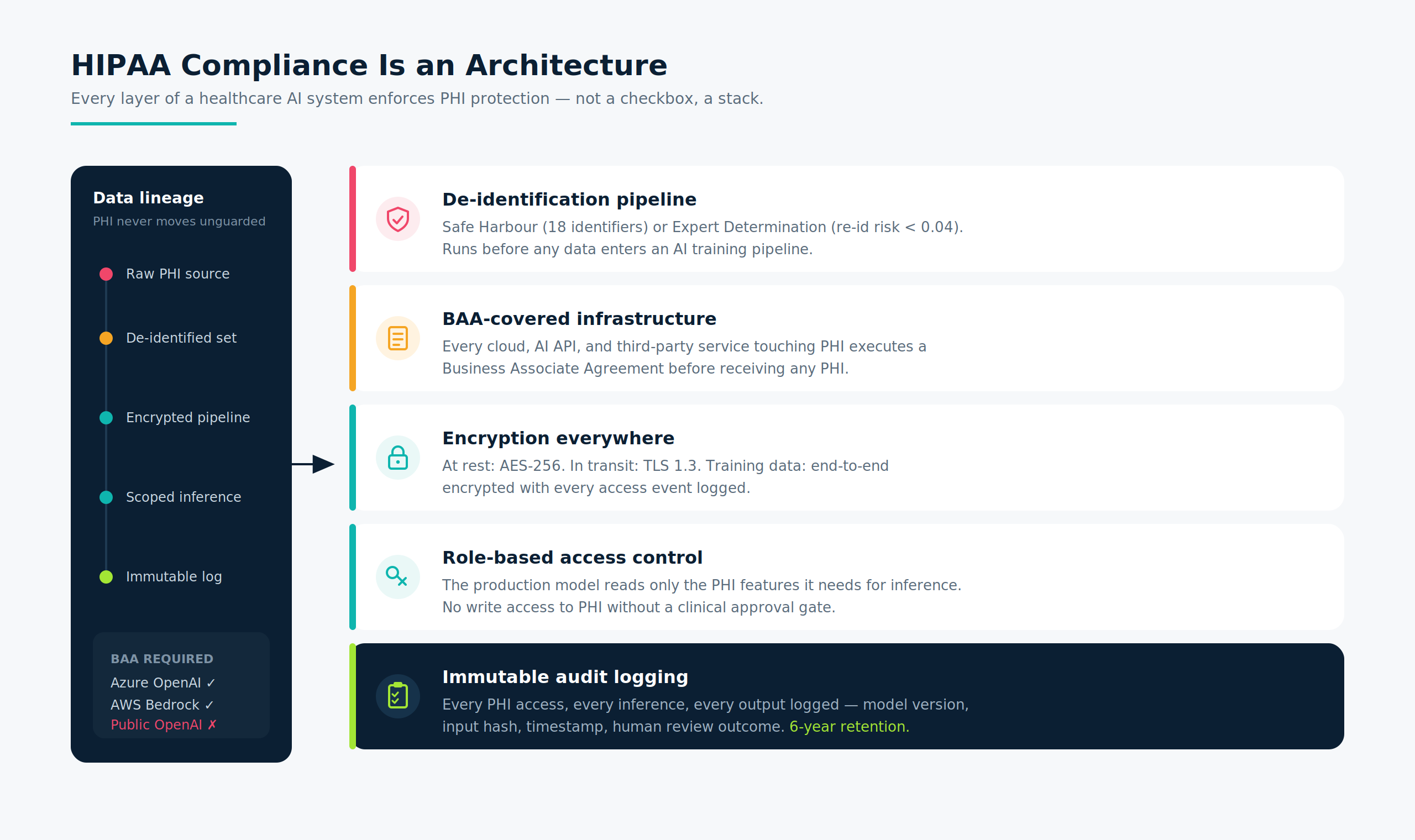
HIPAA compliance is not a checkbox, it is an architecture. Every layer of a healthcare AI system must implement PHI protection:
- De-identification pipeline, PHI removed from training data using Safe Harbour (18 specified identifiers removed) or Expert Determination (statistical risk of re-identification below 0.04). De-identification must happen before data enters any AI training pipeline. De-identified data remains de-identified through the entire ML workflow.
- BAA execution, every cloud provider, every AI API, every third-party service that touches PHI must execute a Business Associate Agreement before receiving any PHI. Azure OpenAI and AWS Bedrock both offer BAA coverage for HIPAA-compliant AI deployments. OpenAI’s public API does not offer BAA coverage, the team uses Azure OpenAI or AWS Bedrock for all production healthcare AI deployments, never the public OpenAI API.
- Encryption, PHI at rest: AES-256. PHI in transit: TLS 1.3. PHI in model training: the training data pipeline must be end-to-end encrypted with access controls logging every access event.
- Access controls, role-based access to PHI. The AI model in production has read access to the PHI features it needs for inference, nothing more. No model in production has write access to PHI without a clinical approval gate.
- Audit logging, every PHI access event, every model inference on PHI, every output generated is logged in an immutable audit trail. HIPAA requires 6-year retention.
Cost and Timeline
Healthcare AI development starts from $25,000 for a HIPAA-compliant AI feature integrated into an existing platform, de-identification pipeline, BAA-covered infrastructure, ML model, FHIR output.
Full healthcare AI platform, clinical NLP + diagnostic support + RPM intelligence + RCM AI + FHIR-native architecture + agentic workflow layer: $100,000–$350,000+ depending on scope.
Timeline: Single HIPAA-compliant AI feature: 10–16 weeks (includes BAA execution, de-identification pipeline, compliance architecture setup). Full AI healthcare platform: 6–12 months.
40–60% lower cost than US equivalent. Somnoware/ResMed acquisition proof. 400+ healthcare clients. Google AI Accelerator 2024.
What You Get
The platform ResMed acquired. Apollo Hospitals. 400+ healthcare clients. 5-year production healthcare engineering track record. Google AI Accelerator 2024 production ML. FHIR R4, HL7 v2, Epic, Cerner integration experience. HIPAA architecture that has passed clinical security reviews. Mayank leads personally.
Let’s Talk About AI in Healthcare Software Development
Somnoware spent 5 years building a platform with the team. When ResMed acquired it, they weren’t buying the code alone, they were buying the data intelligence the platform had accumulated, the clinical workflows it had automated, and the population health analytics it had made possible.
The platform that accumulates clinically valuable data over time while operating reliably and compliantly is the platform that becomes an acquisition target.
30 minutes. Architecture review. HIPAA compliance posture. FDA SaMD classification analysis. Concrete proposal within a week.
mayank@engineerbabu.com
Mayank Pratap | Co-founder, EngineerBabu | engineerbabu.com Somnoware/ResMed Acquired · Apollo Hospitals · 400+ Healthcare Clients · Google AI Accelerator 2024 · CMMI Level 5 · CTO 17yr Wishfin · Backed by Vijay Shekhar Sharma
FAQ
-
What is AI in healthcare software development?
Building HIPAA-compliant AI systems for healthcare, clinical NLP for documentation automation, diagnostic decision support, remote patient monitoring intelligence, prior authorisation automation, RCM denial prediction, and agentic clinical workflows. Healthcare AI requires PHI de-identification, BAA-covered infrastructure, FDA SaMD classification compliance, and human-in-the-loop gates for all clinical decision-support features.
-
What is HIPAA compliance in healthcare AI development?
PHI de-identification before AI training data, BAA execution with all cloud providers and AI APIs handling PHI, AES-256 encryption at rest, TLS 1.3 in transit, role-based access controls, and 6-year immutable audit logging of all PHI access events. Azure OpenAI and AWS Bedrock offer BAA coverage; the public OpenAI API does not.
-
What is clinical NLP and what does it enable?
Natural language processing trained on clinical text, physician notes, discharge summaries, radiology reports. Enables: ambient documentation (AI generates SOAP notes from recorded encounters), prior auth automation (clinical indicators extracted from notes and matched against payer criteria in under 2 minutes), clinical coding assistance (ICD-10/CPT code suggestions from documentation).
-
What is FDA SaMD and when does healthcare AI require FDA review?
Software as a Medical Device: AI software that analyses patient data and generates recommendations intended to inform clinical decisions. The January 2026 FDA CDS guidance clarifies that AI generating diagnostic recommendations remains subject to SaMD review even when framed as decision support. The clinical decision support exemption requires that the clinician can independently review the underlying information and the software is not the sole basis for the clinical decision.
-
What are agentic AI workflows in healthcare?
Multi-agent systems coordinating clinical administrative tasks end-to-end: prior auth agent (pulls clinical docs, parses against payer criteria, submits request autonomously), RCM pre-submission agent (runs denial prediction on every claim before submission), RPM monitoring agent (continuously monitors device data streams and fires clinical alerts). Human review gates required for any action with clinical implications.
-
How does EngineerBabu’s healthcare AI experience differ from other agencies?
Somnoware, 5-year partnership, platform acquired by ResMed (a $4B medical device company). Apollo Hospitals. 400+ healthcare clients across US, India, and Australia. FHIR R4 integration with Epic, Cerner, Athenahealth. Google AI Accelerator 2024. Production RPM intelligence, clinical NLP, and RCM AI deployed in live healthcare environments.