AI Symptom Checker App Development: A 2026 Build Guide


Create engaging, high-performance mobile applications tailored to your business needs. We craft future-ready apps that offer smooth user experiences on all devices.
Build robust and scalable websites and CMS platforms that help you manage content effortlessly. Our development ensures a seamless digital presence.
Launch secure, feature-rich online stores with intuitive shopping experiences. We build tailored eCommerce platforms designed for growth.
Design captivating games with immersive gameplay and stunning graphics. From concept to launch, we build engaging experiences that players love.
Enhance your customer relationships with customized Salesforce implementations. Drive growth and efficiency with smarter CRM solutions.
Harness artificial intelligence and machine learning to automate workflows and gain actionable insights. Our AI transforms data into smart decisions.
Accelerate your software delivery lifecycle with continuous integration, delivery, and infrastructure automation to boost efficiency.

TL;DR
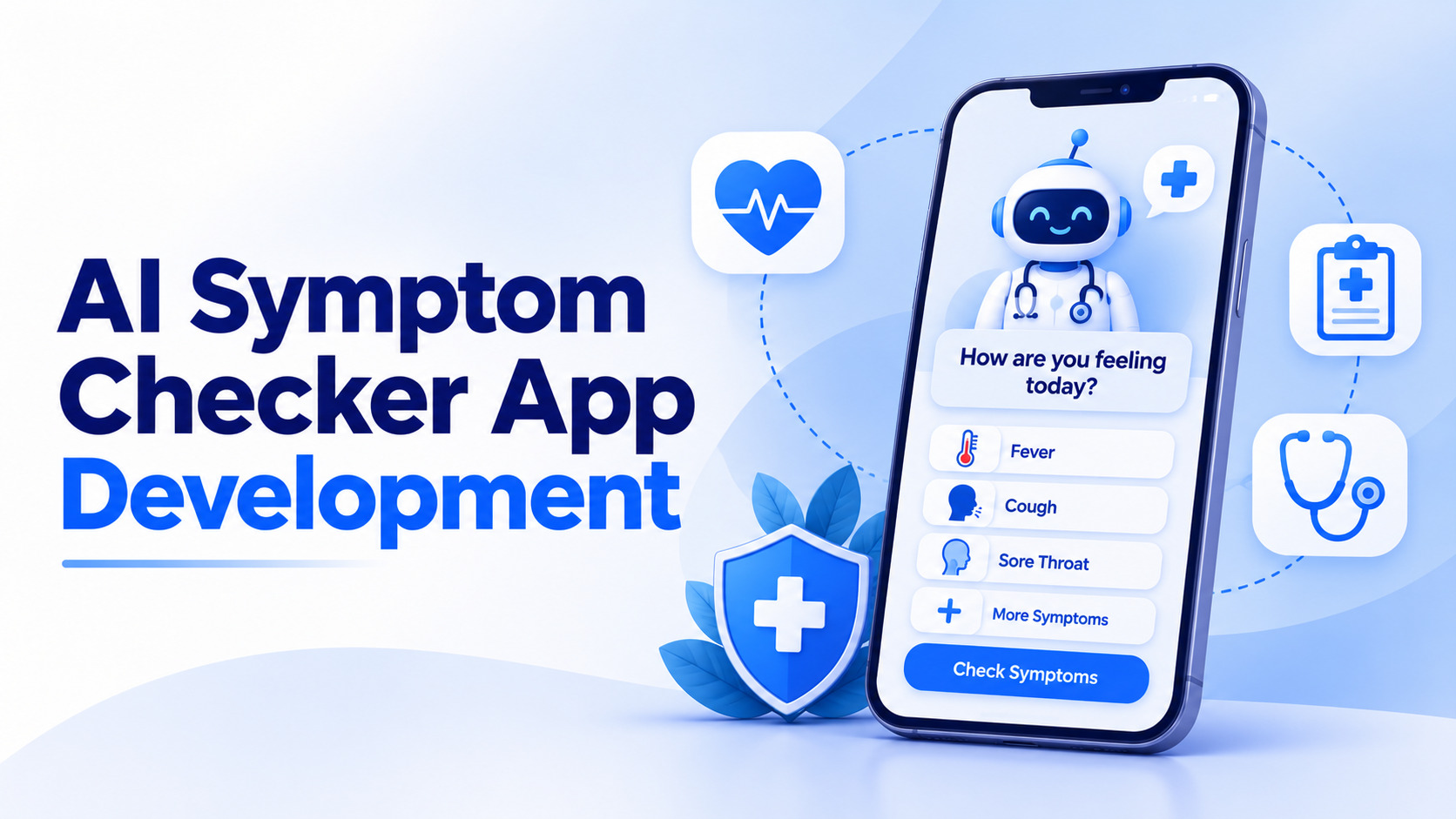
An AI symptom checker app takes reported symptoms, reasons across them, and returns likely causes plus a care recommendation. That recommendation is the product.
Self care, see a doctor this week, or go to the emergency room now, those three outputs carry clinical weight. This guide covers what sits inside the system, how to build it, what regulators expect, and what the work costs.
Three layers do the real work, and teams usually underestimate the first and third.
Users describe symptoms in messy language. “My chest feels tight” and “pressure in my chest” mean different things clinically.
Your intake layer normalizes free text into structured clinical concepts, then asks follow up questions that narrow the space. Adaptive questioning matters here. A fixed 20 question form kills completion rates fast.
This is where probability meets rules. Most production systems blend a Bayesian or knowledge graph model with hard coded safety rules, rather than handing everything to a language model.
The hybrid approach keeps outputs explainable, and explainability is what clinical reviewers and regulators will ask you about first.
Disposition means the urgency decision. It is the part users screenshot and share. Treat it as a separate, auditable component with its own test suite, its own version history, and its own clinical sign off.
AI in healthcare is projected to grow from USD 50.7 billion in 2026 to USD 505.6 billion by 2033, a 38.9% CAGR, according to Grand View Research. Triage is one of the clearest paths to value inside that number, because it touches cost directly.
Health systems want fewer avoidable emergency visits. Insurers want members routed to the cheapest appropriate setting. Virtual care providers want a front door that qualifies patients before a clinician’s time is spent.
A symptom checker serves all three buyers, which is why AI symptom checker app development keeps attracting budget even when other digital health spending tightens.
Pick a condition set before anything else. A pediatric app, a women’s health app, and a general adult triage app need different content and different safety rules. Write down what the product will never do, such as naming a diagnosis or adjusting medication.
That boundary statement drives your regulatory path, your copy, and your model guardrails. Narrow scope also makes clinical validation affordable, since you test against a defined set of presentations instead of all of medicine. Most teams that skip this step rebuild the reasoning layer within a year.
Source your condition library, symptom vocabulary, and escalation rules from licensed medical content or build them with practicing clinicians. Map everything to standard terminologies such as SNOMED CT and ICD-10 so outputs travel cleanly into health records.
Document authorship and review dates for every rule, because auditors will ask. Expect this phase to take longer than the engineering sprint that follows it. Quality here determines whether your app is clinically defensible or simply plausible sounding, and no amount of model tuning fixes weak content.
Train or integrate the reasoning engine, then wrap it in deterministic safety rules that cannot be overridden by probability. Log every input, output, and model version for traceability.
Teams using machine learning development services typically run the model and the rules engine as separate services, so clinical rules can be updated without retraining. Add confidence thresholds that route low certainty cases to a human or to a conservative recommendation. Silence beats a confident wrong answer in triage.
Run the system against clinical vignettes reviewed by physicians, and measure safe triage rate, not just top condition accuracy. Safe triage rate tells you how often the app under escalates, which is the failure mode that causes harm.
Once validation holds, connect the output to the care system through FHIR R4 integration so assessments land in the patient record. Pilot with a limited cohort, monitor disagreement between app and clinician, and tune before scaling.
Positioning language decides classification. Describe the app as providing general health information and suggesting when to seek care, and it usually stays outside device regulation.
Claim it diagnoses or recommends treatment, and you move into software as a medical device territory, with the review timeline that comes with it. Review medical device software regulations before marketing copy is written, not after.
Alongside that, US products need a HIPAA posture from day one. Encryption at rest and in transit, access logging, signed BAAs with every vendor, and retention rules are the baseline. Teams shipping a HIPAA compliant app bake these controls into architecture rather than bolting them on before launch.
| Build stage | Typical share of budget | What it covers |
| Clinical content and validation | 25 to 30% | Condition library, rules, physician review |
| AI and backend engineering | 35 to 40% | Reasoning engine, APIs, logging |
| Apps and conversational UI | 15 to 20% | iOS, Android, adaptive question flow |
| Compliance and security | 10 to 15% | HIPAA controls, audits, documentation |
A focused MVP with a limited condition set generally runs $60,000 to $120,000. A multi specialty product with EHR integration and formal clinical validation lands between $150,000 and $350,000. Ongoing clinical content maintenance is a permanent line item, not a project cost.
EngineerBabu builds healthcare AI products where clinical risk is part of the engineering brief.
The team covers symptom intake design, hybrid reasoning engines, triage rule systems, EHR and FHIR integration, and HIPAA ready cloud infrastructure, with senior engineers staying on the project from scope to launch.
The company operates on a CMMI Level 5 delivery process, was selected into the Google AI Accelerator, and has supported 200+ VC funded products across fintech and healthtech.
For founders who want the wider picture before scoping, this walkthrough on how to build a healthcare app is a useful companion read. You can also plug in AI developers to extend your existing team instead of outsourcing the full build.
AI symptom checker app development rewards teams that treat clinical safety as the core feature rather than a compliance chore. Scope narrowly, invest in content, keep rules separate from the model, and validate against urgency outcomes.
Do that, and you ship a product clinicians will stand behind.
Published studies place top condition accuracy well below physician performance, though urgency advice tends to be more conservative. Most products position themselves as a routing aid, never as a replacement for clinical judgment.
Partially. Rules based triage and cached condition content can run on device, which helps in low connectivity markets. Model heavy reasoning and record syncing still need a server connection to function reliably.
Yes, practically speaking. A licensed medical reviewer must approve content, sign off on escalation rules, and review flagged cases. Most teams retain a part time medical director rather than hiring full time.
Common models include licensing to insurers and hospitals, per assessment fees, lead routing into telehealth visits, and white label deployment. Direct consumer subscriptions rarely sustain these products on their own.
Start with the languages your care network can actually serve. Symptom vocabulary needs native clinical review per language, so machine translation alone introduces real safety risk into triage output.