AI Travel Planner App Development: Build Guide for 2027


Create engaging, high-performance mobile applications tailored to your business needs. We craft future-ready apps that offer smooth user experiences on all devices.
Build robust and scalable websites and CMS platforms that help you manage content effortlessly. Our development ensures a seamless digital presence.
Launch secure, feature-rich online stores with intuitive shopping experiences. We build tailored eCommerce platforms designed for growth.
Design captivating games with immersive gameplay and stunning graphics. From concept to launch, we build engaging experiences that players love.
Enhance your customer relationships with customized Salesforce implementations. Drive growth and efficiency with smarter CRM solutions.
Harness artificial intelligence and machine learning to automate workflows and gain actionable insights. Our AI transforms data into smart decisions.
Accelerate your software delivery lifecycle with continuous integration, delivery, and infrastructure automation to boost efficiency.

TL;DR
A chatbot that writes a beautiful five-day Lisbon itinerary and cannot book a single thing on it is a very expensive toy.
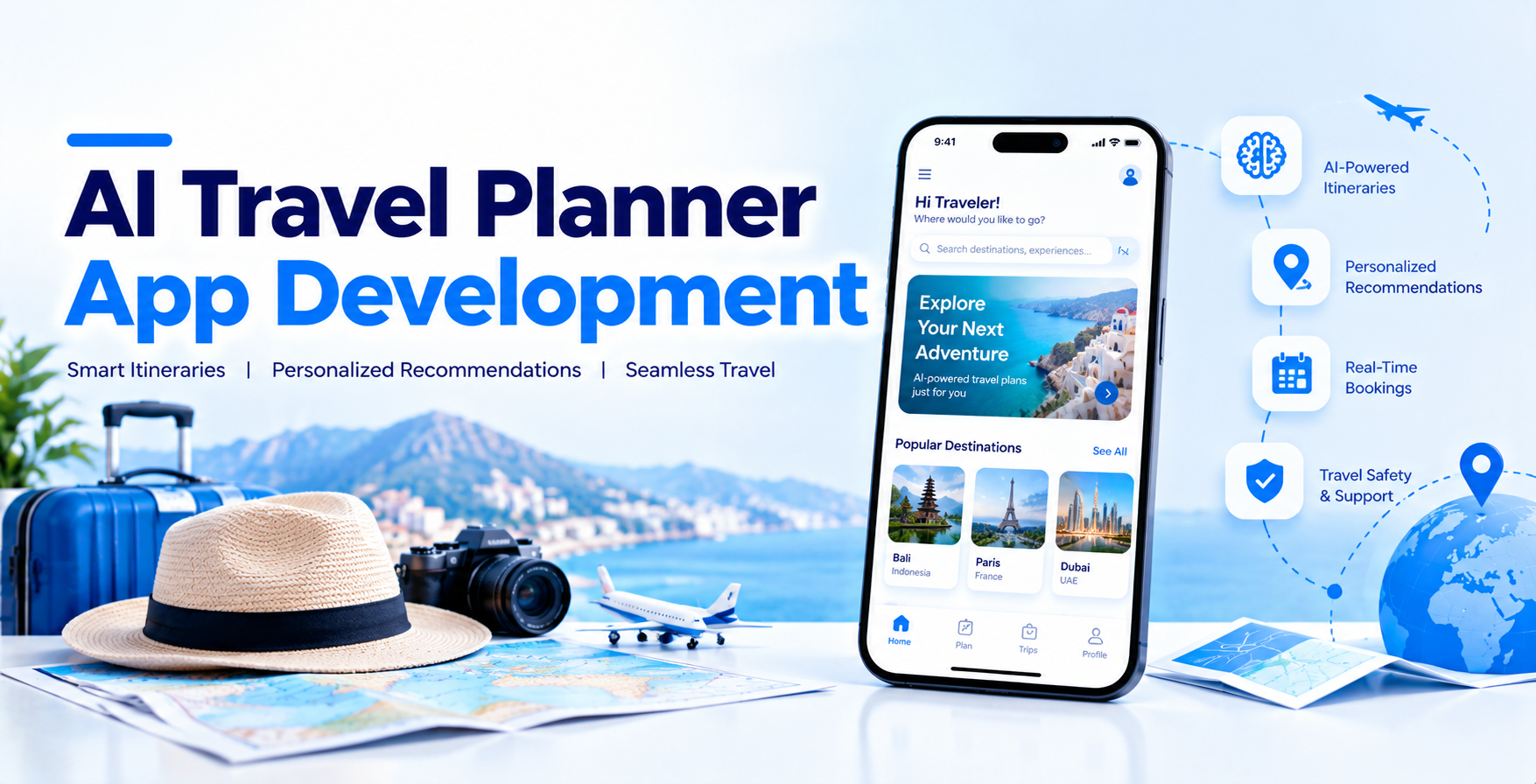
AI travel planner app development means building an app that turns a loose travel intent into a specific, bookable plan. The user says something vague like a week in Japan in April, under $3,000, no early flights.
The system turns that into dated flights, hotels near the right neighborhoods, and a day structure that respects opening hours and travel time. The hard part is not the writing. It is the constraints.
Ask a general assistant to plan a trip and you get plausible fiction. Hotels that closed, flight times that do not exist, museums open on the wrong days. The text reads well because the model optimizes for coherence, not correctness.
Travel punishes this harder than most domains. Prices move hourly, availability vanishes, and a single wrong assumption breaks the whole chain. Proper conversational AI development for travel means the model never states a fact it did not retrieve.
Grounding every claim through RAG application development against live supplier data is what separates a planner from a generator.
Users are not asking for a better search box. They are asking for three things.
Start narrow and deep rather than broad and shallow.
Teams coming from a flight booking app projects usually have the hardest piece already solved. Those starting from an online booking app foundation have the transaction layer but need the reasoning layer built from scratch.
The architecture that works is not one model doing everything. It is a coordinator delegating to specialists.
A constraint parser converts conversation into a structured trip specification. A retrieval layer pulls live flights, stays, and activities matching that spec. A planner solves the sequencing problem, which is closer to routing than to writing.
A writer renders the result in human language. A validator checks every claim against retrieved data before display.
Running these as a multi-agent AI system keeps failures contained and debuggable. When an itinerary goes wrong, you know which stage produced the error. The language layer, built with generative AI development services, handles presentation and clarification only. It never invents availability.
Pick a single city and a single traveler profile, such as four-day leisure trips to Barcelona for couples. Build intent capture, retrieval against two or three supplier APIs, planning, and display.
Ship it to a few hundred real users. A focused MVP development release here answers the only question that matters early: do people accept the generated plan, or do they rewrite it? Breadth before that answer is wasted engineering.
A plan the user has to re-search elsewhere converts terribly. Integrate flight, hotel, and activity booking so the itinerary becomes a cart. This is mostly API development work across GDS providers, hotel aggregators, and activity marketplaces, each with different rate limits and cancellation semantics.
Build an idempotent booking orchestrator, because partial failures across three suppliers mid-transaction are the norm rather than the exception.
Scale to more cities by making the destination a data problem rather than a code problem. Every location needs local transit times, seasonal patterns, neighborhood characteristics, and activity metadata.
Quality degrades fast if you expand coverage faster than data depth. Measure plan acceptance rate per destination and refuse to launch a city until it clears the same bar your pilot city did.
Monitor flights, weather, and closures for active trips and push revised plans automatically. This is the feature that converts a planning tool into a travel companion, and it is also the one that justifies subscription pricing.
It requires reliable push infrastructure, offline itinerary access, and conservative triggering so users are not notified about things they do not care about.
Four models are working in the market right now, and most products eventually blend two.
A single-destination MVP with conversational planning and read-only inventory typically runs $70,000 to $140,000 over four to six months. Adding booking, multi-destination coverage, and in-trip replanning takes a production build to $200,000 to $500,000 across nine to sixteen months.
Supplier integrations drive more of that than the AI work does. Each new booking provider adds two to five weeks. Inference costs are real but manageable, usually $0.15 to $0.60 per completed plan depending on how aggressively you cache, which fits the broader patterns in mobile app development cost planning.
Expect the full build to track the longer end of a typical timeline to build a mobile app because of partner approval cycles.
EngineerBabu builds AI travel products where the agent orchestration, supplier integrations, and app layer are delivered by one team rather than stitched across vendors. That covers retrieval design, booking reliability, and the mobile app development work that users actually touch.
The team was selected into the Google AI Accelerator, and delivery runs on a CMMI Level 5 process with senior engineers staying on the project through launch.
AI travel planner app development is won on groundedness and transactability, not on prose quality. The products that last will be the ones where every suggestion is real, bookable, and still correct an hour later.
Narrow the scope, ground every claim, and make the plan purchasable inside the app. That is the whole game.
It is building an app that converts natural language travel intent into a dated, constraint-respecting, bookable itinerary by combining language models with live supplier inventory and a planning engine.
No. Language models have no live access to pricing or availability and will produce confident errors. They need retrieval, validation, and a separate planning layer.
A flight source such as Amadeus or Duffel, a hotel source such as a bedbank aggregator, an activities provider, and a mapping service for travel time calculations.
Track plan acceptance rate, edit depth before booking, booking conversion, and factual error rate per plan. Acceptance rate is the most honest early signal.
Upfront, yes. White-label platforms limit your constraint logic and data ownership, which becomes the product differentiator once you scale past one destination.