Adaptive Learning App Development: A Practical Build Guide


Create engaging, high-performance mobile applications tailored to your business needs. We craft future-ready apps that offer smooth user experiences on all devices.
Build robust and scalable websites and CMS platforms that help you manage content effortlessly. Our development ensures a seamless digital presence.
Launch secure, feature-rich online stores with intuitive shopping experiences. We build tailored eCommerce platforms designed for growth.
Design captivating games with immersive gameplay and stunning graphics. From concept to launch, we build engaging experiences that players love.
Enhance your customer relationships with customized Salesforce implementations. Drive growth and efficiency with smarter CRM solutions.
Harness artificial intelligence and machine learning to automate workflows and gain actionable insights. Our AI transforms data into smart decisions.
Accelerate your software delivery lifecycle with continuous integration, delivery, and infrastructure automation to boost efficiency.

TL;DR
Most apps that call themselves adaptive are doing branching. A learner misses two questions, the app serves easier ones, and that is the whole intelligence.
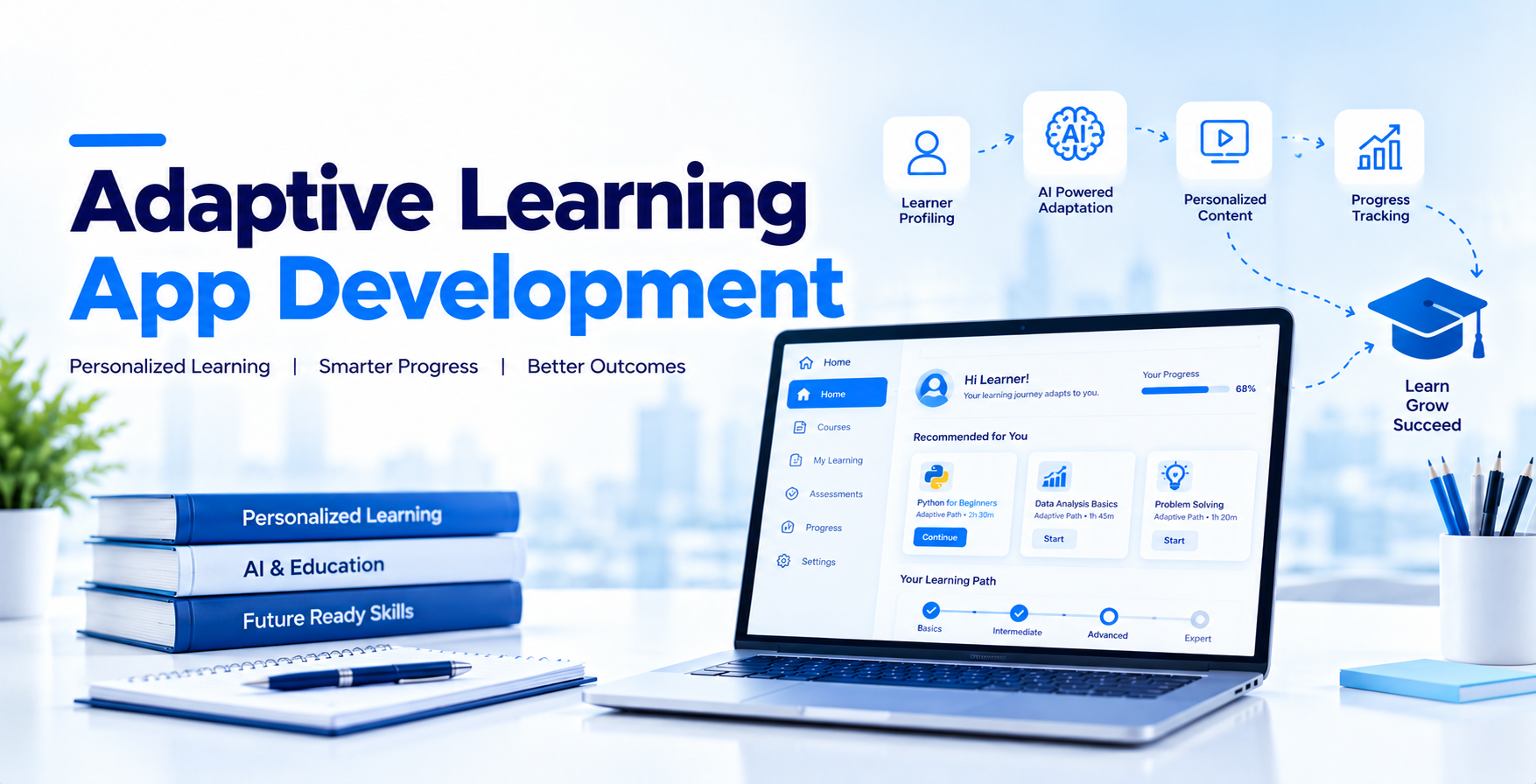
Adaptive learning app development is the practice of building education software that adjusts to each learner individually, using evidence from their behavior to decide what comes next. Real adaptation is a loop.
The app observes, updates a belief about the learner, selects the next item based on that belief, then observes again. Everything in this guide exists to make that loop reliable.
Difficulty ladders are not adaptation. Neither are quiz scores that unlock the next module. Both react to a single event instead of building a picture of the learner over time.
Adaptation starts when the system holds a probabilistic view of mastery per concept and updates it continuously.
Serious education app development company work treats that learner state as the product’s core asset. Everything visible to the student is just a rendering of it.
Think of the system as four stacked layers. Each one fails in a different way, and most struggling products have a weak layer they have not identified.
This is a per-student estimate of mastery across every concept in your curriculum. It updates on every interaction: answers, hint usage, time on task, retries, and abandonment.
Store it as a time-series rather than a single current value. That history powers retention prediction and lets you show progress honestly. Strong data analytics services work here pays off twice, once in the model and once in the reporting teachers ask for.
Your content needs structure before any algorithm can use it. Every item gets tagged with the concept it teaches, its prerequisites, its difficulty estimate, and its format.
That tagging produces a knowledge graph, and the graph is what lets the engine say a learner struggling with fractions should revisit division first. Teams running course management software often already have half this metadata sitting unused in their catalog.
This layer reads the learner model, consults the content graph, and picks the next item. It handles sequencing, difficulty targeting, spaced review scheduling, and when to intervene with a hint or a different format.
Build it as a separate service with a clear interface. Treating it as machine learning development services infrastructure rather than app logic means you can swap algorithms without touching the client.
Learners disengage when an app feels arbitrary. The delivery layer shows why this item appeared, what mastery looks like, and how far the goal is.
Transparency measurably improves persistence. Good features of an online learning platform include a visible skill map, a reason for each recommendation, and the option to override the path.
Four approaches dominate adaptive learning app development, and the right one depends on your content volume and data maturity.
Not every personalization feature justifies its build cost. These consistently do.
An existing LMS software development company build can host most of this, provided the data model supports concept-level tracking rather than course-level completion.
Before writing code, break your subject into atomic concepts and define prerequisite relationships between them. A high school algebra course typically yields 120 to 250 concepts. Work with subject matter experts, not engineers, on this.
The graph determines everything the adaptation engine can reason about later.
Teams that rush this step end up with a clever algorithm navigating a curriculum structure too coarse to produce meaningful recommendations, and retrofitting the graph after launch means re-tagging every item.
Every item needs a concept tag, a difficulty estimate, a format type, and an expected completion time. Start difficulty estimates with expert judgment, then recalibrate from real response data once you have a few thousand attempts.
Budget more time than feels reasonable here. Content tagging is the hidden cost in adaptive learning app development, and partial tagging produces a system that adapts confidently in some areas and randomly in others.
Pick one subject and one grade band. Use transparent rules for sequencing so you can debug behavior easily and explain it to pilot schools.
An MVP development approach here has a second purpose beyond validation: it generates the labeled interaction data your statistical models will need. Run it with real learners for a full term, instrument every interaction, and resist adding subjects until the loop works.
Once you have sufficient interaction volume, swap the rules engine for knowledge tracing or IRT behind the same interface. Run both in parallel initially and compare outcomes on learning gain, not engagement.
This is also the point to layer in generative hints and explanations if your subject benefits from them. Most teams making this transition while trying to build an e-learning platform from scratch simultaneously end up doing neither well.
Add pre and post assessments, track concept-level mastery over time, and compare cohorts against a non-adaptive control where possible. Usage metrics tell you the app is sticky. Outcome metrics tell you it works.
Institutional buyers increasingly ask for efficacy evidence during procurement, and having a measurement framework running from month one makes that conversation straightforward instead of retroactive.
A single-subject adaptive MVP with rule-based sequencing runs roughly $60,000 to $120,000 over four to six months.
Adding knowledge tracing, instructor dashboards, and multi-subject support moves a production build to $180,000 to $400,000 across nine to fifteen months.
Content tagging sits outside those numbers and often surprises teams. Typical edtech platform development cost planning should allocate separate budget for curriculum work.
Gamification and streaks add less than people expect, usually 10 to 15%, which is well documented in the breakdown of cost to build an app like Duolingo.
Three metrics separate real adaptive products from decorated quiz apps.
EngineerBabu builds adaptive platforms with the data science and product engineering in the same team, which matters because the handoff between them is where most adaptive products break.
The work covers concept graph design, model selection, instructor tooling, and mobile delivery.
Delivery runs on a CMMI Level 5 process, and the team has shipped education products from first pilot to multi-cohort rollout.
Adaptive learning app development succeeds when the learner model is good enough that
the content decisions it drives feel obvious to a teacher looking over the student’s shoulder. That is a higher bar than any engagement metric.
Build the graph properly, tag the content honestly, and the algorithm becomes the easy part.
It is building education software that models each learner’s mastery and adjusts content, difficulty, and pacing accordingly, using approaches like knowledge tracing or item response theory rather than fixed branching rules.
Knowledge tracing typically needs several thousand interactions per concept before predictions stabilize. Starting with rule-based logic lets you collect that data while still shipping a useful product.
Often yes, if its data model tracks concept-level performance. If it only records course completion, you will need a separate learner model service alongside it.
No. Language models generate content and explanations well but hold no reliable memory of mastery. The strongest products use both together.
Most products see measurable differences in learning gain after one full term of use, assuming pre and post assessments were instrumented from launch.