How to Build an App Like Udaan: Features, Stack, Cost and Timeline


Create engaging, high-performance mobile applications tailored to your business needs. We craft future-ready apps that offer smooth user experiences on all devices.
Build robust and scalable websites and CMS platforms that help you manage content effortlessly. Our development ensures a seamless digital presence.
Launch secure, feature-rich online stores with intuitive shopping experiences. We build tailored eCommerce platforms designed for growth.
Design captivating games with immersive gameplay and stunning graphics. From concept to launch, we build engaging experiences that players love.
Enhance your customer relationships with customized Salesforce implementations. Drive growth and efficiency with smarter CRM solutions.
Harness artificial intelligence and machine learning to automate workflows and gain actionable insights. Our AI transforms data into smart decisions.
Accelerate your software delivery lifecycle with continuous integration, delivery, and infrastructure automation to boost efficiency.
Hire app developers ready to turn your ideas into sleek, high-performing mobile apps for any platform.
Bring in frontend pros who craft smooth, beautiful, and user-friendly interfaces that your visitors will love.
Get backend developers who build fast, secure, and reliable systems to keep everything running behind the scenes.
Hire eCommerce developers who build secure, scalable online stores designed to offer seamless shopping and grow your sales.
Get dedicated developers committed to your projects, delivering consistent quality and speed as an extension of your team.
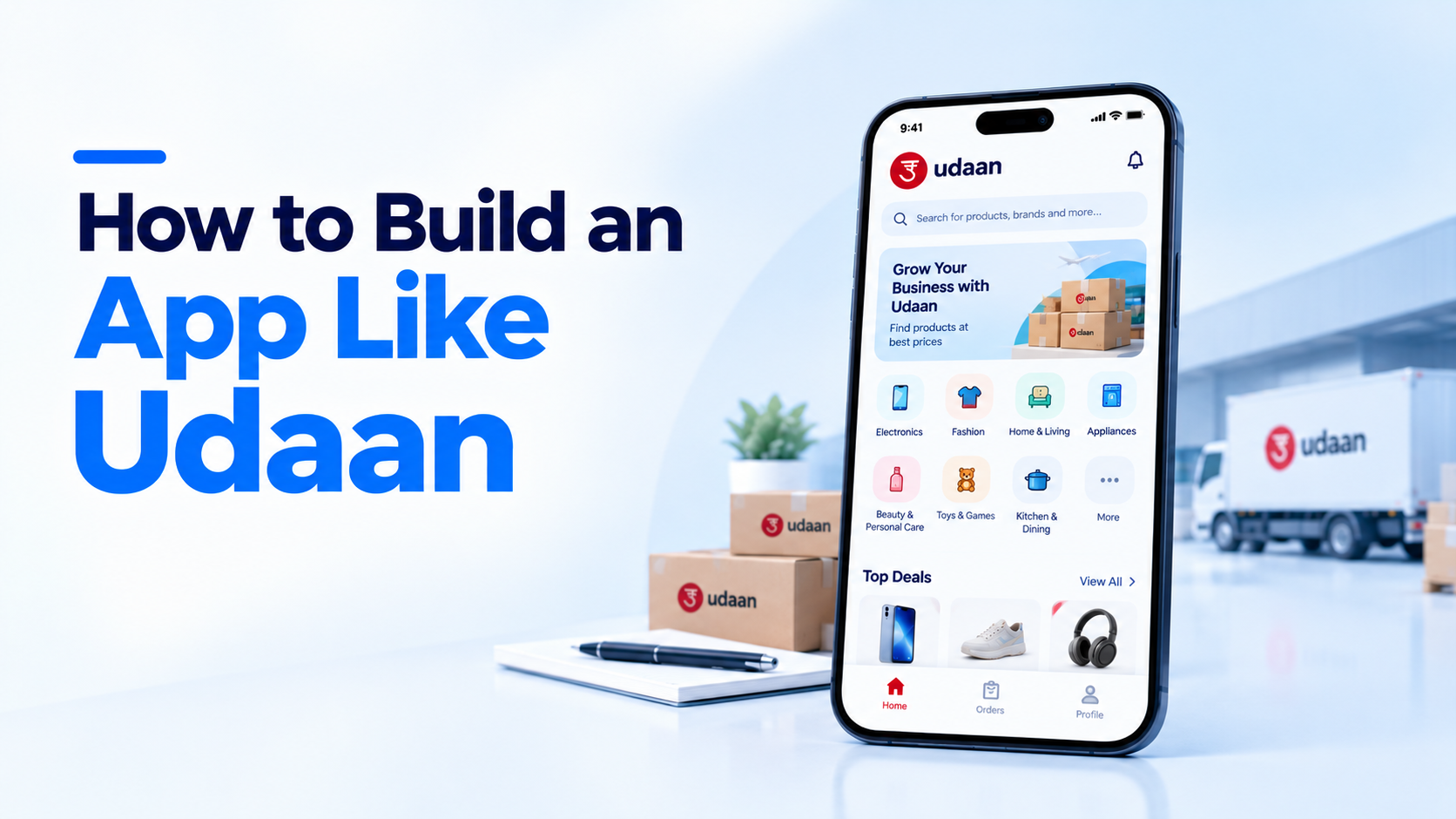
A kirana owner in Nagpur places a ₹14,000 order at 11:40 at night, across four brands, on credit, and expects it at his shutter by Thursday morning. No distributor call. No minimum order argument. No sales rep visit.
That single interaction is the product. Everything else, the catalog, the credit engine, the fleet, exists to make it feel unremarkable.
TL;DR
Udaan is a B2B wholesale marketplace connecting manufacturers, wholesalers, and brands directly to India’s small retailers. It removes two or three layers of distribution and replaces them with an app, a logistics network, and working capital.
The company reached unicorn status faster than almost any Indian startup, largely because it solved supply before it chased buyers.
The opportunity behind it is still expanding. India’s eB2B market is projected to reach $90 to $100 billion in GMV by 2030, within a B2B general trade opportunity of roughly $1.2 trillion, according to Redseer Strategy Consultants.
Founders who want to build an app like Udaan usually describe one app. In practice you are building four products that happen to share a database.
Retailers order between customers, often on a cracked screen with one hand. The interface has to tolerate that. Vernacular language support, repeat-order shortcuts, slab pricing visible before checkout, and a cart that survives a dropped connection.
Search matters more than browsing. A retailer knows the exact SKU they want and will abandon the app if it takes four taps to find it.
Sellers need bulk catalog upload, quantity-based pricing slabs, inventory sync, order acceptance, and a payout dashboard with clear settlement dates.
This is closer to B2B ecommerce platform development than to a consumer seller app. Expect spreadsheet imports, not one-product-at-a-time forms.
B2B orders are heavy, multi-seller, and intolerant of delay. You need pickup scheduling, hub routing, consignment consolidation, proof of delivery, and returns handling.
Most teams underestimate this and wire in warehouse management system development only after the first festive season breaks their manual process.
General trade runs on credit. Retailers buy now and pay in 14 to 30 days, and a marketplace that ignores this loses to the distributor who does not.
You will need underwriting signals, credit limits, repayment tracking, and collections. Many platforms start by partnering with an NBFC rather than lending off their own balance sheet, which borrows heavily from standard BNPL app development patterns.
Do not launch across grocery, electronics, and apparel at once. Pick a single category with high reorder frequency and a tight geographic cluster, ideally one city with dense retail.
Density is what makes delivery economics work. Forty stores on one route is a viable business. Forty stores across a state is a charity. Grocery and FMCG are the usual starting points because retailers reorder weekly, which gives you repeat transactions fast. Prove the loop in that cluster before you add a second category or a second city.
Sign your sellers first. An empty marketplace cannot be fixed with marketing spend, and retailers who open a thin catalog once rarely return.
Target enough SKUs to cover the majority of a retailer’s weekly basket in your chosen category. Negotiate landing prices that leave you margin after logistics, because thin B2B margins punish every inefficiency. Many teams run the first few weeks on spreadsheets and WhatsApp to validate supply, then build the seller platform once the terms are proven.
Build only what completes one transaction: browse, order, pay, deliver, reorder. Skip analytics dashboards, loyalty tiers, and recommendation engines.
This is standard MVP development discipline applied to a marketplace. Your goal in version one is a retailer who places a second order without being called. Instrument everything around that moment: time to first order, basket size, reorder rate, and fill rate. Those four numbers tell you more than any feature request will in month three.
Run deliveries with a small owned fleet or a local 3PL before you automate routing. Manual operations expose the real constraints: pickup windows, loading time, rejected consignments, cash collection at the door.
Only after you see those patterns should you invest in route optimization and field force automation software development. Teams that automate first end up optimizing a process that turns out to be wrong. Keep a delivery person’s feedback loop short, because they will spot operational failures weeks before your dashboards do.
Introduce credit only after you have repeat-order data on a retailer. Order history is your best underwriting signal, better than any document they can produce.
Start with small limits and short cycles, then expand based on repayment behavior. Track days sales outstanding obsessively, because B2B marketplaces rarely die from low demand. They die from receivables that never come back. Partner with a lender for the first phase so defaults do not land on your own balance sheet.
| Layer | Typical choice |
| Buyer and seller apps | React Native or Flutter |
| Backend | Node.js or Java with Spring Boot, microservices |
| Database | PostgreSQL, with Redis for cart and session |
| Search | Elasticsearch or Typesense for SKU lookup |
| Payments | Razorpay or Cashfree, plus NBFC APIs for credit |
| Logistics | Custom routing service, maps API, driver app |
| Analytics | Event pipeline feeding BI, often alongside data analytics services |
Search deserves more attention than it usually gets. Retailers type brand names, local names, and abbreviations. Fuzzy matching and synonym mapping directly affect conversion.
Order management should be its own service from the start. It will be the busiest part of the system and the one you redeploy most often.
| Phase | Scope | Timeline | Indicative cost |
| Discovery | Category, unit economics, supply plan | 3 to 4 weeks | $6,000 to $12,000 |
| MVP | Buyer app, seller panel, basic ops | 4 to 6 months | $70,000 to $150,000 |
| Logistics module | Routing, POD, returns | 2 to 3 months | $35,000 to $70,000 |
| Credit module | Limits, underwriting, collections | 2 to 3 months | $40,000 to $90,000 |
| Scale | Multi-category, multi-city | Ongoing | Variable |
These ranges shift with team location and category complexity. A deeper breakdown of what drives these numbers sits in this guide to the cost to build an app.
Take rate on GMV is the headline, usually 3 to 8% depending on category. It is rarely enough on its own.
The real margin stack includes interest spread on credit, logistics fees charged to sellers, brand advertising and placement inside the app, and private label products where you own the full margin. Udaan leaned on all four.
Advertising deserves particular attention. Once you have retailer traffic, emerging brands will pay for shelf position, and that revenue carries almost no cost.
If you want to build an app like Udaan, the software is the most predictable part of the project. Six months and a competent team gets you a working platform.
What separates the survivors is operational discipline: dense supply in one cluster, honest unit economics per order, and credit extended only to retailers whose behavior you can already see.
Start narrow, prove the reorder loop, and widen only when the numbers hold. If you are scoping that first version, EngineerBabu has built marketplace and supply chain platforms through exactly this sequence.
A single-category MVP covering buyer app, seller panel, and basic operations typically runs $70,000 to $150,000. Adding full logistics and credit modules pushes total first-year development toward $200,000 or more.
Plan 5 to 7 months to a live MVP in one city and one category. Logistics and credit modules usually follow in months 7 through 12, once order volume justifies them.
Not initially. Most platforms start with third-party logistics partners and move to an owned or hybrid fleet only when route density makes it cheaper. Density, not scale, is the trigger.
In Indian general trade, effectively yes. Retailers expect 14 to 30 day terms from distributors. Partnering with an NBFC lets you offer this without carrying the default risk yourself.
Unit economics per order. B2B margins are thin, so every rupee of logistics, packaging, and collection cost matters. Platforms usually fail on cost per order rather than on demand.