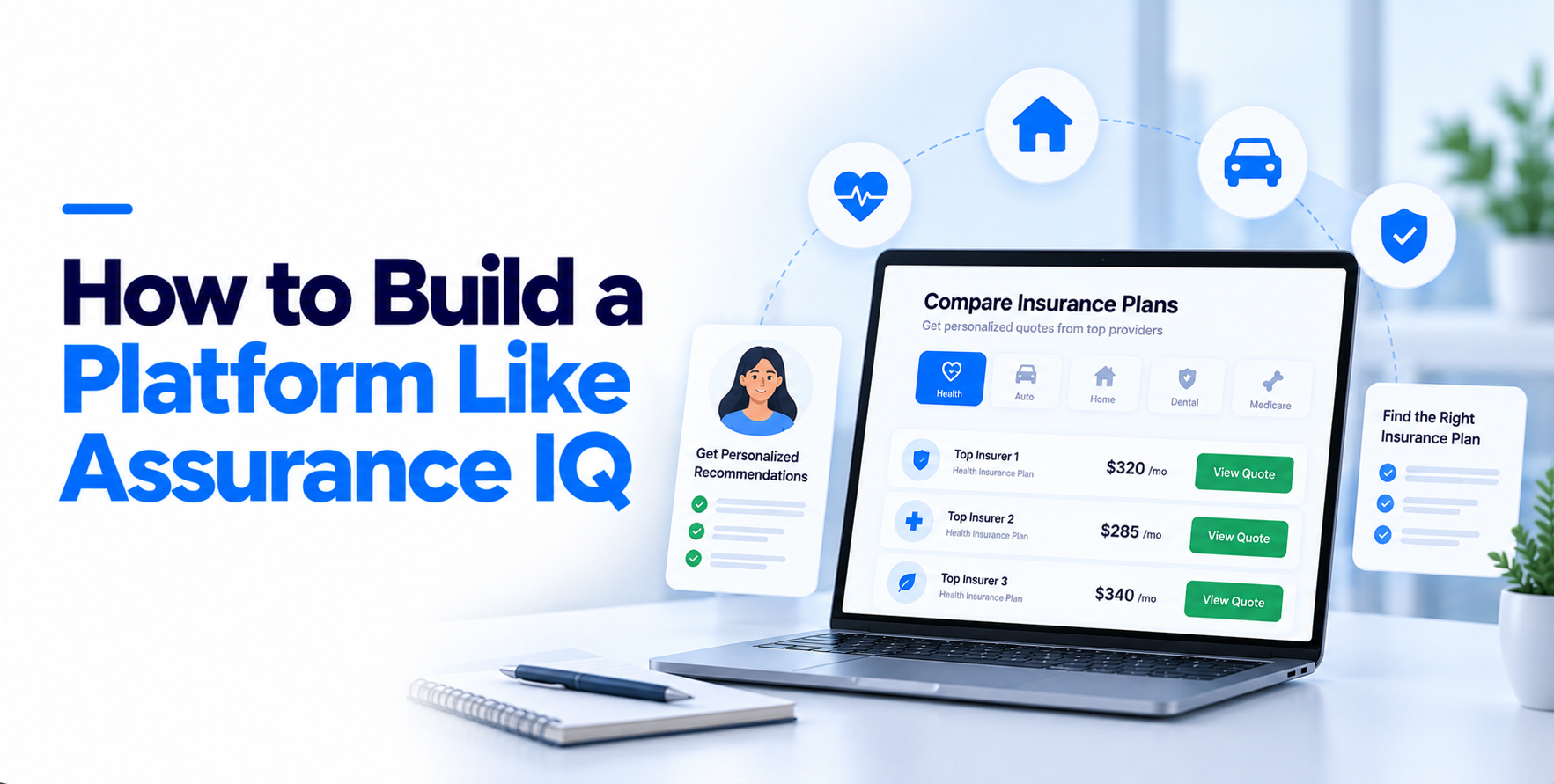
How to Build a Platform Like Assurance IQ (And What Its Collapse Teaches Founders)


Create engaging, high-performance mobile applications tailored to your business needs. We craft future-ready apps that offer smooth user experiences on all devices.
Build robust and scalable websites and CMS platforms that help you manage content effortlessly. Our development ensures a seamless digital presence.
Launch secure, feature-rich online stores with intuitive shopping experiences. We build tailored eCommerce platforms designed for growth.
Design captivating games with immersive gameplay and stunning graphics. From concept to launch, we build engaging experiences that players love.
Enhance your customer relationships with customized Salesforce implementations. Drive growth and efficiency with smarter CRM solutions.
Harness artificial intelligence and machine learning to automate workflows and gain actionable insights. Our AI transforms data into smart decisions.
Accelerate your software delivery lifecycle with continuous integration, delivery, and infrastructure automation to boost efficiency.
Hire app developers ready to turn your ideas into sleek, high-performing mobile apps for any platform.
Bring in frontend pros who craft smooth, beautiful, and user-friendly interfaces that your visitors will love.
Get backend developers who build fast, secure, and reliable systems to keep everything running behind the scenes.
Hire eCommerce developers who build secure, scalable online stores designed to offer seamless shopping and grow your sales.
Get dedicated developers committed to your projects, delivering consistent quality and speed as an extension of your team.
Prudential paid $2.35 billion for Assurance IQ in 2019. Five years later, it shut the business down. In between, it wrote off about $2.14 billion in goodwill.
Nothing in that story is about a missing feature.
For founders who want to build a platform like Assurance IQ for the US market, that should change what they build first. The matching engine was never the moat. Compliant conversion was.
EngineerBabu is a CMMI Level 5 product engineering company. When its team built EarlySalary’s lending stack, which now processes ₹10,000 crore in disbursements, the first decision was who is allowed to say what to a customer, and how to prove it later. US insurance distribution is the same problem with bigger fines.
Building a platform like Assurance IQ means building a direct-to-consumer insurance marketplace with licensed agents in the loop.
Consumers share their needs, machine learning narrows the carrier and plan options, agents advise and enroll, and carriers pay commissions. It is a compliance-heavy B2C system where every claim, call and consent must be provable.
Assurance IQ was a consumer-facing insurtech brokerage. It sold Medicare, health, life and auto plans from more than 20 carriers at the time of its 2019 acquisition, and consumers could buy online or connect with an agent. It was founded in 2016 and never raised outside capital before the sale.
The model is simple to describe. Traffic comes in through search, ads and mail. Software qualifies and matches. A licensed agent closes. The carrier pays commission, often over time and only if the policy stays active.
That last part is where the economics get hard.
Demand is not the problem. KFF reports that 55% of eligible Medicare beneficiaries are enrolled in Medicare Advantage in 2026, and UnitedHealth Group and Humana together hold 46% of that market.
Just over 35 million people are enrolled. Every one of them faces an annual choice among dozens of plans, with an enrollment window that runs from October 15 to December 7. That complexity is what a good matching platform earns from.
The open lanes are narrow ones. Final expense cover, Medicare supplement, small-business benefits, and Spanish-language or rural-focused enrollment are all served unevenly by the big brokers.
New platforms should be built for one of those lanes, not for “insurance” as a whole.
Here is the record. Every founder in this space should read it.
Prudential recorded goodwill impairments of $1.06 billion in 2021, $903 million in 2022 and $177 million in the fourth quarter of 2023. Press reports say the business posted twelve consecutive quarterly losses totalling $381 million after the acquisition. Prudential stopped Assurance from selling new policies in 2024 and wound it down.
In August 2025, the FTC announced that Assurance IQ would pay $100 million to settle allegations that its telemarketers misled consumers about short-term medical and limited benefit plans. The FTC alleged misstatements about preexisting condition coverage, benefit caps and provider networks. Prudential guaranteed the payment.
Separately, a TCPA class action over unwanted calls settled for over $21 million. These are allegations and settlements, not findings of wrongdoing at every level. But the pattern is clear.
The lesson: a funnel tuned only for conversion will eventually collide with the rules, unless compliance is built into it from day one.
Feature scope is where budgets quietly double. Teams should split the list into what consumers use and what agents and the compliance team use, and build the second half earlier than expected.
Basic versions of every back-office item are needed at launch. Analytics and advanced QA automation can wait for phase two.
Regulated, money-moving platforms do not forgive shortcuts. The setup below is a sound base for a platform like Assurance IQ at US scale.
The best start is web-first. Customer acquisition comes from search, ads and email, so a fast, mobile-first web funnel matters more than an app. A native app can be added later for retention and renewals.
React or Next.js handles the funnel well. The consent and disclosure components should be shared, so every entry point records the same proof.
A modular monolith is a better start than microservices. Insurance platforms fail because of integrations and compliance, not request volume. Clean module boundaries ship faster and are easier to audit.
PostgreSQL holds the commission ledger and consent records. Carriers differ widely: some offer modern APIs, others only agent portals or file feeds. Teams should plan for both and put each carrier behind its own adapter.
Rules should come first and models second. A transparent ranking of eligibility, coverage fit and cost is easier to defend than a black box. Machine learning can be added for lead scoring and agent-to-lead matching once there is enough data.
If commission influences the ranking, it should be logged, and the reason shown to the consumer should be about suitability.
A cloud telephony provider with full recording and transcripts is needed. Consent should be stored as immutable records: timestamp, IP address, disclosure text version and channel.
Traffic comes in spikes. The October 15 to December 7 window stresses the funnel and agent capacity at the same time. The web tier should autoscale, and calls should be queued intelligently.
Founders should pick one product line and one customer segment that can be described in one sentence. Then they must decide how the business will be licensed: its own agency licence in its home state plus non-resident licences elsewhere, or a partnership with a licensed agency, MGA or IMO.
Starting with a handful of carriers, not twenty, is wiser. Scoping the work as an MVP development effort keeps phase one at 5-6 months instead of a year.
The prohibited-claims list should be written first. Statements about preexisting conditions, benefit caps, network access and ACA compliance should never depend on an individual agent’s memory.
The product should enforce them with approved scripts, real-time prompts, disclosure timestamps and QA flags. On LoanOS, a seven-module lending platform, audit trails were part of the design, not a later addition. Insurance needs the same approach.
This step takes most of the schedule. Each carrier has its own eligibility rules, quote format, enrollment flow and commission schedule.
Every carrier should sit behind an adapter with timeouts, retries and a kill switch. Each carrier needs about 3-6 weeks. On EarlySalary, external integrations set the pace of the lending stack, not sprint velocity. The same is true here.
The first plan results should appear within a few seconds, with slower carriers streaming in after. The consumer’s progress should be saved after every field, so a dropped call or closed tab does not lose the lead.
The ranking logic should stay explainable. EngineerBabu’s AI inventory work for Simba Beer reinforced a lesson that applies here: models are only as good as the data captured upstream, so the funnel should be instrumented before any model is trained.
Agents need CRM, click-to-call, recording, QA scoring and clear next actions. Commissions need a proper ledger with chargebacks for lapsed policies.
PostgreSQL with immutable entries and reconciliation against carrier statements works well. As with OpenMoney, where regulated products come from partners, data quality depends on those partners’ data.
Every event should be tracked, from quiz start to enrolled policy, along with every disclosure and consent. Load testing should happen before the enrollment window, not during it.
A pilot with 10-20 agents in 3-5 states is a safe start. QA pass rate, complaint rate, first-call enrollment and 90-day persistence should be watched before any money goes into acquisition.
| Build stage | Scope | Estimated cost |
| MVP | Consumer funnel and needs quiz, 3-5 carriers in one product line, agent CRM, call recording, consent store, basic commission ledger (5-6 months) | $140,000 to $220,000 |
| Growth build | 8-12 carriers, matching engine with lead scoring, e-application, QA scoring, persistency reporting, multi-state licence tracker (8-10 months) | $260,000 to $450,000 |
| Full platform | Multi-line (Medicare, life, health, auto), 20+ carriers, real-time script enforcement, analytics, SOC 2 readiness (12-16 months) | $550,000 to $900,000+ |
Maintenance usually takes 15% to 20% of the build cost each year. Cloud, telephony and monitoring add $6,000 to $15,000 a month.
The build is the smaller bill. Paid acquisition, agent payroll and the gap between spending on a lead and collecting commission cost far more. Generic insurance mobile app guides quote $60,000 to $250,000, but those scopes leave out carrier integrations, licensed-agent tooling and call recording.
For a wider breakdown, see this guide on mobile app development cost in the USA.
This is engineering guidance, not legal advice. Insurance counsel should review the model before launch.
| Area | What it governs | What it means for the build |
| State producer licensing (via NIPR) | Who can sell or advise in each state | Licence and appointment tracker, routing by licensed state |
| FTC Act Section 5 and Telemarketing Sales Rule | Deceptive claims and telemarketing conduct | Approved claims library, script enforcement, call QA |
| TCPA and Do Not Call rules | Autodialed calls, texts and consent | Provable consent capture, suppression and DNC scrubbing |
| CMS third-party marketing organization (TPMO) rules | Medicare marketing, disclaimers, recorded calls, data sharing | Standard disclaimer, full call recording, per-partner consent |
| HIPAA (where protected health information is handled) and state privacy laws | Health data and tracking technology | Data minimisation, access controls, careful use of website trackers |
| NAIC data security model law and NYDFS Part 500 | Security programs for insurance entities | Encryption, access control, incident response |
Two details trip people up. The FCC’s one-to-one consent rule for lead generation was vacated by the Eleventh Circuit in January 2025, but the TCPA, the Telemarketing Sales Rule and Do Not Call rules still apply. CMS’s separate consent requirement for sharing Medicare beneficiary data between marketing organizations has its own life.
CMS also finalized a 2026 rule that changes several Medicare marketing requirements starting with contract year 2027. Counsel should confirm what applies on the launch date.
Teams can also review common mobile app development mistakes before kickoff to avoid painful rework.
The decision to build a platform like Assurance IQ is really a discipline decision. The products belong to carriers, the technology is well understood, and the audience is large. What separates platforms that last is whether the compliance layer is stronger than the growth layer.
For founders scoping an insurance distribution platform for the US market, EngineerBabu can help map features, licence route and compliance architecture to a realistic build plan before development starts. Co-founder Mayank Pratap usually takes these calls: mayank@engineerbabu.com
EngineerBabu is a technology development company building products across fintech, healthtech and AI, from MVPs to scaled, production-ready platforms.
It holds a CMMI Level 5 rating, has worked with 4 unicorn clients, and has supported 200+ VC-funded products. The company is backed by Vijay Shekhar Sharma and was founded by Mayank Pratap (Co-founder).
A focused MVP with 3-5 carriers, agent tooling, call recording and consent capture typically costs $140,000 to $220,000. A multi-line platform with 20+ carriers and real-time script enforcement costs $550,000 to $900,000+. Customer acquisition and agent payroll usually cost more than the software itself.
A first release takes about 5-6 months, and a full multi-line platform takes 12-16 months. Carrier integrations take 3-6 weeks each, and licence approvals run in parallel. The real schedule risk is external: carrier readiness and state licensing, not the engineering team.
For advising or selling, yes. That means a home-state licence, non-resident licences in each state where policies are sold, and carrier appointments. Another option is to partner with a licensed agency, MGA or IMO. A pure software vendor serving licensed sellers generally does not need a licence, but this should be confirmed with counsel.
Prudential said it wound the business down after a strategic review. Public records show twelve straight quarterly losses after the 2019 purchase, goodwill impairments of about $2.14 billion, and legal actions including a $100 million FTC settlement in August 2025 over alleged deceptive health plan sales. Compliance and unit economics both mattered.
Yes, with guardrails. The best start is a transparent rules-based ranking on eligibility, coverage fit and cost. Machine learning can be added for lead scoring and agent matching once the data is clean. The reason for each recommendation should be logged, and commission alone should never drive the ranking.
Yes. Co-founder Mayank Pratap takes these calls personally. Founders can bring their product line, licence route and carrier list, and the team will pressure-test the architecture and compliance design before anything is signed. If partnering with an existing agency is smarter for the founder’s stage, he will say so plainly on the first call.