How to Build an App Like The Pattern: A Founder's Build Guide


Create engaging, high-performance mobile applications tailored to your business needs. We craft future-ready apps that offer smooth user experiences on all devices.
Build robust and scalable websites and CMS platforms that help you manage content effortlessly. Our development ensures a seamless digital presence.
Launch secure, feature-rich online stores with intuitive shopping experiences. We build tailored eCommerce platforms designed for growth.
Design captivating games with immersive gameplay and stunning graphics. From concept to launch, we build engaging experiences that players love.
Enhance your customer relationships with customized Salesforce implementations. Drive growth and efficiency with smarter CRM solutions.
Harness artificial intelligence and machine learning to automate workflows and gain actionable insights. Our AI transforms data into smart decisions.
Accelerate your software delivery lifecycle with continuous integration, delivery, and infrastructure automation to boost efficiency.
Hire app developers ready to turn your ideas into sleek, high-performing mobile apps for any platform.
Bring in frontend pros who craft smooth, beautiful, and user-friendly interfaces that your visitors will love.
Get backend developers who build fast, secure, and reliable systems to keep everything running behind the scenes.
Hire eCommerce developers who build secure, scalable online stores designed to offer seamless shopping and grow your sales.
Get dedicated developers committed to your projects, delivering consistent quality and speed as an extension of your team.
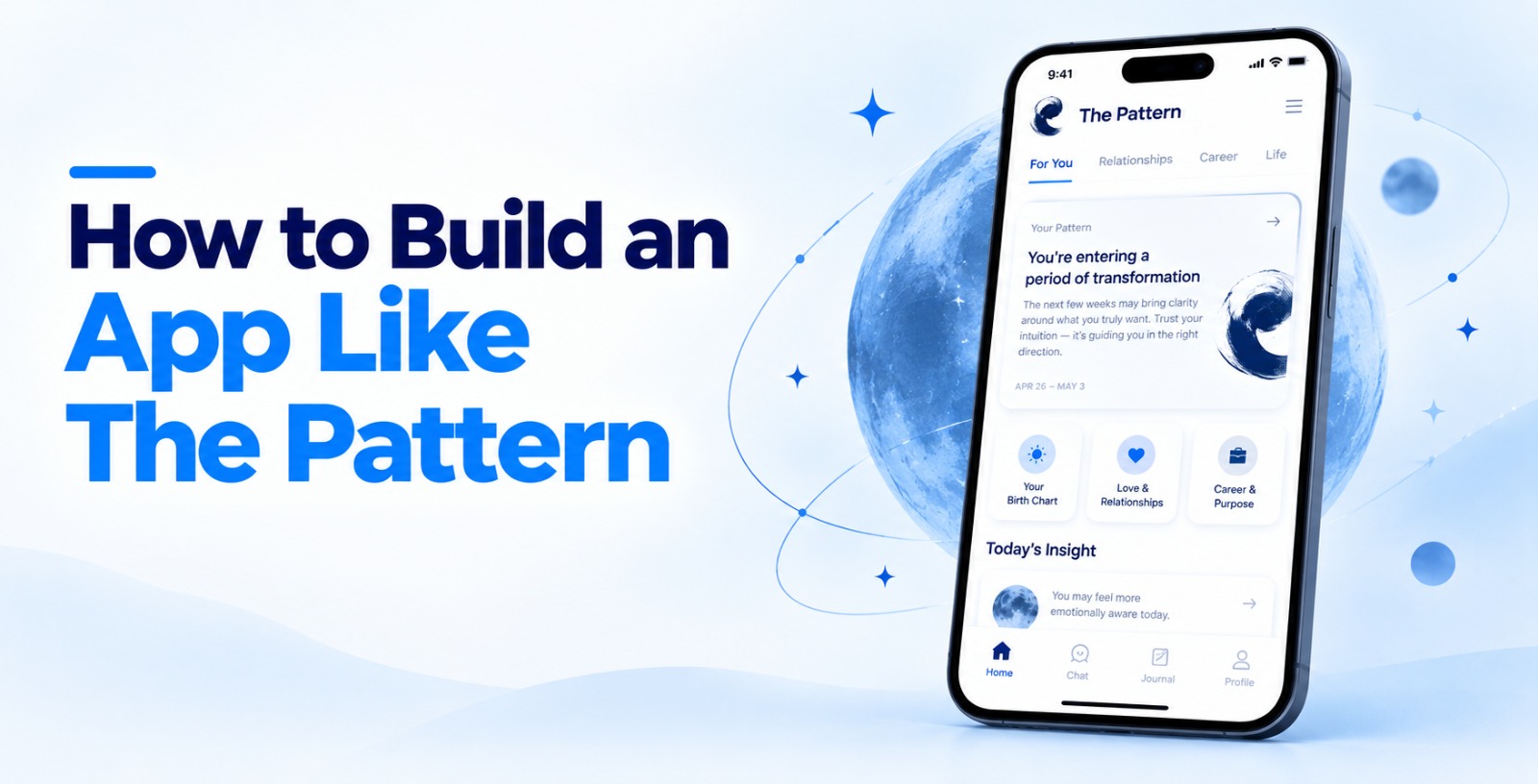
A user opens The Pattern, reads a paragraph about why they shut down when things get close, and screenshots it immediately. Then they send it to three friends with the same two words: “this is scary.”
Nobody screenshots a daily horoscope. That difference is the entire business.
TL;DR
If you want to build an app like The Pattern, understand the product category first. This is a self-knowledge app that happens to use a birth chart as its input.
Users get a profile broken into psychological traits, plus timed cycles that explain why a specific month feels heavy. There are no zodiac sun sign jokes and very little astrology vocabulary on the surface.
That positioning has commercial weight behind it. The astrology app market sits at $6.29 billion in 2026 and is forecast to reach $46.6 billion by 2035 per Business Research Insights, with personalization named as a primary driver.
Co-Star gets away with one sentence. The Pattern needs several paragraphs per trait, and they have to feel specific.
That means a content library in the range of hundreds of thousands of words, structured by placement, aspect, and intensity. Underestimating this is the single most common planning failure in this category.
The Pattern’s signature feature shows life cycles with start and end dates. Behind it sits progressed chart math and transit calculations running across years, not days.
You are computing a timeline per user, caching it, and refreshing it as transits move. This is a background job architecture problem before it is an astrology problem.
Bonds compare two charts and describe a relationship honestly, including the ugly parts. The output has to make sense to both people reading it.
Synastry logic, plus careful permission handling, plus writing that does not accuse anyone. Harder than it looks on a whiteboard.
| Feature | What the user gets | What it costs you to build |
| Deep profile | Trait by trait psychological read | Heavy content, light engineering |
| Timing cycles | Dated life phases with context | Heavy engineering, moderate content |
| Bonds and compatibility | Honest two-person dynamics | Moderate both, high privacy care |
| Daily update | Short note tied to current transits | Light engineering, recurring content |
| Connect and chat | Matching with compatible users | Real-time infrastructure, moderation |
| Paid tier | Deeper reports, relationship add-ons | Billing, entitlements, paywall logic |
The chat and matching side pulls in messaging infrastructure you would recognize from any dating app development project, including moderation and reporting from day one.
Build onboarding, the chart calculation service, and the profile view. Ship a product that does one thing exceptionally well, which is telling a user something true about themselves.
Write the interpretation content for the ten or twelve highest impact placements first, at full depth, rather than covering everything shallowly. Users judge you on the first screen they read, not on coverage.
Run this phase for roughly ten weeks. Measure one number, which is the share of users who finish reading their full profile.
Now add the cycles engine. Compute progressed positions and major transits, segment them into labeled phases, and attach dated windows to each one.
Pair every phase with a short daily or weekly note so the app has a reason to exist between big moments. This is where retention curves either flatten out or collapse.
Expect eight to ten weeks here. Treat the background job layer seriously, because nightly recomputation across a growing user base becomes an infrastructure bill fast, as explained in this piece on cloud computing and app scalability.
Add Bonds, invite flows, and the paid tier together. Compatibility is what makes people recruit their friends, and it is also what people pay for.
Build entitlements properly from the start. Mixed free and paid content with sloppy gating creates support tickets and refund requests you will be answering for months.
Ten weeks is realistic. Launch the paywall to a segment first, then roll it wider once conversion and churn both look stable.
Any competent team can calculate a chart. Almost nobody can write 300,000 words of psychological interpretation that lands.
Hire two or three writers with real astrology and psychology backgrounds. Give them a structured template per trait, including the shadow side, the growth edge, and a concrete example.
Use AI to accelerate variation, never to originate. Models trained on your own library through thoughtful AI integration can draft variants your editors then approve, which keeps velocity up without flattening the voice.
React Native covers both platforms well here, because the interface is mostly text and simple motion. Teams wanting maximum polish still go native, and this comparison of native versus cross-platform development lays out the real tradeoffs.
On the backend, Python handles astrological computation comfortably and has the richest library support. PostgreSQL stores users and charts, Redis queues the nightly timing jobs, and object storage holds your content library with versioning.
For chat, use a managed real-time service rather than building sockets yourself. Moderation tooling should ship with it, not after it.
| Phase | Scope | Cost | Duration |
| Phase one | Profile and chart engine | $30,000 to $45,000 | 10 weeks |
| Phase two | Timing cycles and daily notes | $25,000 to $40,000 | 9 weeks |
| Phase three | Bonds, chat, paid tier | $25,000 to $45,000 | 10 weeks |
| Content | Interpretation library | $15,000 to $35,000 | Parallel |
Total for a full first release lands between $95,000 and $165,000 with offshore delivery. A tighter phase one only launch runs closer to $45,000.
Founders deciding how much to ship initially should read this breakdown of MVP versus full-scale development before locking scope.
Shipping all features at once. A thin version of five features loses to a deep version of one. The profile alone can carry a launch.
Writing like a horoscope. The moment copy says “as a Scorpio, you,” the product loses its distinctiveness.
Ignoring the emotional weight. Telling someone about their attachment wounds is serious. Build in care, and avoid clinical or diagnostic language entirely, a lesson well covered in work on mental health app development.
Underfunding content. Teams that budget 10% for writing and 90% for code almost always have to redo the writing.
The decision to build an app like The Pattern is really a decision to run a content company with an engineering team attached. That order matters.
Get the writing right, make the timing engine genuinely accurate, and let compatibility do your marketing. Products in this category grow through screenshots, not ad spend.
If you are ready to scope this properly, EngineerBabu can help you map phase one and get a profile engine into users’ hands.
EngineerBabu is a technology development company building products across fintech, healthtech, and AI, from MVPs to scaled, production-ready platforms.
It holds a CMMI Level 5 rating, has worked with 4 unicorn clients, and has supported 200+ VC-funded products. The company is backed by Vijay Shekhar Sharma.
Founded by Mayank Pratap (Co-founder) · mayank@engineerbabu.com
It presents psychological profiles and timed life cycles instead of daily predictions, and it mostly avoids astrology terminology on the surface. That framing reaches users who would never download a horoscope app.
Plan for several hundred thousand words across traits, cycles, and compatibility combinations. Phase one needs only the highest impact placements written at full depth.
Yes. It requires progressed chart calculations, multi-year transit tracking, and scheduled recomputation per user. Budget real engineering time for the background job layer.
Not realistically. A workable team is two mobile developers, one backend engineer with math comfort, a designer, and at least two content writers.
Around $95,000 to $165,000 for a complete first release including content, or roughly $45,000 for a profile only launch built to validate demand.