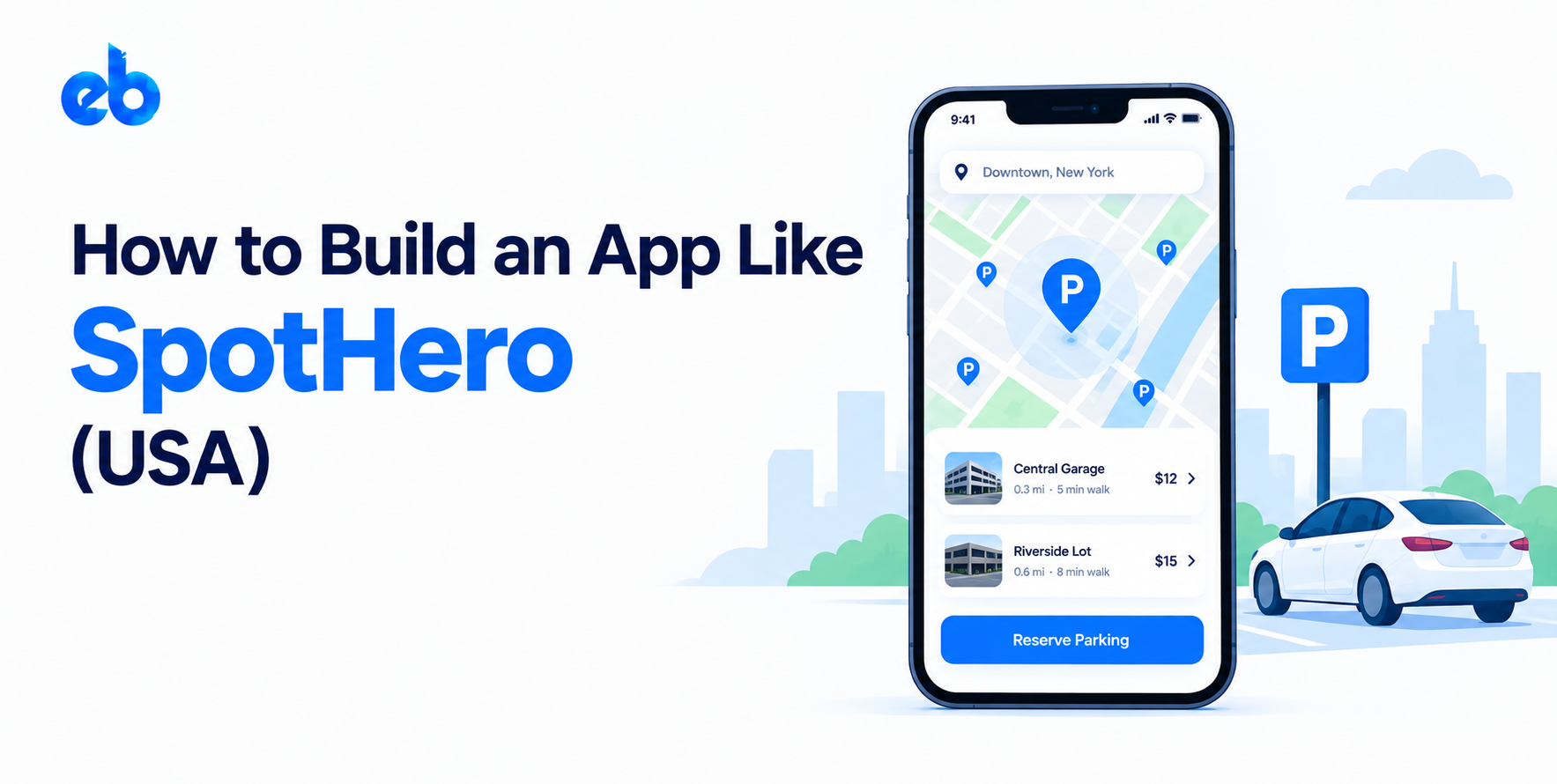
How to Build an App Like ParkMobile in the USA (2026 Guide)


Create engaging, high-performance mobile applications tailored to your business needs. We craft future-ready apps that offer smooth user experiences on all devices.
Build robust and scalable websites and CMS platforms that help you manage content effortlessly. Our development ensures a seamless digital presence.
Launch secure, feature-rich online stores with intuitive shopping experiences. We build tailored eCommerce platforms designed for growth.
Design captivating games with immersive gameplay and stunning graphics. From concept to launch, we build engaging experiences that players love.
Enhance your customer relationships with customized Salesforce implementations. Drive growth and efficiency with smarter CRM solutions.
Harness artificial intelligence and machine learning to automate workflows and gain actionable insights. Our AI transforms data into smart decisions.
Accelerate your software delivery lifecycle with continuous integration, delivery, and infrastructure automation to boost efficiency.
Hire app developers ready to turn your ideas into sleek, high-performing mobile apps for any platform.
Bring in frontend pros who craft smooth, beautiful, and user-friendly interfaces that your visitors will love.
Get backend developers who build fast, secure, and reliable systems to keep everything running behind the scenes.
Hire eCommerce developers who build secure, scalable online stores designed to offer seamless shopping and grow your sales.
Get dedicated developers committed to your projects, delivering consistent quality and speed as an extension of your team.
Nobody opens a parking app for fun. They open it standing in the rain, meter blinking, four minutes late for a dentist appointment. That single moment is the entire product. Everything else is plumbing.
Which is why so many parking startups stall. They copy the screens and miss the machinery underneath: zone databases, municipal rate rules, enforcement handshakes, and payment flows that cannot fail on a weak cell signal.
This guide breaks down what it actually takes to build an app like ParkMobile for the US market, from the first zone record to the city contract that makes the whole thing viable.
To build an app like ParkMobile you need four connected systems: a driver-facing mobile app, a zone and rate engine, a payment layer certified for card data, and an enforcement API that tells parking officers who paid. ParkMobile itself operates across hundreds of US cities, campuses, and stadiums, which tells you the real moat is distribution deals, not code.
Digital parking is not a trend piece anymore. It is municipal infrastructure. The global smart parking systems market sat at $10.2 billion in 2025 and is projected to grow from $12.3 billion in 2026 to $53.4 billion by 2033, a 23.3% CAGR (Grand View Research). US cities are retiring coin meters faster than they are replacing them, and every retired meter creates a gap that an app fills. That gap is your opening.
Most teams underestimate this part, so map it before you scope anything.
Zone lookup, session start, timer, extension, receipts, and reservations. It has to work on a dying battery in an underground garage with two bars of signal. Offline tolerance is a feature, not a nice-to-have.
Cities set rates by block, by hour, and by day. Holidays, event surges, residential permits, and disabled parking all change the math. Your rate engine needs to express those rules without a developer touching code every time a council votes.
This is the piece nobody demos. A parking officer types a plate into a handheld and needs an instant paid or unpaid answer. If that lookup is slow or wrong, drivers get ticketed after paying, and the city drops you.
Geofencing sits underneath most of this, since the app must know which zone a driver is standing in before it can quote a rate. Precision here separates a usable product from a support nightmare.
Garage reservations, EV charging status, license plate recognition at gates, in-car integrations, and permit management for universities. Add these once your zone data is clean. Not before.
Pick one city, or even one district, and go deep. To build an app like ParkMobile you need signed authorization from the parking authority before a single driver can pay legally. Approach a mid-sized city where the incumbent contract is expiring, not New York on day one. Ask for their current zone inventory, rate schedules, and enforcement workflow in writing. This document becomes your product spec. Teams that skip this step build beautiful apps that no municipality will switch on.
Start with the rules engine, not the screens. Every zone needs coordinates, a zone code, rate tiers, maximum stay limits, enforcement hours, and exception rules for holidays or events. Model this as configurable data that city staff can edit through a dashboard. Hard-coding rates guarantees painful releases every quarter. Test the engine against three months of the city’s historical rate changes before you trust it. If it reproduces every past rate correctly, your foundation is sound.
Time the entire journey with a stopwatch. Open app, confirm zone, confirm plate, confirm duration, pay. Anything over 30 seconds loses users to the meter. Thoughtful UI/UX design matters more here than in almost any other category, because the user is stressed, standing, and often in poor light. Default to the last plate used and the last duration chosen. Make extension a single tap from the lock screen notification. Every removed tap shows up directly in retention.
Card-on-file is the standard, so tokenize everything and never store raw card data yourself. Choosing the right payment gateways early prevents an expensive migration at month nine. Support Apple Pay and Google Pay from launch, since they convert far better than manual card entry. Many operators also add a prepaid balance, which works much like a digital wallet and reduces per-transaction fees on short sessions. Handle failed authorizations gracefully with a retry window rather than an instant session cancellation.
This is where projects slip. Parking authorities run legacy handheld systems, and your app must feed them near instantly. Solid API development practice matters because these integrations are rarely documented well. Build a plate lookup endpoint that responds in under 500 milliseconds under load. Add a reconciliation feed so the city can audit revenue daily. Budget six to ten weeks for this stage alone, including their testing cycles. Nobody approves an enforcement integration quickly.
Launch on 50 to 100 spaces, not the whole city. Watch session start failures, extension usage, and support tickets per thousand sessions. Fix the top three failure modes before expanding. This mirrors how any good on-demand app reaches scale, through controlled geographic rollout rather than a single loud launch. Once your failure rate stabilizes, expansion becomes a sales problem instead of an engineering one. That shift is the real milestone.
| Layer | Practical choice | Why |
| Mobile | Flutter or React Native | One codebase, near-native maps performance |
| Backend | Node.js or Go | Handles concurrent session spikes at event start |
| Database | PostgreSQL with PostGIS | Geospatial zone queries out of the box |
| Realtime | WebSockets plus push | Timer sync and expiry alerts |
| Infra | AWS or GCP, multi-AZ | Uptime clauses in city contracts are strict |
Most teams that build an app like ParkMobile go cross-platform, and Flutter handles map-heavy screens well. If you expect deep CarPlay and Android Auto work later, weigh the native vs cross-platform development tradeoff before writing code.
PCI DSS applies the moment you touch card data, and tokenization through a certified processor keeps your scope narrow. State-level privacy laws, including CCPA in California, govern how long you retain plate and location history. Municipal contracts usually add their own data residency and audit clauses on top.
Plate numbers plus timestamps plus coordinates form a sensitive dataset. Define retention windows early, and delete aggressively once enforcement and dispute windows close.
The reservation and white-label lines usually carry the margin. Transaction fees alone rarely fund growth at small volumes.
| Scope | Timeline | Cost range |
| Single-city MVP | 16 to 22 weeks | $70,000 to $130,000 |
| Multi-city platform with dashboard | 7 to 10 months | $150,000 to $260,000 |
| Full suite with reservations, EV, LPR | 10 to 14 months | $280,000 to $450,000+ |
Budgets stretch when city integrations arrive late and when zone data needs manual cleanup. A staged MVP development approach keeps that risk contained. For a wider breakdown of what drives these numbers, read this guide on mobile app development cost in the USA.
Teams that set out to build an app like ParkMobile usually need a partner comfortable with geospatial logic, payment compliance, and legacy municipal integrations in the same sprint. EngineerBabu’s mobile app development services cover that full range, from zone engine architecture to enforcement APIs and city dashboards.
The same engineering patterns show up in high-concurrency location products, which is why the team’s work on projects like an app like Uber transfers directly to parking.
EngineerBabu is a mobile and web app development company building products across fintech, healthtech, and AI, from MVPs to scaled, production-ready platforms.
It holds a CMMI Level 5 rating, has worked with 4 unicorn clients, and has supported 200+ VC-funded products. The company is backed by Vijay Shekhar Sharma.
Founded by Mayank Pratap (Co-founder) · mayank@engineerbabu.com
The hard part is never the timer screen. It is the zone database, the enforcement handshake, and the city relationship that makes both matter. Get those three right and the app almost builds itself.
Ready to scope your build? Talk to EngineerBabu about parking and mobility platform development for the US market.
A single-city MVP typically costs $70,000 to $130,000. A multi-city platform with an operator dashboard runs $150,000 to $260,000, depending on integration depth.
Yes, for on-street parking. Public curb space is municipal, so you need an agreement with the parking authority. Private garages and campuses can be onboarded directly.
Roughly 16 to 22 weeks for a focused MVP. Enforcement and payment integrations usually add four to eight weeks beyond core development.
A mix of in-ground sensors, camera-based detection, and predictive models trained on historical session data. Most US apps start with historical prediction, since sensor hardware is expensive.
Yes, by winning contracts it does not hold. Mid-sized cities, universities, hospitals, and stadium operators are the realistic entry points for new platforms.
White-label ships in weeks but limits your rate logic and integrations. Custom gives you the flexibility cities eventually demand, which is why most serious operators end up rebuilding.