How to Build an App Like Apple Podcasts (USA)


Create engaging, high-performance mobile applications tailored to your business needs. We craft future-ready apps that offer smooth user experiences on all devices.
Build robust and scalable websites and CMS platforms that help you manage content effortlessly. Our development ensures a seamless digital presence.
Launch secure, feature-rich online stores with intuitive shopping experiences. We build tailored eCommerce platforms designed for growth.
Design captivating games with immersive gameplay and stunning graphics. From concept to launch, we build engaging experiences that players love.
Enhance your customer relationships with customized Salesforce implementations. Drive growth and efficiency with smarter CRM solutions.
Harness artificial intelligence and machine learning to automate workflows and gain actionable insights. Our AI transforms data into smart decisions.
Accelerate your software delivery lifecycle with continuous integration, delivery, and infrastructure automation to boost efficiency.
Hire app developers ready to turn your ideas into sleek, high-performing mobile apps for any platform.
Bring in frontend pros who craft smooth, beautiful, and user-friendly interfaces that your visitors will love.
Get backend developers who build fast, secure, and reliable systems to keep everything running behind the scenes.
Hire eCommerce developers who build secure, scalable online stores designed to offer seamless shopping and grow your sales.
Get dedicated developers committed to your projects, delivering consistent quality and speed as an extension of your team.
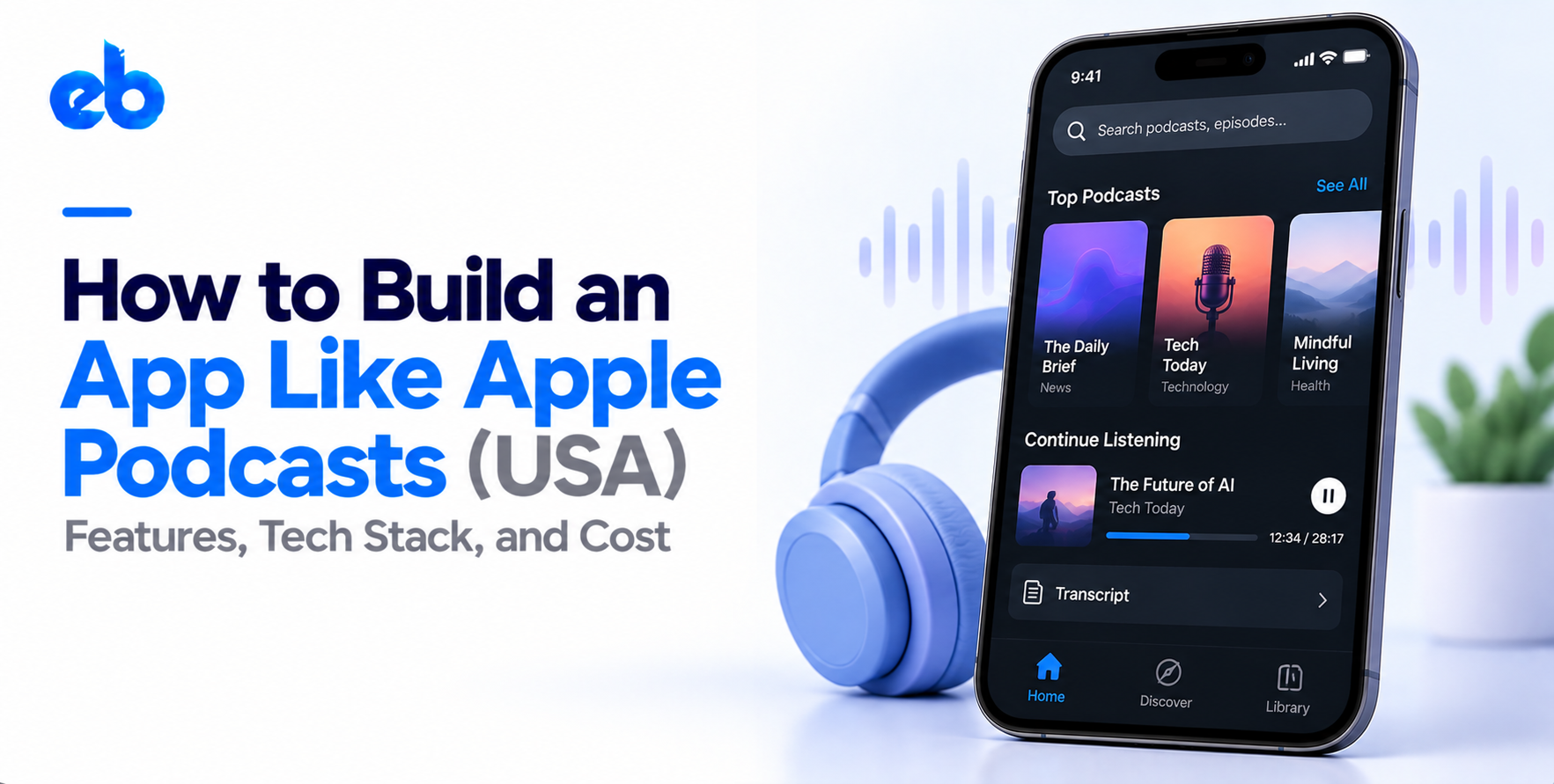
Apple Podcasts hosts almost none of the audio it plays. It reads public RSS feeds, caches artwork, and points your phone at someone else’s server. That single architectural fact is why a two-person team can ship a credible podcast app, and why so many of them die anyway.
The catalog was never the moat. Playback was.
So if you want to build an app like Apple Podcasts for the US market, the real work sits in feed parsing, buffering behavior, and giving listeners a reason to switch. This guide walks through what that actually involves.
TL;DR
To build an app like Apple Podcasts, you need four systems working together: an RSS feed crawler that ingests and normalizes podcast metadata, a streaming audio player with offline caching, a cross-device sync service, and a recommendation layer. Everything else, including subscriptions, transcripts, and creator dashboards, sits on top of those four.
The audience is not the problem. Edison Research’s The Infinite Dial 2026 found that 58% of Americans aged 12 and older, roughly 167 million people, listen to podcasts monthly, an all time high (source).
Attention is fragmented across Spotify, YouTube, and Apple. None of them serve niche listening well. Language learners, audio drama fans, enterprise internal podcasts, and faith communities all get generic feeds.
That is where new apps win. Not by being broader, but by being sharper for one group.
Feature scope is where budgets quietly double. Split your list into what listeners touch and what publishers touch, then ship the listener side first.
Small details carry real weight here. A podcast app that forgets playback position loses trust faster than one missing a search filter. Most features of a successful mobile app in this category are reliability features, not novelty ones.
Publisher tooling can wait until phase two. Listeners come first, and thoughtful UI/UX design matters more than dashboards on day one.
Audio apps punish shortcuts. Here is what typically holds up in production when you build an app like Apple Podcasts at US scale.
Go cross-platform unless you have a hardware-specific reason not to. React Native development handles the UI well, but audio playback usually needs native modules on both sides. AVPlayer on iOS, ExoPlayer on Android.
If CarPlay, Apple Watch, and widgets are core to your pitch, weigh native vs cross-platform development seriously before committing.
Node.js or Go both work for the crawler. You are parsing thousands of XML feeds on a schedule, deduplicating episodes, and handling malformed markup constantly. Feeds break often, so build defensively.
Postgres for relational data, Elasticsearch for search, Redis for queue state. Your API development layer sits between the crawler and the clients.
Audio files stream from the publisher’s host, not yours. Your CDN caches artwork, transcripts, and search indexes. Traffic spikes hard when a popular show drops, so cloud computing plays a direct role in app scalability here.
Do not start with “podcast app.” Start with a listener you can describe in one sentence. Spanish learners who want dual transcripts. Runners who want tempo-matched queues. Executives who want 10-minute briefings from long shows.
Your wedge determines your data model, not just your marketing. Define one behavior your app does better than Apple, then validate it with 20 real listeners. Scoping this as an MVP development effort keeps phase one at six to ten weeks instead of six months.
This is the true foundation. Write a crawler that fetches feeds on a rolling schedule, respects HTTP caching headers, and normalizes wildly inconsistent XML into clean records.
Expect broken enclosures, missing durations, duplicate GUIDs, and artwork at every resolution imaginable. Handle all of it silently.
Index the iTunes namespace tags for categories and explicit flags. Store a content hash per episode to detect edits. Crawl popular feeds every 15 minutes, dormant ones daily. Feed health is a background job that never stops running.
Playback is where users decide. Build native audio modules that survive backgrounding, interruptions, Bluetooth handoffs, and poor networks without losing position.
Buffer intelligently. Start playback within 500ms of a tap, prefetch the next two minutes, and degrade to a lower bitrate rather than stalling. Save playback position locally every few seconds and sync it on reconnect.
Test on real commutes, not office Wi-Fi. Solid iOS app development practice matters here because Apple’s audio session rules are unforgiving when calls interrupt playback.
Downloads are the most requested feature and the most commonly broken one. Let users set per-show auto-download rules, cap total storage, and auto-delete finished episodes.
Queue downloads in a background service that survives app termination. Resume partial files instead of restarting them. Warn before large downloads on cellular.
Storage bloat is the number one uninstall trigger for audio apps, so surface a clear storage screen early. Good mobile app performance optimization work pays for itself on this feature alone.
Top-100 charts are a solved problem and a boring one. Personalization is your differentiator when you build an app like Apple Podcasts today.
Use listening history, completion rates, and skip patterns to model taste. Transcript-level semantic search lets users find the episode where a specific topic was discussed, not just the show.
Collaborative filtering works once you have scale, so use content-based signals first. Partnering on AI development early keeps the data pipeline clean enough to train on later.
Ship with analytics wired into every playback event: start, pause, seek, skip, complete, abandon. These events are your entire product roadmap.
Run performance testing against slow networks, 5-year-old devices, and multi-hour sessions. Memory leaks surface only on long playback.
Soft launch in one US metro or one interest community. Watch day-7 retention and average session length before spending on acquisition.
| Build stage | Scope | Estimated cost |
| MVP | RSS ingest, playback, downloads, basic search | $45,000 to $80,000 |
| Growth build | Sync, personalization, transcripts, subscriptions | $90,000 to $160,000 |
| Full platform | Creator tools, ad insertion, analytics, multi-device | $180,000 to $300,000+ |
Ongoing costs matter just as much. Budget 15% to 20% annually for maintenance, plus CDN and storage bills that scale with your catalog size.
For a stage-by-stage breakdown, this guide on mobile app development cost in the USA is worth reading before you approve a quote.
Public RSS feeds are fair to index, but the audio belongs to the publisher. Never re-host episodes without permission, and honor removal requests within days.
App Store review gets strict with audio apps. Background audio entitlements need justification, and any paid tier must route through Apple’s in-app purchase system.
If you offer private paid feeds, your subscription management platform needs secure token-based feed URLs that expire on cancellation. Add CCPA-compliant data handling and WCAG accessibility from the start, since retrofitting both is expensive.
The decision to build an app like Apple Podcasts is really a decision about focus. The catalog is free, the format is open, and the audience is enormous and underserved in specific pockets.
What separates the apps that last is unglamorous engineering. Reliable downloads, instant playback, and sync that never loses your place.
If you are scoping a podcast or audio product for the US market, EngineerBabu can help you map features to a realistic build plan before development starts.
EngineerBabu is a technology development company building products across fintech, healthtech, and AI, from MVPs to scaled, production-ready platforms.
It holds a CMMI Level 5 rating, has worked with 4 unicorn clients, and has supported 200+ VC-funded products. The company is backed by Vijay Shekhar Sharma.
Founded by Mayank Pratap (Co-founder) · mayank@engineerbabu.com
An MVP with ingestion, playback, and downloads typically takes 10 to 14 weeks. A full platform with personalization and creator tools runs 6 to 9 months.
No. Public RSS feeds are meant for open distribution. You stream from the publisher’s host and must honor takedown requests promptly.
Cross-platform works for most of the UI. Audio playback, CarPlay, and background services usually need native modules on both iOS and Android.
Premium subscriptions, dynamic ad insertion, creator revenue shares, and white-label licensing to media brands are the four proven models.
Feed normalization and offline download reliability. Both look simple in a demo and break constantly at scale across thousands of inconsistent feeds.