How to Build a SaaS Subscription Management Platform - Billing, Dunning, Revenue Recognition, Churn 2026


Create engaging, high-performance mobile applications tailored to your business needs. We craft future-ready apps that offer smooth user experiences on all devices.
Build robust and scalable websites and CMS platforms that help you manage content effortlessly. Our development ensures a seamless digital presence.
Launch secure, feature-rich online stores with intuitive shopping experiences. We build tailored eCommerce platforms designed for growth.
Design captivating games with immersive gameplay and stunning graphics. From concept to launch, we build engaging experiences that players love.
Enhance your customer relationships with customized Salesforce implementations. Drive growth and efficiency with smarter CRM solutions.
Harness artificial intelligence and machine learning to automate workflows and gain actionable insights. Our AI transforms data into smart decisions.
Accelerate your software delivery lifecycle with continuous integration, delivery, and infrastructure automation to boost efficiency.
Hire app developers ready to turn your ideas into sleek, high-performing mobile apps for any platform.
Bring in frontend pros who craft smooth, beautiful, and user-friendly interfaces that your visitors will love.
Get backend developers who build fast, secure, and reliable systems to keep everything running behind the scenes.
Hire eCommerce developers who build secure, scalable online stores designed to offer seamless shopping and grow your sales.
Get dedicated developers committed to your projects, delivering consistent quality and speed as an extension of your team.
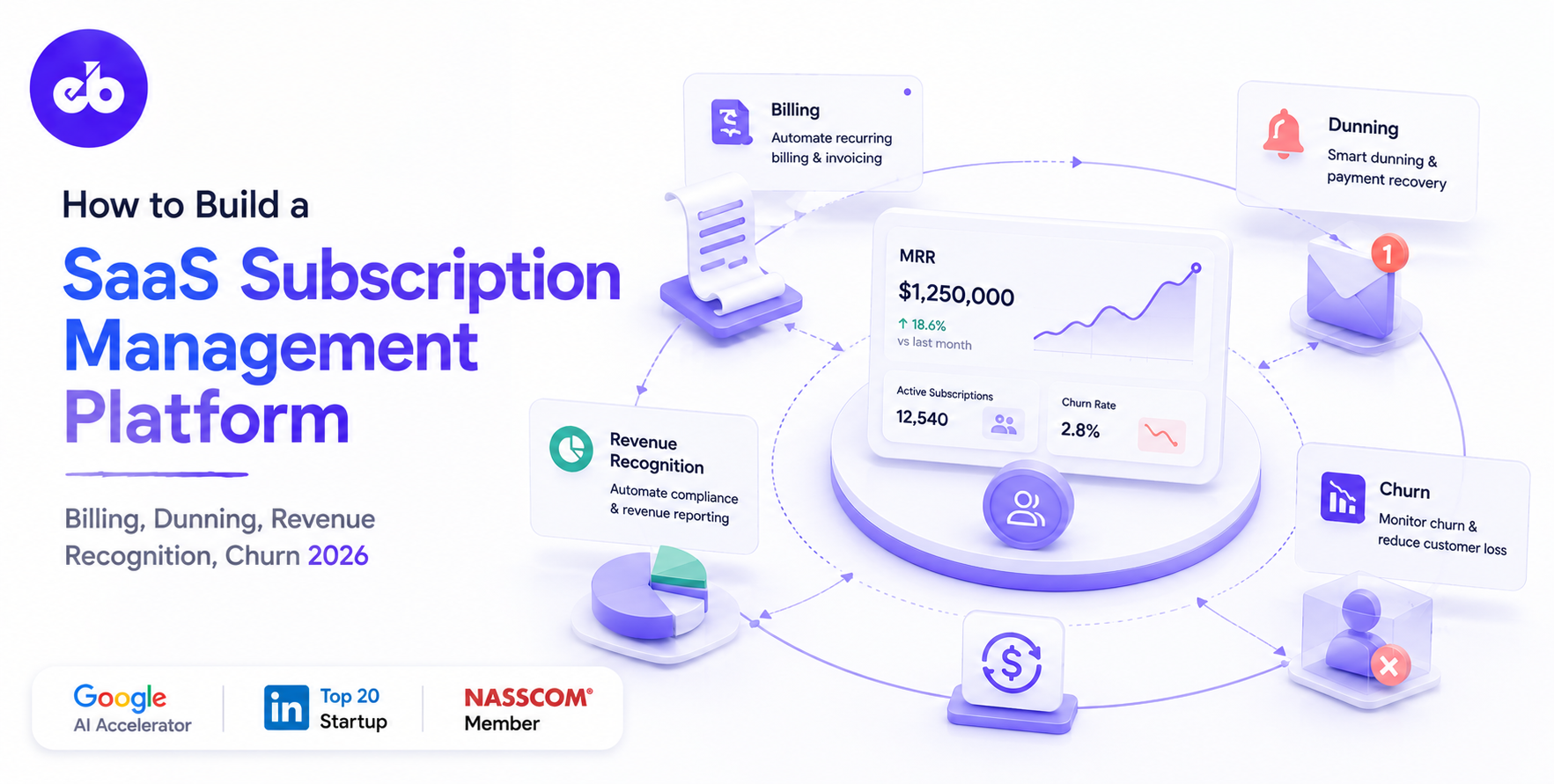
Subscription billing is deceptively simple on the surface, charging a card every month.
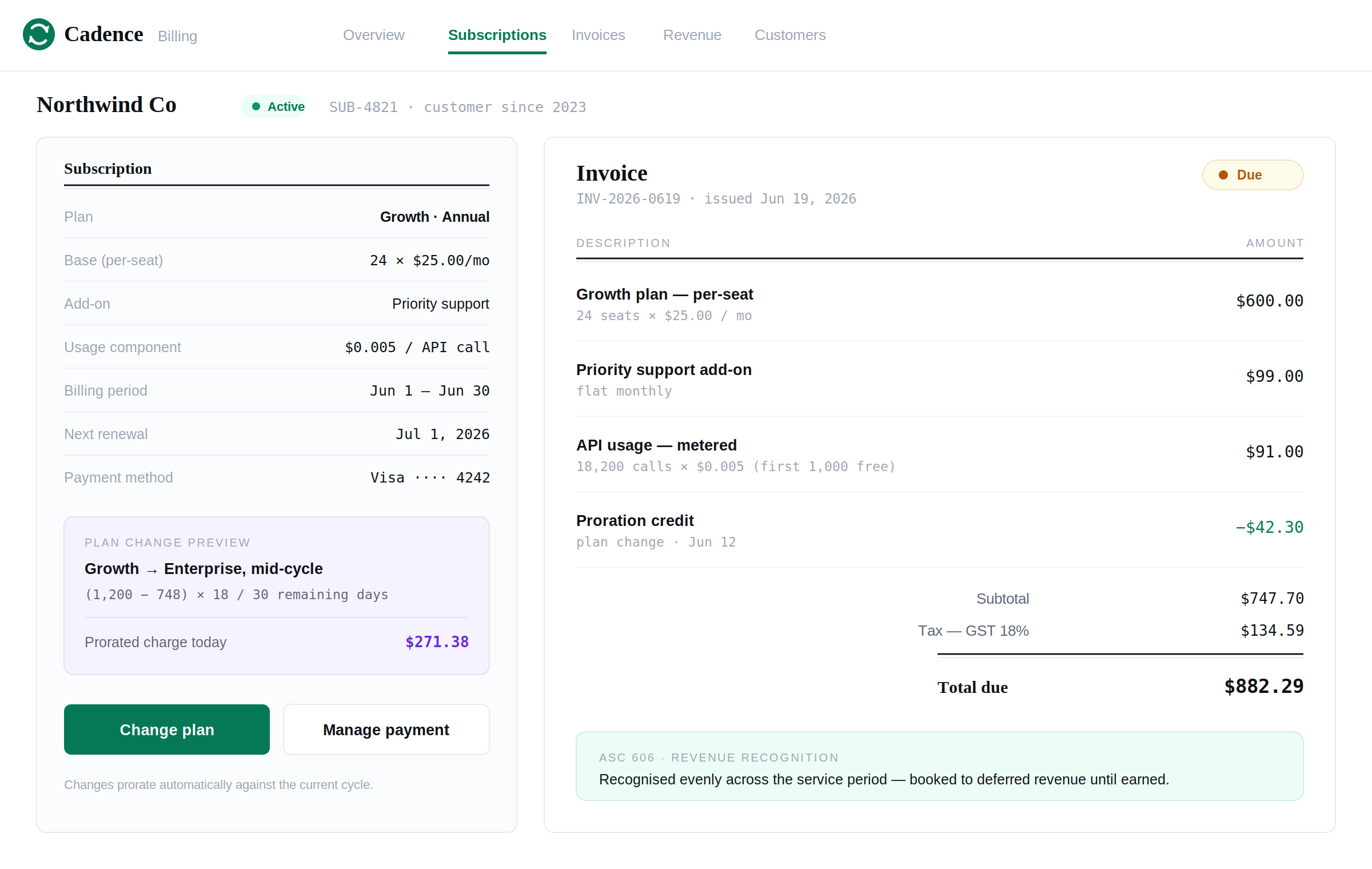
The complexity emerges at scale: hundreds of pricing plans, mid-cycle upgrades and downgrades, failed payment recovery, proration, usage-based components, multi-currency, tax compliance across jurisdictions, and ASC 606 revenue recognition.
Subscription billing powers the revenue engine of SaaS businesses, subscription marketplaces, media platforms, and digital service providers. While recurring monthly payments appear straightforward, enterprise subscription platforms must manage flexible pricing models, billing automation, payment recovery, taxation, accounting compliance, and customer lifecycle events without revenue leakage.
A modern subscription billing platform should automate recurring invoices, handle plan changes with accurate proration, recover failed payments through intelligent dunning, support global payment methods, and integrate seamlessly with CRM, ERP, accounting, and analytics systems.
At EngineerBabu, we build enterprise SaaS platforms and fintech solutions that automate complex billing workflows, payment orchestration, and financial reporting.
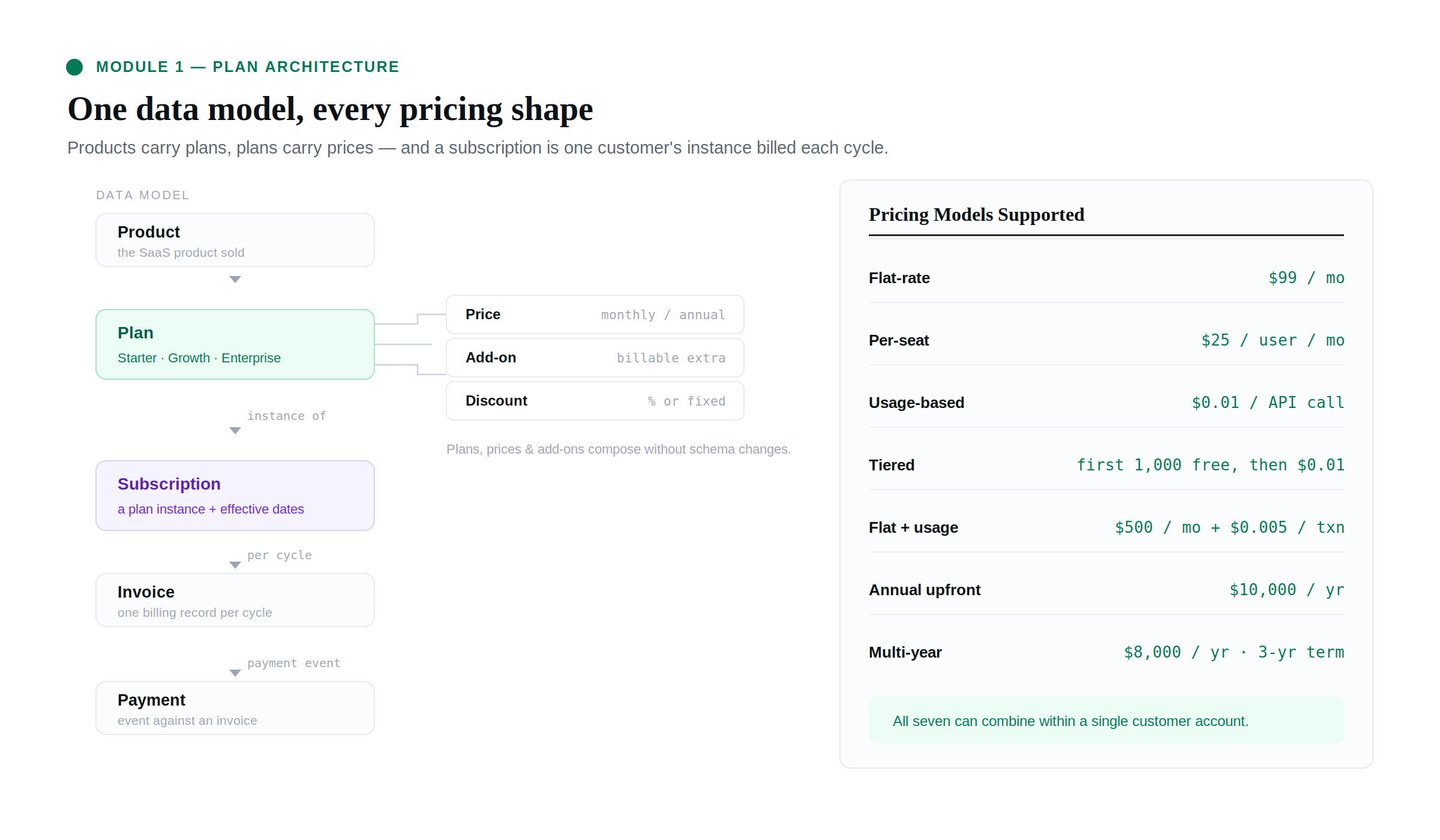
The data model:
| Entity | Description |
| Product | The SaaS product being sold |
| Plan | A pricing variant (Starter/Growth/Enterprise) |
| Price | Specific billing terms per plan (monthly/annual, amount) |
| Add-on | Optional features billable in addition to base plan |
| Discount | Percentage or fixed amount discount |
| Subscription | Customer’s instance of a plan with effective dates |
| Invoice | Billing record per billing cycle |
| Payment | Payment event against an invoice |
Pricing models supported:
| Model | Example |
| Flat-rate | $99/month |
| Per-seat | $25/user/month |
| Usage-based | $0.01 per API call |
| Tiered | First 1,000 calls free, then $0.01 |
| Flat + usage | $500/month + $0.005/transaction |
| Annual upfront | $10,000/year |
| Multi-year | $8,000/year (3-year commitment) |
Proration logic:
Upgrade proration =
(New plan price – Old plan price) ×
(Days remaining in cycle / Days in cycle)
Downgrade proration (credit) =
(Old plan price – New plan price) ×
(Days remaining in cycle / Days in cycle)
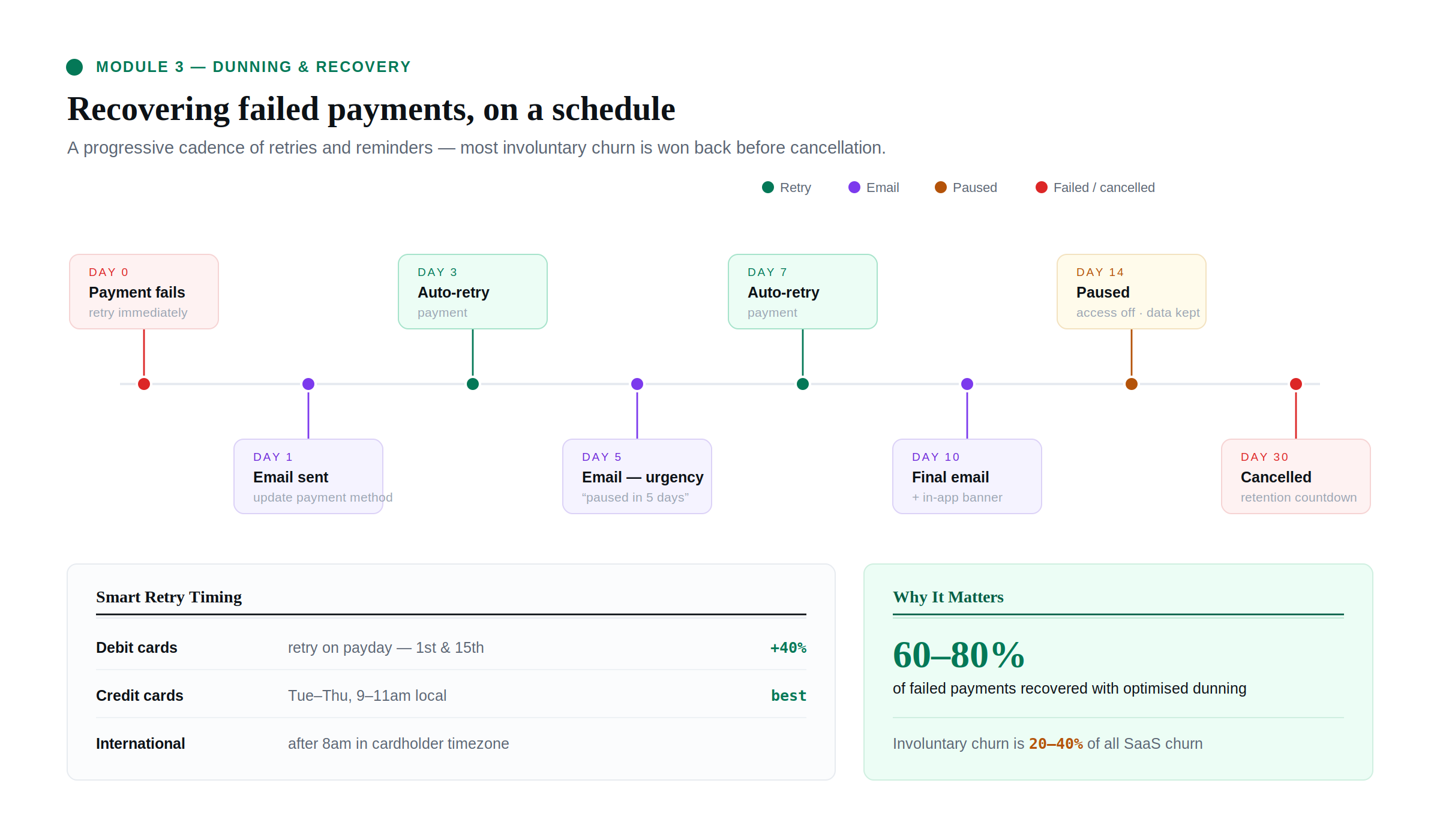
Failed payment recovery – the dunning sequence:
| Day | Action |
| Day 0 | Payment fails → retry immediately |
| Day 1 | Email: “Payment failed – please update your payment method” |
| Day 3 | Retry payment automatically |
| Day 5 | Email with urgency: “Account will be paused in 5 days” |
| Day 7 | Retry payment automatically |
| Day 10 | Final email + in-app banner |
| Day 14 | Subscription paused (access restricted, data retained) |
| Day 30 | Subscription cancelled, data retention countdown begins |
Smart retry timing:
The platform learns optimal retry times from historical success rates:
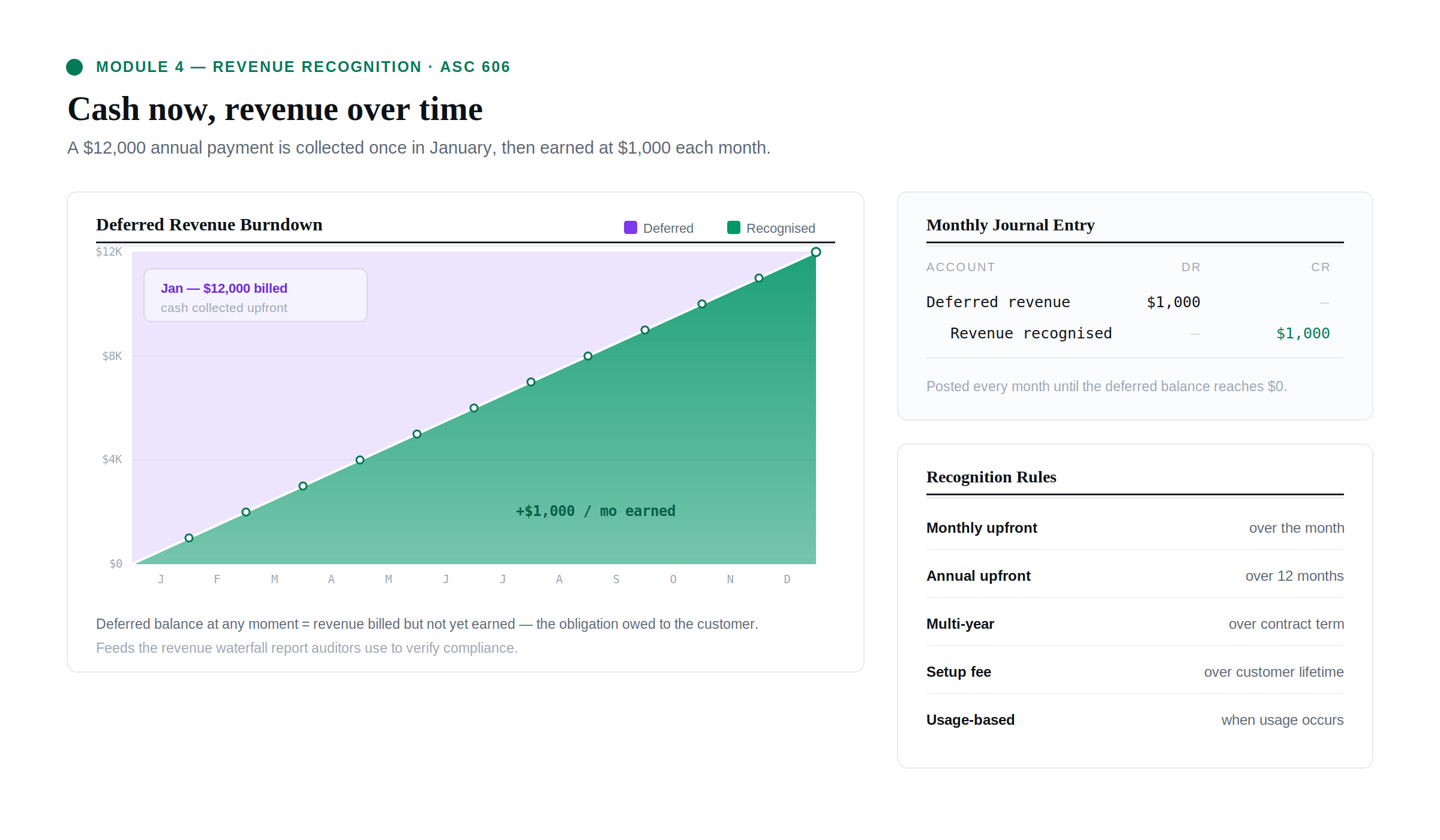
Recognition rules:
| Scenario | Treatment |
| Monthly subscription upfront | Recognise evenly over the month |
| Annual subscription upfront | Recognise evenly over 12 months |
| Multi-year contract | Recognise evenly over contract term |
| Setup fee | Recognise over expected customer lifetime |
| Usage-based | Recognise when usage occurs |
Deferred revenue tracking:
For each prepaid subscription, the platform generates monthly journal entries: debit Deferred Revenue, credit Revenue Recognised. The deferred revenue balance at any point represents future obligations that have been billed but not yet earned.
Churn prediction signals:
| Signal | High Churn Risk |
| Product usage | Declining 3+ consecutive weeks |
| Support tickets | Multiple unresolved |
| Feature adoption | Key features not adopted within 30 days |
| Payment history | Recent failed payment |
| Engagement | No admin login in 14+ days |
| NPS score | Detractor (0–6) on last survey |
NRR (Net Revenue Retention):
NRR = (MRR at end of period – churned MRR + expansion MRR)
/ MRR at start of period
NRR above 100% means the customer base is growing without new customer acquisition.
| Module | Cost Range (USD) | Notes |
| Subscription plan architecture + data model | $6K – $12K | |
| Recurring billing engine (all pricing models) | $8K – $15K | |
| Proration calculation engine | $4K – $8K | |
| Stripe/Braintree integration | $5K – $10K | |
| Dunning orchestration + smart retry | $6K – $12K | |
| Tax calculation (TaxJar/Avalara) | $5K – $10K | |
| ASC 606 revenue recognition + journal entries | $8K – $15K | |
| Churn prediction model | $8K – $15K | |
| Expansion + NRR analytics | $5K – $10K | |
| Customer self-service portal | $5K – $10K | |
| Accounting integration (QuickBooks/NetSuite) | $5K – $10K | |
| AWS + SOC 2 + VAPT | $5K – $10K | |
| Total | $70K – $137K | Full subscription platform |
Contact: mayank@engineerbabu.com
Subscription billing is no longer just a recurring payment system. It is the financial backbone of every SaaS business, directly influencing revenue, customer retention, accounting compliance, and operational efficiency.
A well-designed billing platform reduces manual effort, minimizes revenue leakage, and creates a seamless customer experience while supporting future growth.
Whether you’re launching a SaaS product or replacing legacy billing infrastructure, EngineerBabu can build a scalable subscription billing platform tailored to your business model.
Contact us at mayank@engineerbabu.com to discuss your requirements.
Dunning is the process of recovering failed recurring payments. Studies show 20 to 40% of SaaS churn is involuntary, caused by failed payments rather than deliberate cancellations. An intelligent dunning sequence maximises recovery through smart retry timing (retrying when historical success rates are highest for this card type and geography), a progressive communication cadence, and multiple recovery channels. Companies implementing optimised dunning recover 60 to 80% of failed payments that would otherwise result in churn.
ASC 606 requires revenue to be recognised when performance obligations are satisfied in SaaS, when the service is delivered, not when cash is collected. A customer paying $12,000 for an annual subscription in January generates $12,000 cash in January but only $1,000 in recognised revenue per month. The billing platform must generate monthly journal entries debiting Deferred Revenue and crediting Revenue Recognised, track deferred revenue balances per subscription, and produce a revenue waterfall report, the documents your auditor needs to verify ASC 606 compliance.
Most enterprise platforms support Stripe, Braintree, PayPal, Adyen, Razorpay, Authorize.Net, and other global payment providers. The billing engine should also support multiple gateways for payment routing and redundancy.
Yes. Modern billing systems can combine flat-rate subscriptions, per-seat pricing, metered usage, tiered billing, and one-time charges within the same customer account, enabling flexible pricing strategies.
Development timelines depend on the required features and integrations. A production-ready enterprise subscription billing platform with recurring billing, dunning, tax automation, revenue recognition, customer portal, and accounting integrations typically takes 4–8 months to build.