How to Build an App Like Kuku FM: Features, Tech Stack, and Cost


Create engaging, high-performance mobile applications tailored to your business needs. We craft future-ready apps that offer smooth user experiences on all devices.
Build robust and scalable websites and CMS platforms that help you manage content effortlessly. Our development ensures a seamless digital presence.
Launch secure, feature-rich online stores with intuitive shopping experiences. We build tailored eCommerce platforms designed for growth.
Design captivating games with immersive gameplay and stunning graphics. From concept to launch, we build engaging experiences that players love.
Enhance your customer relationships with customized Salesforce implementations. Drive growth and efficiency with smarter CRM solutions.
Harness artificial intelligence and machine learning to automate workflows and gain actionable insights. Our AI transforms data into smart decisions.
Accelerate your software delivery lifecycle with continuous integration, delivery, and infrastructure automation to boost efficiency.
Hire app developers ready to turn your ideas into sleek, high-performing mobile apps for any platform.
Bring in frontend pros who craft smooth, beautiful, and user-friendly interfaces that your visitors will love.
Get backend developers who build fast, secure, and reliable systems to keep everything running behind the scenes.
Hire eCommerce developers who build secure, scalable online stores designed to offer seamless shopping and grow your sales.
Get dedicated developers committed to your projects, delivering consistent quality and speed as an extension of your team.
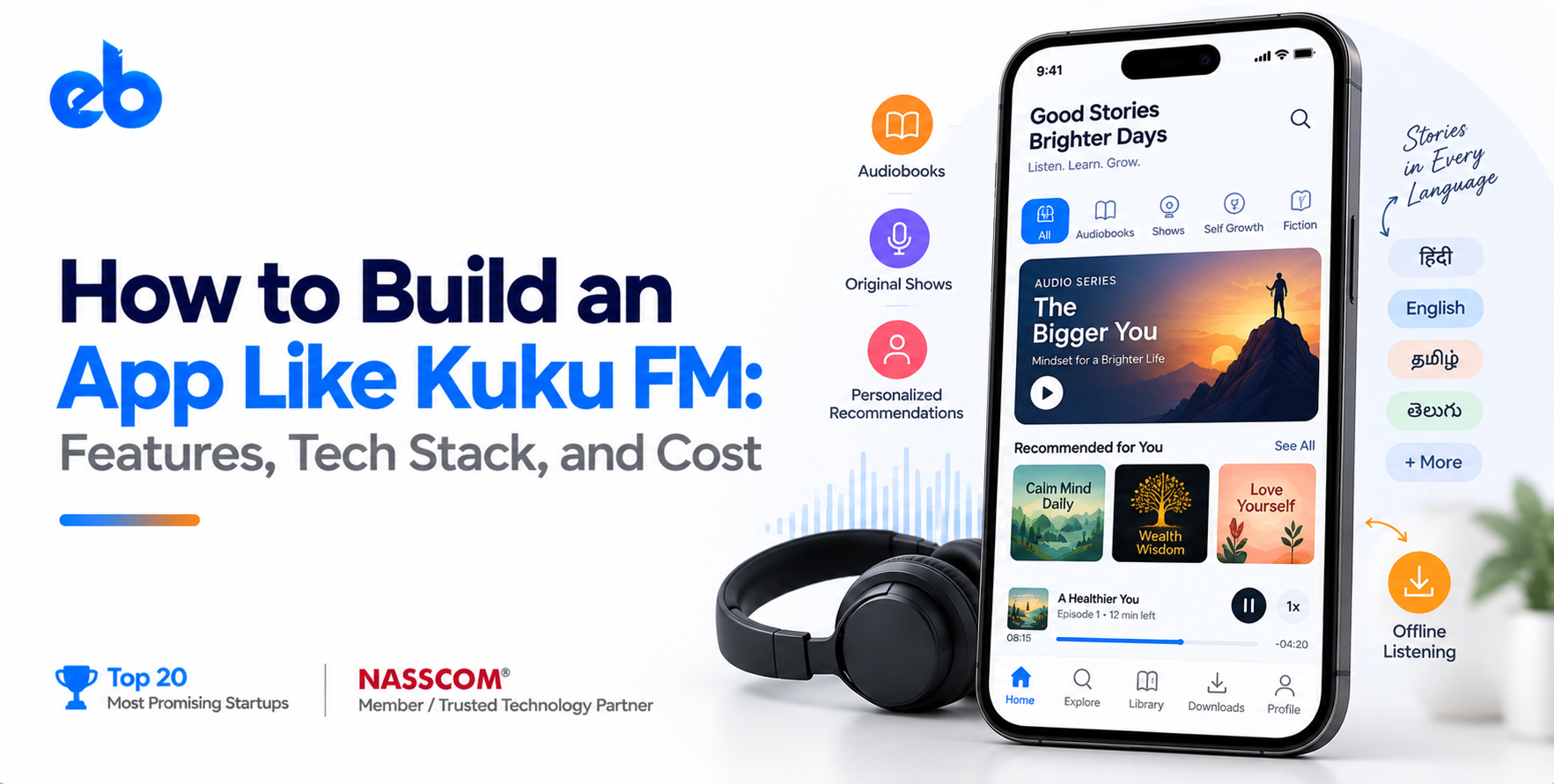
Nobody Opens Kuku FM to Kill Time on the Couch. They open it on a crowded bus, in a kitchen, or on a night shift. Audio fills the hours where a screen simply cannot compete.
That single behavioral insight built a business. Kuku FM reported revenue of ₹258.4 crore in FY25, a 148% jump from ₹104.2 crore the year before, according to Inc42. Ten million paid users in a market that supposedly refuses to pay for content.
So founders keep asking how to build an app like Kuku FM. The honest answer starts somewhere unexpected: the hardest part is not the player, it is everything feeding the player.
Strip the app down and three things carry the weight.
First, original content in languages that big platforms ignored. Hindi, Marathi, Tamil, Bengali, and more, produced in house rather than licensed.
Second, serialized storytelling. Episodes end on a cliffhanger, so daily return visits happen without a push notification war.
Third, pricing built for a first-time digital spender. Low annual plans plus microtransactions lower the barrier instead of gating everything behind one expensive wall.
Miss any of these and you have built a media player, not a habit. Before you commit an engineering budget, study what separates features of a successful mobile app from a feature list nobody uses.
Completion rate matters more than downloads here. A show people abandon at minute four is a cost center.
Audio looks lightweight next to video, which is exactly why teams build it carelessly. Then rural 4G shows up and buffering kills retention.
A workable streaming stack needs four layers. Ingest handles raw uploads and transcodes each file into HLS or DASH segments at several bitrates. Storage keeps masters in object storage while segments sit in a CDN close to listeners.
Delivery uses adaptive bitrate so playback drops quality instead of stopping. Protection covers signed URLs, token expiry, and DRM so your catalog does not end up on a file-sharing site.
Plan capacity early, because cloud computing and app scalability decide whether a hit release feels smooth or embarrassing.
| Layer | Practical choice |
| Mobile apps | Flutter or React Native for both platforms, Swift and Kotlin for deep audio control |
| Backend | Node.js or Go for APIs, Python for the recommendation service |
| Streaming | HLS with adaptive bitrate, CloudFront or Cloudflare CDN |
| Storage and database | S3 for audio masters, PostgreSQL for catalog, Redis for sessions |
| Search | Elasticsearch or Algolia for multilingual title and narrator search |
| Analytics | ClickHouse or BigQuery for playback events at scale |
| Payments | Razorpay or Stripe, plus Play Store and App Store billing |
Most startups ship faster with a shared codebase. Weigh the tradeoffs with a quick look at cross-platform app frameworks before locking in a native build for both platforms.
Kuku FM did not launch with every genre. It won a lane first. Choose two or three languages and two content formats, such as serialized fiction and self-help.
Then answer the awkward questions early. Who writes the scripts, who narrates, what does one episode cost, and how many episodes ship per week? Your catalog roadmap for the first six months sets your burn rate more than your engineering team does.
Lock this before design, because format decisions shape the player, the paywall, and the data model behind everything.
Audio apps are used with one hand, often without looking. So the player screen carries most of the design load, not the home feed.
Make play, skip, speed, and download reachable by thumb. Keep the mini player persistent across screens so browsing never interrupts playback. Show episode progress on every card, because listeners return to unfinished shows more than new ones.
Test the flow in low light and with a cracked screen protector, since that is the real environment. A clean UI/UX design pass here saves expensive rework later.
Start with the ingest pipeline. Upload triggers transcoding into three or four bitrates, generates HLS segments, and pushes them to your CDN with signed URLs.
Next comes the playback service that issues tokens, tracks position, and syncs progress across devices. Store playback events as a stream, not as database updates, or your writes will collapse at scale.
Then add offline downloads with encrypted storage and license expiry. Build these three pieces before any recommendation work, since every later feature reads from this same event pipeline.
A recommendation engine for audio cannot copy the ecommerce playbook. Clicks mean little. Completion, replay, and time of day mean everything.
Begin with rules. Surface next episodes, same-narrator shows, and same-genre picks. Collect three to four weeks of playback data before training anything.
Then layer collaborative filtering on completion rates and session depth. Teams exploring AI in mobile app development often jump straight to models, which fails without clean event data underneath. Rules first, models after.
Subscription logic is where audio apps quietly lose revenue. Build the entitlement service as one source of truth for who can play what, across web, Android, and iOS.
Support annual plans, monthly plans, trials, and coin-based unlocks for single episodes. Handle grace periods, failed renewals, refunds, and regional pricing from day one.
Store-billing rules also apply, so plan for platform commission in your unit economics. Comparing payment gateways for startups early prevents a painful migration once volume grows.
Emulators lie about audio. Test on mid-range Android devices on patchy mobile data, because that is your core user.
Check buffering behavior during network switches, background playback during calls, download resumption, and battery drain over long sessions. Validate playback accuracy after app restarts and forced kills.
Run software testing across device tiers and languages before store submission. Launch with a small catalog in one language, then expand once retention curves prove that people actually finish episodes.
Subscriptions carry the business, but they rarely carry it alone.
Conversion depends on where you place the paywall. Cutting a listener off mid-cliffhanger converts far better than blocking episode one.
| Scope | What you get | Estimated cost |
| MVP | One language, basic player, downloads, single subscription plan | $25,000 to $45,000 |
| Growth build | Multi-language catalog, coins, rules-based recommendations, admin panel | $50,000 to $90,000 |
| Full platform | ML personalization, DRM, ad tier, creator payouts, analytics stack | $100,000 to $180,000+ |
Content production sits outside these numbers and often exceeds them. Streaming and CDN bills scale with listening hours, not user count, so model that separately.
Mobile app development cost also depends on location and team structure.
A focused MVP takes 14 to 18 weeks. Discovery and content planning run two to three weeks, design three weeks, core development eight to ten weeks, and testing three weeks.
A full platform with personalization and multiple languages runs seven to nine months.
Streaming infrastructure and the recommendation layer consume most of that extra time, not the screens. A realistic timeline to build a mobile app always accounts for content readiness too.
These Mobile app development mistakes can affect your budget and scope drastically.
Teams that build an app like Kuku FM usually need three capabilities in one place: streaming infrastructure, subscription engineering, and data work that turns playback events into recommendations.
EngineerBabu delivers mobile app development across exactly that stack, with CMMI Level 5 process behind it and senior engineers staying on the project past kickoff. The company has built products across fintech, healthtech, and AI, from first MVPs to platforms handling serious traffic.
The technology to build an app like Kuku FM is well understood. Streaming, entitlements, and personalization are solved problems with known patterns.
What is not solved is content that people finish and pricing they accept. Get those right, and engineering becomes the easy half of the job.
Ready to scope your build?
Talk to the EngineerBabu team about your audio streaming product.
An MVP runs $25,000 to $45,000. A full platform with multi-language content, DRM, and ML personalization typically lands between $100,000 and $180,000, excluding content production.
Roughly 14 to 18 weeks for an MVP and seven to nine months for a full platform. Streaming infrastructure and the recommendation layer drive most of that timeline.
Flutter or React Native for mobile, Node.js or Go for APIs, HLS with adaptive bitrate for delivery, and a CDN close to your listeners. Python handles the recommendation service well.
Licensing gets you live faster, but margins stay thin and nothing stops a competitor from licensing the same catalog. Kuku FM’s moat came from owning originals in underserved languages.
Adaptive bitrate streaming drops quality instead of pausing playback, and offline downloads cover dead zones entirely. Both are mandatory for Tier 2 and Tier 3 markets.
Subscriptions produce predictable revenue and better retention economics. Most successful platforms run both, using an ad-supported free tier to monetize listeners who never convert.