Quick Commerce App Development: Architecture, Cost, and Timeline


Create engaging, high-performance mobile applications tailored to your business needs. We craft future-ready apps that offer smooth user experiences on all devices.
Build robust and scalable websites and CMS platforms that help you manage content effortlessly. Our development ensures a seamless digital presence.
Launch secure, feature-rich online stores with intuitive shopping experiences. We build tailored eCommerce platforms designed for growth.
Design captivating games with immersive gameplay and stunning graphics. From concept to launch, we build engaging experiences that players love.
Enhance your customer relationships with customized Salesforce implementations. Drive growth and efficiency with smarter CRM solutions.
Harness artificial intelligence and machine learning to automate workflows and gain actionable insights. Our AI transforms data into smart decisions.
Accelerate your software delivery lifecycle with continuous integration, delivery, and infrastructure automation to boost efficiency.
Hire app developers ready to turn your ideas into sleek, high-performing mobile apps for any platform.
Bring in frontend pros who craft smooth, beautiful, and user-friendly interfaces that your visitors will love.
Get backend developers who build fast, secure, and reliable systems to keep everything running behind the scenes.
Hire eCommerce developers who build secure, scalable online stores designed to offer seamless shopping and grow your sales.
Get dedicated developers committed to your projects, delivering consistent quality and speed as an extension of your team.
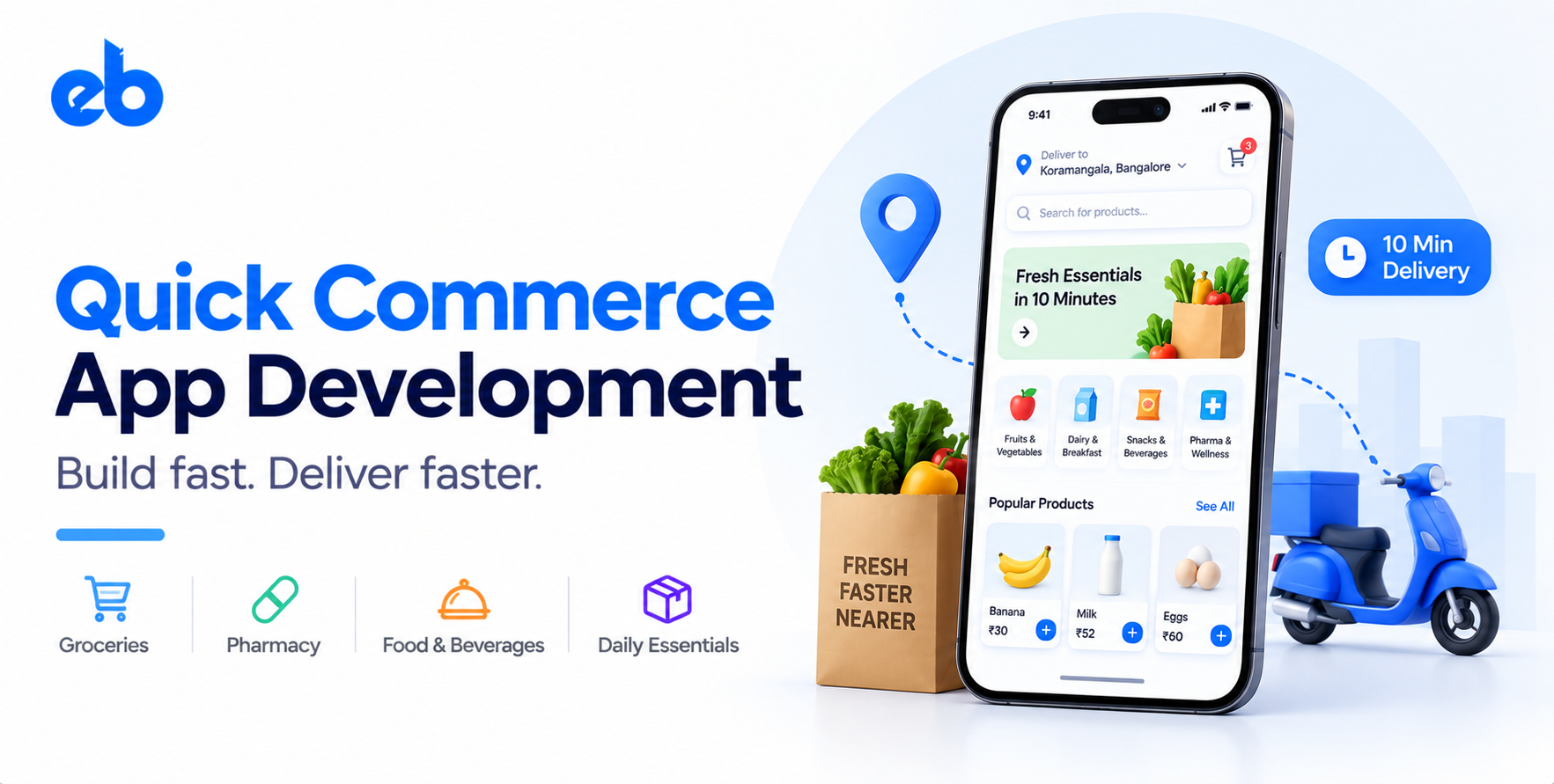
Quick commerce app development is not one app. It is four systems that have to agree with each other in under 600 seconds: a customer app, a picker app inside the dark store, a rider app, and an operations console tying them together.
Teams underestimate this constantly. They scope a grocery storefront, build a clean checkout, and then discover the promise of 10-minute delivery is an inventory and routing problem wearing a shopping cart.
The category has proven the model works at scale. Indian dark store counts rose from roughly 5,990 in December 2025 to about 6,280 in January 2026, while orders per day per dark store improved around 15% year over year to roughly 1,255 (Redseer).
That number matters more than market size. It tells you the software has to make each store productive, not just make each order possible. If you are extending an existing catalog business, a conventional grocery delivery app build gives you maybe half of what you need here.
The surface looks like ecommerce. The constraints look like air traffic control.
| Dimension | Ecommerce | Food delivery | Quick commerce |
| Fulfillment window | 2 to 7 days | 30 to 45 minutes | 10 to 20 minutes |
| Inventory source | Central warehouse | Restaurant kitchen | Dark store, 2,000 to 25,000 SKUs |
| Delivery radius | National | 5 to 7 km | 2 to 3 km |
| Inventory accuracy needed | Tolerant | Not applicable | Near real time |
| Items per order | 1 to 3 | 1 to 5 | 8 to 15 |
That last row is the one that breaks naive builds. A food delivery app moves one prepared package. Quick commerce moves a basket that a human picks from shelves while the clock runs.
Your software has to shrink picking time, not just delivery time. Aisle-ordered pick lists routinely save 60 to 90 seconds per order, which is meaningful when the whole promise is 10 minutes.
| Product | Primary user | What it must do well |
| Customer app | Shopper | Serviceability check, live stock, honest ETA, fast checkout |
| Picker app | Dark store staff | Aisle-sequenced pick list, barcode scan, substitution flow |
| Rider app | Delivery partner | Batched trips, navigation, proof of delivery, earnings view |
| Ops dashboard | City and store managers | Live order board, stock alerts, rider supply, SLA breaches |
Founders fund the customer app and treat the rest as internal tooling. That is backwards. Store managers and pickers use their apps for eight hours straight, so a clumsy picker interface costs you seconds on every order, every day.
Plan all four in the same Mobile App Development scope. Building them in sequence creates integration debt you will pay for at launch.
Stock is not a single number. It is per store, per SKU, and reserved the moment an item enters a cart.
Without soft reservations, two customers buy the last carton of milk within the same second. One of them gets a cancellation, and cancellations are the fastest way to lose a repeat user.
Strong inventory management software sits underneath every serious quick commerce platform, handling reservations, expiry, damages, and cycle counts.
Before showing a catalog, the app resolves which dark store serves that pin code, whether it is open, and whether it currently has rider capacity.
Use geofenced polygons rather than simple radius math. Real catchments follow roads, rivers, and flyovers, not circles.
This is your hardest algorithm. The engine assigns riders while weighing distance, current load, batching opportunities, and promised times.
The dispatch logic borrows heavily from ride-hailing app architecture, though quick commerce adds a twist. Riders often carry two or three orders heading in the same direction, so batching quality drives your cost per delivery more than anything else.
An ETA is picking time plus queue time plus travel time. Most builds model only travel time, then miss promises during evening peaks.
Measure each component separately. You cannot fix what you have averaged into one number.
Forecasting is the highest-value model in the stack. Each dark store needs tomorrow’s demand predicted at SKU level, because a store that stocks wrong either loses sales or throws away perishables.
Teams investing in ML Development typically start with replenishment forecasting, then move to dynamic ETA and batching optimization. Support automation built through AI Development handles the repetitive “where is my order” traffic that spikes during outages.
Skip personalization early. Getting stock right beats recommending products you do not have.
| Scope | What it includes | Timeline | Indicative cost |
| Single-store pilot | Customer, picker, rider apps, basic admin | 4 to 5 months | $80,000 to $120,000 |
| Single-city platform | Multi-store inventory, dispatch, batching | 5 to 7 months | $120,000 to $180,000 |
| Multi-city platform | Forecasting, ads, wallet, advanced ops | 8 to 12 months | $250,000+ |
Cost drivers follow a predictable order: dispatch complexity, inventory accuracy requirements, number of operator apps, and third-party integrations. Broader on-demand app cost benchmarks apply here, with a premium for the real-time layer.
A disciplined MVP Development scope for one dark store gives you real operating data within five months, which beats guessing at batching rules for a network you have not launched.
Decide the delivery radius, store count, and SKU range before design starts. A 2,000-SKU convenience assortment and a 25,000-SKU megastore need different picking flows, different search behavior, and different inventory models.
Map the catchment with your operations team, including building clusters, gated societies, and roads riders cannot legally use. These decisions shape your data model, so making them after development starts forces rework across three apps at once.
Write down the target promise time too, since 10 minutes and 20 minutes justify very different engineering.
Start here, not with the customer app. Model stock per store, per SKU, with reservation, replenishment, expiry, and damage states from day one.
Build the inbound flow as well, covering goods receipt, put-away, and cycle counts. Stores that cannot record a delivery accurately will show phantom stock within a week, and phantom stock produces cancellations.
Expose everything through clean internal services. When batching and forecasting arrive later, they read from this layer rather than scraping your order tables.
Build the picker and rider apps in the same cycle as the customer app. They share order states, and splitting them across phases creates mismatched status models that are painful to reconcile.
Design the picker app for speed under pressure: large tap targets, barcode scanning, one-tap substitution, and offline tolerance for cold storage dead zones.
Give riders batch visibility, clear navigation, and transparent earnings. Rider retention is an operating cost, and a confusing app quietly raises it every week.
Now connect the moving parts. Dispatch consumes store capacity, rider availability, and order promises, then assigns and rebalances continuously as conditions change.
Careful API Development matters here because maps, payments, and SMS providers all bill per call and all fail occasionally. Cache routing responses, and design fallbacks so a maps outage degrades ETAs instead of stopping orders.
Instrument every state change. You will need that event trail to debug your first bad peak hour.
Launch a single dark store and run it for four to six weeks. Track cancellation rate, pick time, on-time percentage, and cost per delivery before adding stores.
Fix the picking flow first, since it is usually the biggest recoverable delay. Work through a complete app launch checklist covering store readiness, rider onboarding, and support scripts, not just app store submission.
Only expand once one store runs profitably at the unit level. Scaling a broken model multiplies losses.
Quick commerce app development rewards teams that treat operations software as the product and the storefront as the interface. The catalog is table stakes. Inventory truth, batching quality, and picking speed are where the margin lives.
Start with one store, one catchment, and one honest promise time. Prove the unit economics there, then let the software carry that model into the next 20 stores.
Quick commerce punishes teams that learn the operations layer on the job. The dispatch engine, the reservation model, and the picker flow all need to be right on day one, because every second they cost you shows up in cancellations and rider payouts.
EngineerBabu builds these systems end to end: dark store inventory, batching and dispatch, rider and picker apps, and the ops console your city managers run the network from.
The work is delivered on a CMMI Level 5 process, with senior engineers staying on the project instead of rotating off after kickoff.
We have shipped products for 4 unicorn clients and supported 200+ VC-funded companies across fintech, healthtech, and on-demand platforms.
Ready to scope your build? Talk to the EngineerBabu team about your dark store model, target promise time, and launch city.
Founded by Mayank Pratap (Co-founder) · mayank@engineerbabu.com
A single-city pilot typically runs $80,000 to $150,000. Multi-city platforms with demand forecasting, batching, and advertising modules start around $250,000 and scale with store count and integrations.
Plan 4 to 6 months for a pilot covering customer, picker, and rider apps plus a basic ops console. Forecasting and advanced batching usually add another two to four months.
React Native or Flutter for the apps, a service-based backend in Node.js or Go, PostgreSQL with Redis for reservations, Kafka for event streaming, and a geospatial layer for serviceability and routing.
No. Many operators start with partner stores or a single leased unit. The software requirements stay identical, since you still need per-store inventory, picking, and dispatch.
Keeping inventory accurate in real time. Dispatch and ETA logic both depend on it, and no routing algorithm can rescue an order containing an item the store does not actually have.
Short delivery radii, dense dark store networks, aisle-sequenced picking, and constant batching. Software shaves seconds at every step, and those seconds are what separate a 10-minute promise from a 20-minute one.