UPI Integration Guide: PSP, TPAP and NPCI Rules


Create engaging, high-performance mobile applications tailored to your business needs. We craft future-ready apps that offer smooth user experiences on all devices.
Build robust and scalable websites and CMS platforms that help you manage content effortlessly. Our development ensures a seamless digital presence.
Launch secure, feature-rich online stores with intuitive shopping experiences. We build tailored eCommerce platforms designed for growth.
Design captivating games with immersive gameplay and stunning graphics. From concept to launch, we build engaging experiences that players love.
Enhance your customer relationships with customized Salesforce implementations. Drive growth and efficiency with smarter CRM solutions.
Harness artificial intelligence and machine learning to automate workflows and gain actionable insights. Our AI transforms data into smart decisions.
Accelerate your software delivery lifecycle with continuous integration, delivery, and infrastructure automation to boost efficiency.
Hire app developers ready to turn your ideas into sleek, high-performing mobile apps for any platform.
Bring in frontend pros who craft smooth, beautiful, and user-friendly interfaces that your visitors will love.
Get backend developers who build fast, secure, and reliable systems to keep everything running behind the scenes.
Hire eCommerce developers who build secure, scalable online stores designed to offer seamless shopping and grow your sales.
Get dedicated developers committed to your projects, delivering consistent quality and speed as an extension of your team.
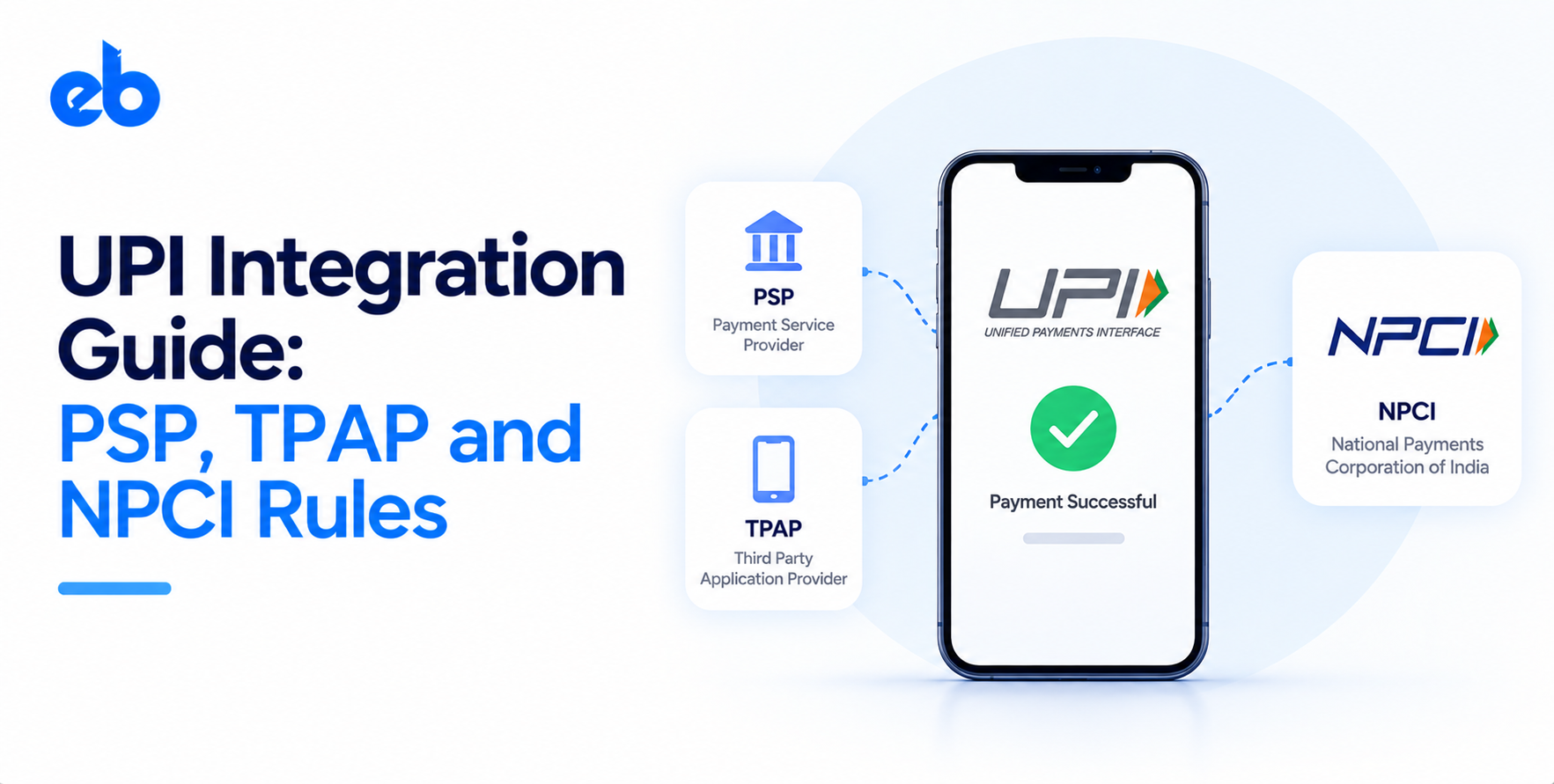
UPI integration connects your application to India’s Unified Payments Interface through three parties. NPCI operates the switch and writes the rules. A PSP bank holds the license and issues the handle. A TPAP is the app the user actually touches.
Where you sit in that chain decides everything else. It sets your approval timeline, your compliance burden, and what your product is legally allowed to do.
Most teams scope this as a two-week API job. Then they discover a sponsor bank agreement, an NPCI certification cycle, and a CERT-In security audit standing between them and go-live.
The scale explains the scrutiny. UPI processed 23.2 billion transactions worth ₹29.9 trillion in May 2026 alone, an all-time high according to NPCI data (IBEF). Rails carrying roughly 740 million payments a day do not hand out access casually.
Four entities touch every UPI transaction. Confusing them is the single most common mistake in early architecture decisions.
| Entity | What it is | What it controls |
| NPCI | The umbrella body operating the UPI switch | Circulars, certification, routing, dispute rules |
| PSP bank | A bank with NPCI membership | UPI handles, UPI PIN, device binding, API access |
| TPAP | A non-bank app provider riding a PSP license | User experience, onboarding, app-side features |
| Issuer or remitter bank | Where the customer’s money sits | Debit authorization, balance, account status |
A TPAP never talks to NPCI directly for transactions. It calls its sponsor PSP bank, which calls the NPCI switch, which routes to the beneficiary side. Every API contract you write sits against the PSP, not against NPCI.
That dependency is why serious TPAPs run multi-bank setups. PhonePe and Google Pay both operate across several sponsor banks so one bank outage does not take the whole app down.
Planning that redundancy early is easier than retrofitting it, and a solid bank API integration checklist saves weeks of discovery.
There are three realistic routes. Picking the wrong one adds months.
| Path | Who it suits | Typical timeline | Approval needed |
| Merchant via payment aggregator | Ecommerce, SaaS, D2C collecting payments | 2 to 4 weeks | None beyond PA onboarding |
| UPI plugin or in-app SDK | Apps wanting checkout inside the app | 4 to 8 weeks | PA and PSP coordination |
| Full TPAP | Products where UPI is the core feature | 5 to 9 months | NPCI approval plus PSP sponsorship |
If you only need to collect money, you are a merchant. You do not need a UPI integration in the regulatory sense. You need a payment aggregator, an RBI-licensed entity that handles settlement and compliance for you.
You need the TPAP route only when UPI is the product. Wallet apps, neobanks, and super apps fall here, and each needs full KYC at onboarding. Choosing KYC and identity verification software before you start building saves painful rework at the sponsor bank review.
These are not policy footnotes. Each one changes code you would otherwise write differently.
NPCI limits any single TPAP to 30% of total UPI transaction volume, measured on a rolling three-month basis. The compliance deadline for TPAPs already over the line is December 31, 2026, after a two-year extension granted in 2024.
Apps approaching the threshold must throttle or stop new user onboarding. If your growth model assumes unlimited acquisition, model that ceiling now.
NPCI’s guidelines on UPI and API usage took effect on August 1, 2025, and they directly constrain app design.
| API | Limit |
| Balance enquiry | 50 per app, per customer, per day |
| List of accounts linked to a mobile number | 25 per app, per customer, per day |
| Transaction status check | 3 attempts, with 90-second gaps |
| Autopay mandate execution | Non-peak windows only |
Peak hours are defined as 10:00 to 13:00 and 17:00 to 21:30. Any polling loop you write must respect these ceilings, because non-compliance invites API restrictions and onboarding suspension.
RBI’s Authentication Mechanisms for Digital Payment Transactions Directions, 2025 became enforceable on April 1, 2026. Every digital payment now needs two distinct authentication factors, and for non-card-present transactions, one factor must be dynamically created per transaction.
Data localization applies on top. Payment data must be stored on servers inside India, which affects your hosting design before you write a line of code. Running your broader fintech compliance checklist alongside the build keeps audit findings from arriving late.
| Category | Per-transaction ceiling |
| Standard P2P and P2M | ₹1,00,000 |
| Capital markets, insurance, collections | ₹2,00,000 |
| IPO and RBI Retail Direct | ₹5,00,000 |
| Hospitals, education, tax payments | ₹5,00,000 |
| UPI Lite | ₹1,000 per payment |
| UPI 123Pay | ₹10,000 |
Banks can set lower limits than NPCI allows. Never hardcode these values, since they change through circulars more often than most teams expect.
Nothing starts before this. Shortlist PSP banks on switch uptime, technical decline rates, and how many TPAPs they already support. Ask for their transaction success rate during peak evening hours, not their annual average.
Negotiate the handle, the API specification version, and the sandbox access timeline in the same agreement. Budget four to eight weeks for due diligence, since the bank reviews your KYC process, your data handling, and your promoter background before signing anything.
This is where most UPI integration projects first slip. Registration requires an outbound SMS from the user’s device to hard-bind the phone number to that specific handset.
Dual-SIM phones, SMS permission denials, and low-cost devices break this flow constantly. Instrument every drop-off point, because a 20% registration failure rate is common in first builds and entirely fixable.
UPI PIN setup follows, using debit card details or Aadhaar OTP depending on the issuing bank.
Four flows cover almost every product: intent, collect, QR, and autopay mandates. Intent hands off to a UPI app and returns. Collect pushes a request to the payer and waits, which means long timeouts and careful state handling.
Build an abstraction layer over the PSP specification instead of coding against one bank’s quirks. Disciplined API Development here is what lets you add a second sponsor bank later without rewriting your payment core.
Settlement files arrive daily, and they will not match your database on day one. Build a reconciliation job that flags mismatches automatically instead of relying on manual checks.
RBI’s turnaround time rules require auto-reversal of failed debits within the prescribed window, with customer compensation when you miss it. NPCI also requires in-app dispute raising, so users must be able to file a complaint without calling support.
Design a transaction state machine early: initiated, pending, deemed success, reversed, settled.
Certification runs in the NPCI sandbox against mandated test cases covering every flow and error code. A CERT-In empanelled security audit runs in parallel, and remediation usually adds two to three weeks.
Go-live is phased. NPCI typically approves a limited user cohort first, then lifts the cap once your decline rates and complaint volumes look clean. Treat that window seriously and work through a full app launch checklist before you request expansion.
UPI settles in seconds, which leaves no room for manual review between authorization and money movement. Risk scoring has to happen inline.
Models built through ML Development can score device, velocity, and beneficiary signals within the transaction window, flagging mule accounts before funds leave. Teams using AI Development for support automation also cut ticket load sharply, since most UPI complaints are status questions a system already knows the answer to.
Keep the fraud model separate from the payment path. A slow model should degrade to a rules fallback, never block a legitimate payment.
Technical declines deserve their own dashboard. They are usually a bank-side problem, but users blame your app every time.
A UPI integration is a regulatory project wearing an engineering costume. The code is manageable. The approvals, certification, and reconciliation logic are what decide your launch date.
Scope your role first, because merchant, plugin, and TPAP paths share almost nothing beyond the acronym. Then build for the rules already published rather than the ones you remember from 2023.
Teams launching a first version usually get there faster through focused MVP Development, shipping one flow cleanly before adding mandates and QR.
An experienced Mobile App Development partner will map sponsor bank timelines into the project plan instead of discovering them in month three.
UPI integration is the process of connecting an app to India’s Unified Payments Interface. It runs through a PSP bank that holds NPCI membership, either directly as a TPAP or indirectly through a payment aggregator.
A PSP is a bank with NPCI membership that issues UPI handles and manages the UPI PIN. A TPAP is a non-bank app provider that offers UPI services to users under that bank’s license.
Merchant integration through an aggregator takes two to four weeks. Full TPAP integration takes five to nine months, since sponsor bank due diligence, NPCI certification, and a security audit all sit in the critical path.
No. Merchants accepting payments work through an RBI-licensed payment aggregator and need no direct NPCI approval. You need NPCI approval only when becoming a TPAP offering UPI services in your own app.
Balance enquiries are capped at 50 per app per customer daily, account list requests at 25, and transaction status checks at three attempts spaced 90 seconds apart. Autopay mandates execute only during non-peak windows.
The remitter bank must auto-reverse the debit within RBI’s prescribed turnaround time. Miss that window and the bank owes the customer compensation, so your reconciliation job needs to surface these cases within hours.