App Maintenance Cost Per Year: A Full Breakdown


Create engaging, high-performance mobile applications tailored to your business needs. We craft future-ready apps that offer smooth user experiences on all devices.
Build robust and scalable websites and CMS platforms that help you manage content effortlessly. Our development ensures a seamless digital presence.
Launch secure, feature-rich online stores with intuitive shopping experiences. We build tailored eCommerce platforms designed for growth.
Design captivating games with immersive gameplay and stunning graphics. From concept to launch, we build engaging experiences that players love.
Enhance your customer relationships with customized Salesforce implementations. Drive growth and efficiency with smarter CRM solutions.
Harness artificial intelligence and machine learning to automate workflows and gain actionable insights. Our AI transforms data into smart decisions.
Accelerate your software delivery lifecycle with continuous integration, delivery, and infrastructure automation to boost efficiency.
Hire app developers ready to turn your ideas into sleek, high-performing mobile apps for any platform.
Bring in frontend pros who craft smooth, beautiful, and user-friendly interfaces that your visitors will love.
Get backend developers who build fast, secure, and reliable systems to keep everything running behind the scenes.
Hire eCommerce developers who build secure, scalable online stores designed to offer seamless shopping and grow your sales.
Get dedicated developers committed to your projects, delivering consistent quality and speed as an extension of your team.
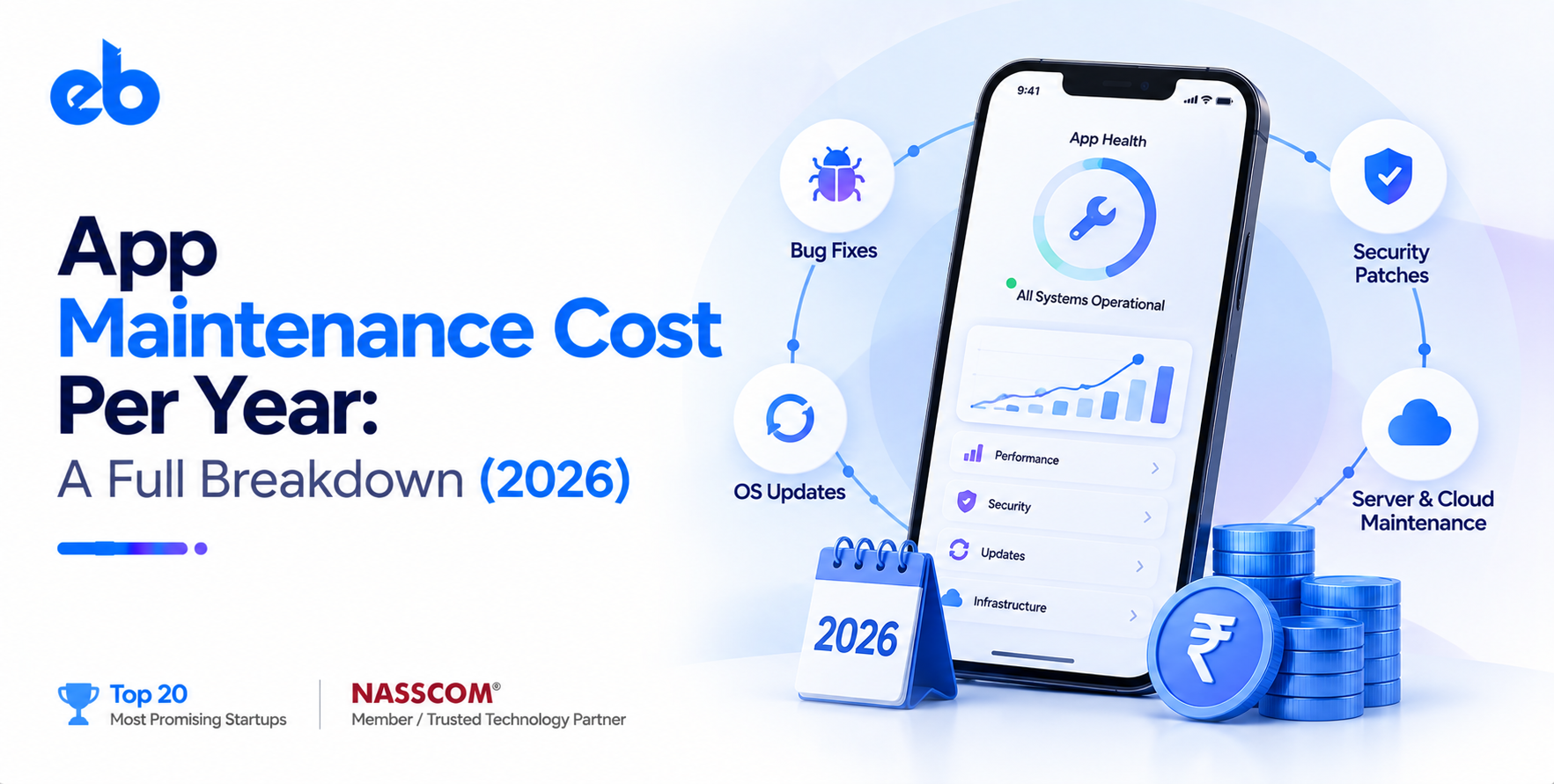
Most teams should plan for an app maintenance cost per year of 15% to 25% of the original development spend. A $60,000 app carries roughly $9,000 to $15,000 in annual upkeep. That figure covers cloud hosting, third-party API fees, OS compatibility work, security patches, crash fixes, and small feature releases.
Here is where it gets uncomfortable. Founders budget the build carefully and treat upkeep as a rounding error. Then year two shows up with a spiking AWS bill, a deprecated payment SDK, and an OS update that quietly breaks Apple sign-in.
This breakdown covers what you actually pay for, what makes the number move, and how to keep it flat.
Both app stores force an annual update cycle whether you have new features or not.
Google Play requires new apps and app updates to target Android 16 (API level 36) from August 31, 2026, while existing apps must target Android 15 or higher to stay available to new users on newer devices (Android Developers).
Skip that work and your app stops appearing for new installs. Apple runs a similar rhythm with a major iOS release every fall, plus periodic changes to privacy rules and review guidelines.
So a share of your maintenance budget buys nothing users will ever notice. It simply keeps you listed.
Maintenance is not one line item. It is five recurring categories that behave very differently.
| Category | Share of annual budget | What it pays for |
| Cloud hosting and infrastructure | 15% to 25% | Servers, databases, storage, CDN, backups |
| Third-party services and APIs | 10% to 20% | Payments, maps, SMS, auth, analytics, push |
| OS and store compliance | 10% to 15% | SDK upgrades, API level targets, store resubmissions |
| Bug fixes, monitoring, support | 20% to 25% | Crash triage, hotfixes, uptime alerts, user tickets |
| Small feature and UX updates | 25% to 35% | Iteration based on user behavior and business asks |
The first three are fixed costs that arrive whether your app grows or not. The last two scale with how many people actually use the product.
A useful rule: if your maintenance spend is entirely hosting and patches, you are preserving an asset. If a third of it goes to feature work, you are compounding one.
Complexity drives the number more than screen count ever will. Here is what the app maintenance cost per year looks like across common project types.
| App type | Typical build cost | Annual maintenance | % of build |
| Informational or utility app | $15,000 to $35,000 | $4,000 to $9,000 | 20% to 25% |
| Mid-complexity app with backend | $50,000 to $120,000 | $12,000 to $30,000 | 20% to 25% |
| Marketplace or on-demand app | $90,000 to $200,000 | $25,000 to $55,000 | 25% to 28% |
| Fintech or healthcare app | $150,000 to $300,000 | $45,000 to $90,000 | 28% to 32% |
| AI-powered app | Varies | Base maintenance + 20% to 30% | 30%+ |
Regulated products sit at the top for a reason. Teams building with a fintech app development company pay for penetration testing, audit logging, and compliance reviews every single year, not once at launch.
This is the bill that surprises people. A pre-launch app might cost $150 a month to host. The same app at 50,000 monthly active users can cross $2,000, driven by database reads, image storage, and bandwidth.
Your provider sets that baseline, so picking the best cloud for mobile apps upfront costs far less than migrating two years in. Cost per user usually drops as you scale. Total cost does not.
Every integration is a subscription with its own pricing curve. Payment gateways take a cut, maps charge per request, and SMS bills per message sent.
Well-structured API Development work pays for itself here, because an abstraction layer lets you swap a provider in days rather than rebuilding the integration.
Two major OS releases a year means two rounds of testing, fixing, and resubmission. Deprecated libraries add more. Budget 40 to 80 engineering hours annually for a mid-complexity app just to stay current.
Crash rates above 1% push users toward uninstalling. This line covers crash reporting tools, on-call response, and the engineering time to ship hotfixes quickly.
AI features carry a cost most estimates ignore. Inference tokens bill monthly, and model accuracy drifts as real user behavior shifts away from your training data.
Products built around AI Development need periodic prompt tuning and evaluation runs. Custom models from ML Development work need scheduled retraining, which adds both compute cost and engineering hours.
A few specific things reliably inflate the number beyond baseline estimates.
Technical debt is the quiet multiplier. Every shortcut taken during the build gets repaid, with interest, out of the maintenance budget.
Switching vendors carries its own overhead, since NDAs in app development and repository access have to be signed and transferred before a new team ships anything.
Maintenance is not a flat annual line. It follows a predictable curve.
| Period | Typical spend | What drives it |
| Year 1 | 10% to 15% of build cost | Warranty fixes, low traffic, stable integrations |
| Year 2 | 18% to 25% | User growth, infrastructure scaling, first OS migrations |
| Year 3 | 20% to 30% | Accumulated debt, library end-of-life, feature expansion |
| Year 4+ | 25%+ or rebuild | Aging architecture, rising cost per change |
Year one feels cheap because most agencies include a 30 to 90 day warranty period. The real number shows up in year two, which is exactly when founders complain their estimate was wrong.
Most apps run on provisioned capacity sized for a traffic peak that happens twice a month. Move to auto-scaling, set billing alerts at 70% of your expected monthly spend, and review your cloud bill quarterly instead of annually.
Archive cold data to cheaper storage tiers. Add caching for the three or four queries responsible for most database load. These changes routinely cut hosting costs by 30% to 40% without touching a single feature. It is the fastest saving available to almost every team.
Pull a list of every paid service your app calls, with its monthly cost and actual usage. Teams almost always find two or three tools nobody has used in months.
Check which integrations are duplicated, since many apps pay separately for analytics that overlap heavily. Then compare usage against your pricing tier, because staying on an old plan after a volume change quietly wastes money. Cancel, downgrade, or consolidate. An hour of review here often saves four figures annually.
Android and iOS release schedules are public and predictable. Block engineering time in June for the iOS beta and in July for Google Play’s August deadline.
Every compatibility update still goes through store review, so run the same app launch checklist you used on day one. Teams that plan this pay normal rates for planned work. Teams that ignore it pay rush rates for emergency fixes after their app disappears from search results. Same work, very different invoice.
Every feature you build is a feature you maintain forever. A tight MVP Development scope keeps your surface area small, which directly shrinks your annual upkeep.
Before shipping anything new, check whether existing features are even used. Most apps have two or three features with near-zero engagement that still need testing, patching, and store review with every release. Cutting them lowers ongoing cost permanently and makes each release faster to validate.
Watch for these signals. Any two together mean rebuilding beats patching.
At that point you are funding life support. A rebuild costs more upfront but resets your app maintenance cost per year to a sane baseline.
Ask for maintenance pricing before you sign the build contract, not after handover. A vendor who will not quote year two is telling you something.
Insist on a written split between fixed costs and variable hours. Solid app development contracts also fix response times, escalation paths, and IP ownership, so your cloud account, repositories, and store listings stay in your name.
Comparing mobile app development companies on build price alone is how teams end up locked into expensive support agreements.
The right Mobile App Development partner will hand you a maintenance estimate with the original proposal, broken down by category.
Your app maintenance cost per year is not overhead. It is the price of keeping a working asset in market, and it is entirely predictable once you break it into categories.
Teams that budget upkeep alongside the build ship steadily for years. Teams that treat it as an afterthought spend year two firefighting instead of growing.
Plan for 20% of your build cost annually, review the number every quarter, and adjust as your traffic tells you more.
Most apps cost 15% to 25% of the original build price annually. That works out to roughly $5,000 for simple apps and $45,000 or more for fintech and healthcare products with compliance requirements.
No. Year one usually runs 10% to 15% because warranty coverage and low traffic keep costs down. Years two and three are higher as users scale and older libraries reach end of life.
Standard contracts cover hosting management, bug fixes, OS compatibility updates, security patches, uptime monitoring, and store submissions. Feature development is normally billed separately at an hourly or sprint rate.
Right-size your cloud infrastructure, audit paid third-party services quarterly, schedule OS updates in advance, and remove features with low usage. These four moves usually cut annual spend by 25% to 35%.
Generally yes. A single React Native or Flutter codebase means one round of fixes instead of two. Native builds still make sense for apps with heavy device hardware or performance demands.
It stays live but degrades. New installs stop on updated Android devices, crashes accumulate after OS releases, and expired certificates or SDKs eventually break core features like login and payments.