HL7 vs FHIR: Key Differences Explained


Create engaging, high-performance mobile applications tailored to your business needs. We craft future-ready apps that offer smooth user experiences on all devices.
Build robust and scalable websites and CMS platforms that help you manage content effortlessly. Our development ensures a seamless digital presence.
Launch secure, feature-rich online stores with intuitive shopping experiences. We build tailored eCommerce platforms designed for growth.
Design captivating games with immersive gameplay and stunning graphics. From concept to launch, we build engaging experiences that players love.
Enhance your customer relationships with customized Salesforce implementations. Drive growth and efficiency with smarter CRM solutions.
Harness artificial intelligence and machine learning to automate workflows and gain actionable insights. Our AI transforms data into smart decisions.
Accelerate your software delivery lifecycle with continuous integration, delivery, and infrastructure automation to boost efficiency.
Hire app developers ready to turn your ideas into sleek, high-performing mobile apps for any platform.
Bring in frontend pros who craft smooth, beautiful, and user-friendly interfaces that your visitors will love.
Get backend developers who build fast, secure, and reliable systems to keep everything running behind the scenes.
Hire eCommerce developers who build secure, scalable online stores designed to offer seamless shopping and grow your sales.
Get dedicated developers committed to your projects, delivering consistent quality and speed as an extension of your team.
A patient walks into an ER in Ohio. Her cardiologist in Dallas has four years of notes, labs, and a stent history sitting in an EHR two time zones away.
Pulling those records takes either a two-week interface build or a single API call. Which one you get was decided years ago, by whoever picked the standard.
That is the HL7 vs FHIR question in practical terms. Both come from the same standards body, Health Level Seven International. Both move clinical data between systems. They do it in completely different ways, and the choice shapes your roadmap for years.
This guide covers the HL7 vs FHIR differences that actually change what you build, what it costs, and how fast you ship.
HL7 is not one standard. It is a family: HL7 v2 (1989), HL7 v3, CDA documents, and FHIR. So when someone frames the debate as HL7 vs FHIR, they almost always mean HL7 v2 vs FHIR.
HL7 v2 is the workhorse. It moves admissions, lab orders, results, and billing events inside hospitals every second of every day. A message looks like this:
PID|1||445566^^^HOSP^MR|
|DOE^JANE||19900415|F
OBX|1|NM|4548-4^Hemoglobin A1c|
|6.8|%|4.0-5.6|H
Pipes, carets, and positional segments. Machines parse it fine. Humans need a spec open on a second monitor.
Two quirks matter. HL7 v2 is loaded with optional fields, so every hospital implements it slightly differently. And it uses custom Z-segments for anything the standard missed, which means no two interfaces are truly identical.
FHIR arrived in 2014 to fix one specific frustration. Healthcare data sat locked behind messaging patterns the rest of software had already abandoned.
Instead of messages, FHIR uses resources. Patient, Observation, Encounter, MedicationRequest, Coverage. Each one is a self-contained object with a URL, returned as JSON over HTTPS.
That single design change opened healthcare data to ordinary web developers. FHIR R4 became normative in 2019, and the 21st Century Cures Act rules then required certified EHRs to expose FHIR APIs.
That origin story explains most of the HL7 vs FHIR gap. One was built for hospital messaging, the other for the open web.
Adoption followed the mandate. In 2024, 70% of U.S. hospitals let patients reach their health information through FHIR-configured apps. That figure comes from ASTP/ONC data.
If you are building anything patient-facing today, healthcare data interoperability runs through FHIR first.
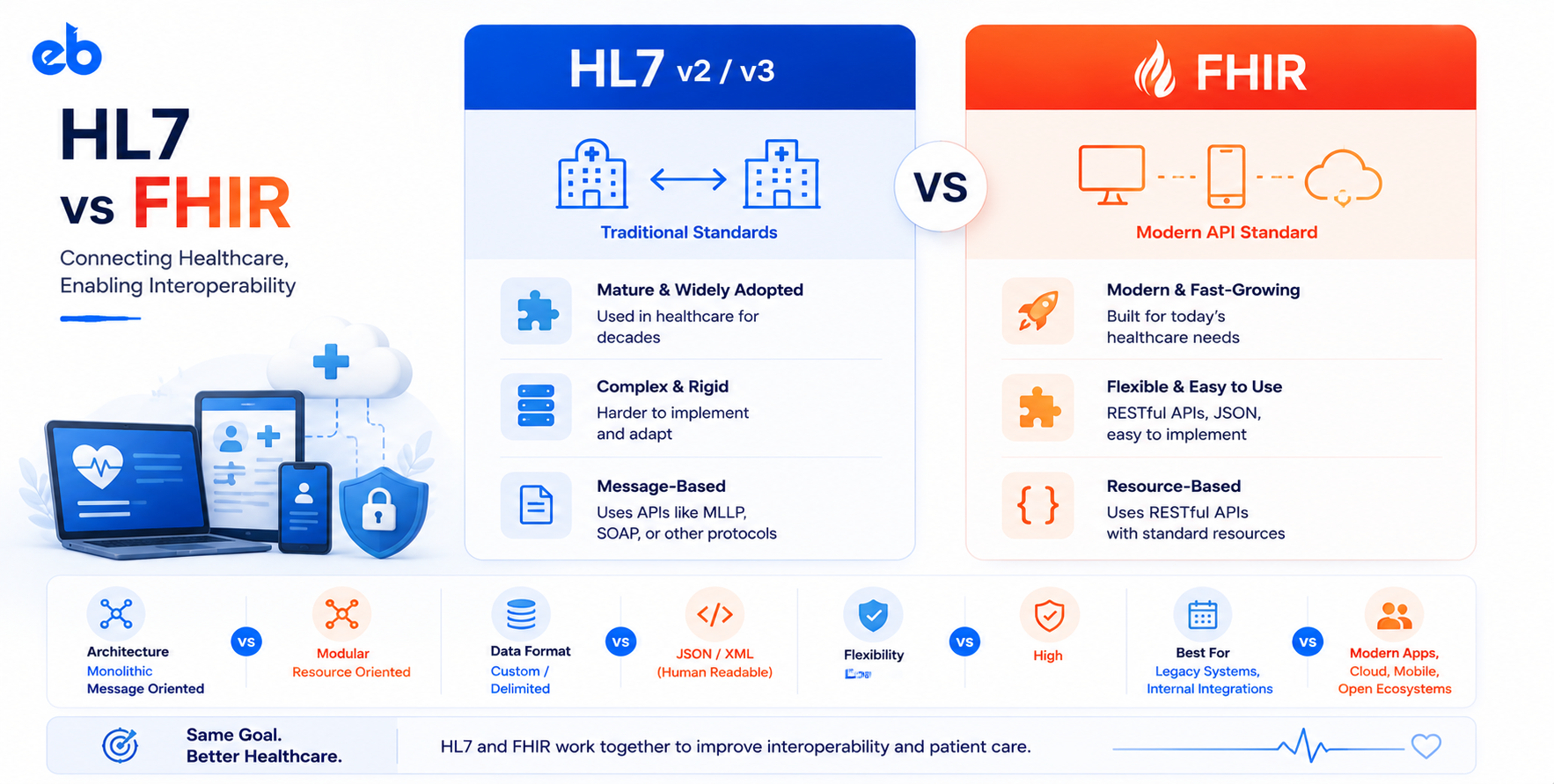
| Dimension | HL7 v2 | FHIR |
| First released | 1989 | 2014, R4 normative in 2019 |
| Unit of data | Message segments | Resources |
| Format | Pipe-delimited, some XML | JSON, XML, RDF |
| Transport | MLLP over TCP, via interface engine | HTTPS REST |
| Pattern | Push, event-triggered | Pull on request, plus subscriptions |
| Documentation | PDF specs, vendor-specific guides | Public spec with live examples |
| Ramp-up for a new dev | Weeks, usually with a specialist | Days |
| Strongest use | Internal hospital workflows | Apps, patient access, partner APIs |
The table settles the surface-level HL7 vs FHIR comparison. The interesting part is what these differences do to your build.
This is the most literal HL7 vs FHIR difference. In HL7 v2, meaning comes from position. PID-5 is the patient name because the spec says segment five holds it. Miscount a delimiter and you have silently mapped the wrong field.
FHIR names everything. A Patient resource has name, birthDate, and identifier as readable keys. Validation is schema-based, so bad data fails loudly instead of passing through wrong.
HL7 v2 travels over MLLP, usually brokered by an interface engine like Mirth, Rhapsody, or Cloverleaf. Each new connection is a configured channel, tested point to point.
FHIR is a GET request. Any team with real API development experience can hit a sandbox endpoint and read a response the same afternoon. No engine required, though most health systems keep one anyway.
This gap is where the HL7 vs FHIR decision costs or saves real money. A new HL7 v2 feed typically takes two to six weeks: spec review, mapping, Z-segment handling, then end-to-end testing with the source system.
A FHIR read against a certified EHR sandbox can work in days. Epic FHIR integration still needs app registration and review, but the coding part is no longer the bottleneck.
The HL7 vs FHIR split shows up hardest here. HL7 v2 was designed for servers talking to servers behind a firewall. It was never meant to reach a phone.
FHIR was. Its JSON responses drop straight into patient-facing mobile app development, and its structured resources are far easier to feed into AI development pipelines than parsing pipes at scale.
Do not write it off. In any honest HL7 vs FHIR comparison, HL7 v2 keeps a real seat at the table.
It is event-driven, so a lab result pushes the moment it is verified. No polling, no delay. It is battle-tested across three decades of edge cases. And every hospital already has the plumbing, staff, and monitoring in place.
For high-volume internal flows like ADT feeds, order routing, and results delivery, ripping out a working v2 interface buys you nothing.
Flip the HL7 vs FHIR question outward and FHIR takes it. It wins anywhere data has to leave the building or reach an end user.
Patient portals, provider directories, prior authorization, remote monitoring, third-party app ecosystems, and payer data exchange all favor it. Granular access helps too. You can request one Observation instead of receiving an entire ORU message and discarding 90% of it.
FHIR also handles versioning gracefully, which matters when you have partners on different release cycles.
Here is the honest resolution to HL7 vs FHIR: it is rarely either-or.
The common pattern is v2 inside, FHIR outside. Internal systems keep exchanging HL7 v2 messages. An interface engine or a dedicated facade converts what is needed into FHIR resources for apps, partners, and patients.
That approach protects working infrastructure while giving new products a modern surface. Teams doing custom EHR software development usually build the FHIR layer first and leave the v2 feeds untouched.
If you are moving in that direction, sequence matters more than speed.
List each HL7 v2 feed you run: message type, source system, destination, volume, and business owner. Most teams find interfaces nobody has touched in years and cannot explain.
Flag which ones actually need external exposure. Internal ADT routing between two hospital systems probably does not. A results feed that a patient app should read absolutely does.
This inventory becomes your scope document, and it is the single best defense against a migration that quietly triples in size.
Mapping is where the HL7 vs FHIR translation gets real. Translate your priority feeds into FHIR equivalents. ADT becomes Patient and Encounter. ORU results become Observation and DiagnosticReport. Orders become ServiceRequest.
Work against US Core profiles rather than base FHIR, since those constraints are what certified EHRs actually implement. Document every unmapped Z-segment now, because custom local data is where migrations stall.
Decide early whether each one becomes a FHIR extension or gets retired, and get a clinical stakeholder to sign off on that call.
Do not rewrite the pipeline. Put a FHIR server or translation layer in front of the existing interface engine. It receives v2 messages, converts them to resources, and serves them over REST.
Keep the first release narrow. One workflow, one or two resource types, one consuming app. Treating this as MVP development rather than a platform program keeps the feedback loop short and exposes mapping errors while they are still cheap to fix.
FHIR endpoints carry PHI over public internet, so auth is not a later phase. Implement SMART on FHIR with OAuth 2.0, scoped tokens, and full audit logging on every read.
Rate-limit external clients and monitor for unusual query patterns. Then validate the whole surface against your HIPAA compliance requirements before a single production record moves. Retrofitting security onto a live FHIR API is painful, expensive, and occasionally reportable.
The HL7 vs FHIR cost curve bends in opposite directions. A single new HL7 v2 interface commonly runs $8,000 to $25,000 in engineering and testing time. Every new partner repeats most of that work.
A FHIR facade over existing feeds is a larger upfront project, often $40,000 to $120,000 depending on resource coverage and security scope. The payoff is marginal cost. Partner number six is a permissions change, not another interface build.
Budget for ongoing profile updates too. FHIR specs and US Core versions move, and so do your partners.
The HL7 vs FHIR debate gets framed as old versus new, which is the wrong frame. HL7 v2 is not broken, and FHIR is not free.
The real question is where your data needs to travel. Inside the hospital, v2 still does its job. Outside it, FHIR is the only reasonable answer. That covers apps, patients, partners, and ML development models that need clean structured inputs.
Most teams end up running both. Plan for that from the start and you avoid the expensive rewrite later.
Building a health product and unsure which standard your integration roadmap should lean on?
Talk to the EngineerBabu team about scoping it properly.
No. The HL7 vs FHIR relationship is family, not rivalry, since FHIR is an HL7 standard itself. HL7 v2 still carries most internal hospital messaging. FHIR is taking over external access, patient-facing apps, and partner integrations, so the two coexist in nearly every health system today.
Structure and transport. HL7 v2 sends pipe-delimited messages over MLLP through an interface engine. FHIR serves named JSON resources over standard HTTPS REST calls. That difference is why FHIR integrations take days while comparable v2 interfaces take weeks.
FHIR, in almost every case. The HL7 vs FHIR choice is simpler when you have no legacy v2 infrastructure to protect, and certified EHRs are already required to expose FHIR APIs. A focused FHIR R4 integration gets you to a working data flow faster than any v2 path.
Yes. Most interface engines and several open-source tools handle v2-to-FHIR mapping, and HL7 publishes official guidance for it. The mapping is mechanical for standard segments. Custom Z-segments always need manual decisions.
No. FHIR defines how data is structured and requested, not how it is secured. You still need SMART on FHIR authorization, encryption in transit and at rest, audit logging, access controls, and signed BAAs with every vendor touching PHI.