How to Build a Collections Management Platform, Dunning Automation, Legal Escalation, Settlement Offers, Recovery Analytics 2026


Create engaging, high-performance mobile applications tailored to your business needs. We craft future-ready apps that offer smooth user experiences on all devices.
Build robust and scalable websites and CMS platforms that help you manage content effortlessly. Our development ensures a seamless digital presence.
Launch secure, feature-rich online stores with intuitive shopping experiences. We build tailored eCommerce platforms designed for growth.
Design captivating games with immersive gameplay and stunning graphics. From concept to launch, we build engaging experiences that players love.
Enhance your customer relationships with customized Salesforce implementations. Drive growth and efficiency with smarter CRM solutions.
Harness artificial intelligence and machine learning to automate workflows and gain actionable insights. Our AI transforms data into smart decisions.
Accelerate your software delivery lifecycle with continuous integration, delivery, and infrastructure automation to boost efficiency.
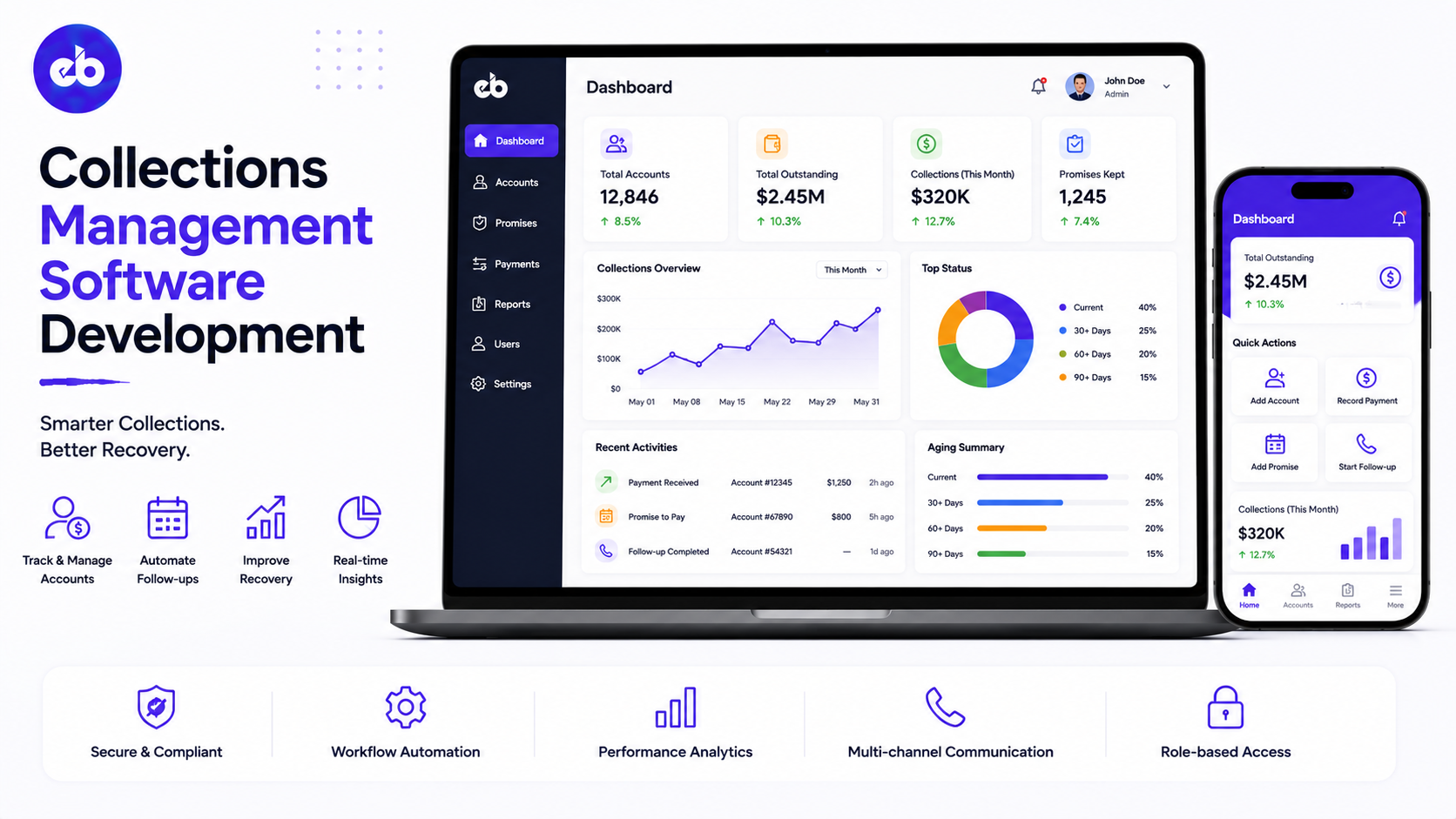
Collections is the function that separates lenders who build sustainable portfolios from lenders who grow fast and collapse. A digital lending platform that can disburse but cannot collect is not a lending business, it is a money transfer service.
The global collections software market is valued at $6.3 billion. In India, the NBFC and digital lending ecosystem, 10,000+ registered NBFCs, 300+ digital lending apps, generates enormous collections demand.
The Reserve Bank of India’s 2022 digital lending guidelines added specific requirements for collections conduct, escalation timelines, and borrower communication that every lender must now operationalise technically.
This guide covers how to build a collections management platform, from the automated dunning sequences that recover pre-NPA accounts through the legal escalation workflows for NPAs through the settlement management tools that maximise recovery on written-off portfolios.
EngineerBabu built LoanOS, processing ₹1,000 crore annually, and lending technology for EarlySalary/Fibe. CMMI Level 5. Google AI Accelerator 2024 Top 20. Contact: mayank@engineerbabu.com
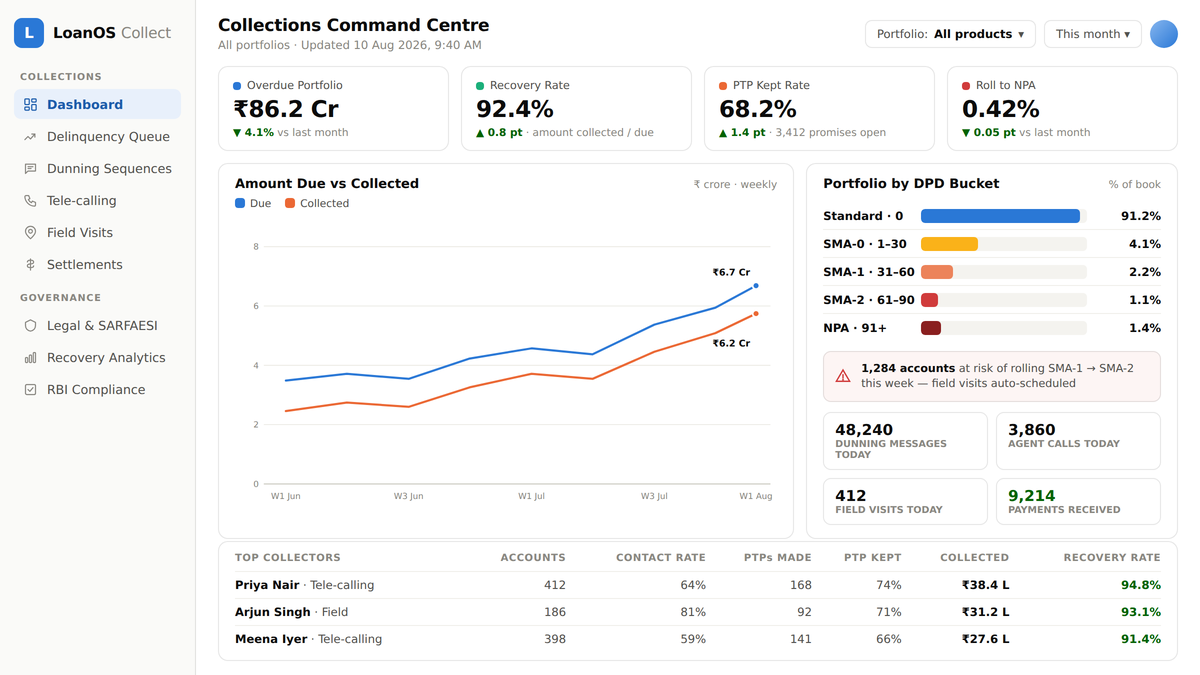
| Function | Module |
| Delinquency monitoring | Real-time DPD tracking, bucket classification |
| Automated dunning | SMS, WhatsApp, IVR, email, multi-channel, personalised |
| Digital payment links | One-click payment in every communication |
| Agent call management | Dialler integration, call scripting, outcome logging |
| Field collections | Field agent app, GPS-verified visits |
| Promise-to-pay tracking | Commitment tracking, follow-up scheduling |
| Escalation management | Legal notice, SARFAESI, arbitration triggers |
| Settlement management | Settlement offer calculation, approval, documentation |
| Legal process management | Lawyer assignment, court date tracking, recovery |
| Recovery analytics | Roll-rate analysis, collector productivity, ROI |
| RBI compliance | Communication norms, DNC compliance, conduct guidelines |
| Integration | LOS, LMS, credit bureau, legal partners |
The DPD (Days Past Due) classification:
| Bucket | DPD Range | Classification | Regulatory |
| Standard | 0 days | Current | Performing |
| SMA-0 | 1–30 days | Special Mention Account | Watch |
| SMA-1 | 31–60 days | Special Mention Account | Watch |
| SMA-2 | 61–90 days | Special Mention Account | Requires action |
| NPA (Sub-standard) | 91–360 days | Non-Performing Asset | NPA |
| NPA (Doubtful) | 361–720 days | Non-Performing Asset | NPA |
| NPA (Loss) | 720+ days | Loss Asset | Write-off consideration |
The delinquency dashboard:
The collections head sees the portfolio stratified by bucket, how much outstanding is in each DPD category, how it has moved since last week (roll rates), and where new delinquency is entering the portfolio. This roll-rate analysis, what percentage of SMA-0 accounts rolled to SMA-1, and SMA-1 to SMA-2, is the primary leading indicator of portfolio quality.
Automated account routing:
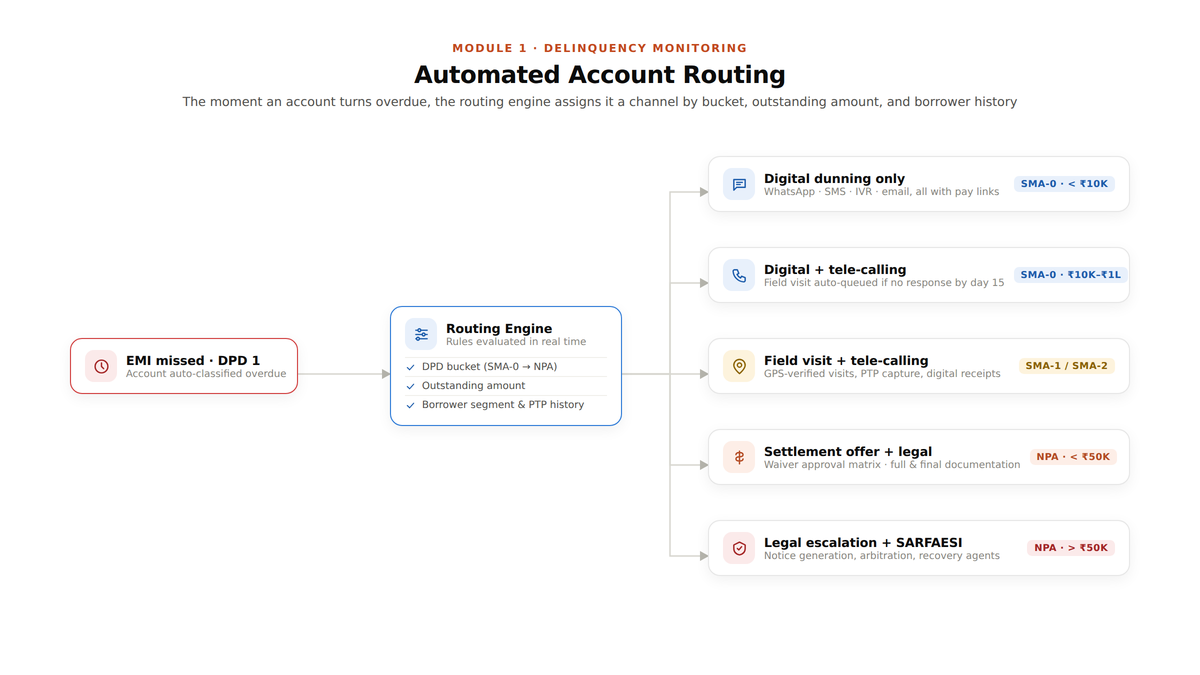
When an account enters delinquency, it is automatically routed to the appropriate collections channel based on bucket, outstanding amount, and borrower segment:
| Account Profile | Primary Channel | Secondary Channel |
| SMA-0, < ₹10,000 outstanding | Automated digital dunning only | IVR call if no response |
| SMA-0, ₹10,000–₹1,00,000 | Digital dunning + tele-calling | Field visit if no response by day 15 |
| SMA-1, any amount | Tele-calling + digital | Field visit |
| SMA-2, any amount | Field visit + tele-calling | Legal notice |
| NPA, < ₹50,000 | Settlement offer + legal | Write-off consideration |
| NPA, > ₹50,000 | Legal escalation + SARFAESI | Recovery agent |
The dunning sequence architecture:
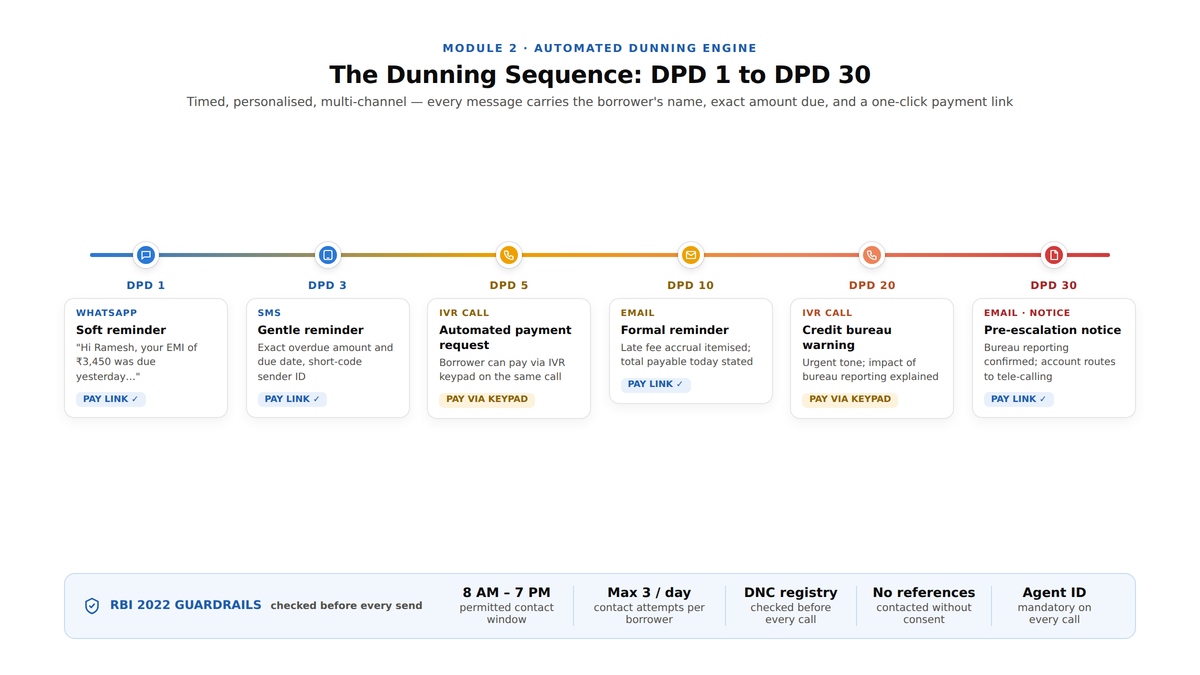
A dunning sequence is a pre-defined series of communications triggered when an account becomes overdue. Each communication is timed, personalised, and includes a one-click payment link.
Dunning sequence, SMA-0 account (0–30 DPD):
| Day | Channel | Message Tone | Payment Link |
| DPD 1 | Reminder, soft | Yes | |
| DPD 3 | SMS | Gentle reminder | Yes |
| DPD 5 | IVR call | Automated, payment request | Payment via IVR keypad |
| DPD 7 | Slightly urgent | Yes | |
| DPD 10 | Formal reminder | Yes | |
| DPD 15 | SMS | Urgent, late fee mentioned | Yes |
| DPD 20 | IVR call | Urgent, credit bureau warning | Payment via IVR keypad |
| DPD 25 | Final pre-escalation warning | Yes | |
| DPD 30 | Formal notice, credit bureau reporting confirmed | Yes |
Personalisation in dunning:
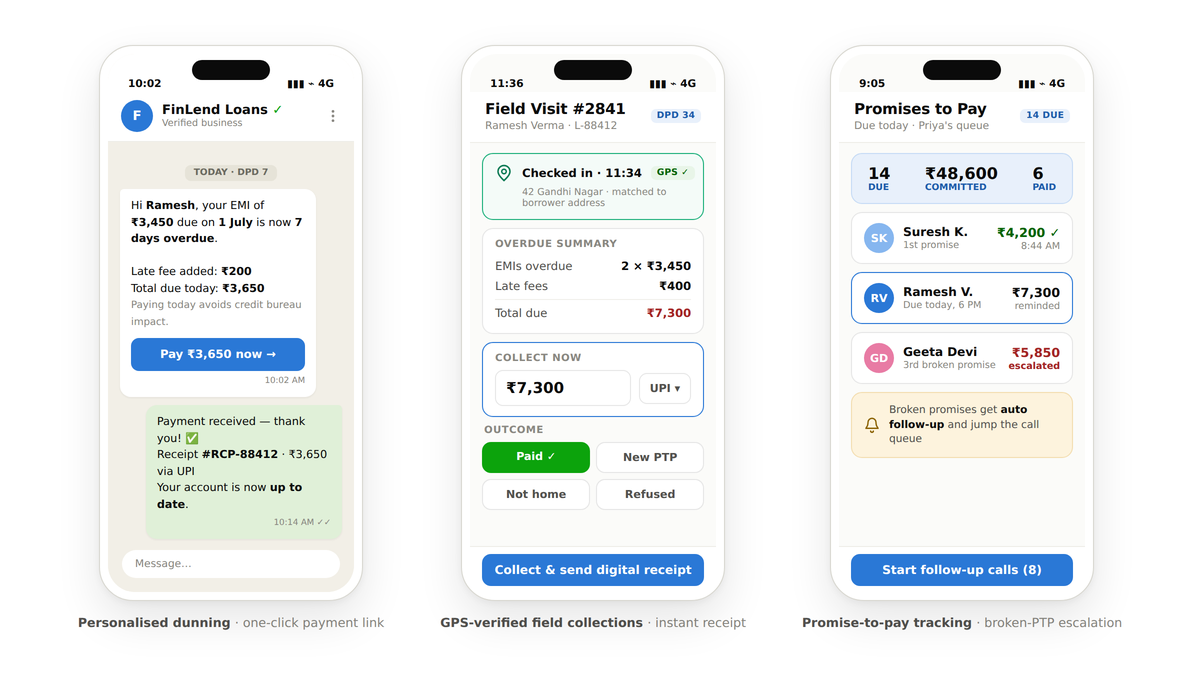
Every message is personalised, the borrower’s name, the exact outstanding amount, the overdue instalment date, the late fee accrued, and the total payable today.
A generic “your payment is overdue” message has 20 to 30% lower response rate than a personalised “Ramesh, your EMI of ₹3,450 due on July 1 is now 7 days overdue. Late fee of ₹200 has been added. Total due today: ₹3,650” message with a payment link.
DNC (Do Not Call) compliance:
Every communication respects TRAI’s DNC registry and RBI’s digital lending communication guidelines, maximum 3 calls per day, calls only between 8am and 7pm, and no communication to references without the borrower’s explicit consent. The dunning engine checks DNC status before every call attempt.
The dialler integration:
The platform integrates with a predictive dialler, automatically calling the next borrower in the queue when an agent becomes available. The agent sees the borrower’s complete profile before the call connects:
| Information Shown | Details |
| Borrower name and contact | |
| Loan details | Loan ID, amount, disbursement date |
| Overdue summary | DPD, overdue instalments, total outstanding |
| Payment history | All past payments, consistency pattern |
| Previous contact attempts | Date, channel, outcome |
| Promise-to-pay history | Did borrower keep previous promises? |
| Call script | Recommended script for this DPD bucket |
Call outcome logging:
After every call, the agent logs the outcome through a structured interface, not a free-text note:
| Outcome Category | Specific Outcomes |
| Connected, promise made | Promise-to-pay date and amount committed |
| Connected, refused to pay | Reason for refusal logged |
| Connected, disputed | Dispute nature logged, routes to dispute resolution |
| Connected, escalation required | Specific escalation type requested |
| Not connected, number busy | Retry scheduled |
| Not connected, no answer | Retry scheduled |
| Wrong number | Number flagged, alternative contact sourced |
| RTP (Refused to Pay) | Hard escalation trigger |
Promise-to-pay tracking:
When a borrower commits to pay by a specific date, the system creates a promise-to-pay record. On the committed date, if payment has not been received, an automatic follow-up communication goes to the borrower and the agent receives an alert to make a follow-up call.
Promises that are broken increase the account’s escalation priority, a borrower who has broken 3 promises is treated differently from one making a first commitment.
The field agent app:
Field agents visit borrowers at their home or business. The app gives the agent the borrower’s address, GPS directions, and complete account history before the visit. During the visit:
| Action | App Function |
| Arrival confirmation | GPS-verified check-in at borrower location |
| Collection | Amount collected, payment mode |
| Receipt | Digital receipt generated and shared via WhatsApp |
| Outcome logging | Payment received / Not home / Refused / New PTP |
| Photo evidence | For field verification requirements |
| Next follow-up | Schedule next visit if required |
Cash collection and digital receipt:
When cash is collected, the app generates a numbered digital receipt instantly, sent to the borrower’s WhatsApp and stored in the platform.
The cash is tracked from collection through the agent’s daily closing submission to the branch vault. The agent’s daily collection report is generated automatically from app entries, no manual tallying.
The settlement framework:
For NPA accounts where full recovery is unlikely, the lender may offer a settlement, accepting less than the full outstanding in exchange for immediate payment and account closure.
Settlement offer calculation:
| Factor | Impact on Settlement Offer |
| Days since NPA | Older NPAs, lower offer (lower probability of recovery) |
| Outstanding amount | Larger outstanding, may justify higher offer as % |
| Collateral availability | Collateralised loan, higher full recovery expectation |
| Borrower financial position | Assessment of actual ability to pay |
| Collection cost incurred | Already spent collection cost reduces the available discount |
| Vintage of relationship | Long-standing customers, slightly better terms |
The settlement approval workflow:
| Settlement Size | Approval Required |
| < 10% waiver of principal | Collections head |
| 10–25% waiver | CFO approval |
| 25–50% waiver | MD/CEO approval |
| > 50% waiver | Board committee |
Settlement documentation:
When a settlement is agreed, the platform generates: Full and final settlement letter, legal document confirming the agreed settlement amount and the complete discharge of all obligations on payment. No-objection certificate (NOC), issued after receipt of settlement payment, confirming account closure.
Credit bureau update, the account status is updated from NPA to “Settled” in all credit bureaus immediately upon payment.
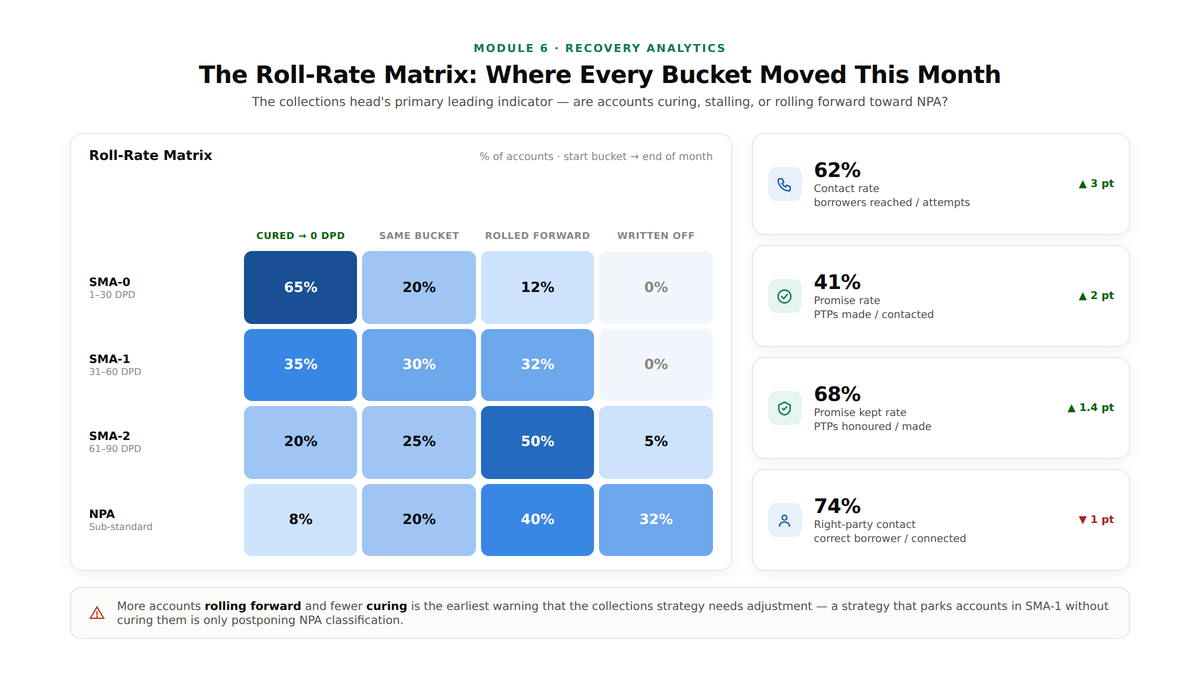
The roll-rate matrix:
The roll-rate matrix shows what percentage of accounts in each DPD bucket at the start of a period moved to each bucket at the end of the period. This is the most important analytical view for a collections head:
| Start Bucket | Cured (0 DPD) | Same Bucket | Rolled to Next | Written Off |
| SMA-0 (1–30) | 65% | 20% | 12% | 0% |
| SMA-1 (31–60) | 35% | 30% | 32% | 0% |
| SMA-2 (61–90) | 20% | 25% | 50% | 5% |
| Sub-standard NPA | 8% | 20% | 40% | 32% |
A roll-rate matrix that shows worsening trends, more accounts rolling forward, fewer curing, is an early warning signal that the collections strategy needs adjustment.
Collector productivity analytics:
| Metric | Calculation |
| Contact rate | Borrowers reached / total attempts |
| Promise rate | PTPs made / borrowers contacted |
| Promise kept rate | PTPs honoured / PTPs made |
| Recovery rate | Amount collected / amount due from the collector’s accounts |
| Right party contact rate | Correct borrower reached / total calls connected |
| Module | Cost Range (USD) | Notes |
| Delinquency monitoring + bucket management | $6K – $12K | Real-time DPD, roll-rate |
| Automated dunning engine (multi-channel) | $10K – $18K | WhatsApp, SMS, IVR, email |
| Payment link generation + gateway | $5K – $10K | One-click payment in communications |
| Tele-calling + dialler integration | $8K – $15K | CRM integration, call logging |
| Promise-to-pay tracking | $5K – $10K | |
| Field collections app (Flutter, GPS) | $8K – $15K | Cash receipt, geo-verification |
| Settlement management + approval workflow | $6K – $12K | |
| Legal escalation workflow | $5K – $10K | Notice generation, tracking |
| Recovery analytics + roll-rate | $5K – $10K | |
| RBI compliance + DNC management | $4K – $8K | Communication norms |
| Credit bureau NPA reporting | $5K – $10K | Real-time status updates |
| AWS + VAPT + Year 1 ops | $5K – $10K | |
| Total | $72K – $140K | Full collections platform |
Contact: mayank@engineerbabu.com
A roll-rate matrix tracks the movement of delinquent accounts between DPD buckets from one period to the next, showing what percentage of accounts in each delinquency category were cured (returned to current), stayed in the same bucket, rolled forward to a worse bucket, or were written off. It is the most important collections analytics view because it provides two critical insights simultaneously: portfolio trajectory (is overall delinquency improving or worsening?) and collections effectiveness (is the collections strategy curing accounts or merely delaying their deterioration?). A collections strategy that keeps accounts in the SMA-1 bucket without curing them to SMA-0 is not successful, it is postponing NPA classification. The roll-rate matrix makes this distinction visible and measurable.
The RBI Digital Lending Guidelines (2022) set specific requirements for collections conduct that lenders must technically enforce: communications must not be made before 8am or after 7pm; maximum 3 contact attempts per day per borrower; collection agents must identify themselves and the lender they represent at the start of every call; communication cannot be made to the borrower’s references, family members, or employer without explicit borrower consent; and collection agents cannot use intimidation, harassment, or misleading statements. A collections platform enforces these through: time-based call blocking (the dialler cannot initiate calls outside permitted hours), daily call count limits enforced at the account level, mandatory agent identification scripts loaded before call connection, consent tracking for any communication to references, and call recording with compliance review. The platform generates a monthly compliance attestation report showing adherence to all communication guidelines.
A promise-to-pay (PTP) is a commitment made by a borrower during a collections interaction, they agree to pay a specific amount on a specific date. PTP tracking improves recovery in three ways. First, it creates accountability, the borrower who has made a specific commitment is psychologically more likely to honour it than one who has not, because breaking a commitment creates cognitive dissonance. Second, it enables precise follow-up, rather than treating all delinquent accounts equally, the collections system prioritises follow-up on broken promises because a borrower who has broken a promise is at higher risk of roll-forward and requires immediate escalation. Third, it provides predictive data, the ratio of promises made to promises kept, by borrower segment, DPD bucket, and collector, tells the collections head which part of the portfolio is genuinely willing-but-unable vs unwilling-to-pay, which drives fundamentally different collection strategies.