How to Build a Microfinance Platform, Group Lending, Field Collection, NBFC Compliance, MIS Reporting 2026



Create engaging, high-performance mobile applications tailored to your business needs. We craft future-ready apps that offer smooth user experiences on all devices.
Build robust and scalable websites and CMS platforms that help you manage content effortlessly. Our development ensures a seamless digital presence.
Launch secure, feature-rich online stores with intuitive shopping experiences. We build tailored eCommerce platforms designed for growth.
Design captivating games with immersive gameplay and stunning graphics. From concept to launch, we build engaging experiences that players love.
Enhance your customer relationships with customized Salesforce implementations. Drive growth and efficiency with smarter CRM solutions.
Harness artificial intelligence and machine learning to automate workflows and gain actionable insights. Our AI transforms data into smart decisions.
Accelerate your software delivery lifecycle with continuous integration, delivery, and infrastructure automation to boost efficiency.
Hire app developers ready to turn your ideas into sleek, high-performing mobile apps for any platform.
Bring in frontend pros who craft smooth, beautiful, and user-friendly interfaces that your visitors will love.
Get backend developers who build fast, secure, and reliable systems to keep everything running behind the scenes.
Hire eCommerce developers who build secure, scalable online stores designed to offer seamless shopping and grow your sales.
Get dedicated developers committed to your projects, delivering consistent quality and speed as an extension of your team.
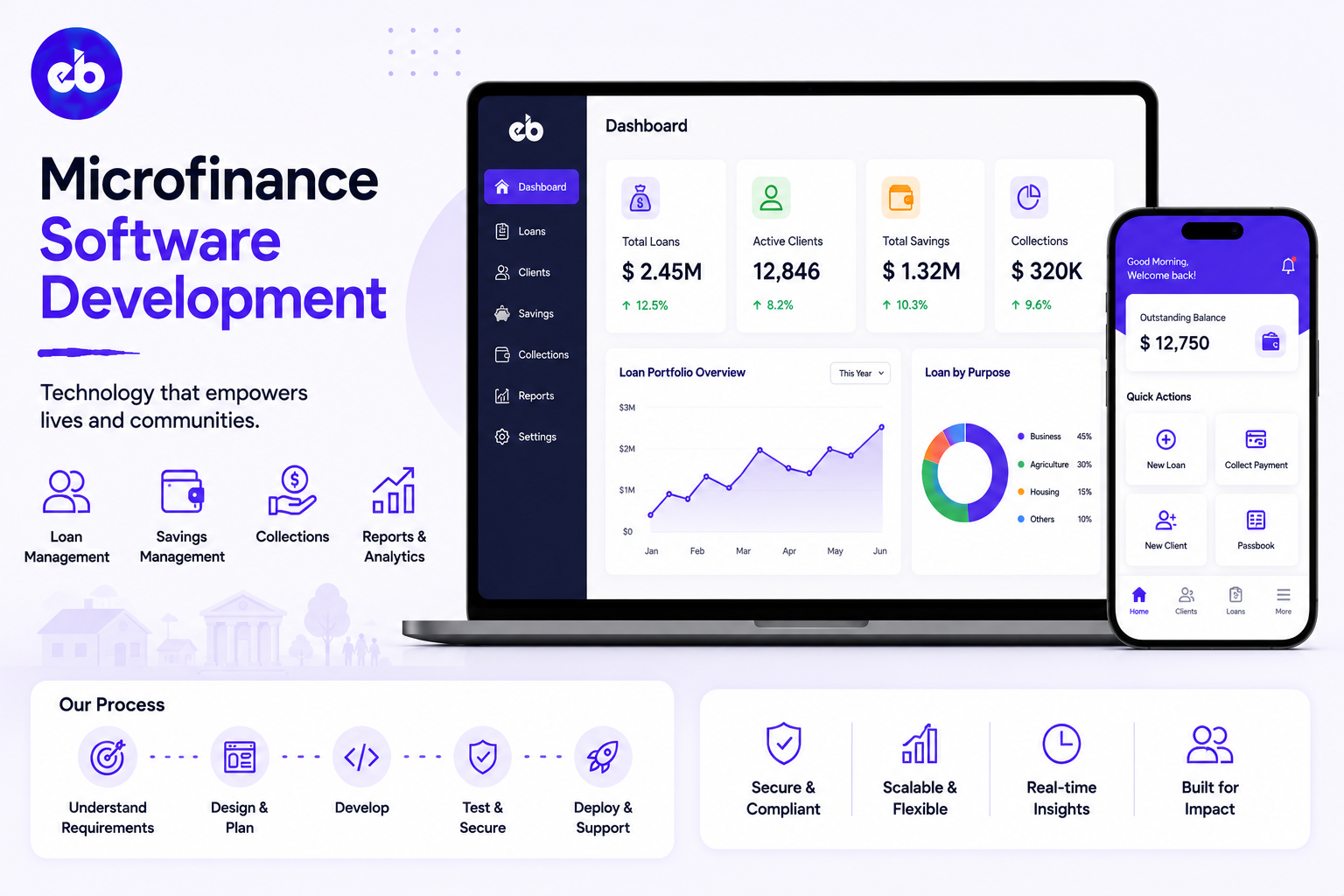
India’s microfinance sector serves 75 million borrowers across 700 million in the eligible population. Gross loan portfolio crossed ₹4 lakh crore in 2025.
The sector has matured, NBFC-MFIs are regulated entities under RBI, the Credit Bureau links have eliminated the ghost borrower problem at scale, and digital collections have replaced physical cash handling for most urban MFIs.
What has not changed: the operational complexity of microfinance. Group lending requires tracking 20 borrowers in each group across weekly meeting cycles, calculating repayments that include principal, interest, and insurance premiums, managing collections from borrowers who have no smartphone and prefer cash, reporting to credit bureaus in real time, and satisfying RBI’s NBFC-MFI reporting requirements on a monthly basis.
Building a microfinance platform that handles this complexity, for a group lender or an individual lending MFI, is a specialised engineering challenge. Generic NBFC software does not understand the group lending model. This guide covers how to build a platform that does.
EngineerBabu built LoanOS, processing ₹1,000 crore annually, and lending platforms for EarlySalary/Fibe. CMMI Level 5. Google AI Accelerator 2024 Top 20. Contact: mayank@engineerbabu.com
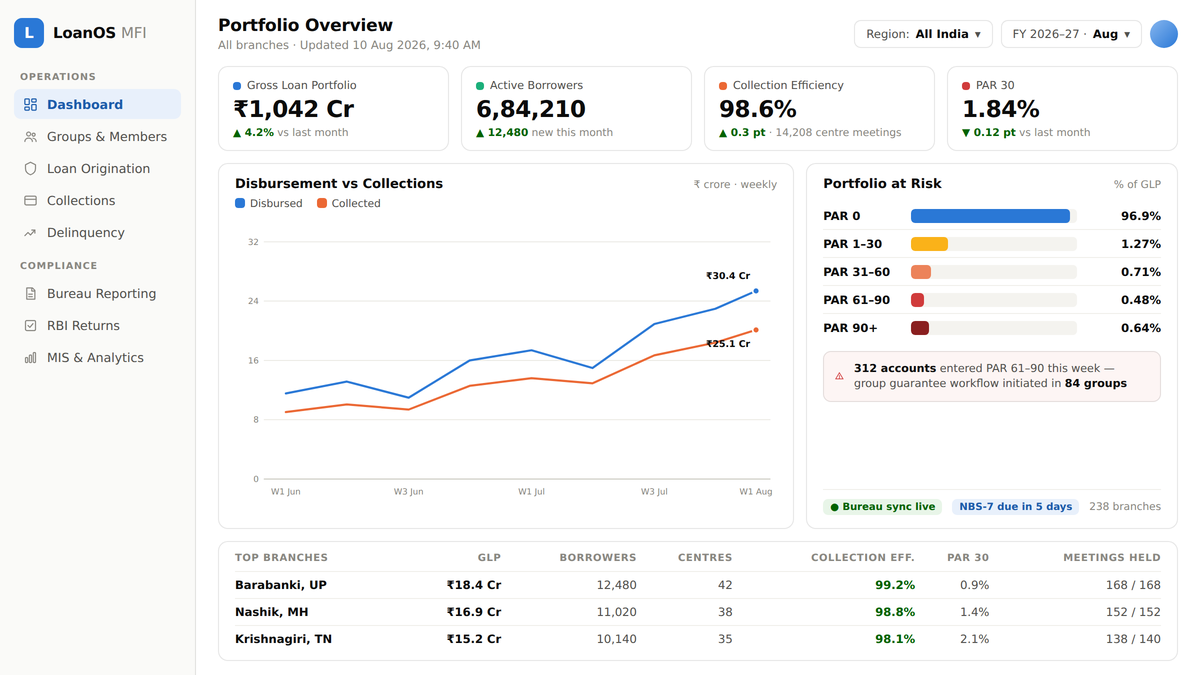
| Function | Module |
| Branch and centre management | Geographic hierarchy, centre meeting schedule |
| Group and member management | JLG/SHG formation, member onboarding, KYC |
| Credit appraisal | Credit bureau check, household income assessment |
| Loan origination | Application, approval workflow, disbursement |
| Repayment schedule | EMI calculation, insurance premium, processing fee |
| Field collection app | Collector app, offline-capable, attendance tracking |
| Cash management | Vault management, denomination tracking, daily tally |
| Delinquency management | Overdue tracking, escalation, recovery |
| Credit bureau reporting | CIBIL, Equifax, Experian, real-time reporting |
| RBI regulatory reporting | NBFC-MFI returns, CRILC reporting |
| MIS and analytics | Portfolio quality, PAR, write-off rates |
| Integration | CBS, accounting, payment gateways |
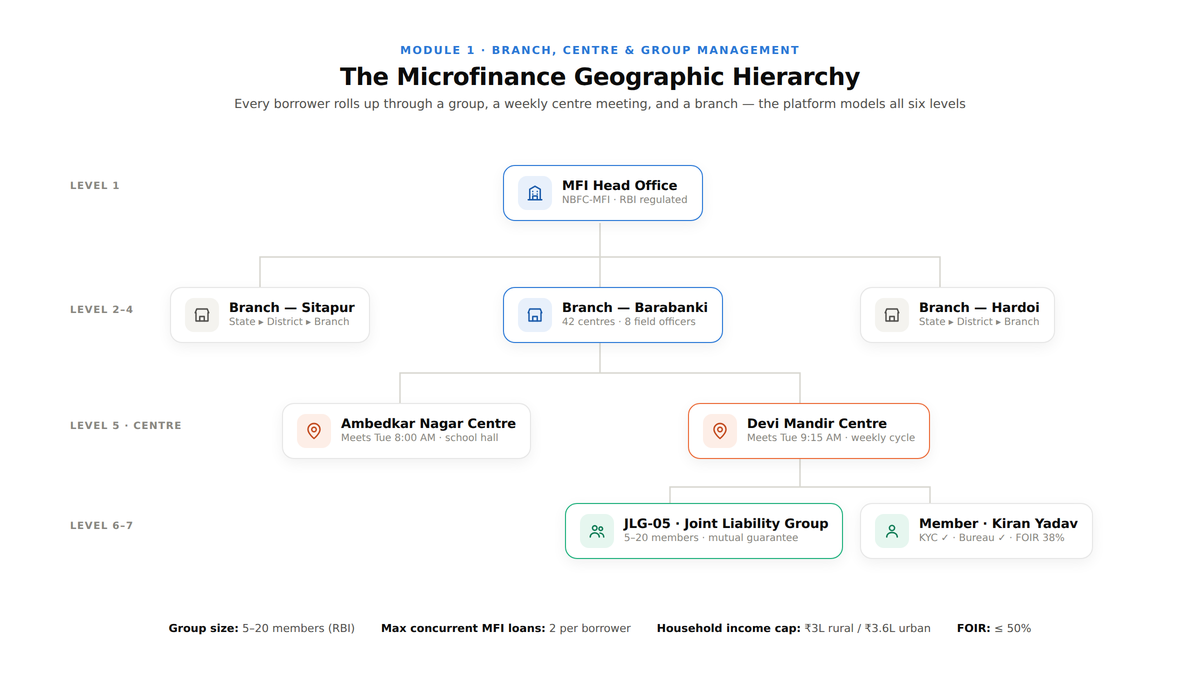
The microfinance geographic hierarchy:
MFI (Head Office)
│
├─ State / Zone
│ └─ District
│ └─ Branch (physical office)
│ └─ Centre (meeting location, school, community hall)
│ └─ Group (JLG, Joint Liability Group, 5–20 members)
│ └─ Member (individual borrower)
The centre meeting schedule:
Every centre meets at a fixed time and location, every week or every fortnight, for loan collection, new loan disbursement, and group business. The platform manages the meeting schedule for every centre, generates the attendance register for the field officer, and tracks whether meetings happened as scheduled.
Group formation rules (RBI NBFC-MFI guidelines):
| Rule | Requirement |
| Group size | Minimum 5, maximum 20 members |
| Member eligibility | Annual household income ≤ ₹3 lakh (rural) or ≤ ₹3.6 lakh (urban/semi-urban) |
| Existing indebtedness | Member cannot have more than 2 MFI loans outstanding |
| FOIR | Fixed obligation to income ratio ≤ 50% |
| Group guarantee | JLG, joint liability, all members guarantee each other |
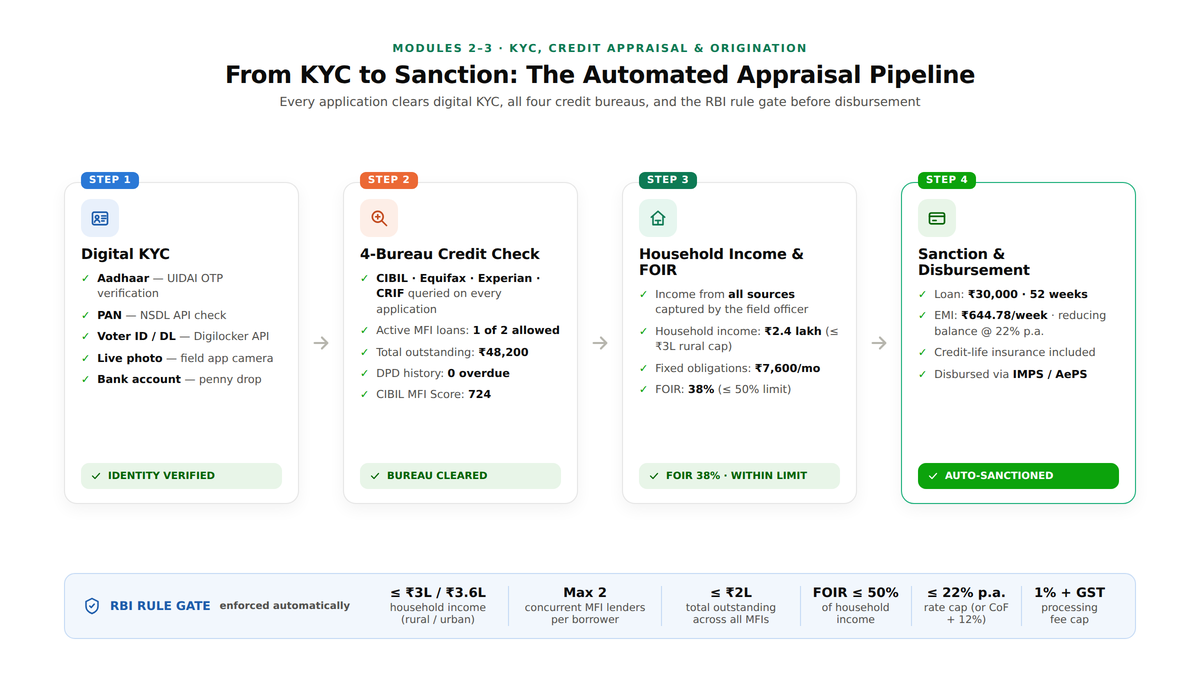
The platform enforces these rules at the group formation stage, credit bureau checks run automatically, household income is captured in the appraisal form, and the FOIR is calculated before loan approval.
Digital KYC:
| Document | Verification |
| Aadhaar | UIDAI OTP-based verification |
| PAN | NSDL API verification |
| Voter ID / Driving licence | Digilocker API |
| Photo | Live camera capture in field app |
| Bank account | Penny drop verification |
Credit bureau integration:
Before any loan is sanctioned, the platform mandatorily checks all four credit bureaus, CIBIL, Equifax, Experian, and CRIF High Mark, for the member’s credit history. The bureau check returns:
Current active MFI loans (count and outstanding), RBI limits to 2 concurrent MFI loans. Total outstanding debt across all lenders. Overdue history and DPD (days past due) buckets. CIBIL MFI Score.
The household income assessment:
For low-income borrowers without formal income documentation, the field officer conducts a household income assessment, capturing income from all sources (agriculture, labour, business, remittances) and all fixed obligations (rent, existing EMIs, school fees). The platform calculates the FOIR and flags the application if it exceeds the RBI limit.
The loan product configuration:
| Parameter | Details |
| Loan amount | ₹10,000 to ₹1,50,000 (RBI NBFC-MFI limit) |
| Tenure | 12, 18, 24 months, weekly or monthly repayment |
| Interest rate | RBI cap: lower of 22% per annum or cost of funds + 12% |
| Processing fee | RBI cap: 1% of loan amount + GST |
| Insurance premium | Life insurance mandatory, credit life, optional health |
| Repayment frequency | Weekly (most common) or monthly |
| Moratorium | 0 or 1 repayment cycle moratorium after disbursement |
The EMI calculation:
For a weekly repayment loan at 22% annual rate:
Reducing balance EMI:
Weekly interest rate = 22% / 52 = 0.4231%
EMI = P × r × (1+r)^n / ((1+r)^n – 1)
For P = ₹30,000, n = 52 weeks:
EMI = ₹30,000 × 0.004231 × (1.004231)^52 / ((1.004231)^52 – 1)
= ₹30,000 × 0.004231 × 1.2458 / 0.2458
= ₹644.78 per week
The platform calculates this precisely and generates the full amortisation schedule, showing the principal and interest component of every instalment, the outstanding balance after each payment, and the insurance premium collected each instalment.
Disbursement methods:
| Method | Use Case |
| Direct bank transfer (IMPS/NEFT) | Borrowers with bank accounts |
| Aadhaar-enabled Payment System (AePS) | Borrowers in areas with BC network |
| Cash disbursement | Rural areas without banking access |
| Pre-paid card | Alternative for unbanked borrowers |
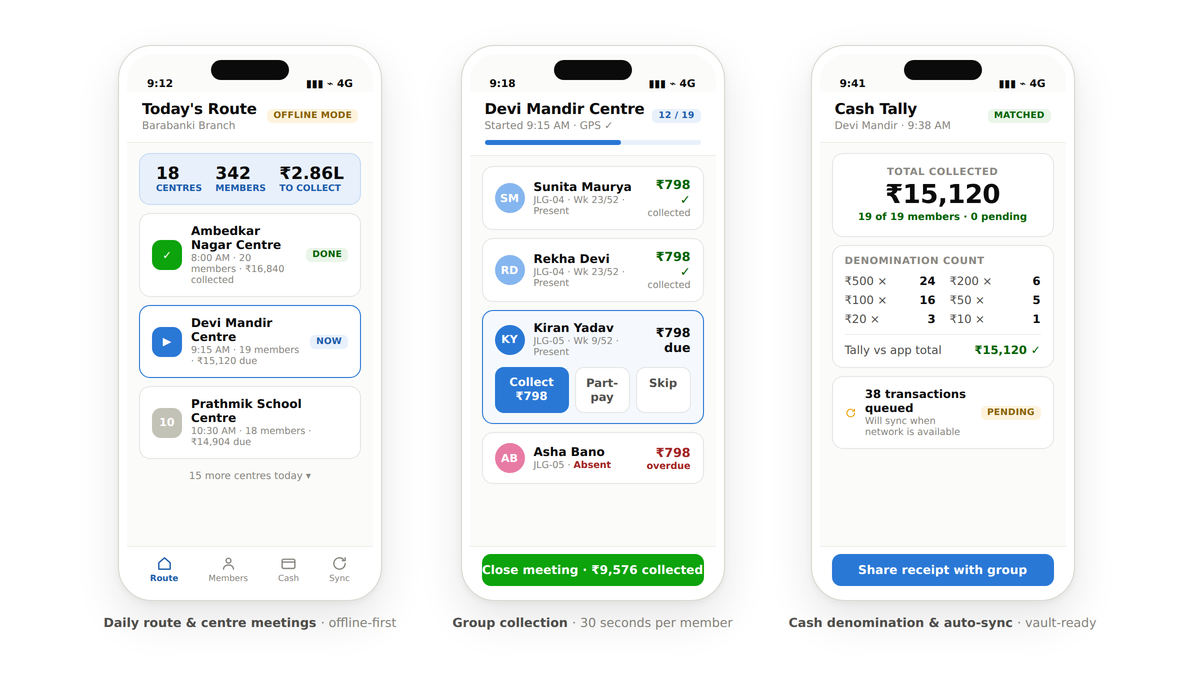
The field collection app is the most critical module for daily operations. Field officers collect repayments from 200 to 400 members per day across 15 to 20 centre meetings. The app must work offline, rural connectivity is unreliable, and must be fast enough to process an entire centre meeting of 20 members in under 15 minutes.
The collection workflow:
| Step | Action | Time |
| Centre meeting start | Field officer marks meeting started, GPS-verified | 1 minute |
| Attendance | Mark each member present or absent | 2 minutes for 20 members |
| Collections | For each member, enter amount collected | 30 seconds per member |
| Exceptions | Record prepayments, part-payments, skips | As needed |
| Meeting close | Summarise total collected, print/share receipt | 2 minutes |
| Sync | Upload all transactions when connectivity available | Background |
Cash denomination tracking:
For centres where cash collection is mandatory, the app includes denomination tracking, the field officer enters the denomination mix of the collected cash. This enables vault management at the branch, counting the day’s collection and matching it against the app’s total without manual reconciliation.
Pre-payment and part-payment handling:
Members sometimes pay more than their due instalment (pre-payment) or less (part-payment). The platform handles both:
Pre-payment: Excess applied to reduce the principal outstanding, shortening the loan tenure. Part-payment: Shortfall recorded as overdue, triggers reminder and escalation if not cleared by next meeting.
The PAR (Portfolio at Risk) framework:
| Bucket | Definition | Action |
| PAR 0 | Current, no overdue | None |
| PAR 1–30 | 1 to 30 days overdue | Field officer contact, group pressure |
| PAR 31–60 | 31 to 60 days overdue | Branch manager visit, recovery plan |
| PAR 61–90 | 61 to 90 days overdue | Senior management, group guarantee invocation |
| PAR 90+ | 90+ days overdue | NPA classification, legal, write-off consideration |
The escalation engine:
When a member misses a payment, the escalation engine:
Day 1 after due: Field officer receives an alert, member missed payment. Day 3: Branch manager notified if not resolved. Day 7: Area manager alert, group guarantee discussion initiated. Day 30: Credit bureau reported as overdue (SMA-1 classification). Day 60: NPA classification triggered if not resolved.
The group guarantee mechanism:
In JLG lending, all members of the group are jointly liable. When one member defaults, the platform activates the group guarantee workflow, the field officer facilitates a group meeting where members collectively decide how to handle the defaulting member’s obligation. This social pressure mechanism is the primary credit risk management tool in JLG microfinance.
NBFC-MFI returns (NBS-7):
The platform generates the monthly NBS-7 return, the primary regulatory filing for NBFC-MFIs, automatically from operational data:
| NBS-7 Component | Data Source |
| Loan portfolio, outstanding, disbursed, repaid | Loan ledger |
| PAR buckets, by geography, by product | Repayment data |
| Borrower count, new, active, exited | Member database |
| Income, interest, fees, insurance commission | Finance module |
| Cost of funds | Borrowing data |
| Capital adequacy | Capital structure + risk-weighted assets |
CRILC reporting:
The Credit Repository of Information on Large Credits (CRILC) requires reporting of all borrowers with exposure above ₹5 crore, typically not relevant for individual MFI borrowers but relevant for the MFI’s own borrowings. The platform generates CRILC data in the required format.
Credit bureau reporting (real-time):
Every loan disbursement, repayment, and delinquency event is reported to CIBIL, Equifax, Experian, and CRIF High Mark in real time through their respective APIs. This real-time bureau reporting is the foundation of the sector’s ghost borrower prevention mechanism.
| Module | Cost Range (USD) | Notes |
| Branch, centre, group hierarchy management | $5K – $10K | |
| Member KYC + credit bureau integration | $8K – $15K | 4 bureau APIs |
| Household income assessment + FOIR | $4K – $8K | |
| Loan origination + approval workflow | $8K – $15K | |
| Repayment schedule + amortisation | $5K – $10K | Reducing balance, insurance |
| Field collection app (Flutter, offline) | $10K – $18K | Offline-first, denomination tracking |
| Cash management + vault | $4K – $8K | |
| Delinquency management + escalation | $6K – $12K | PAR tracking, escalation rules |
| Credit bureau reporting (real-time) | $8K – $15K | 4 bureau API integrations |
| RBI regulatory reporting (NBS-7, CRILC) | $6K – $12K | |
| MIS + portfolio analytics | $5K – $10K | PAR, write-offs, disbursement trends |
| AWS + VAPT + Year 1 ops | $5K – $10K | |
| Total | $74K – $143K | Full microfinance platform |
Contact: mayank@engineerbabu.com
A Joint Liability Group (JLG) is a group of 5 to 20 individuals, typically women in India’s NBFC-MFI sector, who take individual loans but provide mutual guarantee for each other’s repayment. If one member defaults, the group is responsible for covering the shortfall before the MFI takes recovery action. The JLG model eliminates the need for collateral, the social collateral of the group replaces physical assets as the credit guarantee. A microfinance platform models JLG by maintaining a group entity that links individual member records, tracks the group’s aggregate delinquency, enforces RBI rules on maximum concurrent loans per member and income eligibility, and manages the group guarantee workflow when a member defaults.
RBI regulations (2022 Master Direction) set the following limits for NBFC-MFIs: maximum annual household income of the borrower, ₹3 lakh for rural areas and ₹3.6 lakh for urban/semi-urban; maximum outstanding loan across all MFIs cannot exceed ₹2 lakh at any point; maximum 2 NBFC-MFIs can lend to the same borrower simultaneously; fixed obligation to income ratio (FOIR), total loan repayments of the household cannot exceed 50% of household income; and maximum loan size is ₹1.5 lakh for the first cycle, increasing in subsequent cycles. A microfinance platform enforces these limits at the loan appraisal stage, running mandatory credit bureau checks for current outstanding, calculating FOIR from the household income assessment, and blocking the loan sanction automatically if any limit is exceeded.
A field collection app for rural microfinance must function offline because most meeting locations, village schools, community halls, fields, have no reliable cellular data. The offline capability works as follows: at the start of each day, the app syncs the full data set for the field officer’s centres, member details, outstanding instalments due, payment history, and centre meeting schedules, to local device storage. During the day’s operations, all transactions are written to local storage. When the field officer returns to an area with connectivity, the branch, a town, or a highway, the app syncs all the day’s transactions to the central server automatically. The server validates the transactions against the master data and flags any discrepancies for manual review. The critical design requirement is that the field officer cannot tell the difference between online and offline mode, the app behaves identically in both states.