How to Build a Ride-Sharing App Like Uber in 2026


Create engaging, high-performance mobile applications tailored to your business needs. We craft future-ready apps that offer smooth user experiences on all devices.
Build robust and scalable websites and CMS platforms that help you manage content effortlessly. Our development ensures a seamless digital presence.
Launch secure, feature-rich online stores with intuitive shopping experiences. We build tailored eCommerce platforms designed for growth.
Design captivating games with immersive gameplay and stunning graphics. From concept to launch, we build engaging experiences that players love.
Enhance your customer relationships with customized Salesforce implementations. Drive growth and efficiency with smarter CRM solutions.
Harness artificial intelligence and machine learning to automate workflows and gain actionable insights. Our AI transforms data into smart decisions.
Accelerate your software delivery lifecycle with continuous integration, delivery, and infrastructure automation to boost efficiency.
Hire app developers ready to turn your ideas into sleek, high-performing mobile apps for any platform.
Bring in frontend pros who craft smooth, beautiful, and user-friendly interfaces that your visitors will love.
Get backend developers who build fast, secure, and reliable systems to keep everything running behind the scenes.
Hire eCommerce developers who build secure, scalable online stores designed to offer seamless shopping and grow your sales.
Get dedicated developers committed to your projects, delivering consistent quality and speed as an extension of your team.

A standard e-commerce marketplace has two sides: seller and buyer. The transaction is asynchronous: the buyer orders, the seller ships, delivery happens later.
A ride sharing app like uber has two sides: driver and rider. The transaction is synchronous; both must be in the right place at the right time, within minutes of each other. And the matching is happening thousands of times simultaneously, in real time, across a city.
On top of that: surge pricing must respond to demand in real time to incentivise driver supply. Drivers must be verified, insured, and background-checked before they’re allowed to operate. The safety architecture must handle emergencies that happen while the rider is in a moving vehicle. And the dispatch engine must maintain sub-3-second response times even when the system is processing 50,000 concurrent ride requests during peak hours.
This is not a typical software problem. Uber processes over 20 million trips daily. The backend that handles that volume is one of the most sophisticated distributed systems in commercial software.
I co-founded EngineerBabu 14 years ago. The team has built logistics dispatch systems including BURQ, a US logistics platform where real-time assignment, route optimisation, and dispatch economics are the core product. The patterns from the BURQ build apply directly to ride-sharing dispatch. The team has also built three-sided marketplace platforms and AI-powered demand forecasting systems across multiple domains. The combination of dispatch engineering, marketplace mechanics, and production ML is exactly what ride-sharing requires.
If you’re ready to build email mayank@engineerbabu.com
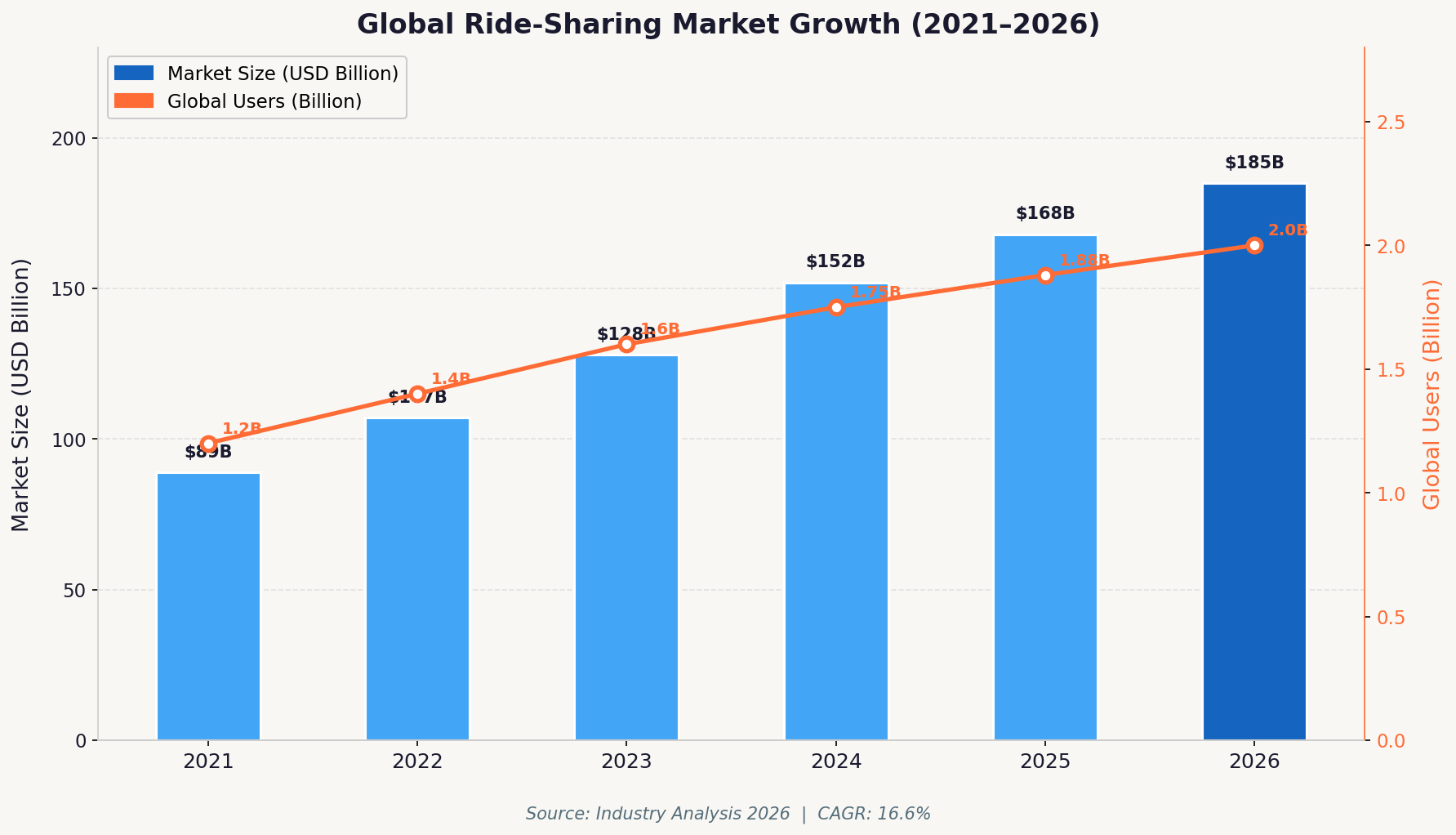
The global ride-sharing market was valued at $185 billion in 2026, growing at 16.6% CAGR. Nearly 2 billion users globally use ride-sharing apps, projected to reach 2.34 billion by 2030.
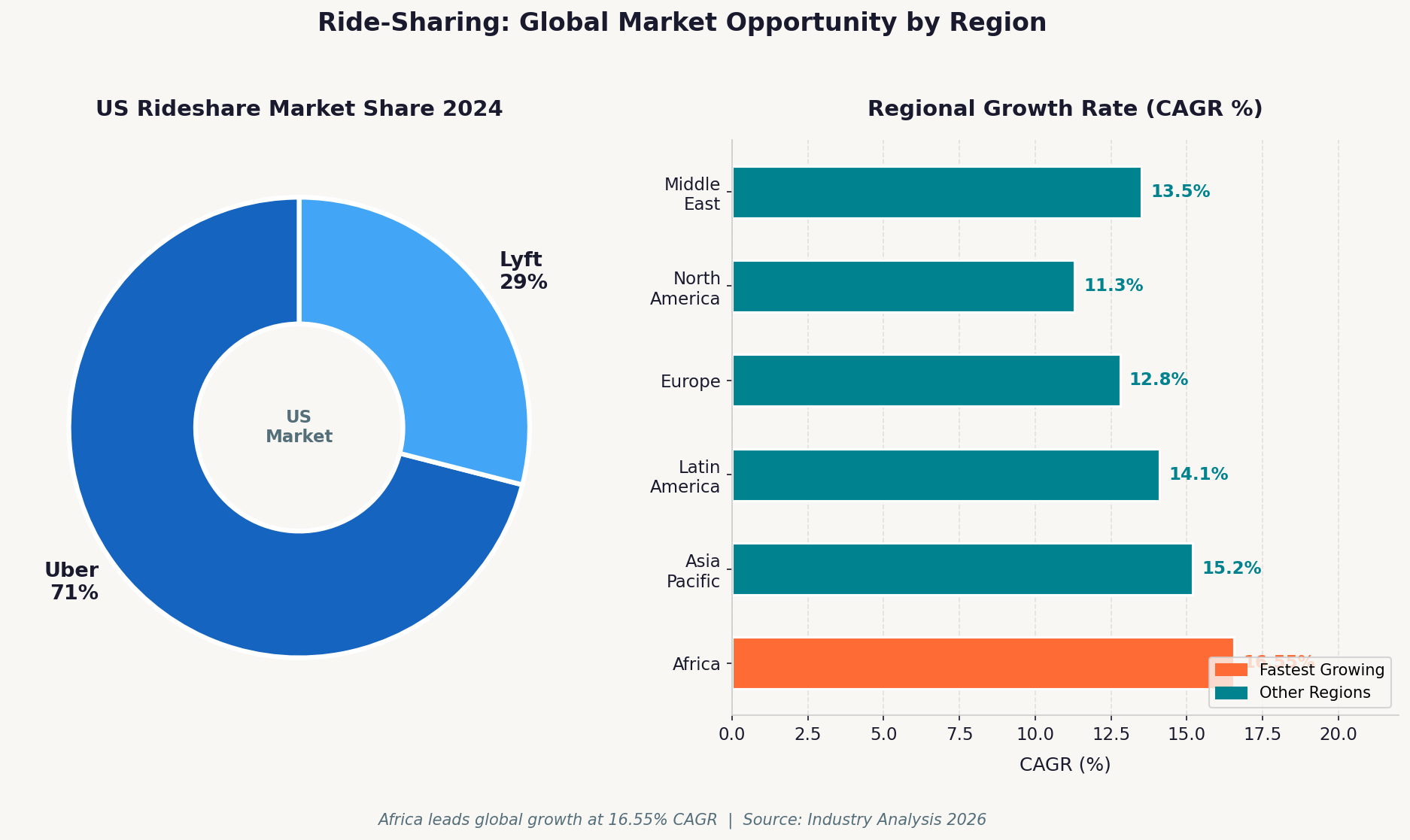
Uber processed 11.3 billion trips globally in 2024, generating $162.8 billion in gross bookings. They hold 71% of the US rideshare market. Lyft holds 29%.
But here’s where new entrants consistently find white space:
Africa is growing at 16.55%, the fastest of any region. Bolt committed EUR 500 million to the continent. Nigeria, Kenya, and South Africa have young demographics and strong smartphone penetration but limited platform presence.
Southeast Asia: Grab dominates but serves primarily urban centres. Tier-2 cities across Vietnam, Philippines, and Indonesia remain underserved.
India: Ola and Rapido compete vigorously in a market where price sensitivity is high and driver economics are challenging. Corporate ride hailing (employee transportation, last-mile connectivity to transit hubs) is underserved by general consumer platforms.
Niche segments that win: corporate mobility (companies contracting dedicated fleet services), women-only rides (safety differentiation), electric vehicle fleets (sustainability-focused enterprises), and rural/intercity routes that large platforms don’t serve.
A ride-sharing app is a two-sided marketplace that connects drivers (supply) with riders (demand) for on-demand transportation. The platform manages real-time matching, route navigation, dynamic pricing, payment processing, and safety all within a window that must deliver a driver to the rider in under 5 minutes to be competitive.
When a rider requests a ride, the dispatch engine must:
This entire sequence must complete in under 3 seconds. The rider is watching the app. If nothing happens for 5 seconds, they think it’s broken.
The architecture requirements:
Geospatial indexing the driver location database must support fast radius queries (“all drivers within 3km of this coordinate”). Standard relational databases can’t do this efficiently at scale. The team uses PostGIS on PostgreSQL for spatial indexing, or a dedicated geospatial service like Redis GEOSEARCH for the hot path.
Every driver is in one of several states: offline, online-available, online-on-trip, online-completing-trip. The dispatch engine only queries available drivers. State transitions must be atomic to prevent double-assignment (two riders assigned to the same driver simultaneously).
Offer timeout and cascade if a driver doesn’t respond within 15 seconds, the offer cascades to the next candidate. The cascading logic must be reliable; a missed cascade means the rider waits while the system retries from scratch.
Batch matching at high demand density (surge), the system doesn’t match one ride at a time. It batches pending requests and pending available drivers, then solves the assignment problem optimally across the batch. This produces better outcomes (lower average ETAs across all riders) than sequential assignment.
The BURQ US logistics platform built by the team uses the same dispatch architecture real-time assignment with geographic indexing, driver state tracking, and batch optimization. The domain is different (package delivery, not passenger transportation) but the dispatch engine patterns are identical.
Surge pricing is the most misunderstood feature in ride-sharing engineering.
Most founders see surge pricing as a revenue maximisation tool. It’s actually a supply management tool. When demand exceeds supply in a geographic zone, the price increase accomplishes two things simultaneously: it reduces demand (some riders decide not to travel at the surge price) and increases supply (drivers who were offline come online because the economics improved).
Building surge pricing correctly:
Zone-based demand tracking the city is divided into hexagonal zones (H3 grid from Uber’s open-source hexagonal grid library is the standard). Each zone has a real-time demand metric: pending requests / available drivers.
Surge multiplier calculation when the demand/supply ratio in a zone exceeds a threshold, a surge multiplier is applied. The multiplier must be calibrated too aggressively and riders abandon the platform; not aggressive enough and driver supply doesn’t materialise.
Dynamic zone recalculation zones recalculate every 30–60 seconds. Events (football match ending, concert letting out) create sudden demand spikes that the surge system must detect and respond to immediately.
Transparent surge disclosure regulatory requirements in most markets require clear surge disclosure to the rider before trip confirmation. The disclosure screen must show the multiplier and the estimated fare.
Driver supply prediction the team builds ML models that predict driver supply 15–30 minutes in advance based on historical patterns and current driver locations. This enables proactive surge activation before the actual supply/demand imbalance occurs, reducing the wait time spike that precedes supply materialisation.
Unlike food delivery, ride-sharing has a passenger physically inside the driver’s vehicle. The safety stakes are materially higher.
Production driver verification:
Identity verification government ID check (Aadhaar in India, DL check in US), liveness check (selfie matching to ID photo). Same computer vision pipeline used in the team’s healthcare and fintech verification builds.
Driving license verification DL validity, expiry date, and category check (commercial/personal). In India, integration with the Parivahan (MoRTH) API for DL validation. In the US, integration with DMV record checks.
Vehicle verification registration document check, insurance verification, vehicle age and condition requirements. In India, RC (Registration Certificate) verification via Vahan API.
Background check, criminal record check, prior traffic violations. In the US, companies like Checkr provide background screening APIs. In India, police verification certificates are required in several states.
Periodic re-verification documents expire. The platform must track document expiry dates, notify drivers before expiry, and automatically deactivate drivers whose documents have expired.
This verification stack must be built before a single driver goes live. There is no “we’ll add verification later” in regulated transportation.
The safety features that matter most in ride-sharing:
Trip sharing the rider can share their live trip link (real-time GPS location + driver details + estimated arrival) with a trusted contact. This is the single highest-value safety feature per unit of engineering effort.
In-trip SOS emergency button that calls emergency services and simultaneously alerts the platform’s safety team with the rider’s location, the driver’s details, and the trip history. Must work when the rider can’t speak (silent SOS option that calls emergency services without audio).
Route deviation detection the platform monitors whether the driver is following the expected route. Significant deviation triggers an automated safety check-in to the rider (“Are you okay? Is your driver taking an unexpected route?”). If the rider doesn’t respond, it escalates to the safety team.
Trusted contacts riders set up trusted contacts who receive automatic notifications when a trip starts and ends. If the trip runs significantly longer than expected, trusted contacts receive an alert.
Driver monitoring sudden sharp braking, excessive speed, prolonged stops in unusual locations detected via the driver app’s accelerometer and GPS. Anomalies surface to the operations team.
The safety architecture is not a set of features. It’s a monitoring pipeline that runs throughout every active trip, connected to a human operations team with defined escalation protocols.
The fundamental challenge in ride-sharing is that the product is worthless without driver supply. And drivers won’t sign up if there aren’t riders. And riders won’t use the platform if wait times are long.
Geographic density first has the same principle as dating apps and grocery apps: don’t launch nationally. Launch in one city, build driver density in that city until average wait times are under 5 minutes, then expand. A city with 200 drivers and 500 daily rides is a better product than one with 2,000 drivers spread across 50 cities.
Driver incentive programs guaranteed hourly minimums during launch periods, signing bonuses, referral bonuses for bringing other drivers onto the platform. These are operational cost investments, but they’re also engineering investments: the platform needs an incentive management system that tracks driver earnings, calculates guarantees, and processes bonus payments.
Driver utilisation dashboard drivers want to know their earnings, trip count, rating, and acceptance rate. This is the driver-facing product that determines whether they stay on the platform. Building a comprehensive driver analytics dashboard is as important as the rider experience.
Multi-service drivers: a driver who can do passenger transport, food delivery, and parcel delivery generates more income per hour. Multi-service capability requires the driver app to support multiple service modes and the dispatch engine to route across service types.
Ride-sharing payment is more complex than food delivery because of the regulatory variation by geography:
India Ola and Rapido see significant cash payment volume. Many drivers and riders in Tier-2/3 cities prefer cash. The platform must support cash trips with driver-reported cash collection and settlement accounting.
Driver earnings settlement: the platform collects full fare from the rider (card, UPI, wallet) and settles the driver’s share (typically 75–80% of fare minus surge commission and any incentives) on a daily or weekly cycle. The settlement accounting must handle refunds, surge commissions, incentive bonuses, and document verification fees correctly.
Surge transparency regulations several regulators (including India’s Ministry of Road Transport) have issued guidance on fare transparency. The platform must maintain detailed fare breakdowns for every trip, accessible to both rider and driver.
TDS deductions in India, TDS (Tax Deducted at Source) is applicable on driver payments above threshold. The platform must calculate, deduct, and remit TDS correctly, and provide drivers with Form 16A annually.
Uber began offering 250,000 weekly autonomous rides via Waymo in Atlanta and Austin in 2026. This is not a far-future concept.
For most new entrants, AV readiness is not an immediate requirement. But the architectural decision that matters now: is the driver state machine and dispatch engine designed for human drivers only, or for a driver abstraction that could represent either a human driver or an autonomous vehicle?
Building with this abstraction costs almost nothing at design time. Retrofitting it costs significantly at scale.
The team builds ride-sharing dispatch engines with a driver abstraction layer; the dispatch engine doesn’t know or care whether the “driver” is a human or a software agent. This allows future AV integration without core engine changes.
Flutter (rider app + driver app) + Next.js (admin ops panel)
Node.js NestJS (core application logic) + Python (ML: dispatch scoring, surge prediction, demand forecasting)
PostgreSQL + PostGIS (geospatial queries) + Redis GEOSEARCH (real-time driver locations)
PostgreSQL with PostGIS for the full data model. Redis GEOSEARCH for the hot path, the real-time driver location query that runs thousands of times per minute during peak periods.
Kafka (event streaming) every trip event (request, match, pickup, dropoff, cancellation, rating) published to Kafka. Downstream consumers: analytics pipeline, safety monitoring, earnings calculation, surge recalculation.
Google Maps Platform Directions API for route calculation and navigation, Distance Matrix for batch ETA estimation, Maps SDK for the rider and driver map displays.
Twilio (communications) masked phone numbers (rider and driver communicate without sharing real phone numbers), SMS notifications, emergency call capability.
Payments: Razorpay (India) + Stripe (international) + Cash trip accounting module
The BURQ US logistics platform real-time dispatch, driver state management, route optimisation, multi-pickup batching is the direct reference. The patterns are identical to ride-sharing; the passenger is replaced by a package, the rider experience is replaced by a sender/receiver experience.
The AI demand forecasting model built for Simba Beer’s supply chain and adapted for food delivery platforms applies directly to ride-sharing driver supply management: predict demand by zone and time window, trigger supply incentives (driver notifications, surge activation) before the demand spike rather than after it.
The team’s marketplace platform experience across Supersourcing and multiple other two-sided platforms provides the monetisation architecture, supply-side onboarding design, and network effects mechanics that define ride-sharing launch strategy.
CTA #2 The team can scope your ride-sharing architecture in a week. mayank@engineerbabu.com
Ride request submitted. Dispatch engine queries the database for nearby drivers using a full-table scan. At 5,000 concurrent drivers, the query takes 3 seconds. At 20,000 concurrent drivers, it times out. The rider sees the app freeze.
The fix: Geospatial index (PostGIS) on the driver location table from day one. Redis GEOSEARCH for the hot path. This is a day-one architectural decision, not a performance optimization to add later.
Demand spikes (major event ending). Surge pricing activates at 2x. No drivers come online because the 2x multiplier isn’t visible to offline drivers in real time. Riders wait 20 minutes. Abandon the platform. Tell their friends not to use it.
The fix: Real-time driver supply notifications when surge activates in their current zone. Push notification to offline drivers in the area: “Surge pricing is live in your area and go online now.” The surge mechanics are only effective if the supply signal reaches potential supply.
The platform launches quickly without full driver verification. A driver with a suspended license operates on the platform. Incident occurs. Regulatory investigation reveals the verification gap. Platform operations suspended.
The fix: Verification infrastructure (ID, DL, vehicle, background check) fully implemented and tested before the first driver is activated. No exceptions. No “we’ll fix verification in Phase 2.”
The platform launches in 10 cities simultaneously with thin driver supply. Average wait times in every city are 15+ minutes. Riders churn immediately. The platform never builds density in any city.
The fix: City-by-city launch with defined density thresholds (minimum X active drivers per sq km during peak hours before launch). Build one city correctly, then expand. The geography of network effects in ride-sharing is local, not national.
White-label ride-sharing platforms: Available, faster to market. Limited dispatch sophistication, generic surge pricing, limited driver verification customisation. Right for validating market demand in a specific niche or geography before committing to custom development.
Custom build: Required for any platform where the dispatch efficiency, surge mechanics, driver supply management, or safety architecture are the competitive differentiation. For markets where gig worker regulations require specific compliance features (EU Platform Worker Directive effective December 2026), custom build provides the flexibility white-label cannot.
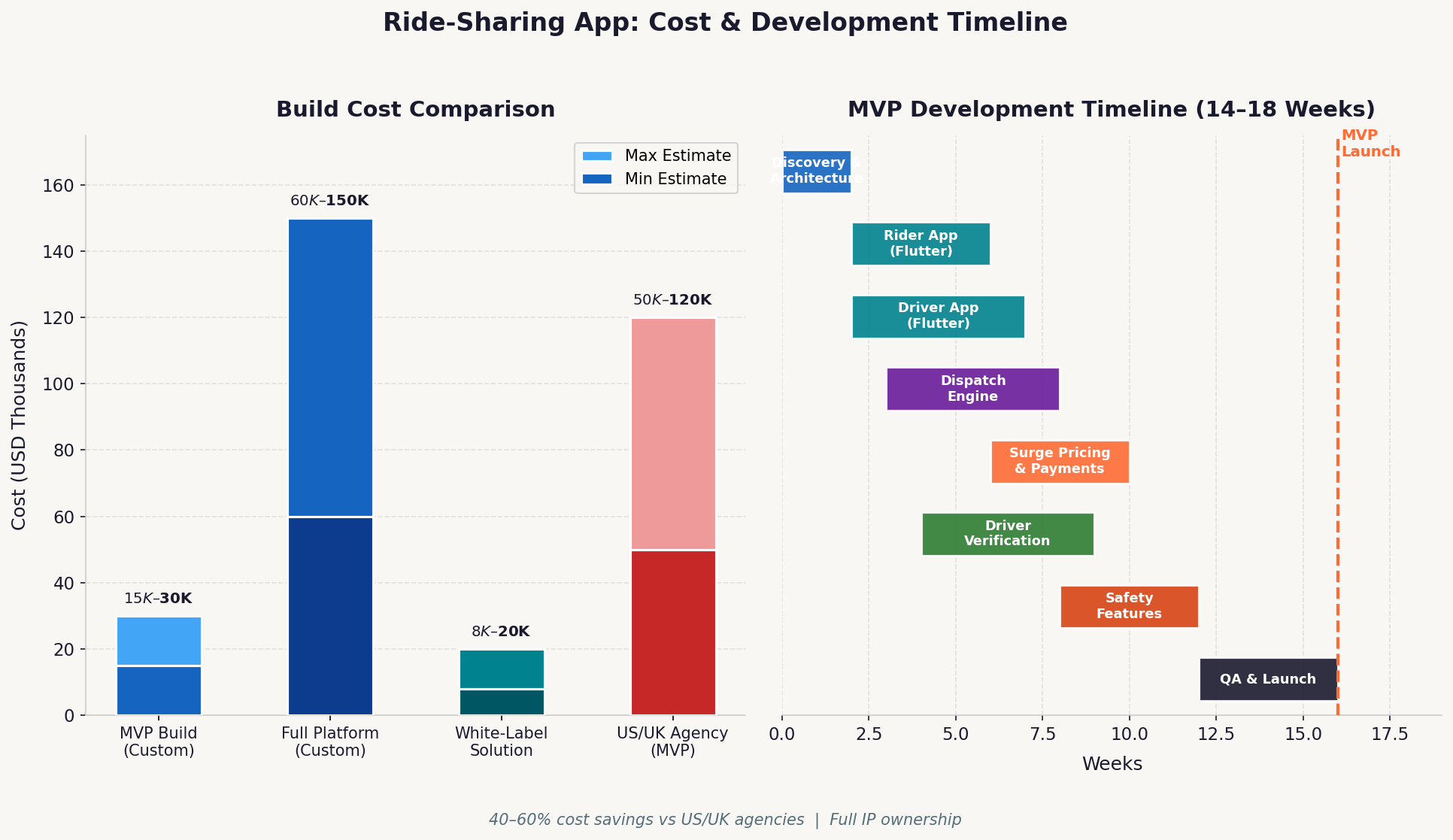
Ride-sharing app development starts from $15K for a production MVP rider app, driver app, geospatial dispatch, basic surge pricing, trip tracking, cash + card payments.
Full platforms AI dispatch optimisation, ML demand forecasting, driver verification pipeline, safety monitoring, regulatory compliance scoped based on market, fleet size, and compliance requirements.
Timeline: MVP in 14–18 weeks. Full platform in 6–10 months.
40–60% cost savings vs US/UK. BURQ logistics dispatch experience directly applicable. Full IP ownership.
BURQ US logistics dispatch architecture. Simba Beer demand forecasting. Multiple marketplace platform builds. Google AI Accelerator 2024 for dispatch scoring and demand prediction.
Mayank leads personally. CMMI Level 5. 4 unicorn clients. 500+ products. Full IP ownership.
A logistics platform came to the team needing real-time dispatch at scale, thousands of concurrent assignments, sub-3-second matching, geographic zone management. The dispatch engine the team built handles it. The same engine, adapted for passenger transport, is what a ride-sharing platform requires.
Every week a ride-sharing platform runs with proximity-only dispatch and static pricing is a week of driver economics and rider experience that falls below the competitive bar.
30 minutes. Honest assessment of your target market, your supply density strategy, and what production ride-sharing dispatch actually requires.
Building a two-sided marketplace connecting drivers and riders for on-demand transportation with real-time geospatial dispatch, dynamic surge pricing, driver verification, safety monitoring, and payment processing. Every transaction is synchronous and time-critical, making it fundamentally harder than asynchronous marketplaces.
Geospatial indexing for the dispatch engine. The query “find all available drivers within 3km” must return in milliseconds at scale. Without PostGIS or Redis GEOSEARCH on the driver location table, this query degrades to unusable latency above 5,000 concurrent drivers. This is a day-one decision.
The city is divided into zones (H3 hexagonal grid). Each zone tracks a demand/supply ratio (pending requests / available drivers) in real time. When the ratio exceeds a threshold, a surge multiplier activates. The multiplier recalculates every 30–60 seconds. ML models predict demand spikes 15–30 minutes in advance to proactively trigger surge before driver supply drops.
Government ID, driving license validation, vehicle registration and insurance verification, and criminal background check. In India: Aadhaar eKYC, Parivahan API for DL validation, Vahan API for RC check. In the US: DMV record checks via Checkr or similar. Verification must be complete before the first driver is activated; there is no “add verification later.”
MVP (rider app, driver app, geospatial dispatch, basic surge, trip tracking, payments): 14–18 weeks. Full platform with AI dispatch, ML demand forecasting, full verification pipeline, and safety monitoring: 6–10 months.
Trip sharing (live link to trusted contacts), in-trip SOS with emergency services integration and platform safety team alert, route deviation detection with automated check-in, trusted contact notifications, and driver monitoring via accelerometer and GPS anomaly detection.
Flutter for rider and driver apps, Next.js for admin panel, Node.js NestJS for application logic, Python for ML (dispatch scoring, surge prediction), PostgreSQL with PostGIS for the full data model, Redis GEOSEARCH for real-time driver location queries, Kafka for event streaming, Google Maps Platform for routing and maps.