Gold Loan App Development Cost in India 2026 - Module-by-Module Breakdown for NBFCs and Fintechs


Create engaging, high-performance mobile applications tailored to your business needs. We craft future-ready apps that offer smooth user experiences on all devices.
Build robust and scalable websites and CMS platforms that help you manage content effortlessly. Our development ensures a seamless digital presence.
Launch secure, feature-rich online stores with intuitive shopping experiences. We build tailored eCommerce platforms designed for growth.
Design captivating games with immersive gameplay and stunning graphics. From concept to launch, we build engaging experiences that players love.
Enhance your customer relationships with customized Salesforce implementations. Drive growth and efficiency with smarter CRM solutions.
Harness artificial intelligence and machine learning to automate workflows and gain actionable insights. Our AI transforms data into smart decisions.
Accelerate your software delivery lifecycle with continuous integration, delivery, and infrastructure automation to boost efficiency.
A founder I spoke with last quarter had budgeted ₹8 lakhs for her gold loan app. She had taken that number from a freelancer who quoted for a basic KYC form and a loan tracking dashboard. Six months later, after integrating real-time gold rate APIs, building the vault tagging system, adding RBI-mandated tiered LTV logic, and wiring up eNACH for EMI collection, the actual cost was ₹38 lakhs. She wasn’t overcharged. She had budgeted for the wrong product.
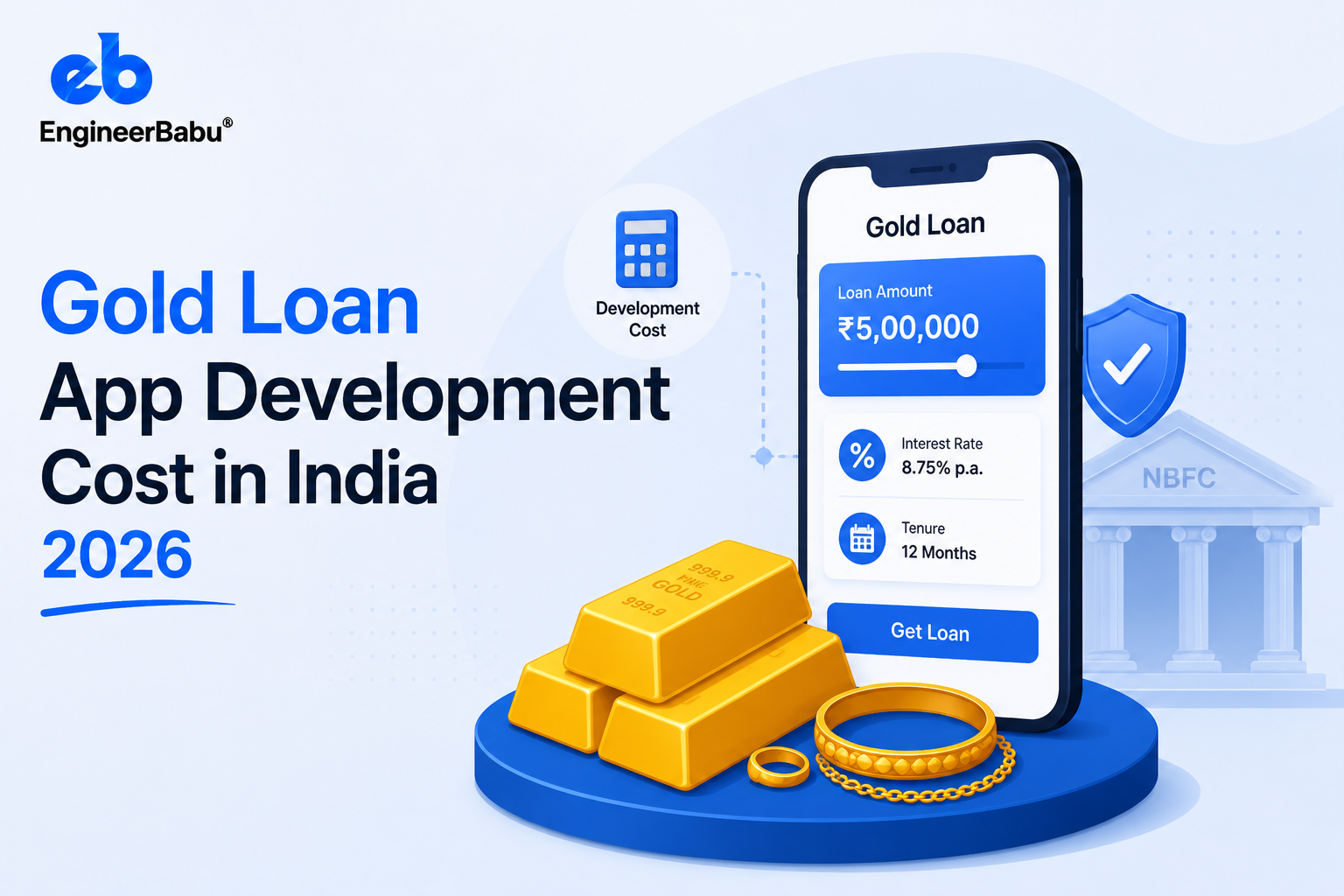
Gold loan app development cost India for a production-grade NBFC platform ranges from ₹18 lakhs to ₹85 lakhs depending on product scope, integration depth, and compliance requirements. An MVP built on white-label infrastructure can come in at ₹6–12 lakhs.
Enterprise-grade platforms with AI-powered gold valuation, multi-branch vault management, doorstep pickup flows, and full RBI April 2026 compliance routinely exceed ₹60 lakhs. The opportunity is massive. India’s gold loan market is projected to cross ₹10 lakh crore by 2026, driven by NBFC expansion and digital lending adoption.
The problem is that most cost guides on the internet quote the MVP number and never explain what you actually need to build a regulated, scalable gold lending product. This guide is different. It breaks down every module, every third-party API, every compliance cost, and every infrastructure expense so you can build a realistic budget before you talk to a single developer.
EngineerBabu, a CMMI Level 5 product engineering company backed by Vijay Shekhar Sharma, has built lending platforms that collectively process thousands of crores in disbursements annually. The numbers in this guide come from real builds, not estimates from a brochure.
Before the cost tables, you need to understand why gold loans have a different cost profile from personal loan or BNPL apps. Three reasons:
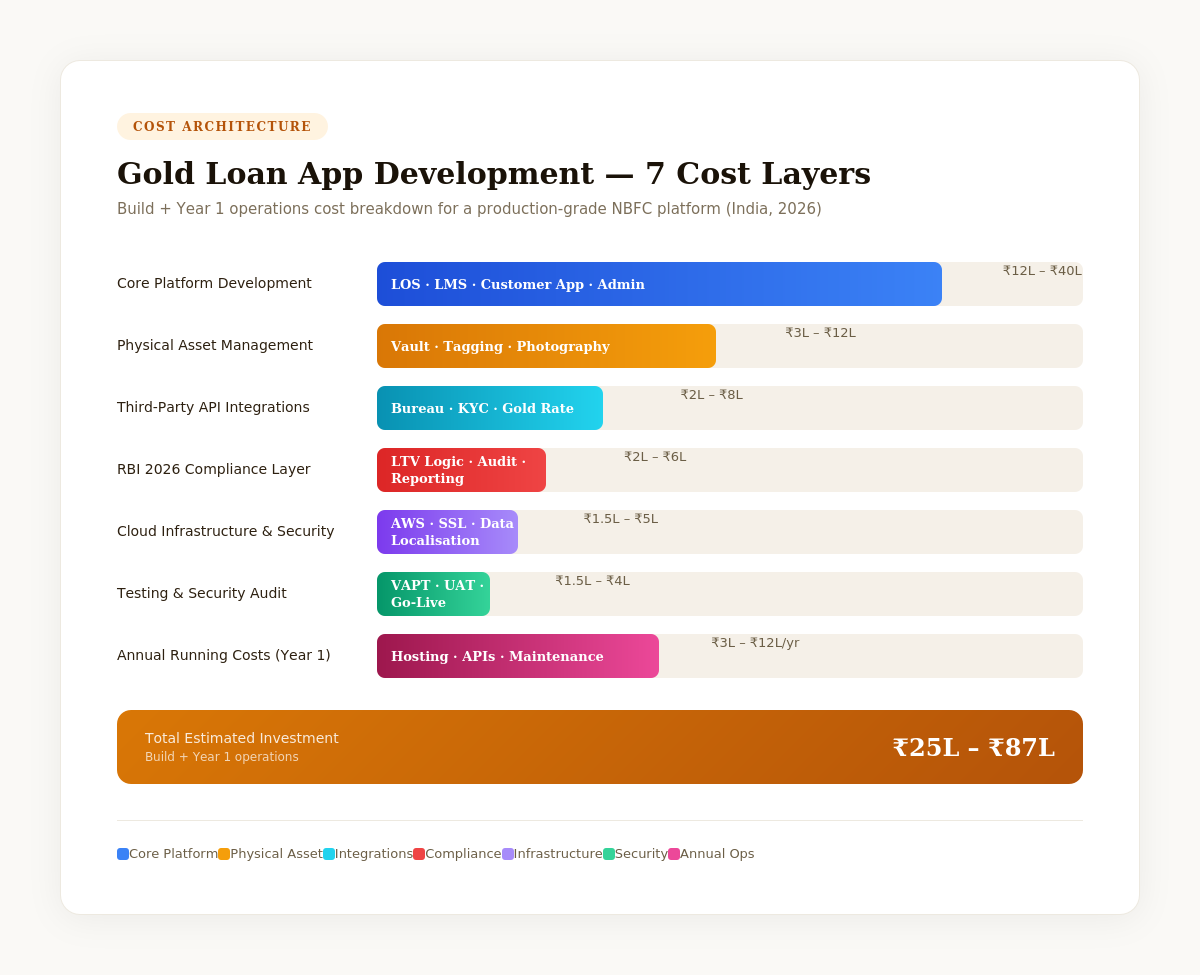
A production-grade gold loan platform has seven cost layers. Most budget conversations miss four of them.
| Cost Layer | What It Includes | Cost Range |
| Core platform development | LOS, LMS, customer app, admin dashboard | ₹12L – ₹40L |
| Physical asset management module | Vault system, tagging, photography, branch ops | ₹3L – ₹12L |
| Third-party API integrations | Bureau, KYC, gold rate, payments, eSign | ₹2L – ₹8L |
| Compliance and regulatory layer | RBI LTV logic, audit trails, reporting | ₹2L – ₹6L |
| Infrastructure and cloud | AWS/GCP setup, security, data localisation | ₹1.5L – ₹5L |
| Testing, security audit, go-live | Pen testing, UAT, RBI inspection readiness | ₹1.5L – ₹4L |
| Annual running costs (Year 1) | Hosting, API subscriptions, maintenance | ₹3L – ₹12L/yr |
| Total (build + Year 1 ops) | ₹25L – ₹87L |
Note: Ranges reflect MVP-leaning vs enterprise-grade builds. All figures are for custom development. White-label options discussed separately below. Verify current API pricing directly with vendor rates change quarterly.
This is the largest cost component and the one most founders underestimate because they think about features, not systems. A gold loan platform is not one product. It is four interconnected systems that must work as one.
System 1 Borrower-Facing App (iOS + Android or Flutter) The customer journey: onboarding, loan application, gold valuation booking, disbursement tracking, EMI management, loan closure, and auction notification.
Development cost: ₹4L – ₹12L depending on complexity.
What drives this number up: doorstep pickup flow (GPS, agent assignment, real-time status updates), in-app gold rate display, OTP-based authentication integrated with Aadhaar, multi-scheme loan options (bullet vs EMI vs overdraft), loyalty programme integration.
What drives this number down: web-first approach over native mobile, limited to one loan scheme type, no doorstep feature in Phase 1.
System 2 Branch Operations App (for field agents and branch staff) This is where the physical asset management happens. Agents use this to: photograph and weigh gold, input purity readings, tag items with unique IDs, photograph the borrower with the gold, generate digital pawn receipts, and confirm vault storage.
Most gold loan cost guides omit this entirely. It is a separate application with different UX requirements (designed for agent use, not borrower use) and different integrations (camera, weighing scale API, barcode/QR scanner, GPS).
Development cost: ₹2L – ₹6L.
What drives this number up: integration with XRF gold purity testing devices (specific hardware APIs), multi-language support for tier 2/3 deployment, offline mode (branches with poor connectivity), real-time sync with head office vault system.
System 3 Loan Management System (LMS) / Backend The operational core. Manages the entire loan lifecycle post-disbursal: interest accrual, EMI schedules, overdue tracking, part payment handling, auction trigger logic, closure workflow, and regulatory reporting.
Development cost: ₹4L – ₹14L.
What drives this number up: support for multiple loan products simultaneously (overdraft + bullet + EMI), multi-branch operations with consolidated reporting, co-lending integration with partner NBFCs or banks, real-time portfolio dashboards for CXOs, API exposure for DSA integrations.
System 4 Admin Dashboard and Reporting CXO-level portfolio visibility, branch performance tracking, auction management, customer service tools, regulatory report generation (CRILC, XBRL, Sahamati AA reporting).
Development cost: ₹2L – ₹8L depending on reporting depth.
| Platform Component | MVP Build | Full-Featured Build |
| Borrower mobile app (Flutter) | ₹3L – ₹5L | ₹8L – ₹12L |
| Branch ops agent app | ₹1.5L – ₹2.5L | ₹4L – ₹6L |
| Backend LMS | ₹4L – ₹7L | ₹10L – ₹14L |
| Admin dashboard | ₹1.5L – ₹3L | ₹5L – ₹8L |
| Core platform total | ₹10L – ₹17.5L | ₹27L – ₹40L |
Timelines: MVP 10–14 weeks. Full build 20–28 weeks.
This is the gold loan-specific layer that no other lending product requires. It is also the layer most vendors don’t include in their initial quotes, which is how the ₹8 lakh estimate becomes a ₹38 lakh reality.
Gold Purity Testing and Valuation Engine The platform must record gold purity (karat value 18K, 20K, 22K, 24K) as entered by the assaying agent, calculate net weight of pure gold content, apply current MCX gold rate, and compute maximum permissible loan value under the applicable LTV tier.
This sounds simple. It isn’t. The LTV calculation must now be dynamic: the same weight of gold generates different maximum loan amounts at ₹2.4 lakh vs ₹2.6 lakh because the RBI 2026 LTV slab changes at ₹2.5 lakh. The engine must handle partial jewellery (mixed purity in one item), multiple items pledged in one loan, and revaluation events when gold prices move.
Vault Management System Every item pledged must be tracked with: unique tag ID (QR/barcode), branch vault location, date of receipt, photograph set (borrower holding item), agent who received it, current status (in vault, released, auctioned), and chain of custody log.
When the borrower closes the loan, the system triggers same-day release (mandatory under RBI 2026 rules) or flags a breach with the automatic ₹5,000/day compensation counter.
Development cost for vault management module: ₹2L – ₹6L depending on whether multi-branch consolidation is needed in Phase 1.
Auction Management Module When a loan defaults, the platform must: notify the borrower 30 days before auction (RBI requirement), publish auction details, record auction outcome, reconcile proceeds against outstanding loan + fees, and remit surplus to borrower. This is a regulated workflow with specific documentation requirements.
Development cost: ₹1L – ₹3L.
Doorstep Gold Loan Flow (Optional in Phase 1, Essential for Scale) Platforms like Rupeek and Oro Money differentiated on doorstep gold pickup an agent visits the borrower, tests the gold at the customer’s location, disburses digitally on the spot. This flow requires: agent mobile app with GPS, live video link to central assaying team, real-time decision from the platform, and instant disbursal to borrower’s bank account.
This is effectively a field operations platform embedded in a lending product. It increases total development cost by ₹4L – ₹10L.
| Component | Basic | Advanced |
| Gold valuation and LTV calculation engine | ₹1L – ₹1.5L | ₹2.5L – ₹3.5L |
| Vault tagging and custody management | ₹1L – ₹2L | ₹3L – ₹5L |
| Auction management workflow | ₹0.5L – ₹1L | ₹1.5L – ₹3L |
| Doorstep flow (agent + customer) | Not included | ₹4L – ₹10L |
| Physical asset module total | ₹2.5L – ₹4.5L | ₹11L – ₹21.5L |
This is the most underestimated cost category in every gold loan platform RFP. APIs are not one-time costs; they have setup fees, per-call costs, and annual subscription components. Here is every API your platform needs, with current pricing.
What it does: Feeds live MCX gold spot prices into the valuation engine. Updated every few minutes during market hours.
Providers: MCX direct data feed, IIFL API, commodity data aggregators.
Cost: ₹15,000 – ₹60,000/year for a clean, reliable feed. Budget for a primary + backup source for uptime reasons.
Why it matters: If your gold rate feed has a 2-hour lag and MCX prices drop 3% during that window, your platform may have already disbursed at an LTV that is now in breach. This is a real regulatory risk.
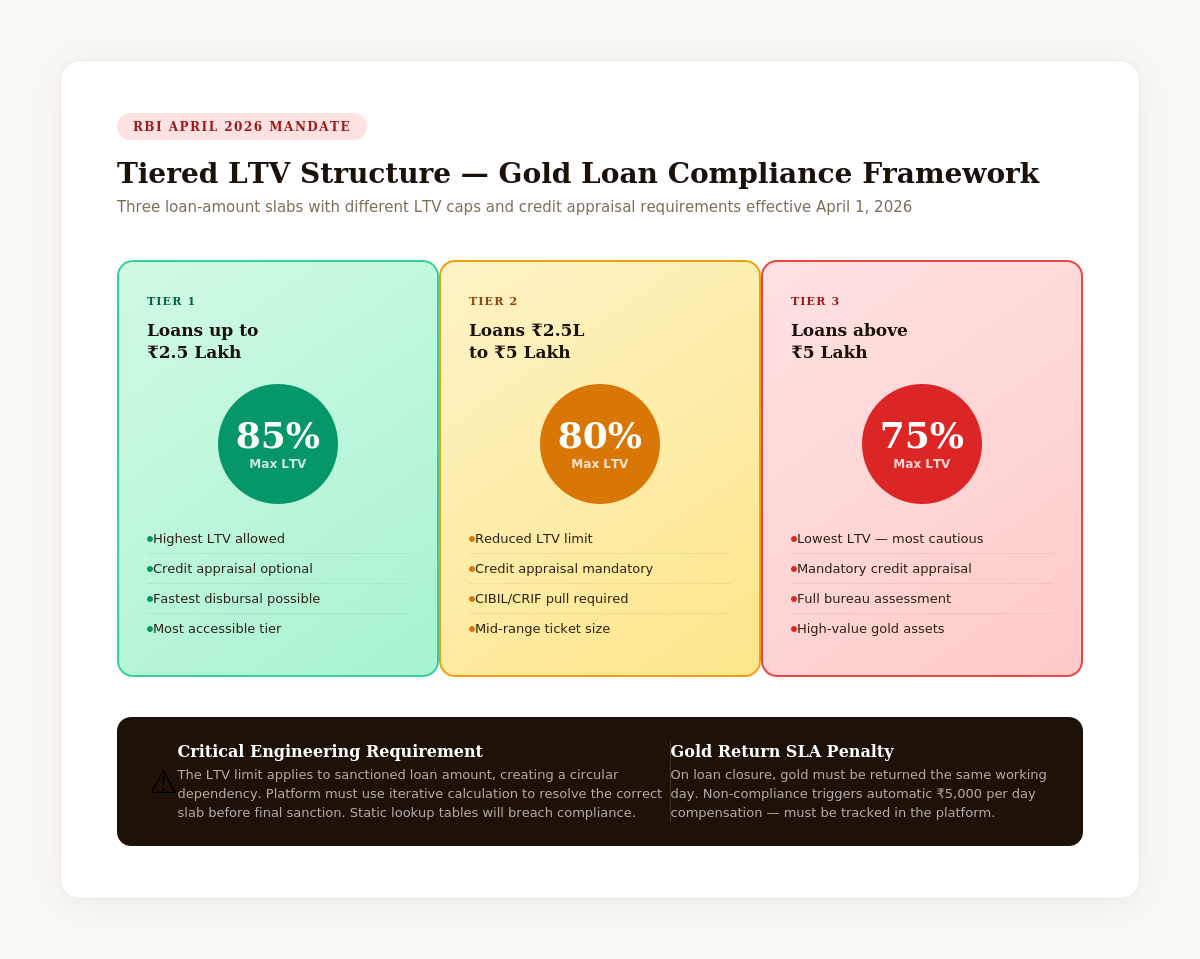
Why gold loans need bureau: RBI April 2026 framework mandates credit appraisal for loans above ₹2.5 lakh. Below that threshold, bureau pull is optional but almost every serious NBFC does it anyway to manage portfolio risk.
| Bureau | Setup/Membership | Per Soft Pull | Per Hard Pull | Enterprise Monthly |
| CIBIL (TransUnion) | ₹50,000 – ₹2,00,000 | ₹15 – ₹25 | ₹35 – ₹60 | Negotiated above 10K/mo |
| CRIF High Mark | ₹30,000 – ₹1,50,000 | ₹12 – ₹20 | ₹30 – ₹50 | Negotiated above 10K/mo |
| Experian | ₹40,000 – ₹1,75,000 | ₹13 – ₹22 | ₹32 – ₹55 | Negotiated above 10K/mo |
Strategy: For gold loans below ₹2.5 lakh, run a soft pull at the pre-qualification stage. Only pull hard when the loan is about to be sanctioned above the threshold. This reduces API spend by 60–70% on high-volume small-ticket gold loan books.
Volume economics at scale: At 1,000 hard pulls/month at ₹50/pull = ₹50,000/month. At 10,000/month, negotiate enterprise rates typically ₹20–35/pull.
| API | Provider Options | Cost Range | Notes |
| Aadhaar OTP e-KYC | UIDAI/licensed KUA | ₹3 – ₹8 per authentication | Requires UIDAI KUA licence (₹1L+ setup) or licensed aggregator |
| PAN verification | Karza, Signzy, IDfy | ₹1.5 – ₹4 per call | Instant. No setup cost with aggregators |
| CKYC fetch | CERSAIE via aggregator | ₹5 – ₹12 per fetch | Faster than Aadhaar for return customers |
| Face match (liveness) | FaceMe, Karza, AWS Rekognition | ₹3 – ₹10 per call | Critical for doorstep and video-assisted gold appraisal |
| Bank account verification (penny drop) | Razorpay, Cashfree | ₹2 – ₹6 per verification | Verify disbursal account before first disbursement |
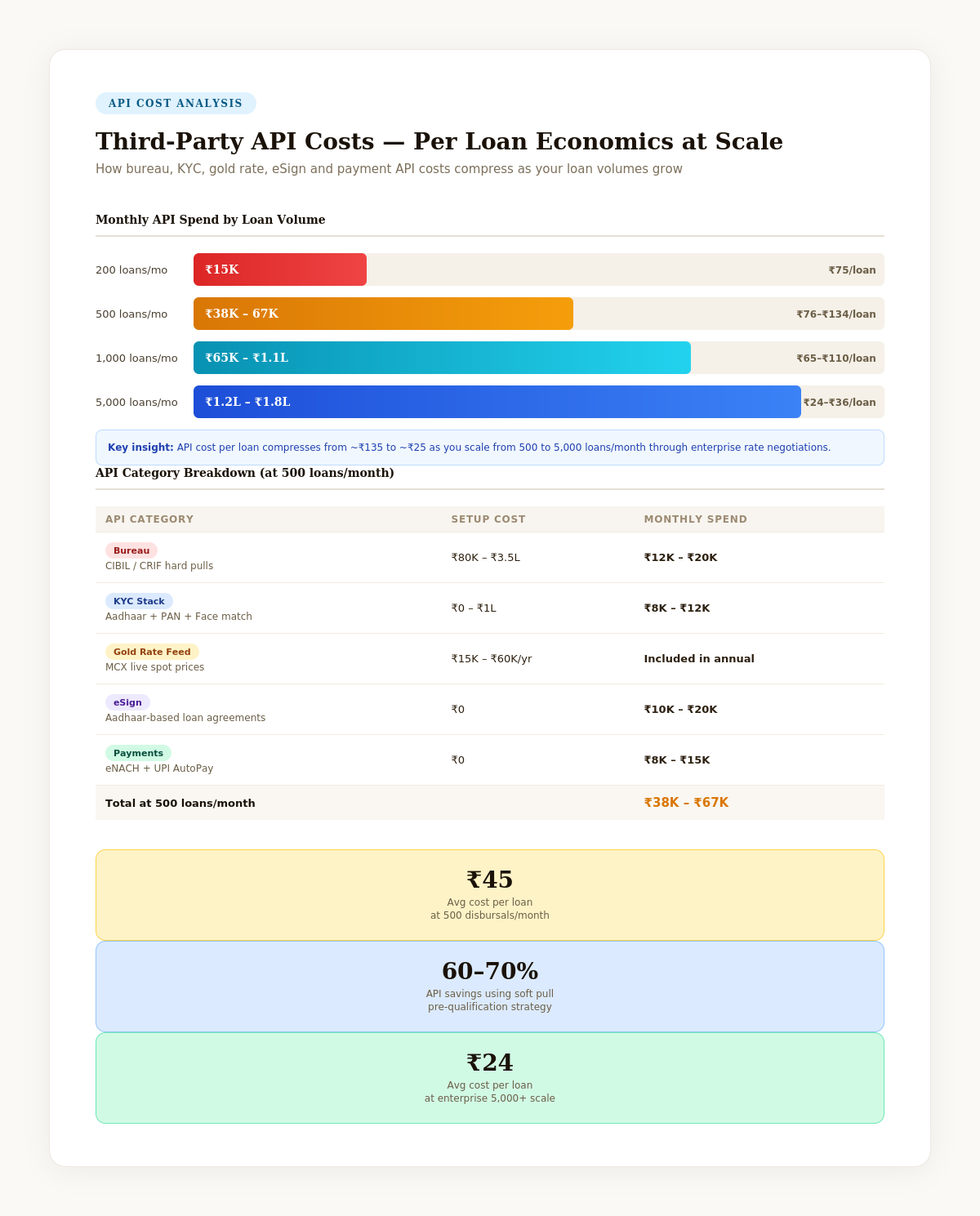
Realistic monthly API cost at 500 loan disbursals/month:
At 5,000 loans/month with enterprise rates: ~₹1.2L/month (₹24/loan). API costs compress meaningfully at scale.
| Service | Provider | Per Transaction | Notes |
| Aadhaar-based eSign | Digio, Leegality, Signdesk | ₹15 – ₹35 | Legally valid, RBI accepted |
| Click-wrap / OTP eSign | Razorpay Documents, Digio | ₹5 – ₹12 | Lower legal strength acceptable for smaller tickets |
| e-Stamp | Stamp vendors via aggregators | ₹50 – ₹200 + stamp duty | Mandatory for loan agreement above certain thresholds |
Loan agreement generation + eSigning at ₹500 loans/month: ~₹10,000 – ₹20,000/month.
| Method | Provider | Cost | Notes |
| eNACH mandate registration | Razorpay, Cashfree, PayU | ₹15 – ₹30 per registration | One-time per customer. Enables auto-debit for EMI |
| UPI AutoPay | PhonePe Business, Razorpay | ₹5 – ₹12 per mandate | Faster activation than eNACH |
| EMI debit execution | Razorpay/Cashfree | 0.5% – 1.2% of transaction | Or ₹3 – ₹10 flat fee per debit depending on agreement |
Gold loans often use bullet repayment (full principal + interest at end of tenure) not EMI. For bullet products, eNACH mandate is still recommended for the closure disbursal event.
| API Category | One-Time Setup | Monthly at 500 Loans |
| Gold rate feed | ₹15K – ₹60K/yr | Included in annual |
| Bureau (CIBIL + CRIF) | ₹80K – ₹3.5L | ₹12K – ₹20K |
| KYC stack (Aadhaar + PAN + face) | ₹0 – ₹1L via aggregator | ₹8K – ₹12K |
| eSign + loan agreement | ₹0 | ₹10K – ₹20K |
| Payment gateway + eNACH | ₹0 | ₹8K – ₹15K |
| Monthly total at 500 loans/month | ₹38K – ₹67K |
This is not optional and it is not free. The April 2026 RBI framework introduced specific technical requirements that must be engineered into your platform. Non-compliance exposes the NBFC to regulatory action. Here is what needs to be built.
The platform must dynamically apply the correct LTV cap based on loan amount not gold value, but disbursed loan amount. The logic:
The challenge: the LTV limit applies to the sanctioned amount, but the sanctionable amount depends on the LTV limit. This creates a circular dependency that must be resolved through iterative calculation. The system must prevent a scenario where a customer’s gold supports a ₹2.6 lakh loan at 80% LTV but the platform calculates it at 85% because the pre-calculation was below ₹2.5 lakh.
Development cost to implement correctly: ₹80,000 – ₹1.5L.
When gold loans are classified under Priority Sector Lending, the platform must capture and validate the declared end use (agriculture, small business, etc.) and maintain monitoring records for RBI inspection.
Development cost: ₹50,000 – ₹1.2L.
RBI now requires: 30-day advance notice to borrower (with delivery confirmation), public auction announcement, transparent bidding process documentation, and surplus remittance to borrower within specified timelines. Each step must be timestamped, documented, and auditable.
Development cost: ₹1L – ₹2L for a fully audit-ready auction workflow.
The platform must automatically trigger and track the gold return process on loan closure. If the branch fails to return within the same working day, the system must: flag the breach, initiate the ₹5,000/day compensation counter, notify the compliance team, and create an audit record.
Development cost: ₹40,000 – ₹80,000.
Every event in the loan lifecycle application, valuation, sanction, disbursal, payment, overdue, auction must be logged in an immutable audit trail. RBI inspectors must be able to pull the complete history of any loan account within hours.
Regulatory reports required: CRILC (NPA reporting), XBRL filing, Sahamati AA reporting for FIU compliance.
Development cost: ₹1.5L – ₹3.5L depending on automation level.
| Compliance Component | Cost Range |
| Tiered LTV calculation engine | ₹80K – ₹1.5L |
| End-use monitoring module | ₹50K – ₹1.2L |
| Auction compliance workflow | ₹1L – ₹2L |
| Gold return SLA tracker | ₹40K – ₹80K |
| Audit trail and regulatory reporting | ₹1.5L – ₹3.5L |
| Compliance layer total | ₹4.2L – ₹9L |
This layer is the most commonly omitted in freelancer and small-vendor quotes. If a vendor has not asked you about tiered LTV enforcement or auction workflow compliance, they have not built for a regulated NBFC.
EngineerBabu builds gold loan infrastructure on AWS. Here is the production-grade setup:
Compute: EC2 instances (t3.medium for staging, c5.large minimum for production) + Auto Scaling Groups for peak load (auction days, salary credit dates)
Database: RDS PostgreSQL for transactional data (encrypted at rest, multi-AZ for 99.95% uptime), DynamoDB for session and event data
Storage: S3 with server-side encryption for gold photographs, KYC documents, and loan agreements with versioning enabled and retention policy aligned to RBI 7-year record-keeping requirement
Security: VPC with private subnets for database layer, WAF (Web Application Firewall) for API protection, CloudTrail for all AWS activity logging, KMS for key management, Secrets Manager for API credentials
Data Localisation: All customer data stored in AWS ap-south-1 (Mumbai region) mandatory for RBI compliance
| Environment | Monthly AWS Cost |
| Development + staging | ₹8,000 – ₹15,000 |
| Production (up to 1,000 loans/month) | ₹25,000 – ₹45,000 |
| Production (1,000 – 10,000 loans/month) | ₹50,000 – ₹1,20,000 |
| Production (10,000+ loans/month) | ₹1,20,000 – ₹3,00,000+ |
Data transfer, CDN (CloudFront for app assets), and third-party monitoring tools (Datadog or CloudWatch) add 15–25% to raw compute costs.
Before going live with any regulated NBFC product, a third-party penetration test and VAPT (Vulnerability Assessment and Penetration Testing) is mandatory for serious operations and often required by banking partners.
VAPT cost from a CERT-empanelled vendor: ₹1.5L – ₹3.5L for the initial go-live audit.
Annual re-audit (required for ISO 27001 and most banking partnerships): ₹1L – ₹2L/year.
| Component | One-Time Setup | Annual |
| AWS initial architecture setup | ₹80K – ₹1.5L | |
| SSL, domain, CDN | ₹10K – ₹25K | ₹10K – ₹25K |
| AWS production hosting (Year 1 at ~1K loans/mo) | ₹3.6L – ₹5.4L | |
| Security audit (VAPT, go-live) | ₹1.5L – ₹3.5L | ₹1L – ₹2L/yr |
| Monitoring (Datadog/Sentry) | ₹60K – ₹1.8L | |
| Infrastructure total (Year 1) | ₹2.4L – ₹5.5L | ₹5.3L – ₹9.6L |
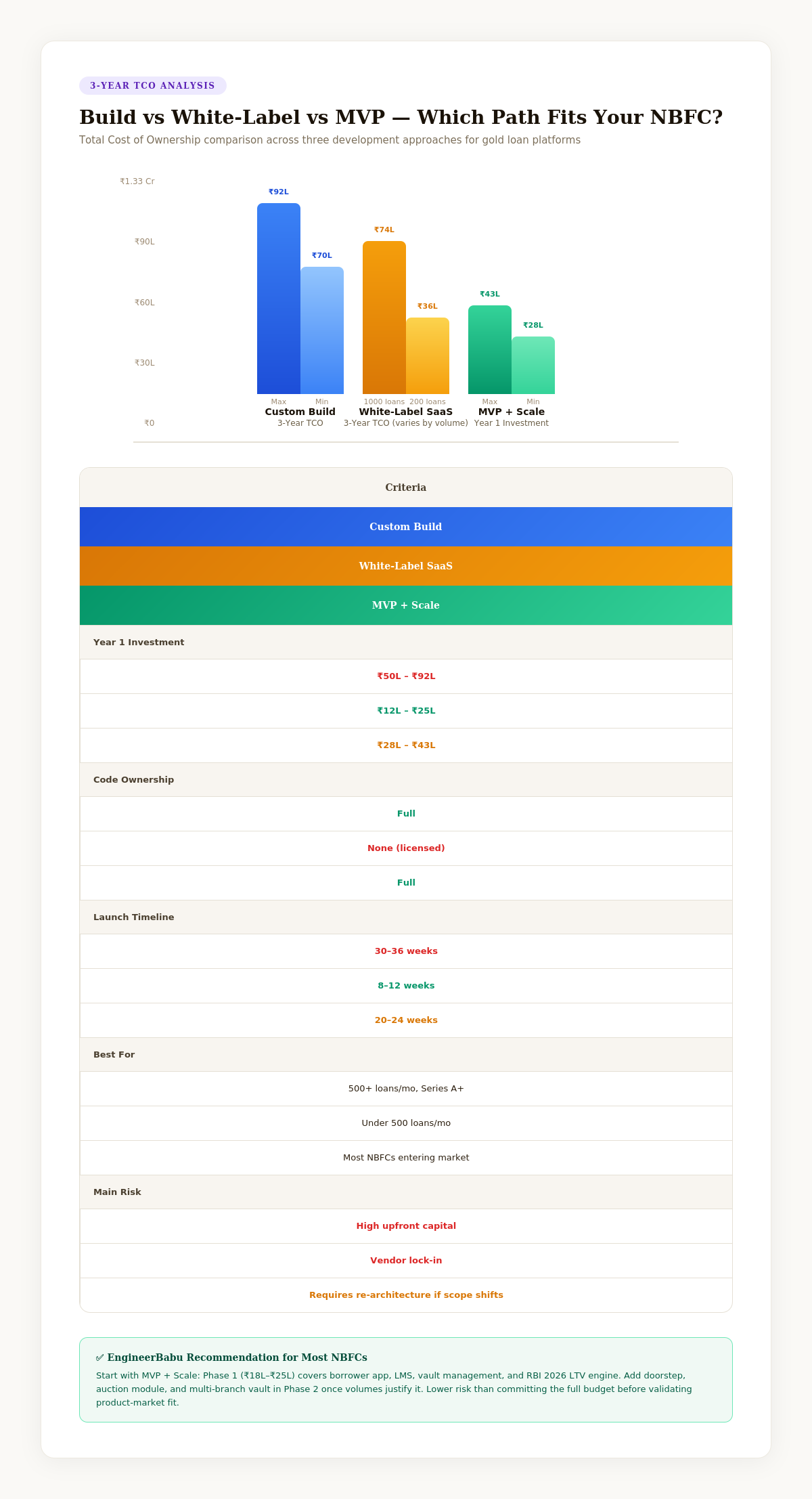
This is the decision every NBFC founder faces. Here is the honest comparison.
What you get: A platform built exactly for your product, your branch structure, your loan schemes, your LTV configuration, your branding. You own the code. No per-loan licensing fee. No vendor lock-in.
What you spend:
| Phase | Cost |
| Year 1 build (full-featured) | ₹35L – ₹65L |
| Year 1 API costs (500 loans/mo) | ₹4.5L – ₹8L |
| Year 1 infrastructure | ₹5.3L – ₹9.6L |
| Year 1 maintenance (15% of build) | ₹5L – ₹10L |
| Year 1 Total | ₹50L – ₹92.6L |
| Year 2 (ops only) | ₹10L – ₹20L |
| Year 3 (ops only) | ₹10L – ₹20L |
| 3-Year TCO | ₹70L – ₹1.33Cr |
Break-even point vs white-label: Typically at 800–1,200 active loans/month where per-loan licensing fees on white-label exceed your infrastructure + maintenance costs.
Providers: Finezza, Nucleus FinnOne, LoanTap OS, LendingKart infrastructure (for others), DigitLend.
Cost structure: Setup fee ₹5L – ₹20L + per-loan fee ₹150 – ₹600 per active loan/month OR revenue share 0.5% – 1.5% of portfolio.
| Volume | Monthly White-Label Cost | Monthly Custom Ops Cost |
| 200 loans/month | ₹60K – ₹1.2L | ₹1.5L – ₹2.5L |
| 500 loans/month | ₹1.5L – ₹3L | ₹1.7L – ₹3L |
| 1,000 loans/month | ₹3L – ₹6L | ₹2L – ₹3.5L |
| 3,000 loans/month | ₹9L – ₹18L | ₹2.5L – ₹5L |
White-label makes sense: When you are below 500 active loans/month, want to launch in under 3 months, and do not need heavy customisation.
Custom build makes sense: When you have more than 500 loans/month active, have a specific product design (multi-scheme, doorstep, co-lending), need full audit trail ownership, or are seeking RBI NBFC licence where technology ownership demonstrates seriousness to regulators.
This is what EngineerBabu recommends for most NBFC clients entering gold loans:
Total 12-month investment: ₹28L – ₹43L. Lower risk than committing the full budget upfront because you validate product-market fit before building every feature.
| Approach | Year 1 Investment | Best For | Main Risk |
| Full custom build | ₹50L – ₹92L | 500+ loan/month target, Series A+ | Capital intensity before validation |
| White-label SaaS | ₹12L – ₹25L setup + per-loan | Under 500 loans/month, fast launch | Vendor lock-in, limited customisation |
| MVP + scale | ₹28L – ₹43L | Most NBFCs entering gold loans | Requires re-architecture if scope changes dramatically |
| Phase | Duration | Deliverable |
| Discovery and architecture | 2–3 weeks | System design, API vendor selection, compliance mapping |
| Core platform MVP | 10–14 weeks | Borrower app, branch agent app, basic LMS, vault management, RBI LTV engine |
| Third-party integrations | Runs parallel to above | Bureau, KYC, gold rate, eSign, payment gateway |
| Testing and compliance audit | 3–4 weeks | VAPT, UAT, RBI LTV logic testing, edge case scenarios |
| Pilot launch | 1–2 weeks | 1–2 branches, controlled loan volume |
| Full launch | Week 18–20 | All branches, full feature set |
Total time from kickoff to production launch: 20–24 weeks for a solid MVP. 30–36 weeks for a full-featured platform.
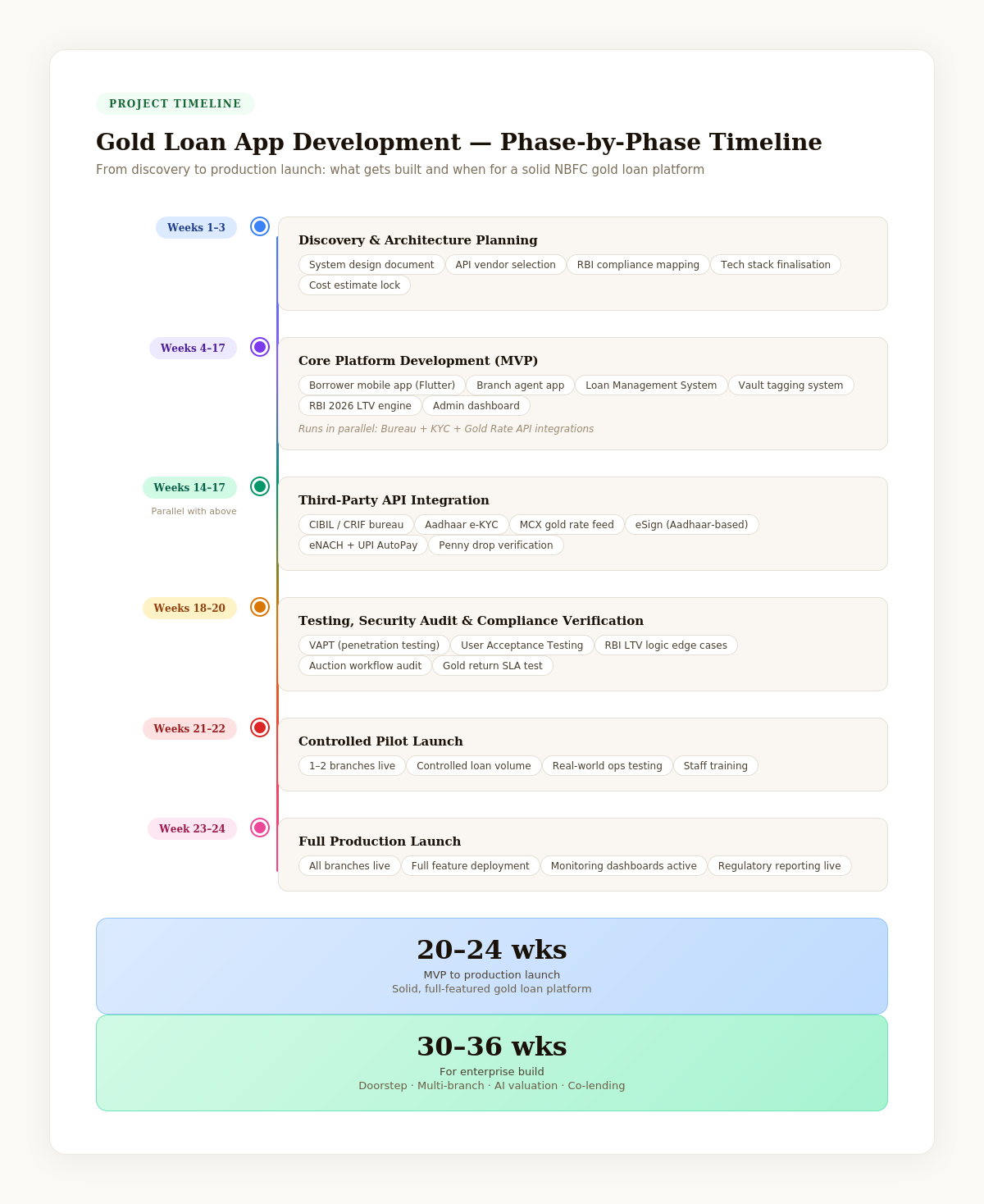
A production-grade gold loan app for an NBFC costs ₹18L – ₹85L to build depending on scope. An MVP covering core borrower app, vault management, LMS, and RBI 2026 compliance runs ₹18L – ₹30L. A full-featured platform with doorstep flow, multi-branch vault, auction module, and AI valuation runs ₹45L – ₹85L. White-label SaaS options exist from ₹5L – ₹20L setup cost with ongoing per-loan fees.
At 500 disbursals/month, expect ₹38,000 – ₹67,000/month in API costs covering bureau pulls, KYC, eSign, and payment gateway. Per-loan API cost is approximately ₹75 – ₹135 at this volume, compressing to ₹25 – ₹50 at enterprise volumes above 5,000 loans/month.
Yes. The tiered LTV engine, mandatory credit appraisal logic above ₹2.5 lakh, gold return SLA tracker, and auction compliance workflow add ₹4L – ₹9L to the compliance layer vs a pre-2026 build. Any vendor quoting for a gold loan platform without asking about the April 2026 tiered LTV rules has not built for the current regulatory environment.
MVP to production launch: 20–24 weeks. Full-featured platform: 30–36 weeks. Key dependencies that extend timelines: UIDAI KUA licence approval (6–8 weeks), bureau membership approval (4–6 weeks), RBI NBFC registration if not already held.
Offshore development (Eastern Europe, Southeast Asia) may appear 20–30% cheaper on surface developer rates but rarely understands the Indian regulatory stack RBI guidelines, Aadhaar integration, CIBIL membership requirements, GST-linked verification. The compliance gaps typically cost 2–3× the apparent savings to fix post-launch. EngineerBabu’s recommendation is always Indian-first development for regulated lending products.
Below 500 active loans/month: white-label is more capital-efficient. Above 500 active loans/month: custom becomes cost-competitive and gives you control over roadmap, compliance posture, and audit infrastructure. If you are targeting a ₹100 crore book within 18 months, start with custom MVP now white-label will become a bottleneck at scale.
Year 1 post-launch: platform maintenance (₹4L – ₹8L), AWS infrastructure (₹3.6L – ₹9.6L), API subscriptions (₹4.5L – ₹8L), annual VAPT (₹1L – ₹2L), regulatory filing support. Total Year 1 ongoing: ₹13L – ₹28L depending on loan volume and infrastructure tier.
Yes. Computer vision models trained on gold images can estimate purity with 85–92% accuracy. However, RBI still requires human assayer confirmation before loan sanction. AI valuation reduces assayer time per item, not the regulatory requirement for human sign-off. Build cost for AI valuation module: ₹8L – ₹20L. EngineerBabu has built vision-based valuation prototypes and contacted us for a feasibility assessment specific to your gold loan product design.