Create engaging, high-performance mobile applications tailored to your business needs. We craft future-ready apps that offer smooth user experiences on all devices.
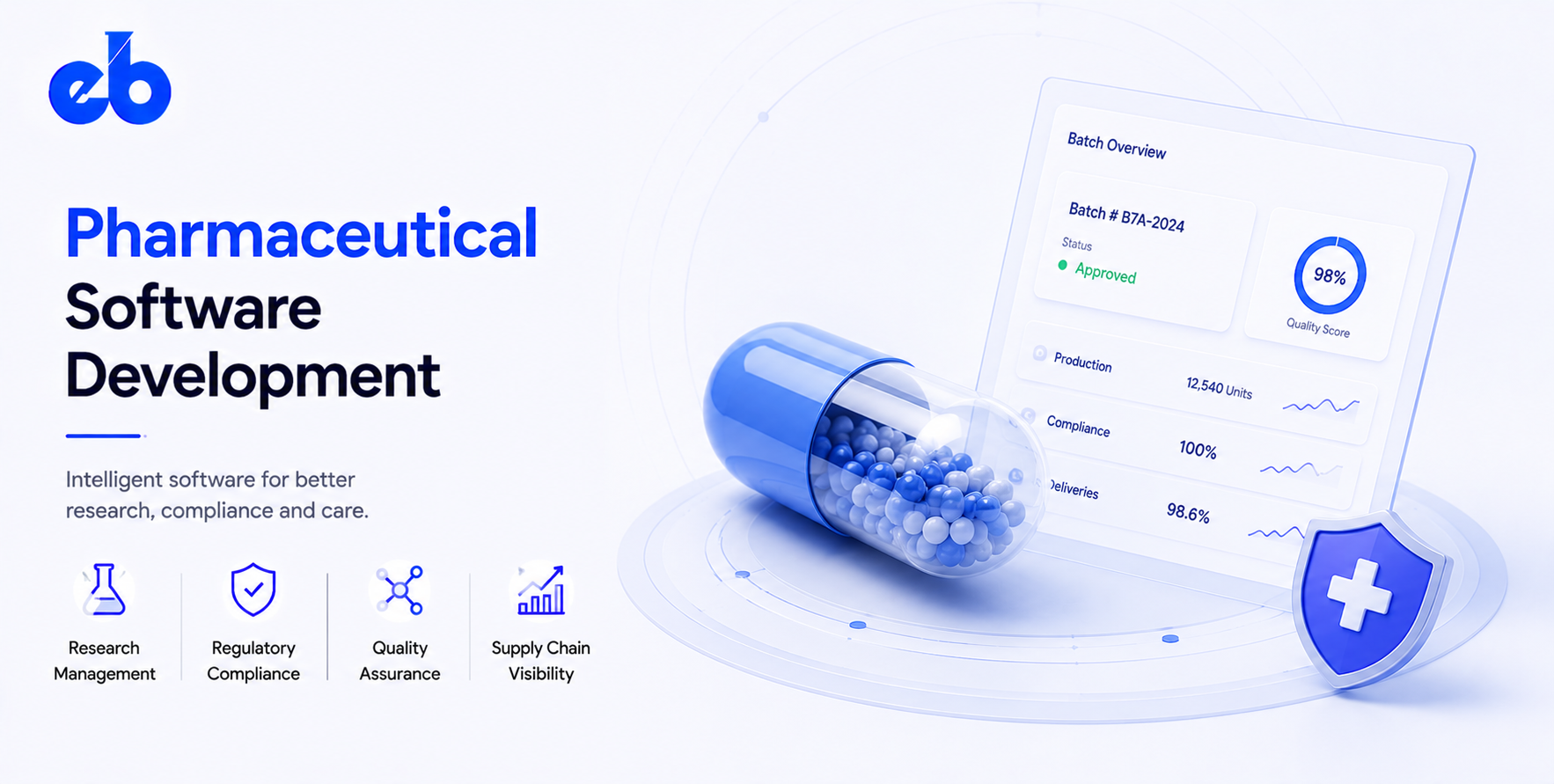
Pharmaceutical Software Development 2026 | EngineerBabu
Mayank Pratap Singh
Founder & CEO of Engineerbabu
An Indian pharmaceutical manufacturer, one of the thousands supplying generic drugs to US pharmacy chains received a chargeback notice from their US distributor in Q4 2025.
The reason: their serialization data was not DSCSA-compliant. Specifically, the EPCIS (Electronic Product Code Information Services) event data they were transmitting for their product shipments was in an older format that didn’t conform to the CBV (Core Business Vocabulary) 2.0 standard that the FDA’s 2025 enforcement framework required. The distributor couldn’t accept the product without valid EPCIS data. The shipment was held.
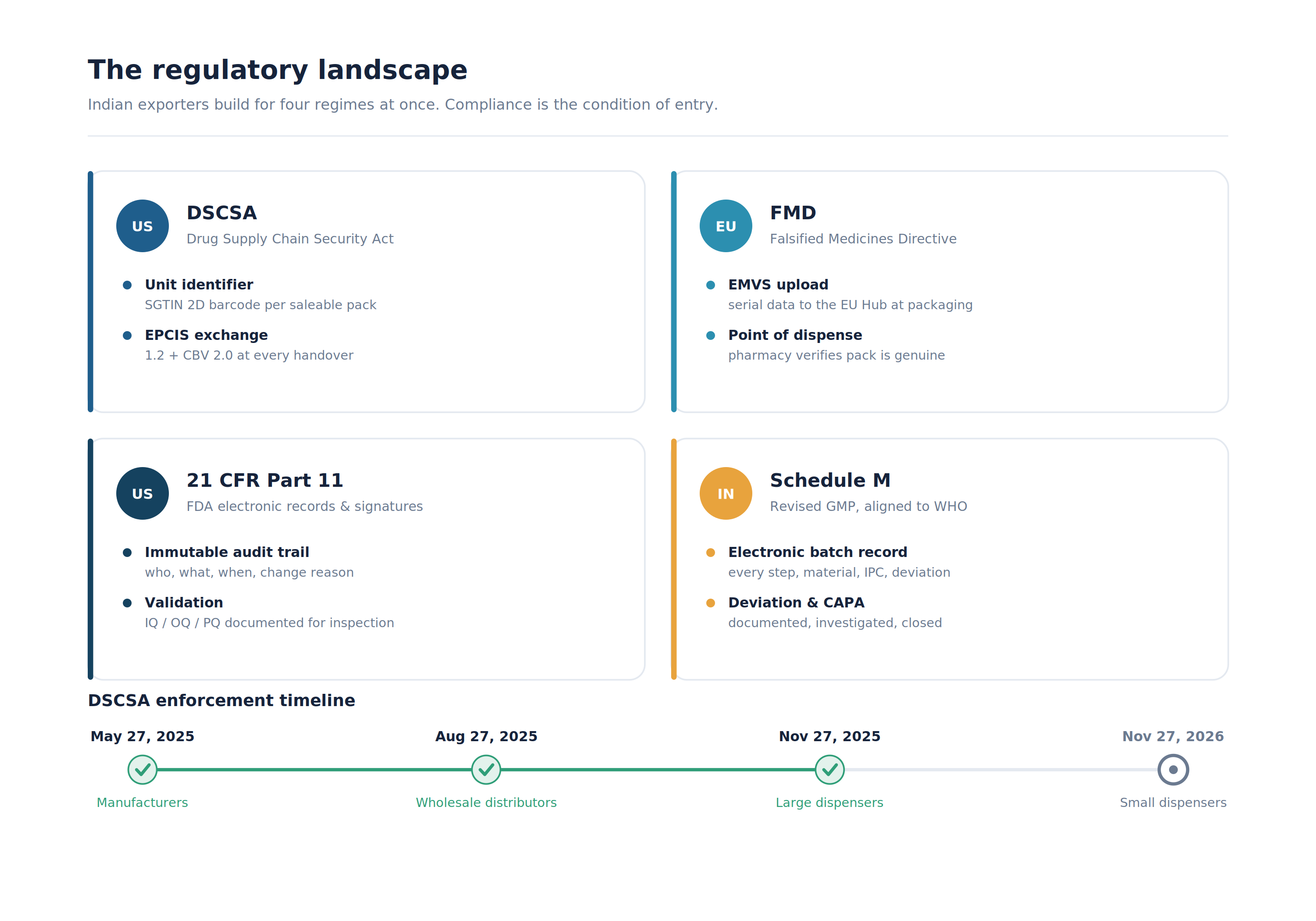
The FDA’s Drug Supply Chain Security Act enforcement timeline is complete. Manufacturers crossed their May 27, 2025 deadline. Wholesale distributors crossed theirs on August 27, 2025. Large dispensers crossed November 27, 2025. The final deadline, small dispensers is November 27, 2026.
For Indian generic manufacturers exporting to the US market, DSCSA compliance is not optional. It is the condition of entry.
I co-founded EngineerBabu 14 years ago. The team built the Qubit pharma traceability platform, a track-and-trace serialization system for pharmaceutical manufacturers navigating DSCSA (US) and FMD (EU) compliance simultaneously.
UUID-based serialization, EPCIS event generation, and integration with TraceLink and other US interoperability networks. That is the specific experience that makes this guide different from a generic software agency writing about pharma.
The global pharmaceutical manufacturing software market reaches $4.43 billion in 2026, growing at 15.8% CAGR to $7.87 billion by 2030. India supplies 20% of global generics. Every Indian pharma exporter needs compliant software.
The Regulatory Landscape Every Indian Pharma Manufacturer Faces
1. DSCSA (United States – Drug Supply Chain Security Act)
Full enforcement active. Every prescription drug in the US supply chain must have:
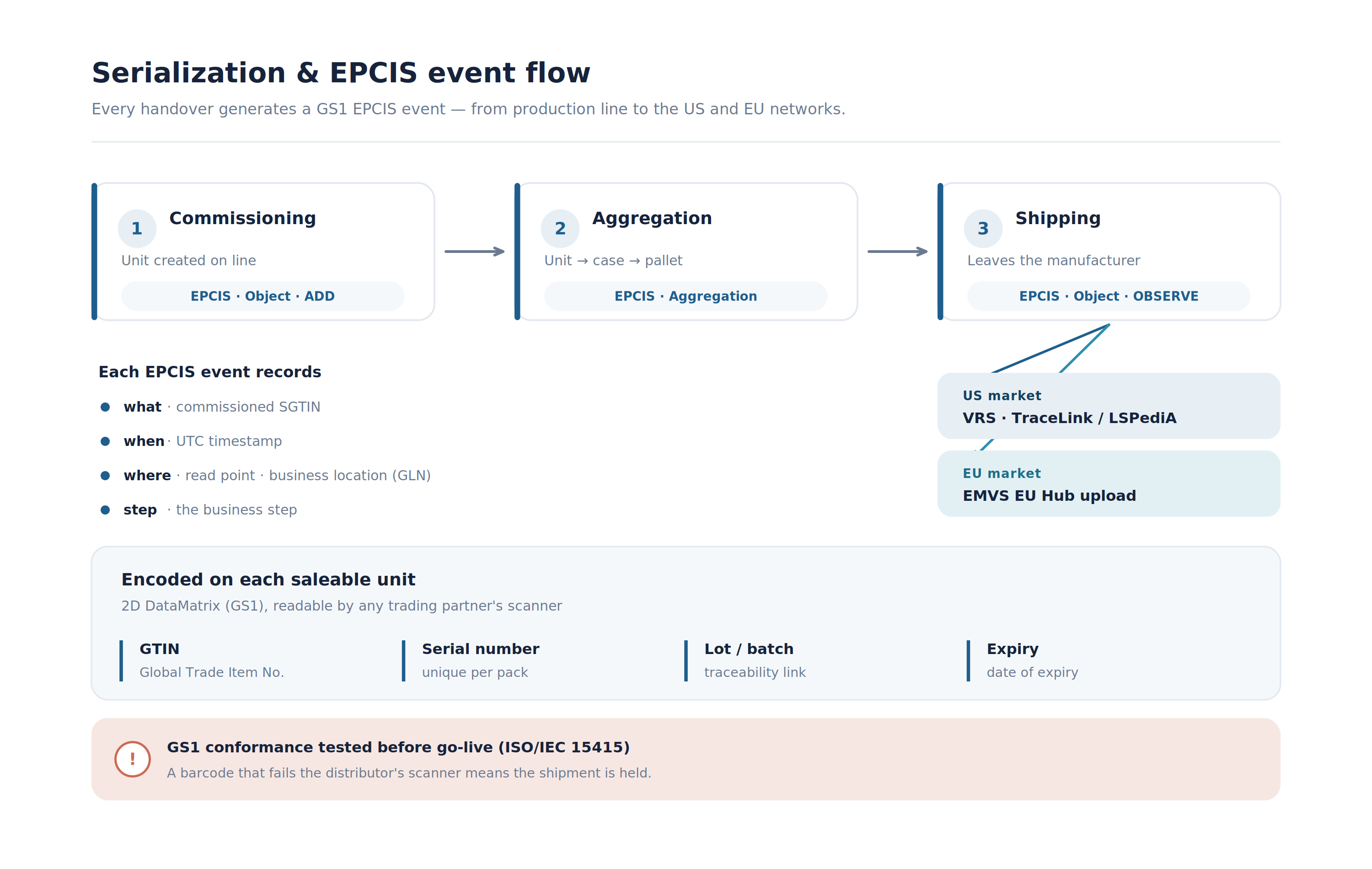
Unique product identifier, a 2D barcode on each saleable unit containing: GTIN (Global Trade Item Number), serial number (unique per package), lot/batch number, expiration date. The barcode must be readable by any trading partner’s scanning system.
Transaction documentation, every time a drug product changes hands (manufacturer to wholesaler, wholesaler to pharmacy), the Transaction Information (TI), Transaction History (TH), and Transaction Statement (TS) must be exchanged electronically. The EPCIS standard (specifically GS1 EPCIS 1.2 + CBV 2.0 for 2025 onwards) is the required format.
Verification routing, when a trading partner needs to verify a product’s legitimacy (e.g., a pharmacy verifying an unusual purchase), they must be able to route a verification query to the manufacturer’s verification system via an authorised Verification Router Service (VRS).
Product tracing, in the event of a recall or investigation, the full transaction history must be available electronically, from manufacturer to the specific dispensing pharmacy.
The Indian exporter’s specific challenge: Indian manufacturers exporting to the US must implement serialization at their Indian production line, generate EPCIS data at the time of packaging, and transmit it through the US interoperability network when the product crosses into the US supply chain. The compliance obligation exists even though the manufacturing happens in India.
2. EU Falsified Medicines Directive (FMD)
Parallel to DSCSA, the EU FMD requires:
2D barcode on each pack: product code, serial number, batch number, expiration date (same structure as DSCSA but with EU-specific product code format).
Upload to EMVS (European Medicines Verification System), at packaging time, the manufacturer uploads serial number data to the EU Hub, which distributes it to national verification organisations. At point of dispensing, the pharmacy’s system queries the national database to verify the product is genuine.
As of 2026, 78+ countries worldwide mandate pharmaceutical serialization. India itself is advancing a national Track and Trace System (TTSP).
3. 21 CFR Part 11 (US FDA Electronic Records)
For pharmaceutical companies subject to FDA inspection (all US-exporting manufacturers), 21 CFR Part 11 governs electronic records and electronic signatures:
Audit trails, every record change must have an immutable audit log: who changed what, when, what the previous value was.
Electronic signatures must be linked to their signatories, cannot be excised, and must be executed only by their owner.
System validation, every GxP-relevant software system must be validated: installation qualification (IQ), operational qualification (OQ), and performance qualification (PQ). The validation documentation must be maintained for FDA inspection.
4. India’s Schedule M (Revised) – GMP for Domestic Manufacturers
CDSCO (Central Drugs Standard Control Organisation) updated the Schedule M GMP guidelines in 2023 (implemented progressively through 2025–2026) to align with WHO GMP standards. Every pharmaceutical manufacturer with a CDSCO manufacturing licence must comply. Key requirements affecting software:
Batch record, every production batch must have a complete electronic batch record showing all steps performed, all materials used, all in-process checks, and all deviation events.
Equipment qualification and calibration, calibration schedule for all production and testing equipment, with electronic records of calibration results.
Deviation and CAPA management, any deviation from the approved manufacturing procedure must be documented, investigated, corrective action defined and implemented.
The 6 Core Modules of a Pharmaceutical Software Platform
1. Serialization and Track-and-Trace Engine
The Qubit platform the team built handles exactly this.
Serial number generation: UUID-based serial numbers meeting the pharmaceutical industry uniqueness requirements (probability of collision must be below defined thresholds for the expected production volume). The serialization engine generates, assigns, and manages serial numbers at the unit (each pack), case (aggregation), and pallet levels.
GS1 barcode encoding: 2D DataMatrix barcode encoding the SGTIN (Serialised Global Trade Item Number) in GS1 standard format. The barcode must pass GS1 conformance checking (quiet zone, module size, error correction level). Poorly encoded barcodes fail scanner verification at the US distributor.
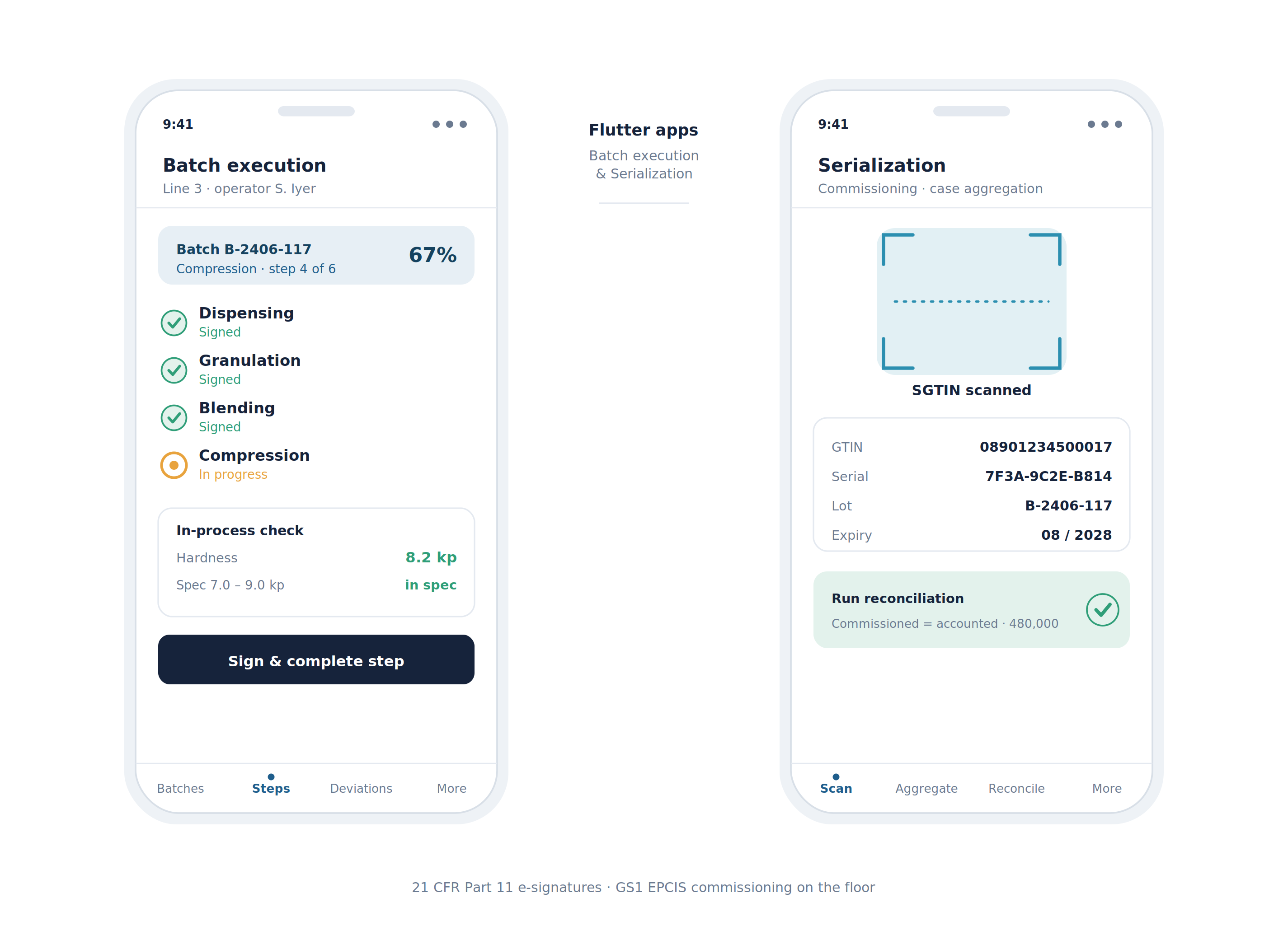
Commissioning event: when a serialized unit is created at the production line, a Commissioning EPCIS event is generated and stored. This event records: what was commissioned (SGTIN), when (timestamp), where (read point, business location in GLN format), and under what business step.
Aggregation: units are packed into cases, cases onto pallets. Each aggregation step generates an EPCIS Aggregation event recording the parent-child relationship (pallet contains cases, case contains units).
Shipping event: when product leaves the manufacturer, a Shipping EPCIS event is generated. This is the event transmitted to the trading partner.
EMVS upload (for EU market): serialized data uploaded to the EU Hub via the EMVS connector at the time of packaging (for EU-destined product).
VRS (Verification Routing Service) integration (for US market): registration with an authorised VRS provider (LSPediA, TraceLink, rfxcel) enabling trading partners to route verification queries to the manufacturer’s serialization system.
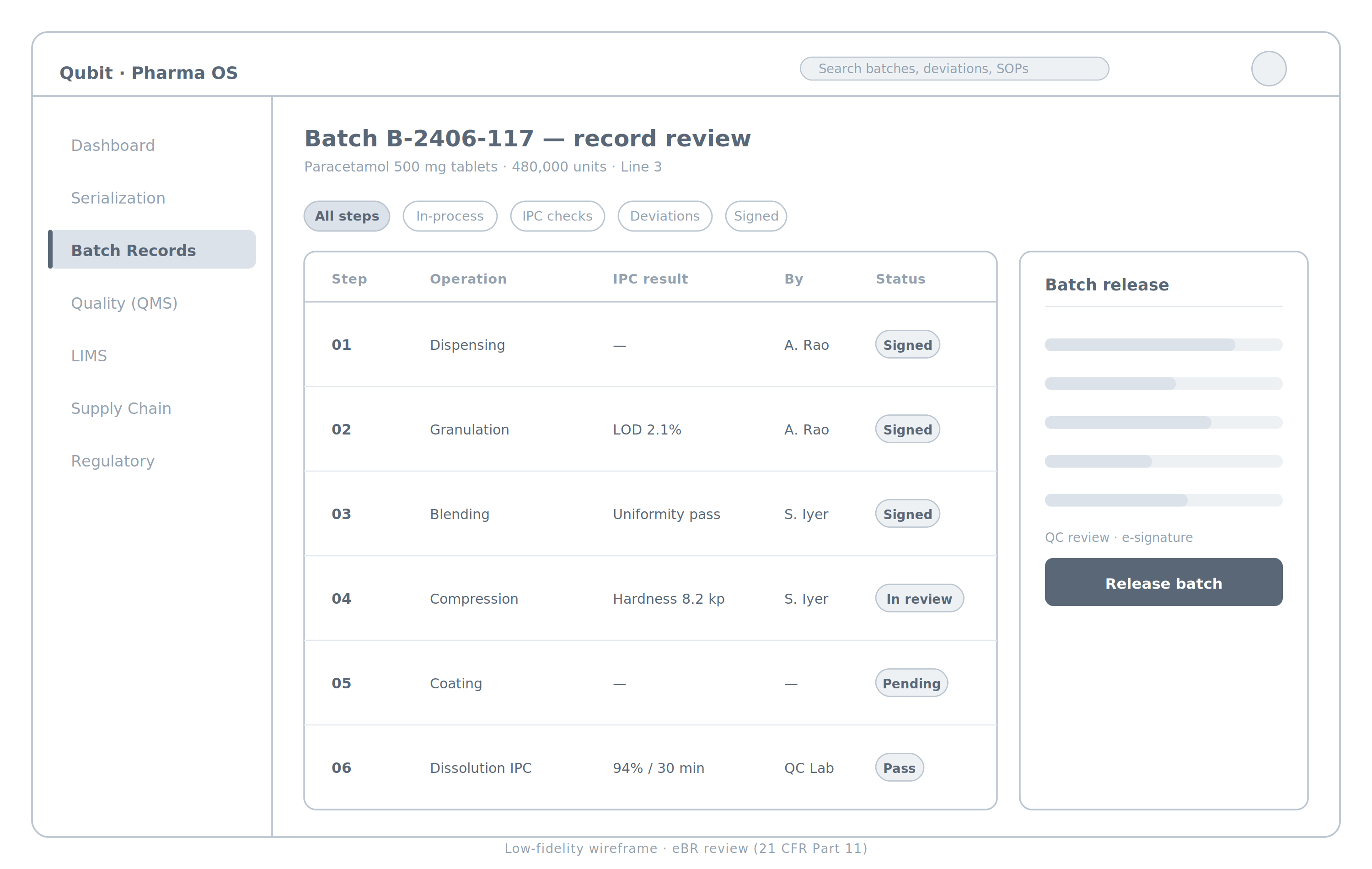
2. Electronic Batch Record (eBR)
The electronic batch record replaces the paper batch record (the traditional pharma “bible” for a production batch):
Recipe management: the approved manufacturing procedure (AMP) defines all production steps, materials, quantities, and in-process control checks. The eBR system manages approved recipes with version control.
Batch execution: during production, operators record each step’s completion via terminal or tablet. Critical steps (material weighing, critical parameter checks) may require electronic signature.
In-process control (IPC) recording: at defined production stages, quality checks are performed and results recorded (tablet hardness, dissolution, sterility check for injectables). Out-of-specification results trigger immediate alerts.
21 CFR Part 11 compliant audit trail: every entry in the batch record, material addition, IPC result, deviation, equipment use is logged with timestamp, user ID, and change reason. Immutable. Exportable for FDA inspection.
Batch release workflow: quality review of the completed batch record, release authorisation by the Quality Control head, electronic signature (21 CFR Part 11 compliant). The batch is not released until the workflow is complete.
3. Quality Management System (QMS)
Deviation management: when production deviates from the approved procedure, a deviation record is raised. The QMS manages the investigation, root cause analysis, impact assessment, and corrective action workflow.
Change control: any change to a validated process, facility, equipment, or material requires a formal change control record. The QMS manages the change request, impact assessment, validation requirements, and approval workflow.
CAPA (Corrective and Preventive Action): when a quality issue is identified (deviation, customer complaint, audit finding), a CAPA record is created. The QMS tracks the corrective action, implementation, effectiveness verification, and closure.
Document management: controlled documents (SOPs, specifications, analytical methods) managed with version control, approval workflow, and distribution control. No unauthorised version can be accessed by production or QC staff.
OOS (Out-of-Specification) investigation: when a laboratory test result is out-of-specification, the OOS investigation procedure must be followed (FDA guidance). The QMS manages the investigation workflow.
Complaint management: customer complaints investigated, linked to batch records, and trended for systemic issues.
4. Laboratory Information Management System (LIMS)
Sample management: samples received, labelled, assigned to analysts, tracked through analysis.
Test method management: approved analytical test methods maintained with version control.
Results recording: analyst records test results electronically. Instrument data integration (HPLC, spectrophotometry, dissolution tester) for automatic data capture.
OOS/OOT handling: out-of-specification and out-of-trend results flagged immediately with workflow triggers for investigation.
Certificate of Analysis (CoA) generation: automated CoA generation from approved batch results. CoA is the document that accompanies each batch for customer and regulatory use.
5. Supply Chain and Cold Chain Management
Supplier qualification: approved supplier list maintained with qualification status (approved, conditional, disqualified), audit history, and supplier risk scores.
Incoming material management: every raw material delivery logged with supplier details, CoA, and inspection results. Non-conforming material quarantined with CAPA trigger.
Cold chain monitoring (for biologics and vaccines): IoT sensor integration for temperature-sensitive products. Temperature excursion alerts with automated hold and investigation trigger.
Serialization data exchange: when finished goods ship, serialization data (EPCIS events) transmitted to the trading partner via the interoperability network. The supply chain module manages the transmission and confirmation receipt.
FDA inspection readiness: 483 observations tracking, warning letter response management, corrective action evidence repository.
Annual Product Review (APR): CDSCO and ICH Q10 require an annual product review covering batch data, stability data, complaint trends, and process capability analysis. The platform generates APR data reports from batch records, QMS, and LIMS.
Stability data management: stability study design, sampling schedule, results recording, and trend analysis. ICH guidelines specify stability testing requirements for registration dossiers.
What Agentic AI Makes Possible in Pharma
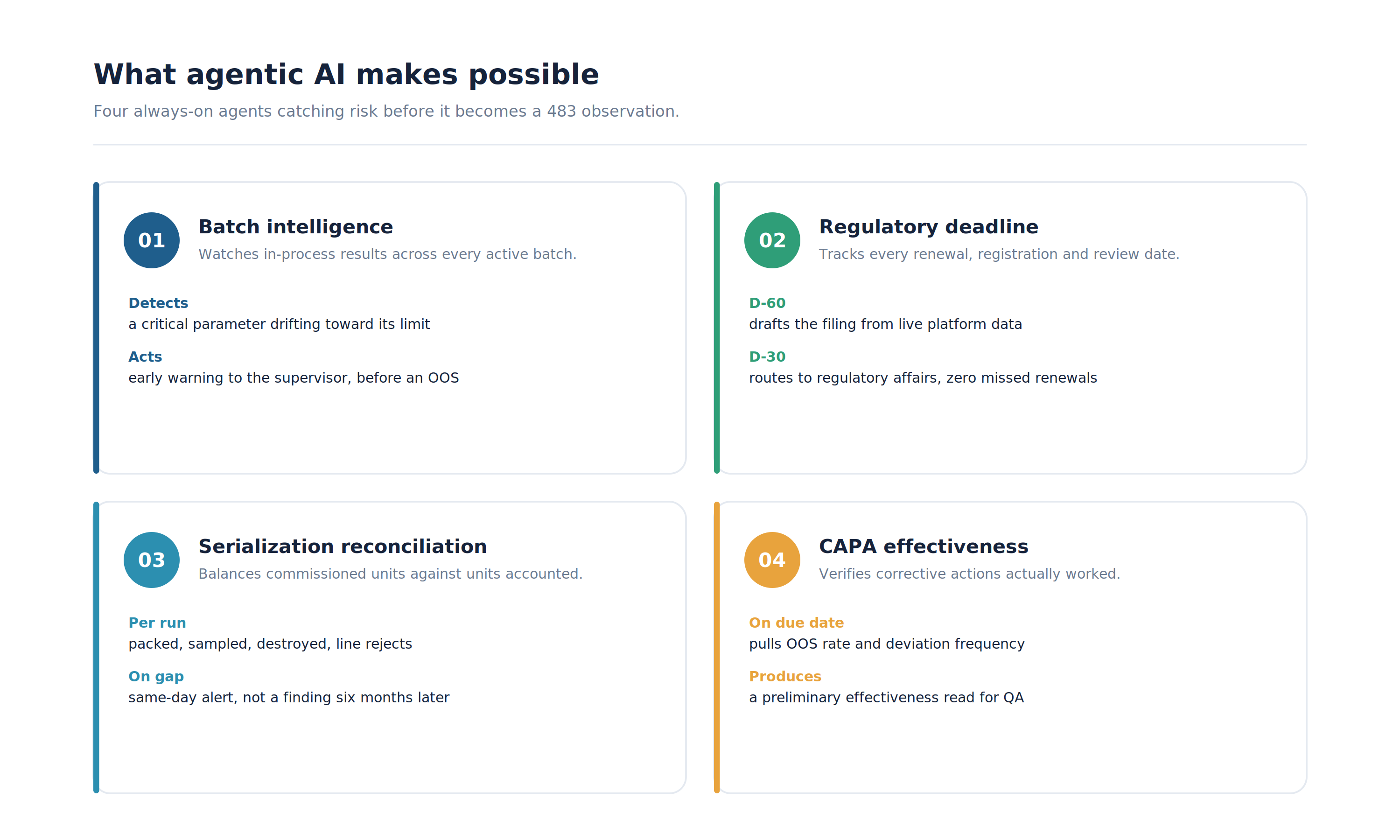
Agent 1 – Batch Intelligence Agent:
Monitors in-process control results for all active batches in real time. When a critical parameter trends toward the specification limit (still in-spec but statistically drifting), the agent fires an early warning to the production supervisor before an OOS occurs. Early intervention opportunity. Fewer batch failures.
Agent 2 – Regulatory Deadline Agent:
Monitors all regulatory filing deadlines, CDSCO licence renewals, drug product registration renewals, FDA PDUFA dates, annual product review deadlines. 60 days before each: generates the required filing documentation from live platform data. 30 days before: sends for regulatory affairs team review. Zero missed renewals.
Agent 3 – Serialization Reconciliation Agent:
At the end of each production run, reconciles serialized units commissioned vs. units accounted for (packed, destroyed, sampled, line rejects). Discrepancies above threshold trigger immediate alert. Missing serial numbers are a compliance risk, the agent catches them the same day, not in an audit 6 months later.
Agent 4 – CAPA Effectiveness Agent:
Monitors CAPA implementations against their target effectiveness dates. When a CAPA’s effectiveness verification date arrives, generates a data pull from the relevant area (batch records, OOS rates, deviation frequency) and produces a preliminary effectiveness assessment for the QA manager’s review.
Integrations: GS1 EPCIS event transmission · TraceLink / LSPediA VRS connector · EMVS EU Hub connector · CDSCO licensing portal · HPLC/spectrophotometry instrument data integration · IoT temperature sensor data (cold chain) · e-Signature platform (21 CFR Part 11 compliant).
The Failure Framework
Failure 1: The Non-Conforming Barcode, serialization system generates 2D DataMatrix barcodes that pass internal scanning but fail GS1 conformance at the trading partner’s receiving scanner. The US distributor rejects the shipment. Fix: GS1 conformance testing (ISO/IEC 15415 for 2D barcodes) run on every barcode encoding configuration before production deployment.
Failure 2: The EPCIS Format Mismatch, EPCIS events generated in an older CBV version that trading partners have deprecated. The FDA’s 2025 enforcement requires EPCIS 1.2 + CBV 2.0. Fix: EPCIS format version configurable. VRS provider’s format requirements validated before go-live. Format update procedure documented and tested.
Failure 3: The Audit Trail Gap, batch records changed by a supervisor without the system capturing the change reason. FDA inspection finds audit trail entries without required change reason documentation. 483 observation issued. Fix: 21 CFR Part 11 audit trail enforced at the database layer, no record modification without timestamp, user ID, and change reason. Immutable. Not configurable off by any user role.
Failure 4: The Recall Without Traceability, a quality issue is found in finished product. The manufacturer needs to identify all affected batches and all customers who received those batches. Without electronic batch records linked to serialization data, the recall investigation takes 3 weeks manually. Fix: forward and backward traceability built at the data model design phase. Every raw material lot → batch → serialized unit → shipment record is linked in the database from the first production run.
Cost and Timeline
Pharmaceutical software development starts from $25,000 for a DSCSA serialization compliance module, serialization engine, GS1 barcode encoding, EPCIS event generation, VRS integration.
Full pharma platform, eBR + QMS + LIMS + serialization + CDSCO compliance + supply chain: $90,000–$250,000 depending on scope.
Timeline: Serialization module: 10–14 weeks. Full pharma platform: 6–12 months.
Qubit pharma traceability platform live proof. Google AI Accelerator 2024. CMMI Level 5. 40–60% lower cost than US/UK equivalent.
FAQ
What is DSCSA compliance for pharmaceutical software?
The Drug Supply Chain Security Act requires every prescription drug in the US supply chain to have a unique 2D barcode (SGTIN), EPCIS-formatted transaction documentation exchanged at every handover, and a verification routing system for product authentication. Full enforcement is active for manufacturers (from May 2025). Indian generic manufacturers exporting to the US must implement DSCSA-compliant serialization at their Indian production lines.
What is EPCIS and why does it matter for pharma?
Electronic Product Code Information Services (EPCIS) is the GS1 standard for recording and sharing supply chain events (commissioning, aggregation, shipping). DSCSA requires EPCIS 1.2 + CBV 2.0 for all transaction documentation. Non-conforming EPCIS data is rejected by US trading partners, blocking product entry into the US supply chain.
What is 21 CFR Part 11 compliance for pharma software?
FDA regulation governing electronic records and signatures in regulated pharmaceutical environments. Requires: immutable audit trails with timestamp, user ID, and change reason for every record modification; electronic signatures that are linked to their signatory and cannot be excised; system validation (IQ, OQ, PQ) with maintained documentation.
What is Schedule M (Revised) compliance?
India’s updated GMP requirements for domestic pharmaceutical manufacturers, aligned with WHO GMP. Requires electronic batch records, equipment qualification, deviation and CAPA management, and document control systems.
How long does it take to build pharmaceutical software?
Mayank Pratap is the Co-founder of EngineerBabu, a CMMI Level 5 product engineering company that has delivered 500+ products across 20+ countries, including 200+ VC-funded builds and 75 Y Combinator-selected products. EngineerBabu was selected into the Google AI Accelerator's top 20 globally in 2024, is backed by Vijay Shekhar Sharma (founder of Paytm), participates in the Harvard Innovation Labs ecosystem, and is a NASSCOM member recognized as one of LinkedIn's Top 20 Startups in India. Mayank has been building technology products for 14 years and leads every client engagement personally. EngineerBabu takes 20 projects a year, all founder-led, all from referrals.