How to Build a Legal AI Research Platform - Case Law Search, RAG Architecture, Citation Verification 2026


Create engaging, high-performance mobile applications tailored to your business needs. We craft future-ready apps that offer smooth user experiences on all devices.
Build robust and scalable websites and CMS platforms that help you manage content effortlessly. Our development ensures a seamless digital presence.
Launch secure, feature-rich online stores with intuitive shopping experiences. We build tailored eCommerce platforms designed for growth.
Design captivating games with immersive gameplay and stunning graphics. From concept to launch, we build engaging experiences that players love.
Enhance your customer relationships with customized Salesforce implementations. Drive growth and efficiency with smarter CRM solutions.
Harness artificial intelligence and machine learning to automate workflows and gain actionable insights. Our AI transforms data into smart decisions.
Accelerate your software delivery lifecycle with continuous integration, delivery, and infrastructure automation to boost efficiency.
Hire app developers ready to turn your ideas into sleek, high-performing mobile apps for any platform.
Bring in frontend pros who craft smooth, beautiful, and user-friendly interfaces that your visitors will love.
Get backend developers who build fast, secure, and reliable systems to keep everything running behind the scenes.
Hire eCommerce developers who build secure, scalable online stores designed to offer seamless shopping and grow your sales.
Get dedicated developers committed to your projects, delivering consistent quality and speed as an extension of your team.
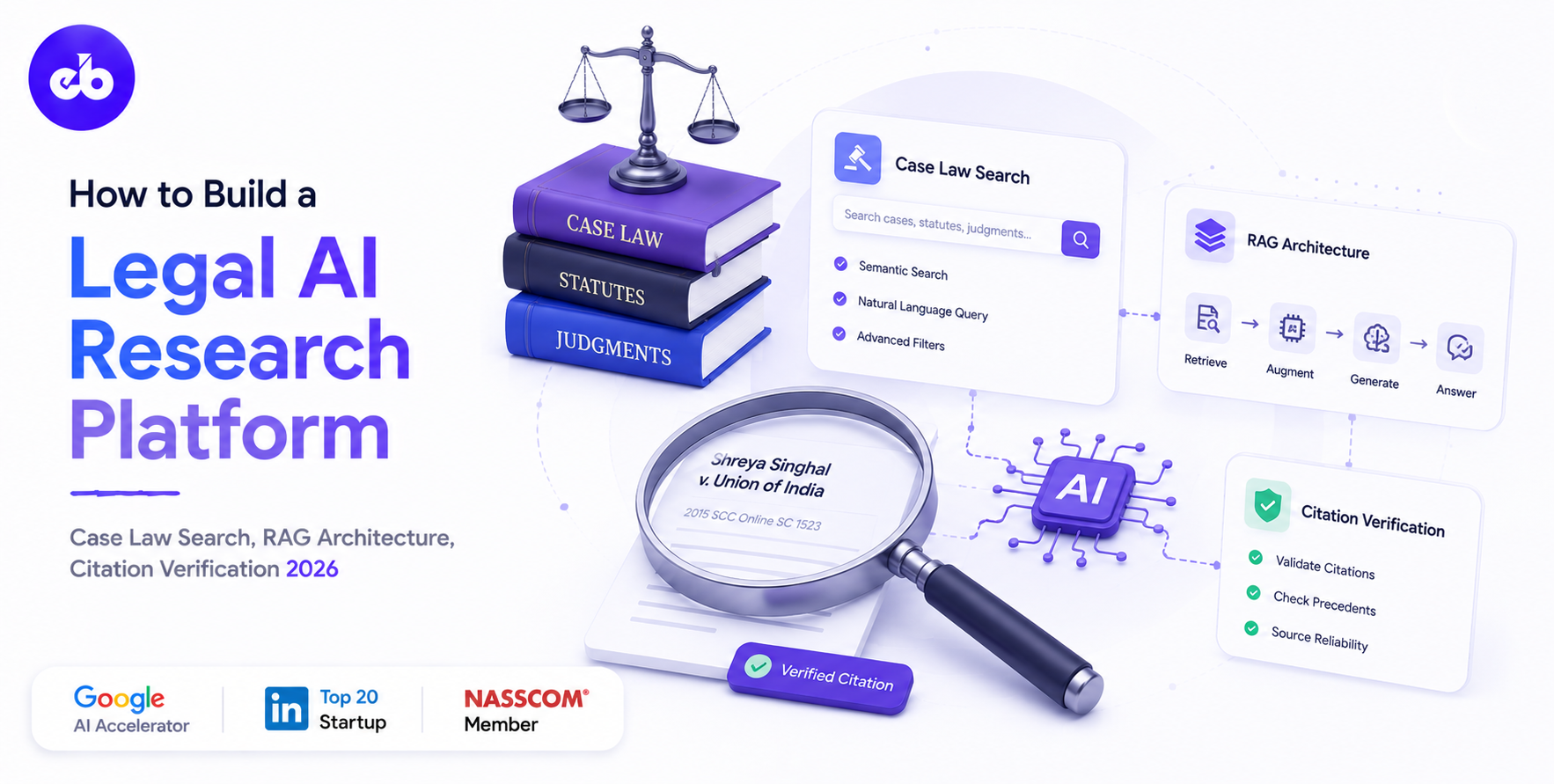
Legal research is one of the most time-intensive activities in legal practice. A junior associate may spend 40 to 60 hours researching precedents and drafting a single motion brief.
AI legal research changes this not by replacing the lawyer’s judgment, but by making the research layer dramatically faster.
The risk is hallucination. An AI that confidently cites a case that does not exist is professionally dangerous. An attorney who files a brief with AI-hallucinated citations risks sanctions.
The architecture of a legal AI platform must make hallucination structurally impossible by grounding every output in verified legal sources through RAG (Retrieval-Augmented Generation).
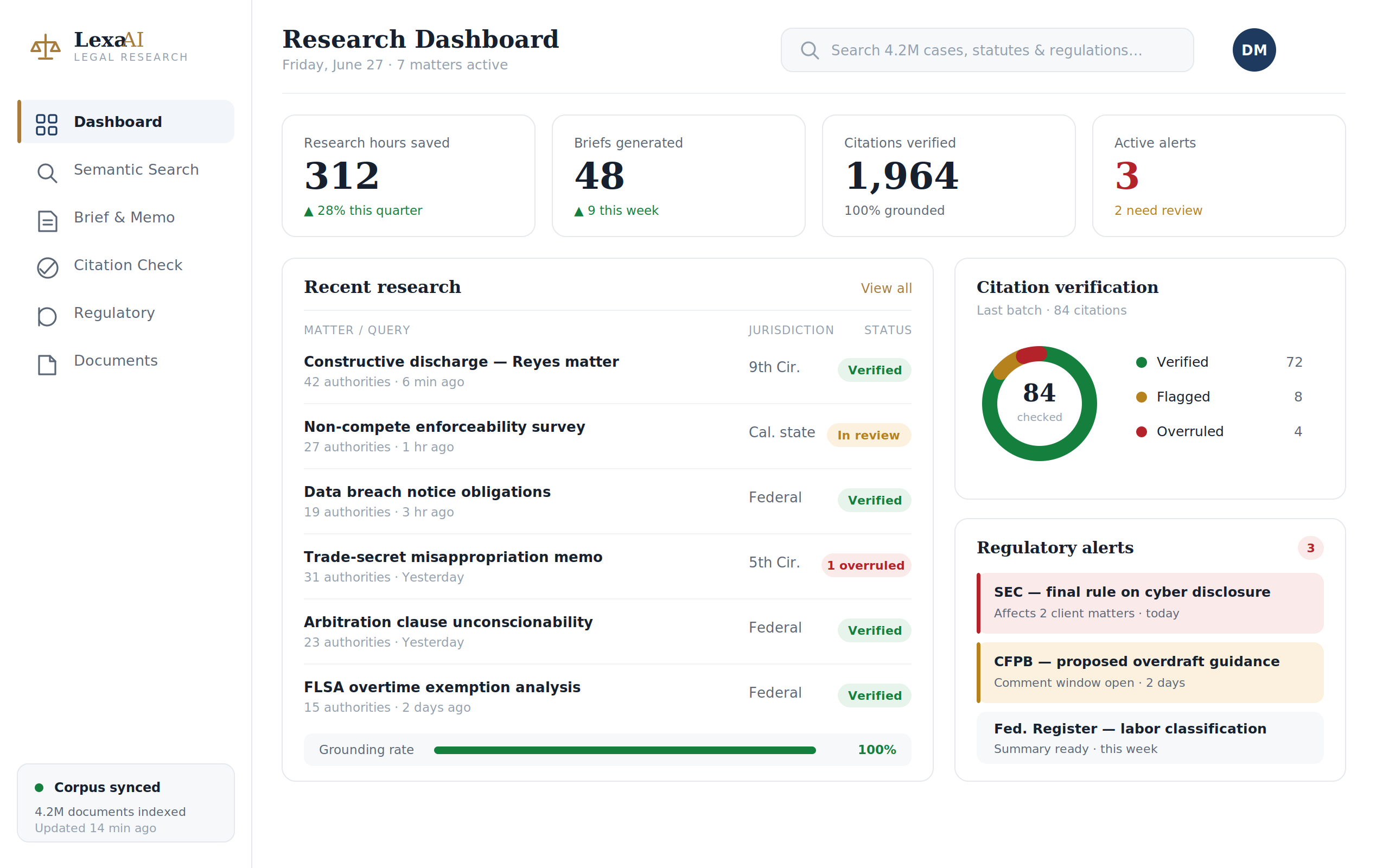
Unlike consumer AI assistants, enterprise legal research software must prioritize accuracy over creativity. Every legal conclusion should be traceable to authoritative sources, with transparent citations and verification mechanisms.
A robust platform typically includes:
These capabilities enable legal teams to research faster while maintaining confidence in every citation and recommendation.
Modern legal practices require technology that improves productivity without increasing risk. AI-assisted legal research helps firms:
Rather than replacing attorneys, AI allows them to focus on legal strategy, negotiation, and advocacy instead of repetitive research tasks.
Document types and sources:
| Document Type | Sources |
| Federal case law | PACER, CourtListener, Caselaw Access Project |
| State case law | State court websites, CourtListener |
| Federal statutes | U.S. Code (Cornell LII, GovInfo) |
| Federal regulations | Code of Federal Regulations (eCFR) |
| State statutes | Individual state legislature websites |
| Agency guidance | Federal agency websites |
Corpus ingestion pipeline:
| Step | Process |
| Source download | Scheduled download of updated legal documents |
| Text extraction | PDF/HTML parsing preserving structural metadata |
| Citation parsing | Identify and structure citations within each document |
| Chunking | Split into 500–1,000 token semantically coherent chunks |
| Embedding | Convert to vector embeddings using legal-domain model |
| Storage | Store with full metadata (case name, court, date, citation) |
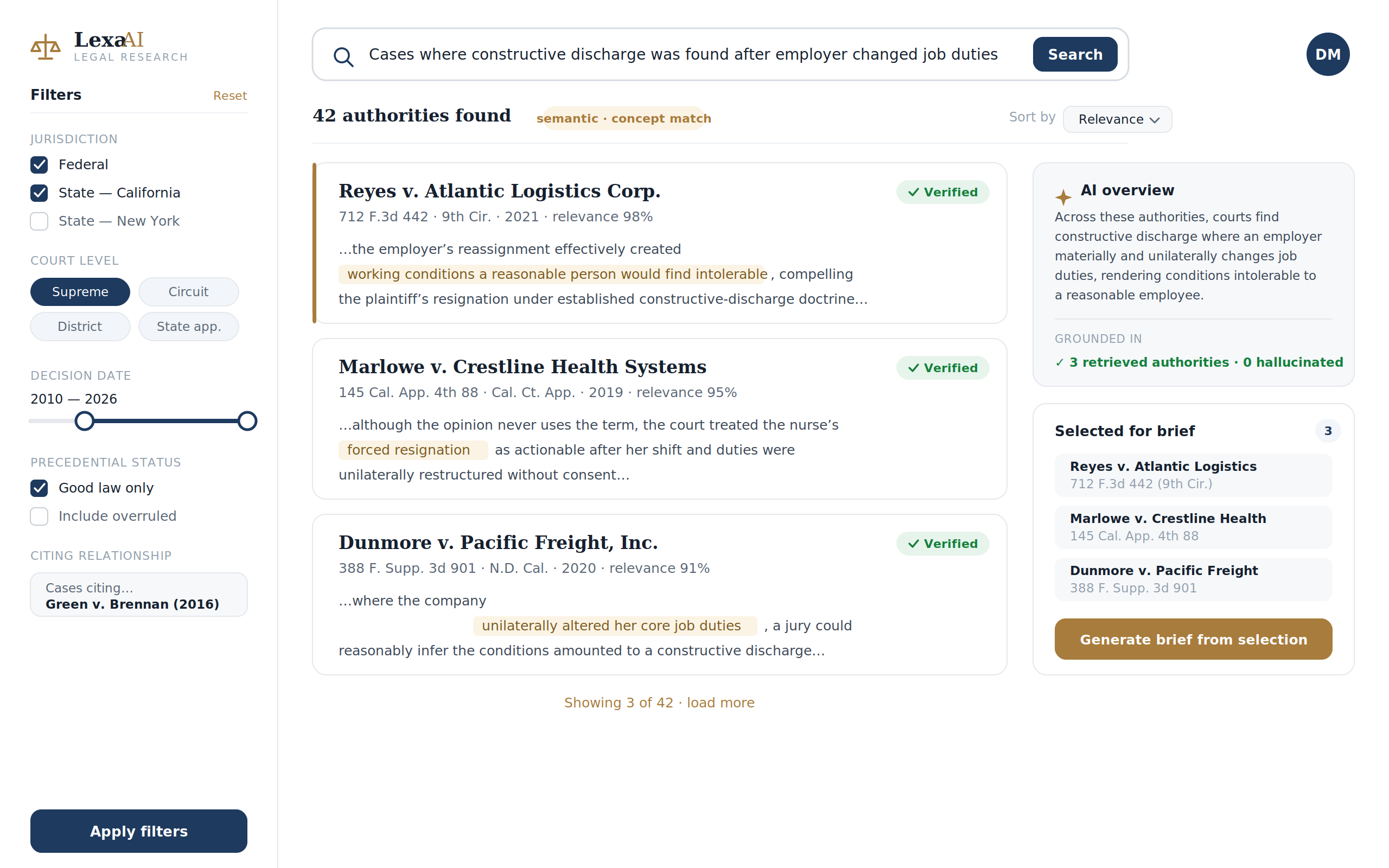
The query flow:
Why semantic search is critical:
Legal research relies on concepts, not keywords. “Constructive discharge” may be discussed in cases that never use that exact phrase, they might say “conditions rendered intolerable” or “forced resignation.” Semantic search finds these cases because the embedding model understands conceptual similarity.
Filterable by:
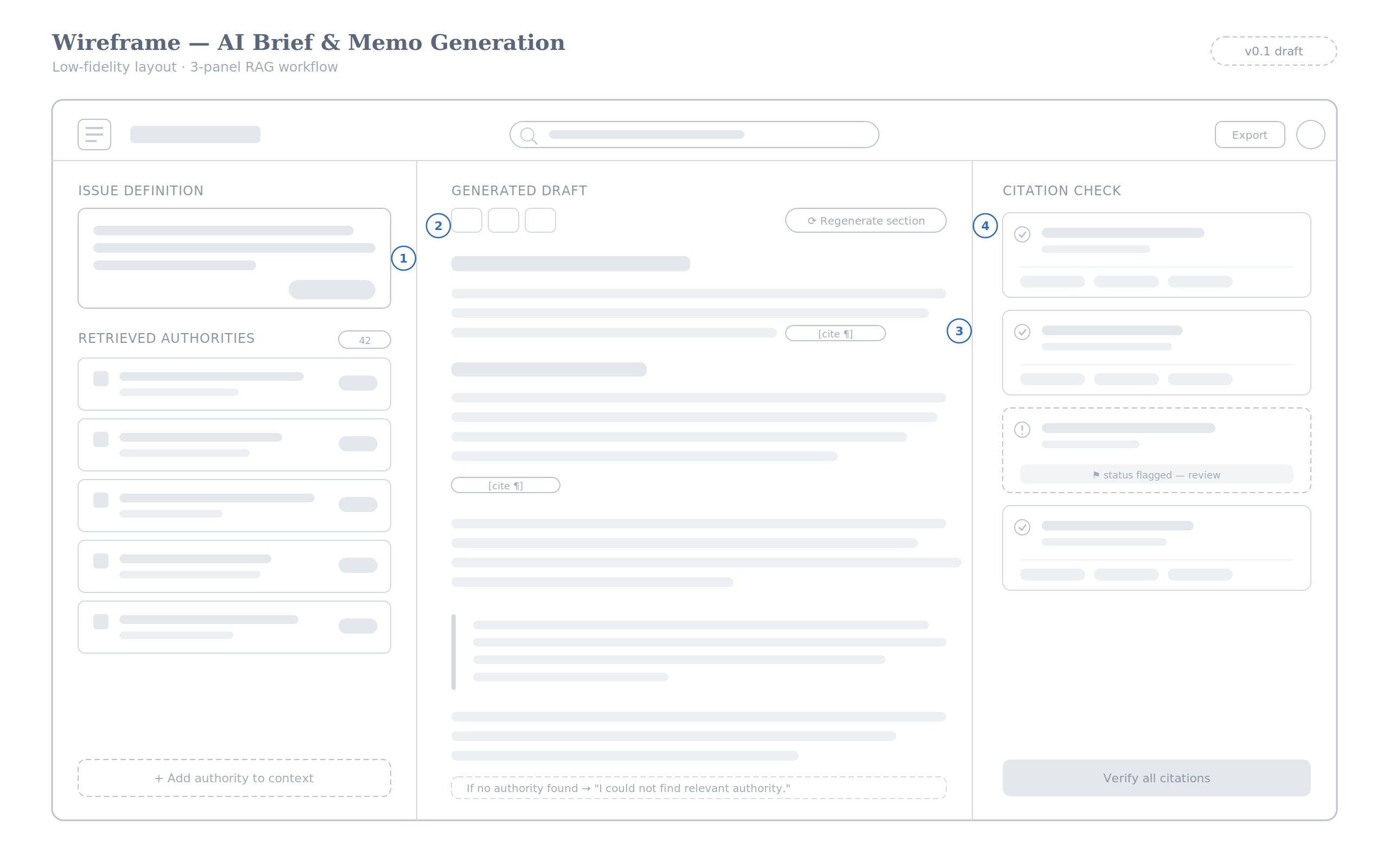
The brief generation workflow:
The LLM prompt constraint:
System: You are a legal researcher.
Answer only from the provided context.
Cite the source document for every factual claim.
If you cannot find relevant authority in the context,
say “I could not find relevant authority for this
proposition” rather than generating a citation.
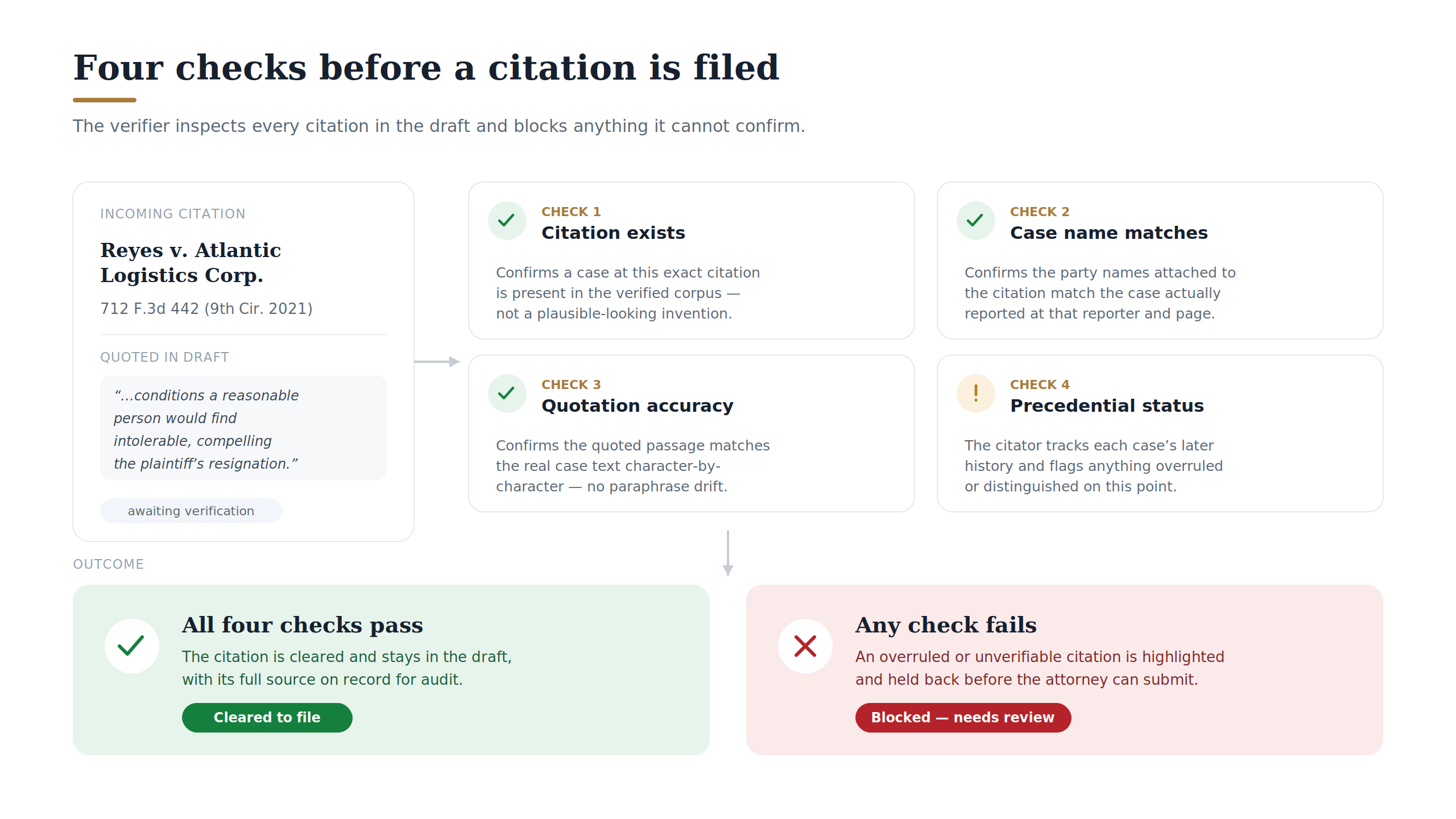
Verification checks:
| Check | What It Confirms |
| Citation exists | The case at this citation exists in the corpus |
| Case name matches | Name matches the cited citation |
| Quotation accuracy | Quoted passage matches actual case text |
| Precedential status | Has the case been overruled? |
| Jurisdiction applicability | Is this binding/persuasive in the target jurisdiction? |
The citator function:
The platform’s citator database tracks each case’s subsequent history, identifying subsequent decisions that expressly overrule or distinguish the cited proposition. Citations flagged as overruled are highlighted before the attorney can submit.
For compliance-focused practices:
| Function | Details |
| Agency monitoring | Federal Register, CFPB, SEC, state agencies |
| Alert configuration | Attorney sets agency, topic, jurisdiction |
| Impact analysis | Which client matters are affected by each change |
| Summary generation | AI summarises change and practical implications |
| Module | Cost Range (USD) | Notes |
| Legal corpus ingestion + scheduled updates | $8K – $15K | Multi-source |
| Vector database + embedding infrastructure | $6K – $12K | Legal-domain model |
| Semantic search + jurisdiction filtering | $8K – $15K | |
| AI brief/memo generation (RAG) | $10K – $20K | Strict grounding prompts |
| Citation verification engine | $8K – $15K | |
| Precedential status (citator) | $6K – $12K | |
| Regulatory monitoring + alerts | $6K – $12K | |
| Matter management integration | $4K – $8K | Clio, MyCase, Thomson Reuters |
| Document editor interface | $8K – $15K | |
| AWS + SOC 2 + VAPT | $5K – $10K | |
| Total | $69K – $134K | Full legal AI platform |
Contact: mayank@engineerbabu.com
AI is transforming legal research by accelerating information retrieval while preserving the attorney’s professional judgment. The most valuable legal AI platforms are built around verified legal sources, transparent citations, and rigorous validation not unrestricted text generation.
By combining semantic search, RAG, citation verification, and regulatory monitoring, firms can improve efficiency without sacrificing accuracy or compliance.
If you’re planning to build a secure legal AI platform for law firms, in-house legal teams, or compliance organizations, EngineerBabu can help. Contact mayank@engineerbabu.com to discuss your legal technology requirements.
RAG (Retrieval-Augmented Generation) grounds AI responses in specific retrieved documents rather than the LLM’s training knowledge. For legal AI, this is non-negotiable because pure LLM responses may hallucinate citations, generating plausible-sounding but fictional case references. An attorney who files a brief with hallucinated citations faces sanctions and potential bar discipline. With RAG, the LLM is provided actual case texts as context and instructed to cite only from those documents. If no relevant case exists, the system returns “no relevant case found” rather than generating a fabricated one.
The citation verifier runs four checks: existence (does the case at this citation exist in the corpus?), case name match, quotation accuracy (does any quoted passage match the actual case text character-by-character?), and precedential status (has the case been overruled on the point being cited?). The precedential status check uses the platform’s citator database, built by tracking each case’s subsequent history, identifying subsequent decisions that expressly overrule or distinguish the cited proposition. Citations flagged as overruled are highlighted before the attorney can file.
Yes. Enterprise legal AI platforms can integrate with practice management systems like Clio and MyCase, document management platforms, Microsoft 365, Google Workspace, CRM systems, and enterprise knowledge repositories.
Ideally, legal databases should receive scheduled or near real-time updates as new judgments, statutes, regulations, and agency guidance become available. Continuous updates help ensure attorneys always work with current legal authorities.
Absolutely. Corporate legal departments use AI for contract research, regulatory compliance, internal policy analysis, litigation support, legal knowledge management, and monitoring legislative or regulatory changes across multiple jurisdictions.