Open Banking API Integration for Fintech Apps in 2027


Create engaging, high-performance mobile applications tailored to your business needs. We craft future-ready apps that offer smooth user experiences on all devices.
Build robust and scalable websites and CMS platforms that help you manage content effortlessly. Our development ensures a seamless digital presence.
Launch secure, feature-rich online stores with intuitive shopping experiences. We build tailored eCommerce platforms designed for growth.
Design captivating games with immersive gameplay and stunning graphics. From concept to launch, we build engaging experiences that players love.
Enhance your customer relationships with customized Salesforce implementations. Drive growth and efficiency with smarter CRM solutions.
Harness artificial intelligence and machine learning to automate workflows and gain actionable insights. Our AI transforms data into smart decisions.
Accelerate your software delivery lifecycle with continuous integration, delivery, and infrastructure automation to boost efficiency.

TL;DR
Screen scraping is finished in most regulated markets. The apps still leaning on it are losing data accuracy and approval rates at once. Open banking API integration is what replaced it.
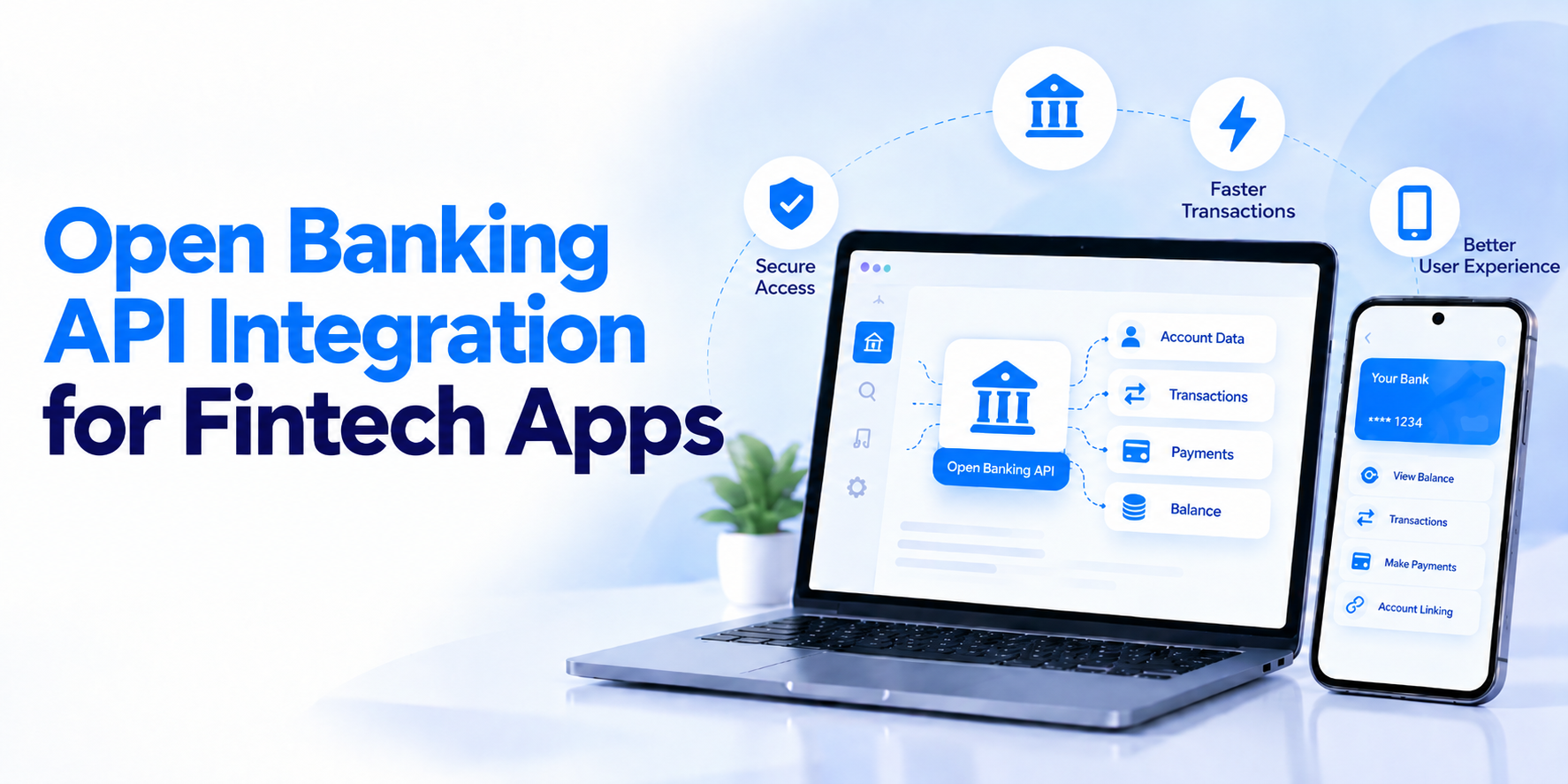
It connects a fintech app to bank-held data and payment services through regulated APIs that run on explicit customer consent. In practice it does four things.
It authenticates the user with their bank, stores that consent, reads account and transaction data, and initiates payments from the user’s own account.
The scale is no longer experimental. The UK ecosystem has crossed 100 billion API calls, including 2.81 billion in June 2026, a record month (Open Banking Limited).
Here is how the layers fit, what to build first, and where these integrations go wrong.
Scraped bank data breaks every time a bank redesigns its login page. It also carries no consent record, which turns it into a liability the moment an auditor asks.
Open banking API integration removes both problems. Data arrives structured, with field names that stay stable across releases. Consent is explicit, scoped, time limited, and revocable inside the user’s banking app.
Verified income and cash flow data also lets you approve thinner files with fewer manual reviews. Teams comparing fintech APIs for financial software find bank-sourced data beats self-reported figures on almost every underwriting metric. Most slot it in alongside the rest of their fintech infrastructure checklist, since bank connectivity rarely ships alone.
Every integration stacks the same four layers. Treating them as separate modules keeps your code portable when you add a second bank or a second country.
The user is redirected to their bank, authenticates there, and approves exactly what your app may access. You get back an access token and a consent reference, each with its own expiry. Consent is scoped, so a token issued for account data will not authorize a payment.
Build this as a real consent-based data sharing architecture, where every token, scope, and expiry is a first-class record. Teams that treat consent as a side effect of login rebuild this layer within a year.
AIS endpoints return accounts, balances, transactions, standing orders, and direct debits. Historical depth varies by bank and market, commonly 12 to 24 months.
Pull only what your use case justifies, because larger payloads mean slower responses and heavier storage duties. Expect inconsistency across banks: different merchant naming, different date fields, different handling of pending items. Normalize all of it at ingestion, never inside product logic.
This is the half of an open banking API integration that actually moves money, straight from the user’s bank account with no card network in the middle. The user approves each payment in their banking app, which keeps fraud exposure low and interchange out of the equation.
Variable recurring payments extend this to repeat collections under a pre-agreed limit. Settlement is usually instant on domestic rails. Even so, treat payment status as an event stream rather than a single response.
Raw transactions are not insight. This layer categorizes spending, identifies salary credits, separates loan repayments from discretionary outflows, and calculates affordability.
For lenders, this is where open banking API integration starts paying for itself. Cash flow signals feed straight into AI in credit scoring models that outperform bureau-only decisions on thin files.
Your open banking API integration route shapes the cost base for years, so make this call early.
Direct integration means connecting to each bank yourself. You get the cleanest data, the lowest per-call cost at volume, and full control over error handling. You also inherit every bank’s certificate rotation and version upgrades.
Aggregators such as Plaid, Tink, TrueLayer, Salt Edge, and Yapily give you one contract and one API shape across hundreds of banks. You trade margin for coverage and speed.
| Factor | Direct bank APIs | Aggregator |
| Time to first connection | Weeks per bank | Days |
| Bank coverage | One at a time | Hundreds out of the box |
| Per-call cost at scale | Lower | Higher |
| Maintenance burden | Yours | Shared with the provider |
| Best fit | Single market, high volume | Multi-bank, fast launch |
Most teams start with an aggregator, then go direct on the two or three banks driving the bulk of volume. That hybrid pattern shows up constantly in APIs for lending platforms. Either way, keep the provider behind an internal interface, which is far simpler if you already run a microservices architecture for fintech apps.
Every open banking API integration starts with a question, not a vendor. Affordability for a loan? A balance check before a debit? Income verification at onboarding? Each answer points to different endpoints, consent durations, and providers.
A lender pulling 12 months of history has little in common with a wallet checking a balance. Define refresh frequency here too, since daily refreshes and one-time pulls price very differently. Skip this step and you pay for data fields your decision engine never reads.
Open banking API integration is regulated access, not open to anyone with a corporate card. In the UK and EU you register as an AISP or PISP, or operate as an agent under an aggregator’s licence. Transport and signing certificates sit on top.
In India, access runs through RBI-licensed account aggregators instead. Budget several weeks for approval and start the paperwork in parallel with design. Identity checks belong in the same plan, so decide early how eKYC, eSign, and bank verification will sit inside one onboarding flow.
Before any product feature, build a service owning authorization URLs, token exchange, refresh, consent expiry, and revocation. Store the scope, bank, user, timestamp, and expiry together as one record.
Prompt users before consent lapses, because a silent expiry looks exactly like a broken app. Handle revocation immediately and delete data you no longer have a right to hold. Auditors examine this service first, and most open banking API integration projects underbuild it. Get it right once and later bank connections become routine.
Bank responses are not consistent enough to use raw. Map every provider’s fields to one internal schema: amount, currency, booking date, value date, counterparty, category, and a stable transaction ID.
Deduplicate aggressively, since pending items reappear as settled ones under new identifiers. Only after normalization should anything reach your scoring or budgeting logic. That boundary lets you swap providers later without touching product code, and it keeps decision outputs explainable when a regulator asks.
Sandbox success proves very little. Test expired tokens, revoked consents, partial account lists, server errors, and rate limits hit at peak traffic. Simulate a bank offline for two hours and confirm the app degrades gracefully instead of failing the journey.
Run security testing across token storage, redirect handling, and webhook endpoints before real customer data moves. Then launch narrow: one bank, one cohort, one use case. A staged rollout keeps an open banking API integration bug a support ticket instead of an incident.
Most open banking API integration problems surface weeks after go-live, not during the build.
Consent expiry is the quiet killer. Many consents run on a 90-day cycle, and plenty of users never re-authorize unless prompted well. Connections decay month over month, and dashboards built on stale data stop being useful.
Bank availability is next. Even mature markets report weighted availability near 99.8%, which still adds up to hours of downtime per bank each year. Retry logic and user messaging matter more than the happy path.
Then comes data drift. Banks change field behavior without much notice, and a mapping that worked in March can misclassify salary credits by September. Monitor your normalization output, not just response codes.
Fraud patterns shift once a new money rail opens. Account takeover attempts follow payment initiation, so controls that prevent fraud in fintech apps must cover open banking journeys from day one.
Latency compounds too, since sequential bank calls inside onboarding add seconds users feel. Your pick of cloud providers for fintech apps shows up directly in conversion.
Open banking API integration lives inside a regulatory frame, and the frame changes by market.
Three duties hold everywhere. Store consent artifacts you can produce on demand, encrypt data in transit and at rest, and delete it when consent ends.
Your fintech compliance checklist should carry each as a line item, alongside PCI DSS compliance requirements in fintech where card data shares the platform.
A healthy open banking API integration shows up in four numbers, not in a provider dashboard.
Track these next to the rest of your fintech KPIs to measure app success and review them weekly through the first quarter.
Open banking API integration is less about the API calls and more about everything around them: consent you can prove, data you can trust, failure modes you planned for.
Teams that get it right build the consent service before the product feature. They normalize early, treat bank downtime as a certainty, and start narrow.
If you want the integration designed alongside the product rather than bolted on later, EngineerBabu works on fintech app development across lending, payments, and neobanking.
Teams mapping the full sequence usually work through how to build a fintech app before locking in providers.
Aggregators typically price per connected account, per API call, or on a monthly platform fee, often with volume tiers. Direct bank access has no per-call fee but carries licensing, certificate, and engineering costs.
Yes. Customers authenticate inside their own banking app and credentials are never shared with the fintech. Access stays read-only unless payment permission is granted, and consent can be revoked anytime.
Open banking covers payment accounts only. Open finance extends the same consent model to pensions, insurance, investments, mortgages, and savings, giving apps a fuller picture of a customer’s financial position.
Yes. Australia, Brazil, India, Saudi Arabia, and Nigeria all run regulated frameworks, while the United States and Canada are still formalizing theirs. Coverage and data depth vary widely between markets.
Not entirely. It offers a lower-cost route for account-to-account payments and refunds. Cards still matter today for chargeback protection, international acceptance, and customers who prefer credit over direct debits.