Mental Health App Development: Features, Compliance, and Cost


Create engaging, high-performance mobile applications tailored to your business needs. We craft future-ready apps that offer smooth user experiences on all devices.
Build robust and scalable websites and CMS platforms that help you manage content effortlessly. Our development ensures a seamless digital presence.
Launch secure, feature-rich online stores with intuitive shopping experiences. We build tailored eCommerce platforms designed for growth.
Design captivating games with immersive gameplay and stunning graphics. From concept to launch, we build engaging experiences that players love.
Enhance your customer relationships with customized Salesforce implementations. Drive growth and efficiency with smarter CRM solutions.
Harness artificial intelligence and machine learning to automate workflows and gain actionable insights. Our AI transforms data into smart decisions.
Accelerate your software delivery lifecycle with continuous integration, delivery, and infrastructure automation to boost efficiency.
Hire app developers ready to turn your ideas into sleek, high-performing mobile apps for any platform.
Bring in frontend pros who craft smooth, beautiful, and user-friendly interfaces that your visitors will love.
Get backend developers who build fast, secure, and reliable systems to keep everything running behind the scenes.
Hire eCommerce developers who build secure, scalable online stores designed to offer seamless shopping and grow your sales.
Get dedicated developers committed to your projects, delivering consistent quality and speed as an extension of your team.
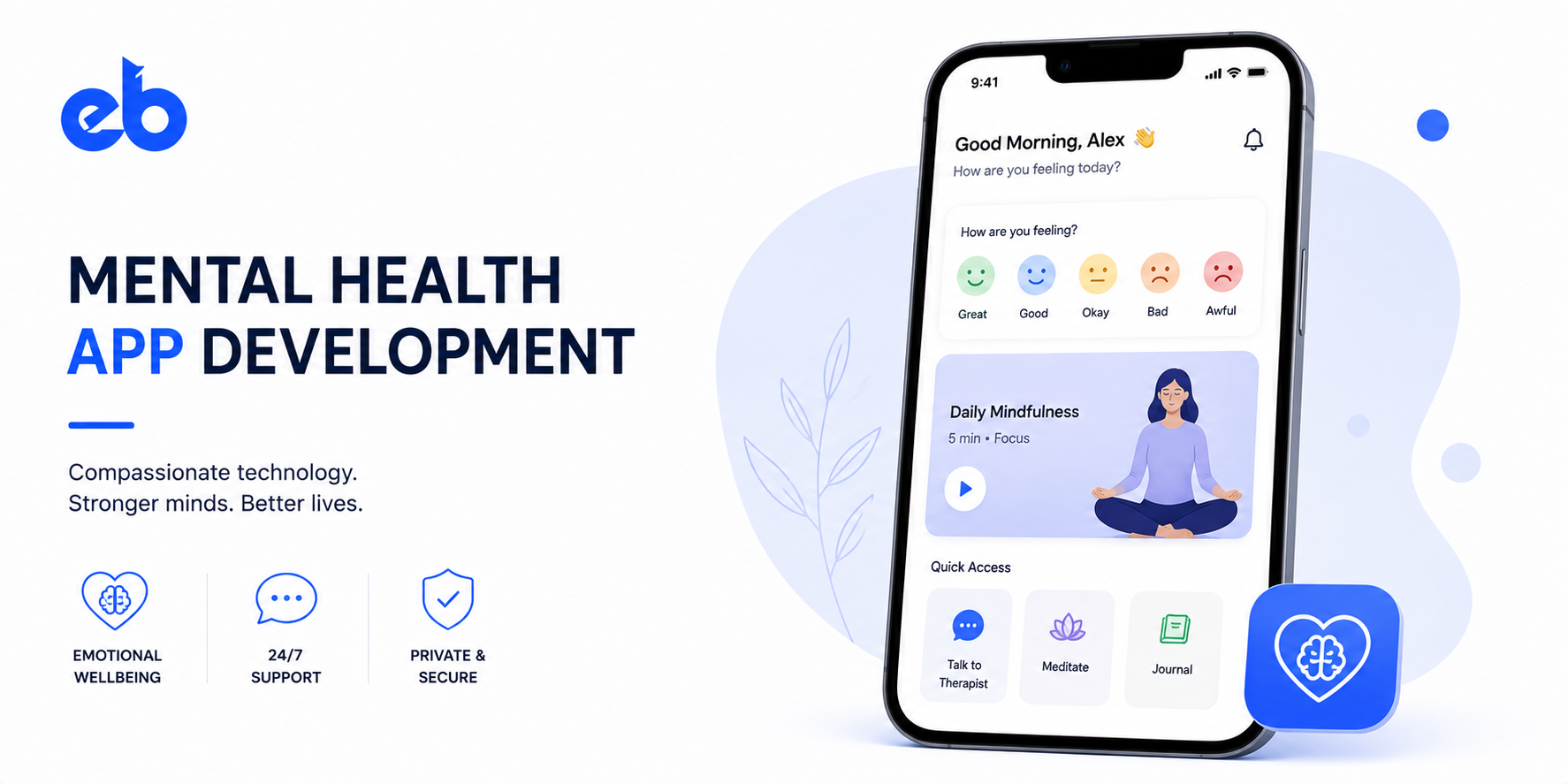
Someone downloads a therapy app at 1 a.m. after a panic attack. They finish onboarding, log a single mood entry, and never open it again. That quiet disappearance, not a crashed build, is how most products in this category actually fail.
Mental Health App Development sits in an awkward middle. You are shipping consumer software that people open on their worst days, under rules originally written for hospitals and clinics.
A JMIR study of 93 popular mental health apps found a median 30-day retention rate of just 3.3% (Journal of Medical Internet Research). Installs are easy in this space. Staying useful is not.
This guide covers what to build, what compliance demands, and what the build actually costs.
Most product categories forgive a bad week. Someone abandons a food delivery app and orders a pizza instead. Someone abandons a depression app mid-episode and the outcome can be serious.
That changes the priorities in mental health app development. Your onboarding cannot be a 12-screen questionnaire that drains someone already low on energy. Your notification logic cannot nag a user who just logged suicidal ideation.
There is also the data problem. Mood logs, session transcripts, and screener scores are protected health information the moment a clinician touches them. A standard mobile app development approach gets you a working product. It does not get you a defensible one.
Clinical input belongs in the build from week one, not at QA. Teams that hire a licensed reviewer after launch usually rewrite half the content.
Feature lists in mental health app development get bloated fast. These carry real weight, and here is why each one earns its place.
Validated instruments like PHQ-9 for depression and GAD-7 for anxiety give you a real baseline. Score them in the app, store the raw responses, and show progress against that first measurement later.
Keep the flow short and conditional. Ask follow-up questions only when a score crosses a threshold, so a low-risk user finishes in two minutes.
Build the risk flag logic here too. Item 9 of the PHQ-9 asks about self-harm, and a positive answer needs to trigger something immediately, not sit in a database.
Tracking is the habit loop that keeps people returning, so friction here decides retention. A daily check-in should take under 15 seconds with a tap-based scale, optional note, and two or three context tags.
Pair it with visible feedback. Weekly patterns, sleep correlations, and trigger frequency give users a reason to keep logging.
If licensed providers are in your product, you need scheduling, video sessions, secure messaging, and session notes. Video must be encrypted end to end with a HIPAA business associate agreement from your vendor.
Asynchronous messaging often beats video for engagement. Users write at midnight and read a reply the next morning, which fits real life better than a fixed 50-minute slot.
Add no-show handling, cancellation windows, and availability rules early. Retrofitting scheduling logic later is painful and touches billing directly.
Structured therapy content is what separates a mood diary from a clinical product. Cognitive restructuring exercises, thought records, behavioral activation plans, and DBT skills modules all follow evidence-based protocols.
Write these with a licensed clinician and cite the protocol you adapted. Regulators and enterprise buyers both ask for that provenance.
This is the part of mental health app development that decides whether your app is safe. Keyword detection in journal entries and messages, screener thresholds, and sudden engagement drops can all signal risk.
Define what happens next in writing. Some products surface a crisis resource screen, others alert an on-call clinician, and some do both depending on severity.
Test escalation paths as rigorously as payments. A silent failure here is a liability event, not a bug ticket.
Providers need caseload views, session history, screener trends, and note templates. Anything that adds admin time gets abandoned by clinicians quickly.
Most platforms also connect outward through API development work to EHR systems, e-prescribing tools, insurance eligibility checks, and identity verification services.
Compliance is where mental health app development budgets and timelines get rewritten. Here is what applies, and when.
HIPAA applies once you handle protected health information on behalf of a covered entity or as a business associate. That includes therapy notes, screener scores tied to identity, and messages with a licensed provider.
Practically, you need encryption at rest and in transit, role-based access control, audit logs for every record view, automatic session timeouts, and signed BAAs with every vendor touching the data.
Wellness journaling with no clinician involved may fall outside HIPAA. Most teams still build to the standard, because enterprise and payer deals require it later. Our guide on how to build a HIPAA-compliant app breaks down the technical controls in detail.
The line runs between general wellness and a medical device. An app that helps users relax sits in wellness territory. An app that claims to treat diagnosed major depressive disorder is a prescription digital therapeutic.
Products in the second group need FDA clearance, usually through the De Novo or 510(k) pathway, backed by clinical evidence.
Your marketing copy decides this as much as your code does. Words like treat, diagnose, and cure move you across the line even if the product did not change.
In the US, therapists are licensed state by state, and care is generally delivered where the patient is located. Your matching logic has to respect that geography.
Build license verification, expiry tracking, and state-based provider filtering into the platform. Manual spreadsheets break the moment you pass a few dozen clinicians.
Users must know what you collect, why, and who sees it. Granular consent beats a single checkbox, especially for research use.
Apple and Google both enforce extra review for health apps, including privacy labels and restrictions on advertising identifiers. Sharing mental health data with ad networks is a fast route to removal and regulatory attention.
Mental health app development costs vary widely because products sharing the same label are rarely comparable. These ranges reflect offshore and hybrid teams building for the US market.
Mood tracking, a small library of CBT exercises, reminders, basic analytics, and secure accounts. No live clinicians, so no scheduling or video.
This is the right scope for validating demand, and MVP development at this level typically runs 12 to 16 weeks. You learn whether people return before spending on a provider network.
Add licensed providers, video sessions, secure messaging, scheduling, payments, a clinician dashboard, and crisis escalation. HIPAA controls and audit logging are fully built out here.
This is the most common bracket for funded startups. Timelines usually land between 5 and 8 months.
Digital therapeutics seeking FDA clearance, employer and payer platforms, or products integrating with hospital EHRs through FHIR. Add clinical trials, SOC 2 audits, and multi-tenant architecture.
Budget separately for regulatory work. Clearance costs are not development costs, and they run in parallel for a year or more.
Across every tier, roughly 10% goes to discovery, 15 to 20% to design, 50% to engineering, and 15% to QA, security testing, and launch.
AI has real uses in mental health app development. Sentiment analysis on journal entries surfaces deterioration a user has not reported. Session summarization saves clinicians hours of documentation each week. Smart triage routes users to the right level of care faster.
Adding these through AI development work typically raises the base build by 20 to 35%, plus ongoing inference costs.
The risky part is autonomous therapeutic conversation. A chatbot that responds to distress without guardrails can cause real harm, and regulators have started paying close attention.
Where custom models make sense is prediction rather than conversation. ML development on your own engagement and outcome data can flag dropout risk days before it happens, which is measurable and defensible.
Keep a human in the loop for anything clinical. Let AI draft, flag, and summarize, and let licensed people decide.
In mental health app development, ask who has shipped a HIPAA product that passed a real security review, not who lists healthcare on a services page. Request the audit log design from a past project.
Ask how they handle clinical input. A team without access to licensed reviewers will hand you content you cannot legally publish.
Get the estimate broken down by stage and feature. A single lump number hides the assumptions that later become change requests. Comparing shortlists of mobile app development companies on those specifics tells you more than any ranking page.
Mental Health App Development rewards restraint. The products that last do a small number of clinically sound things reliably, then expand once retention proves the model works.
Compliance decisions made in month one shape what you can sell in year two. Building to HIPAA before you need it, and keeping medical claims out of your copy until you have evidence, keeps every future door open.
If you are scoping a build and want a cost breakdown tied to your actual feature set and compliance path, working with a team experienced across healthcare and fintech products makes that estimate far more reliable.
EngineerBabu is a technology development company building products across fintech, healthtech, and AI, from MVPs to scaled, production-ready platforms.
It holds a CMMI Level 5 rating, has worked with 4 unicorn clients, and has supported 200+ VC-funded products. The company is backed by Vijay Shekhar Sharma.
Founded by Mayank Pratap (Co-founder) · mayank@engineerbabu.com
A self-guided MVP runs $40,000 to $80,000. A full therapy platform with licensed providers and video sessions falls between $90,000 and $180,000. Clinical-grade products pursuing FDA clearance start around $200,000 before regulatory costs.
If licensed clinicians handle user data, yes. Pure self-help wellness tools may sit outside HIPAA, but most teams build to the standard anyway because enterprise and payer contracts require it.
An MVP takes 12 to 16 weeks. A therapy platform with scheduling, video, and a clinician dashboard usually needs 5 to 8 months, plus additional time for security review.
Only if you make treatment or diagnostic claims for a specific condition. Wellness and general support apps do not require clearance, but marketing language can move a product across that line.
No. In mental health app development, AI works well for triage, journaling analysis, and clinician documentation. Autonomous therapeutic conversation without human oversight carries clinical and regulatory risk that most products should avoid.