How to Manage an Offshore Software Development Team Without Losing Your Mind (or Your Product)


Create engaging, high-performance mobile applications tailored to your business needs. We craft future-ready apps that offer smooth user experiences on all devices.
Build robust and scalable websites and CMS platforms that help you manage content effortlessly. Our development ensures a seamless digital presence.
Launch secure, feature-rich online stores with intuitive shopping experiences. We build tailored eCommerce platforms designed for growth.
Design captivating games with immersive gameplay and stunning graphics. From concept to launch, we build engaging experiences that players love.
Enhance your customer relationships with customized Salesforce implementations. Drive growth and efficiency with smarter CRM solutions.
Harness artificial intelligence and machine learning to automate workflows and gain actionable insights. Our AI transforms data into smart decisions.
Accelerate your software delivery lifecycle with continuous integration, delivery, and infrastructure automation to boost efficiency.
Hire app developers ready to turn your ideas into sleek, high-performing mobile apps for any platform.
Bring in frontend pros who craft smooth, beautiful, and user-friendly interfaces that your visitors will love.
Get backend developers who build fast, secure, and reliable systems to keep everything running behind the scenes.
Hire eCommerce developers who build secure, scalable online stores designed to offer seamless shopping and grow your sales.
Get dedicated developers committed to your projects, delivering consistent quality and speed as an extension of your team.
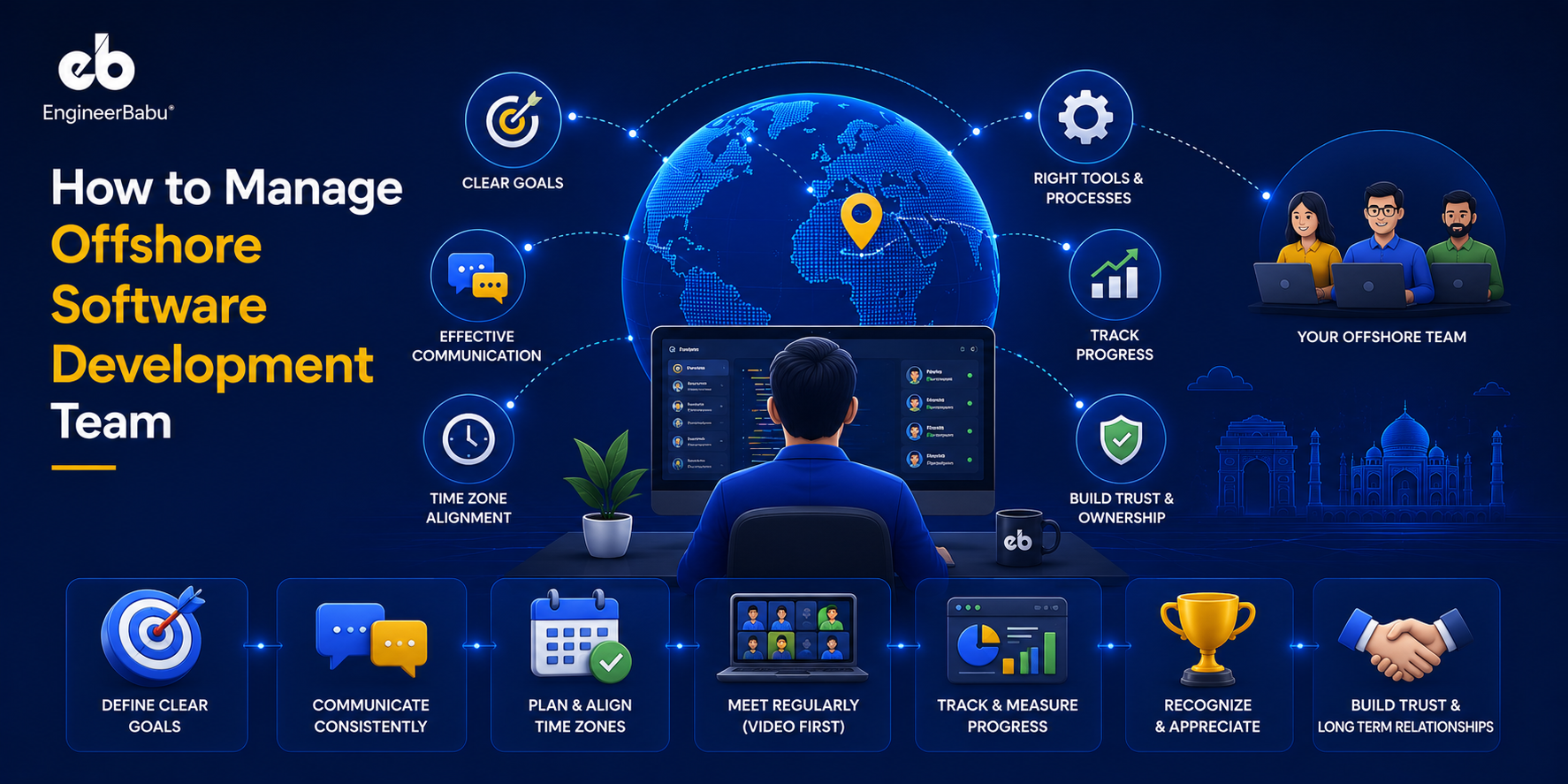
I recently asked a founder in our network how his offshore team was doing. His answer: “We’re 4 months in, burned $80,000, and I still can’t tell you what they shipped last week.”
That’s not an offshore problem. That’s a management problem wearing an offshore costume.
I’ve overseen 500+ product builds across 20+ countries through EngineerBabu, a CMMI Level 5 product engineering company. The mechanics of managing an offshore software development team are not mysterious.
But the mistakes are remarkably consistent, and they almost always happen in the first 90 days before a single line of production code gets written.
This guide is what I’d tell you over coffee before you signed anything.
Managing an offshore software development team means creating systems, communication rhythms, and accountability structures that produce predictable output from engineers working in a different timezone, culture, and context from your own.
The word “offshore” is doing a lot of heavy lifting. Replace it with “remote distributed team” and you’ll make better decisions. Most of the principles are identical. The timezone gap just makes the cost of unclear communication 3x higher.
Most CTOs I talk to blame underperformance on the offshore team. They’re usually 80% wrong.
The offshore software market was expected to surpass $179B in 2025, led by India (54% of US outsourcing) and Eastern Europe’s skilled, cost-effective talent.
Adopting outcome-based outsourcing models that prioritize measurable results and innovation.
The issues I see repeatedly:
Engineers build what they understand, not what you meant. When requirements are ambiguous, offshore teams default to what’s technically easiest, not what’s strategically correct.
Offshore teams get messages from the CEO, the CTO, a product manager, and a designer, all contradicting each other. They don’t tell you this. They go quiet and pick one.
Sending a Slack message at 5 PM your time and expecting a reply by morning is not a communication strategy. It’s a frustration generator.
The first time you see working software is week 8. By then, the wrong thing has been built perfectly.
The structure you choose will determine whether you can manage this team at all.
A dedicated offshore team means you’re essentially running a distributed arm of your company. The engineers are yours on a monthly retainer. You control sprint planning, you define backlog, you set culture norms.
This model works for products with ongoing development needs and companies that have at least one senior technical person who can interface daily.
A project-based engagement means you’re buying a defined output. Vendor manages the team. You manage the spec.
This works for one-time builds with very clear requirements, but it’s not “managing an offshore team” in the real sense. You’re managing a contract.
Most of the companies I work with who succeed long-term run dedicated teams. When the EngineerBabu team built OpenMoney’s neobank infrastructure with mutual fund integration, we operated as a dedicated product team embedded in their development process.
That’s why the product shipped clean.
For a team of 5-10 engineers offshore, you need:
One offshore tech lead who owns technical decisions and communicates upward to you daily. This person must be senior enough to push back on bad requirements, not just execute them.
One in-house product owner on your side who owns the backlog and is available for at least 2 hours per day during offshore working hours. This is non-negotiable. Teams without a product owner on the client side drift by week 3.
A QA resource who is not on the same team as the qa developers. Internal QA is not QA. It’s social politeness.
A DevOps process owned explicitly by someone. Deployments that aren’t automated become deployment anxiety. Deployment anxiety becomes delayed releases. Delayed releases become “offshore teams are slow.”
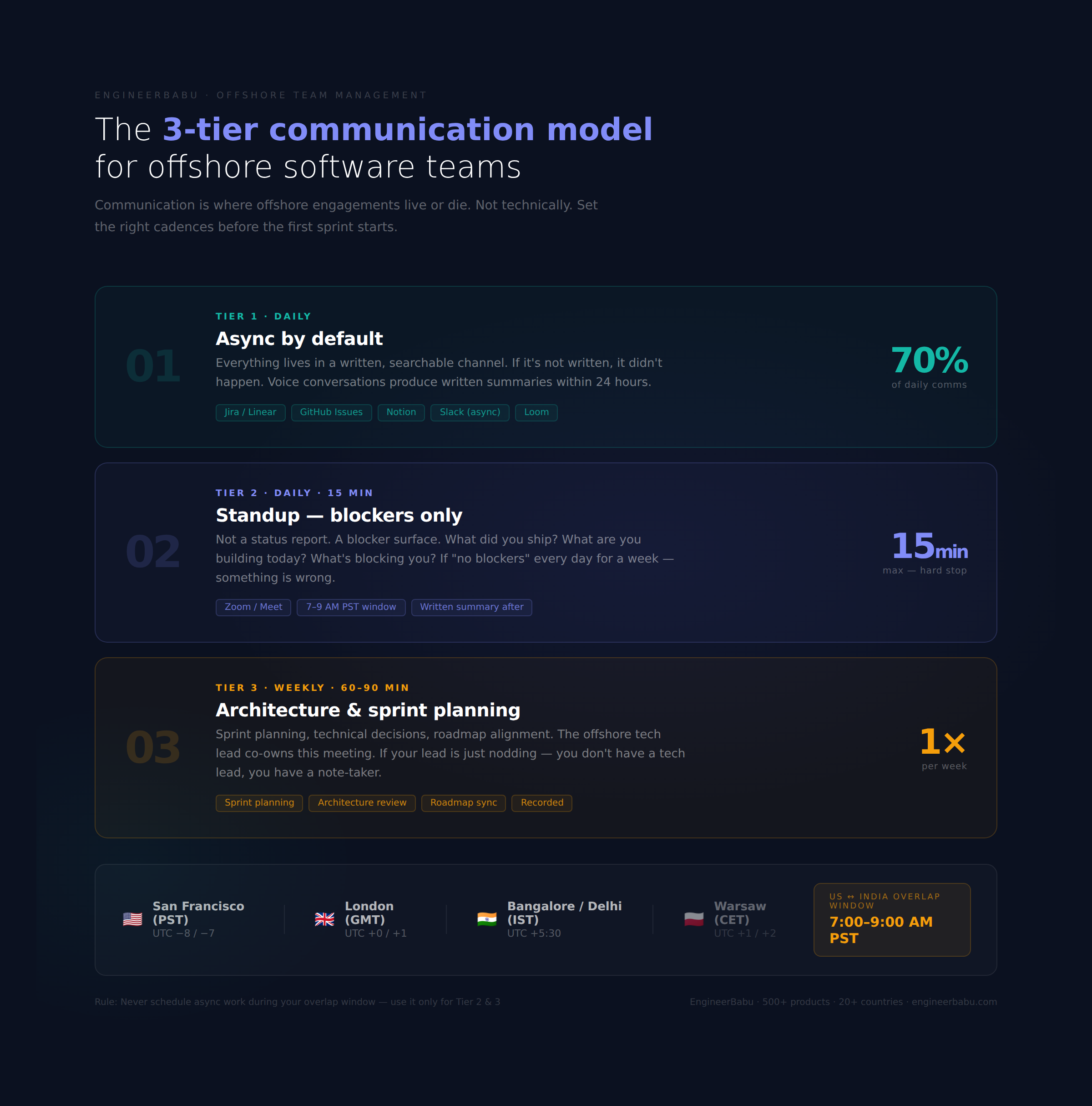
Communication is where offshore engagements live or die. Not technically. Communication.
Everything goes into a written, searchable channel. Jira, Linear, Notion, GitHub issues. If it’s not written, it didn’t happen. Voice conversations must produce written summaries within 24 hours. This tier handles 70% of daily communication.
Not a status report. A blocker surface. The only questions that matter: What did you ship? What are you building today? What’s blocking you? If an engineer says “no blockers” every day for a week, something is wrong. Either nothing is blocking them or they don’t feel safe raising issues. Both need attention.
This is where sprint planning, technical decisions, and roadmap alignment happen. The offshore tech lead co-owns this meeting. If your vendor’s lead is just taking notes and nodding, you don’t have a tech lead. You have a note-taker.
If you’re a US-based company working with an Indian offshore team, you have a 9.5 to 13.5 hour gap depending on your coast. This is workable, but it requires intentionality.
The only practical overlap window is 7-9 AM PST, which is 7:30-9:30 PM IST. Use this window exclusively for Tier 2 and Tier 3 communication. Never schedule async work in this window.
For European companies working with Southeast Asian teams, the overlap can shrink to near zero. In those cases, synchronous meetings should happen once weekly, and everything else needs to be documented so thoroughly that no one waits on a reply to move forward.
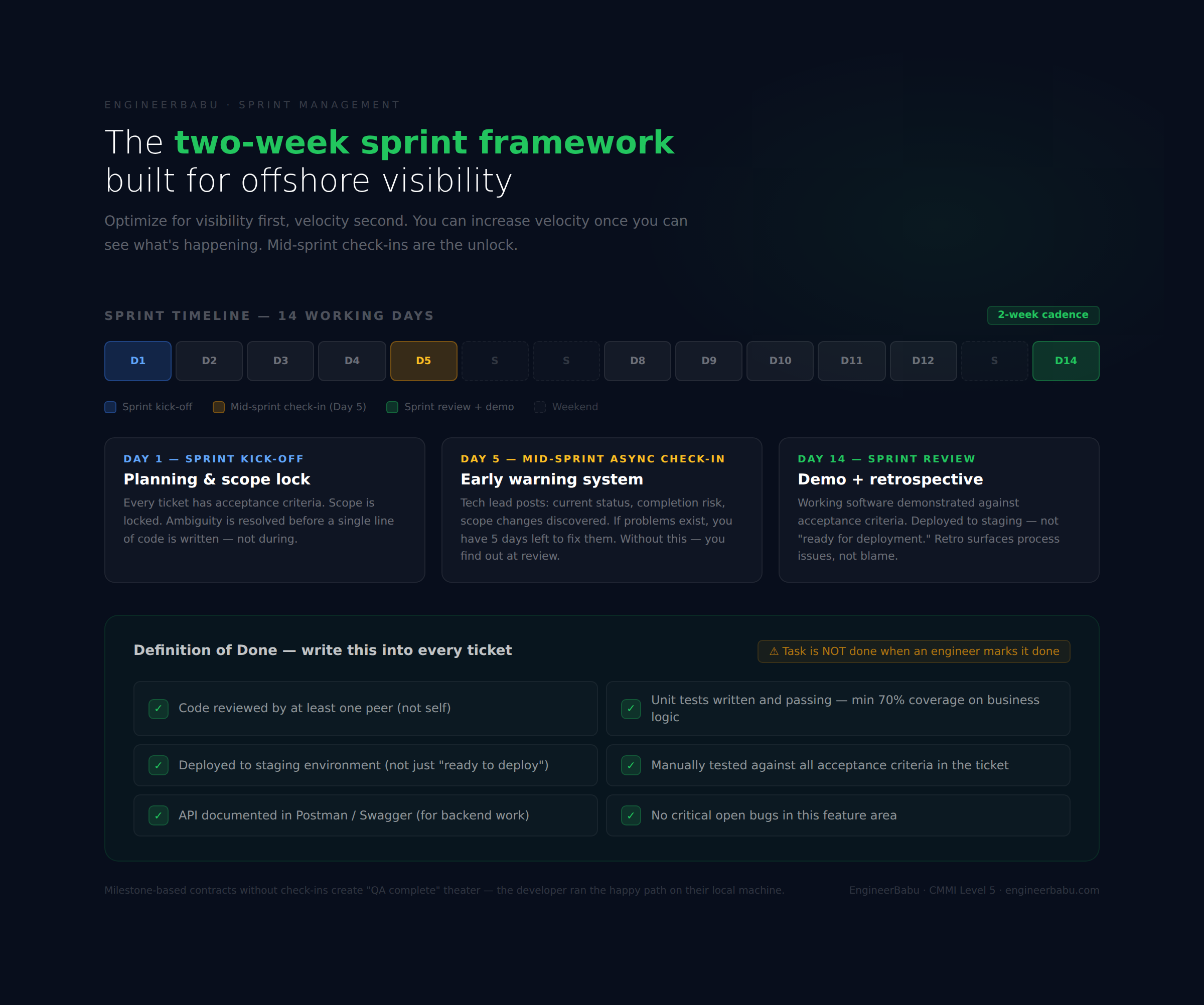
The sprint framework you choose for your offshore team should optimize for visibility, not velocity. You can always increase velocity once you have visibility.
Two-week sprints are the sweet spot for offshore teams. Short enough to catch drift early. Long enough to ship meaningful output. Combine them with a mid-sprint async check-in at day 5 where the tech lead posts: current status, completion risk, any scope changes discovered.
If the mid-sprint check-in reveals problems, you have 5 days to address them before the sprint ends. Without it, you discover problems at sprint review and lose the entire sprint to rework.
Your definition of done needs to be more specific than what you’d use for an in-house team. Write it into every ticket:
A task is not done when an engineer marks it done. A task is done when it meets every criterion above.
Many offshore contracts are structured around milestones: design, development, QA, and deployment. This structure creates a dangerous illusion of progress.
The milestone gets marked complete. You celebrate. Three weeks later, you realize “QA complete” meant the developer ran through the happy path on their local machine.
Instead, define milestones with verifiable criteria. “Backend API complete” means: API documented in Postman/Swagger, all endpoints return expected response for documented inputs, error states are handled and tested, performance is within agreed SLAs.
Your tooling decisions directly affect how manageable your offshore team is.
GitHub or GitLab with mandatory pull request reviews before merge. No direct commits to main. Every PR requires at least one review from someone other than the author. This is not bureaucracy. This is quality control and knowledge sharing.
Set branch naming conventions in writing. I’ve seen offshore teams create 40 branches named “feature-fix-2-final-FINAL.” You’ll spend an hour a week just understanding what’s deployed where.
For most teams in the 5-20 engineer range, Jira or Linear works well. The choice matters less than discipline. Every task needs a clear description, acceptance criteria, and estimated effort before it enters a sprint.
If your backlog is a list of features named in three words or fewer, your team is estimating and executing on ambiguity.
Automate your deployment pipeline before the offshore team writes a single line of production code. This is not optional. Manual deployments in an offshore context become “we’re waiting on someone to deploy” which becomes delays which becomes missed commitments.
GitHub Actions, CircleCI, or AWS CodePipeline. The tool matters less than having automated tests run on every push and automated deployment to staging on every merge to main.
Your offshore team should not be the ones telling you something broke in production. Your monitoring should. Datadog, New Relic, or Sentry. Set up alerting before launch. Define who owns an alert (offshore tech lead handles Sev2 during their hours, on-call rotation for Sev1 in all timezones).
When the EngineerBabu team built EarlySalary’s lending platform, now having disbursed over ₹10,000 crore, one of the first decisions was a monitoring architecture that gave both teams visibility simultaneously.
The offshore team in India and the product team could see the same dashboards in real-time. That single decision eliminated an entire category of communication overhead.
Hiring an offshore team deserves the same rigor as hiring in-house. It usually gets a fraction of it.
Skills tests and portfolio reviews are table-stakes. What actually predicts performance:
A communication assessment:
Ask the engineer to explain a complex technical decision from their previous project in writing. Not a voice call. Writing. What you’re evaluating: clarity of thought, ability to frame trade-offs, precision of language. An engineer who can’t write clearly will not communicate blockers clearly.
A debugging session over video:
Give them a broken piece of code. Watch how they approach it. Do they read the error message?Do they ask questions or just start changing things? The debugging approach tells you about their problem-solving process more than any portfolio.
A requirements analysis exercise:
Give them a vague feature request (“add notifications to the app”). Ask them to write the questions they’d need answered before estimating. An experienced engineer will generate 8-12 clarifying questions. A junior engineer will estimate immediately.
Time and material with monthly caps is more manageable than fixed-price for most product development engagements.
Fixed-price works when requirements are completely defined (rare) and when you have the technical sophistication to audit work quality (also rare).
Whatever the contract structure, include:
Culture affects how teams communicate, how they escalate problems, and how they interpret authority. Ignoring this creates invisible friction.
One pattern I’ve seen consistently across our projects in India, Eastern Europe, and Southeast Asia: engineers from high-context cultures often won’t tell you something is impossible. They’ll tell you it’s “challenging” or “we’ll try our best.” You read that as optimism. They meant “this can’t be done in the time you’ve allocated.”
Solve this through process, not cultural training. Ask for written risk flags in every sprint. Create a formal channel where engineers can raise concerns without it feeling like failure. Celebrate problems raised early. Never punish a team for surfacing bad news.
Psychological safety in an offshore team is harder to build because you don’t share physical space or casual conversation. You have to engineer it deliberately. A team that trusts you with bad news is worth far more than a team that tells you everything is fine until it isn’t.
Here is the counterintuitive truth from working across 200+ VC-funded products: the offshore teams that underperform almost never have a talent problem. They have a clarity problem.
The best offshore engineers I’ve worked with are as good as any in-house team I’ve seen. But they’re operating with information that’s incomplete, requirements that shift without notice, and feedback loops that are 12 hours long.
They’re asked to make judgment calls on things they should never have to judge because the product owner wasn’t available when the question arose.
The fix is not micromanagement. It’s better upfront investment in process. Spend 3 weeks defining your communication protocols, your definition of done, your technical standards, and your sprint rituals before the first sprint starts.
Most companies spend that time in product strategy meetings and hand the offshore team a 3-paragraph Notion doc.
The companies that succeed with offshore teams are not running some complex offshore management methodology. They’re running good product development practices that work especially well when the team is distributed.
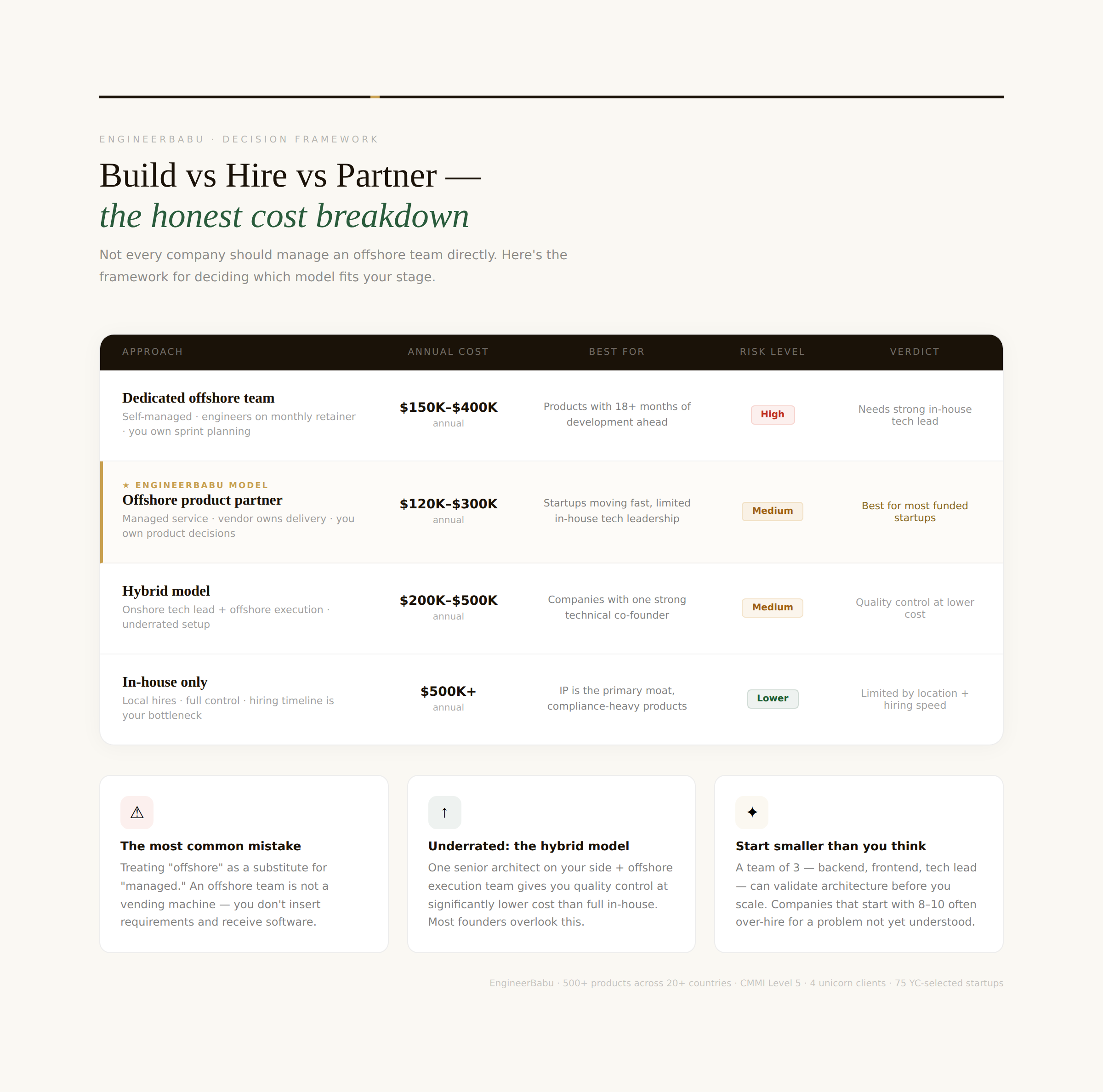
Not every company should manage an offshore team directly. Here’s the honest breakdown:
| Approach | Best for | Real cost (annual) | Risk |
| Dedicated offshore team (self-managed) | Products with 18+ months of development ahead | $150,000-$400,000 | High management overhead, quality variance |
| Offshore product partner (managed service) | Startups moving fast, limited in-house tech leadership | $120,000-$300,000 | Vendor dependency, margin on top of engineer cost |
| Hybrid (onshore lead + offshore execution) | Companies with one strong technical co-founder | $200,000-$500,000 | Communication overhead, coordination cost |
| In-house only | Products where IP is the primary moat, compliance-heavy | $500,000+ | Hiring timeline, location limits |
The hybrid model is underrated. One senior engineer or architect on your side who owns technical direction, combined with an offshore team executing, gives you quality control at significantly lower cost than full in-house.
The offshore development model works. The companies that say it doesn’t work are usually the ones who treated “offshore” as a substitute for “managed.”
An offshore team is not a vending machine. You don’t insert requirements and receive software. It’s a professional relationship between engineers who happen to be in a different timezone and a client who happens to need software built.
The same things that make any professional relationship work, clarity, trust, feedback, accountability, make this work too. The timezone just makes the stakes of getting those things wrong higher.
The 75 YC-selected products we’ve built at EngineerBabu and the 4 unicorn clients in our portfolio didn’t happen because we have a proprietary offshore management methodology.
They happened because we built those products with the same discipline we’d expect from any high-performing team: clear requirements, honest communication, and accountability to outcomes.
If you’re at the point where you’re thinking through offshore team structure, communication protocols, or vendor evaluation, these are exactly the conversations I’m usually having with founders before they commit.
Not a sales call. Just a technical conversation. I can tell you in 30 minutes whether the structure you’re planning has the failure modes I’ve seen 50 times before.
Reach me directly: mayank@engineerbabu.com
Mayank Pratap is the co-founder of EngineerBabu, a CMMI Level 5 product engineering company that has delivered 500+ products across 20+ countries. Selected for the Google AI Accelerator (Top 20 globally, 2024), backed by Vijay Shekhar Sharma (Paytm founder).
EngineerBabu has built products for 4 unicorns and 75 YC-selected startups. Mayank personally leads product and architecture conversations on every engagement.
FAQ:
Three non-negotiables: a robust NDA with jurisdiction specified, assignment of IP clauses in every contractor agreement, and continuous code delivery to your own private repository.
Don’t rely on the vendor’s code repository as your primary source of truth. Your code should be in your GitHub account from day one of the engagement.
Start smaller than you think you need. A team of 3, one backend engineer, one frontend engineer, and a tech lead, can validate product architecture before you scale.
Companies that start with 8-10 engineers offshore often find they’ve over-hired for a problem that wasn’t fully understood yet.
Most “delivery problems” I’ve audited turn out to be requirements problems.The pattern is usually obvious once you look at the actual artifacts.
Yes, at least once in the first 6 months. Video calls are functional. In-person is transformational. The relationships you build in 3 days in-person will sustain you through 6 months of async communication friction. Budget for it.
In my experience across 500+ projects, the single most common cause is a product owner who is unavailable during offshore working hours. The team needs real-time answers to real-time questions.