Custom Software Development Company in USA, UK, UAE & India | EngineerBabu


Create engaging, high-performance mobile applications tailored to your business needs. We craft future-ready apps that offer smooth user experiences on all devices.
Build robust and scalable websites and CMS platforms that help you manage content effortlessly. Our development ensures a seamless digital presence.
Launch secure, feature-rich online stores with intuitive shopping experiences. We build tailored eCommerce platforms designed for growth.
Design captivating games with immersive gameplay and stunning graphics. From concept to launch, we build engaging experiences that players love.
Enhance your customer relationships with customized Salesforce implementations. Drive growth and efficiency with smarter CRM solutions.
Harness artificial intelligence and machine learning to automate workflows and gain actionable insights. Our AI transforms data into smart decisions.
Accelerate your software delivery lifecycle with continuous integration, delivery, and infrastructure automation to boost efficiency.
Hire app developers ready to turn your ideas into sleek, high-performing mobile apps for any platform.
Bring in frontend pros who craft smooth, beautiful, and user-friendly interfaces that your visitors will love.
Get backend developers who build fast, secure, and reliable systems to keep everything running behind the scenes.
Hire eCommerce developers who build secure, scalable online stores designed to offer seamless shopping and grow your sales.
Get dedicated developers committed to your projects, delivering consistent quality and speed as an extension of your team.
I reviewed the architecture of a fintech product last quarter that had already burned $400,000 with a different vendor. The backend was a monolith pretending to be microservices. The “API integrations” were actually screen-scraping. And the product was six months late.
The founders had hired what looked like a credible custom software development company. Strong portfolio website. Decent-looking case studies. A discovery call that hit all the right notes.
What they didn’t know until it was too late: that vendor had never actually shipped a product at scale. They’d built prototypes. There’s a difference, and that difference costs founders everything.
I’ve been building technology products for 14 years. EngineerBabu, the company I co-founded, has delivered 500+ projects across 20+ countries, including 75 YC-selected builds and 200+ VC-funded products. We take 20 projects a year. Every client comes from a referral. I’m personally on every architecture call.
This is not a company overview. This is what I wish someone had told those founders before they signed that contract.
A custom software development company designs, engineers, and deploys software built specifically for your business requirements – not adapted from a template, not a white-labeled SaaS product, not a no-code tool stitched together with duct tape. The engagement covers discovery, architecture design, full-stack development, QA, DevOps, and post-launch support.
That’s the textbook answer. Here’s the honest one.
Most companies that call themselves custom software development firms are actually staff augmentation providers with a project pitch deck. They’ll place 3 developers on your project, hand you the code in a repo, and call it done. No architecture ownership. No product thinking. No accountability when the system falls apart under load.
The distinction matters more than ever in 2025. According to Statista, the global custom software development market is projected to reach $146.18 billion by 2030, growing at a CAGR of 22.5% from 2023. The demand is real. So is the noise.
When you’re evaluating a partner for a product that needs to scale across geographies – USA, UK, UAE, India – the bar needs to be higher than “they have a nice website.”
Most articles on this topic treat “global software development” as a single conversation. It isn’t.
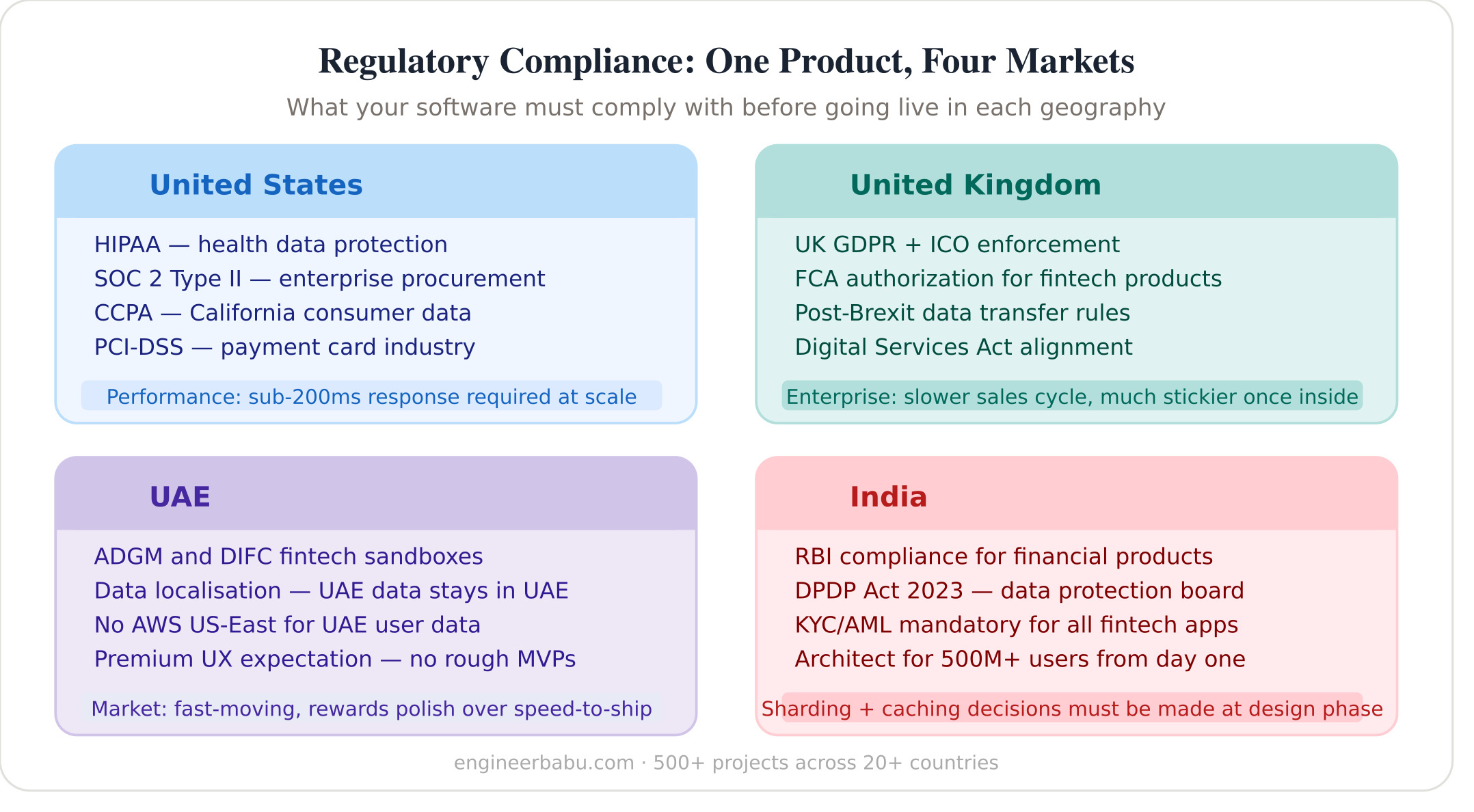
Building a product that operates across the US, UK, UAE, and India means navigating four distinct regulatory environments, four different data residency expectations, and four user behavior profiles.
In the USA: HIPAA compliance if you touch health data. SOC 2 Type II is increasingly a procurement requirement from enterprise clients. California’s CCPA for consumer applications. The US market also has the highest expectation for performance – sub-200ms response times are table stakes, not differentiators.
In the UK: GDPR applies, and post-Brexit the UK has its own ICO enforcement. Financial products need FCA authorization or FCA-regulated partnerships. The UK enterprise market moves slower than US but is stickier once you’re in.
In the UAE: ADGM and DIFC have their own fintech regulatory sandboxes. Data localization requirements are strict – you cannot simply store UAE user data on AWS US-East. The market rewards products that feel premium and move fast; the tolerance for half-built MVPs is low.
In India: RBI compliance for any financial product. Data Protection Board requirements post-DPDP Act 2023. The sheer scale challenge – you’re building for 500 million smartphone users, which means your architecture decisions around caching, queuing, and database sharding need to be made on day one, not when you hit a wall.
When the EngineerBabu team built the lending stack for EarlySalary – now processing over ₹10,000 crore in disbursements – the first technical decision wasn’t about features. It was about where data would live, which regulatory checkpoints were non-negotiable, and what the failure modes would look like under peak load. That thinking needs to happen before a single line of code is written.
I’ve been on the other side of this conversation hundreds of times. Founders evaluating vendors, CTO-less startups trying to figure out who to trust, enterprises looking to modernize legacy systems. Here’s the framework I’d use if I were in your seat.
Can the vendor produce a documented architecture decision record (ADR) for your project? Can they explain why they chose PostgreSQL over MongoDB for your use case? If the answer is “we use what the client prefers,” that’s a red flag. A real product engineering partner has opinions. They push back when your feature request creates technical debt.
Any vendor can build version 1. The question is: are their clients still running production systems they built 3 years ago? Request references from clients who are 18+ months post-launch. Ask specifically about how the vendor handled production incidents, performance degradation, and scope changes.
There are three common models: fixed-price project, dedicated team, and time-and-material. Each has a right context.
Fixed-price works only when the scope is truly fixed – which is rare in product development. Most “fixed price” contracts are vehicles for change order abuse.
Dedicated team works when you have product management capacity in-house and need execution bandwidth.
Time-and-material with milestone accountability is what I recommend for most early-stage products. You’re not capping innovation with a fixed scope, but you’re creating checkpoints where both sides evaluate progress.
Ask for a breakdown of their estimate. Not “front-end: 200 hours, back-end: 400 hours.” A legitimate estimate includes API integration complexity, QA test coverage plan, infrastructure provisioning, security review, and buffer for third-party dependency delays. Most CTOs I talk to underestimate integration work by 3 to 4x. A vendor who doesn’t flag this in their estimate either hasn’t done this before or is low-balling to win the deal.
OWASP Top 10 compliance should be baseline, not a premium add-on. Ask about their code review process – is it automated, manual, or both? Do they conduct penetration testing before launch? For products operating in regulated markets (financial services, healthcare, legal tech), security isn’t a feature. It’s a prerequisite.
Every client asks “what tech stack do you use?” That’s the wrong question.
The right question is: “For my specific product, user base, and scaling trajectory, what stack would you recommend, and why?”
Here’s how I think about it across product types:
For consumer apps (10k to 10M users): React Native for mobile (unless you have a strong reason for native – you usually don’t at MVP stage). Node.js or Go for backend services. PostgreSQL as primary database. Redis for caching. AWS or GCP depending on your team’s familiarity. CI/CD via GitHub Actions. This stack is boring. That’s the point.
For enterprise SaaS (B2B, multi-tenancy): Microservices architecture from day one if you’re targeting 50+ enterprise clients. Each service owns its data. Event-driven communication via Kafka or RabbitMQ. Kubernetes for container orchestration. Separate infrastructure per tenant for enterprise-grade isolation. This adds 30-40% to your initial build cost. It’s worth it if enterprise sales is your model.
For fintech products (lending, neobanking, payments): This is where I’ll spend more time because we’ve built 7 lending platforms and 4 neobank products. The core modules -origination, underwriting, disbursement, collections, reconciliation – need to be decoupled services. Not because microservices are trendy but because compliance updates to your underwriting logic cannot require a full system redeploy. You need audit trails at the data layer, not just the application layer. Every API call to a credit bureau, KYC/AML provider, or payment gateway needs to be logged with immutable records.
For AI-integrated products: LLM integration via API (OpenAI, Anthropic, or self-hosted models) is straightforward. The hard part is retrieval-augmented generation (RAG) architecture – chunking strategy, embedding model selection, vector database choice (Pinecone vs. Weaviate vs. pgvector depending on your data volume). We built an AI inventory management system for Simba Beer that processes real-time field intelligence from 200+ points of sale. The model accuracy was secondary to data pipeline reliability. Most AI products fail because of data infrastructure, not model quality.
I am going to be more direct here than most vendors will be, because vague pricing is how clients get burned.
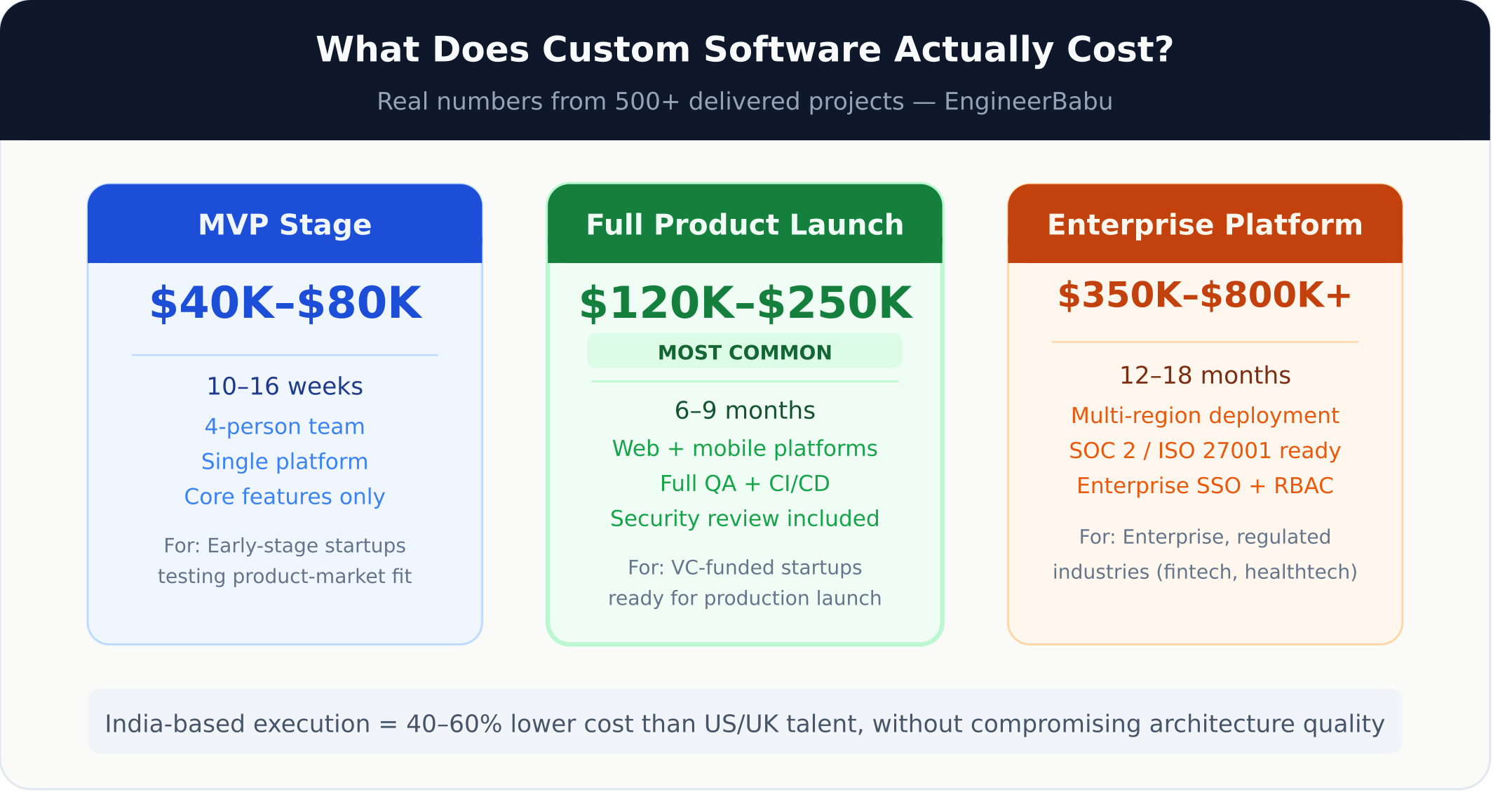
MVP (3 months, single platform, core feature set): $40,000 to $80,000. This assumes a 4-person team (tech lead, 2 developers, 1 QA), 12 to 16 weeks, and a clearly scoped feature set. No AI integration, no complex third-party integrations, no enterprise security requirements.
Full product launch (6 to 9 months, multi-platform, production-ready): $120,000 to $250,000. Two platforms (web + mobile), full QA coverage, CI/CD pipeline, monitoring setup, security review, and documentation. This is where most funded startups land.
Enterprise-grade platform (12 to 18 months, multi-region, compliance-ready): $350,000 to $800,000+. Multi-region deployment, SOC 2 or ISO 27001 compliance readiness, enterprise SSO, RBAC, SLA commitments, dedicated DevOps. LoanOS, the 7-module lending platform EngineerBabu built, fell in this range.
Geography-based cost dynamics: Development rates in India run 40 to 60% lower than equivalent senior talent in the US or UK. This is real and not something I’ll pretend doesn’t matter. But the cost differential only holds if the team has the product thinking to match the technical execution. A $35/hour developer who needs 3x the hours and generates 5x the rework is not cheaper than a $80/hour developer who ships clean, scalable code.
The right model for most global products: product leadership and architecture in a high-cost market (US, UK, UAE), execution team in India with strong English communication and product context. That’s how EngineerBabu operates. Our CTO on fintech products has 17 years of lending technology experience. The code is written by an Indian team that has shipped 75+ YC-backed products. It is not an either/or.
This is the pattern I see most consistently across 500+ projects, so I’m going to be direct.
Most teams build for the user count they have today. They’ll say “we’ll optimize when we need to” – which sounds reasonable until you hit a wall at 50,000 concurrent users and your architecture requires a ground-up rewrite to fix it.
Scalability is not something you bolt on after product-market fit. Three specific decisions made at the foundation determine your ceiling:
Database architecture: Row-level data vs. columnar storage vs. hybrid. Most products start with a relational database (correct) but fail to plan for read replica strategy, connection pooling, and query optimization. I’ve seen products where a single unindexed query was bringing down the entire service under load.
Stateless service design: Your application servers should be stateless. Sessions, user context, and temporary data belong in Redis or similar. This sounds obvious. It’s wrong in the majority of codebases I audit.
Async processing: Anything that isn’t time-critical (email sends, report generation, webhook deliveries, ML inference) should be offloaded to a message queue. RabbitMQ, SQS, or Kafka depending on your throughput requirements. Products that do everything synchronously hit response time walls at scale that require architectural surgery to fix.
According to a 2025 Gartner report, 60% of software projects that fail in production fail not because of bugs, but because of architectural decisions made in the first 30 days of development. (Source: Gartner, 2025) I believe that number is conservative.
I’ll tell you exactly what our engagement looks like because most vendors hide this behind a “discovery call” wall.
Week 1-2: Technical Discovery. I’m on the first call personally. We map your business requirements to technical requirements. Product scope document. Architecture proposal. Technology recommendations with reasoning. You get a document you can take to any other vendor and use as a benchmark.
Week 2-3: Estimation and Team Formation. Detailed scope breakdown. Timeline with milestones. Team composition with specific people’s backgrounds (not “senior developer” but the actual person’s experience). Fixed deliverables per milestone.
Month 1-3: Foundation Sprint. Architecture setup, CI/CD pipeline, core authentication and authorization, primary database schema, API contract definition. At the end of this phase, you have a working skeleton with security baked in, not bolted on.
Month 3-6+: Feature Sprints. Two-week sprint cycles. Bi-weekly demos. Scope adjustment conversations happen in real time, not at the end when it’s too late to course-correct.
Post-launch: 90-day hypercare period. We don’t disappear after deployment. Production incidents get a 2-hour response SLA. Then we transition to a retainer or hand off to your internal team – your choice.
| Criteria | Custom Development | SaaS/Off-the-Shelf | Low-Code/No-Code |
| Upfront Cost | $40K–$800K+ | $0–$50K/year | $5K–$80K |
| Time to Launch | 3–18 months | 1–4 weeks | 2–12 weeks |
| Scalability | Unlimited | Vendor-limited | Platform-limited |
| IP Ownership | Full | None | Partial |
| Custom Workflows | Complete | Limited | Moderate |
| Compliance Flexibility | Full control | Vendor-dependent | Limited |
| Long-term Cost | Lower at scale | High at scale | Medium |
| Right For | Complex, unique products | Standard workflows | Internal tools, MVPs |
The decision isn’t always custom development. I tell clients not to build custom software if a SaaS product can handle 80%+ of their core workflow without significant workarounds. But if your product IS your competitive advantage – if the software is the business, not just a tool for the business – you can’t rent someone else’s ceiling.
An MVP with core features typically takes 10 to 16 weeks with a focused team. A production-ready, multi-platform product with integrations and compliance requirements takes 6 to 12 months. Timeline depends more on scope clarity than team size – adding developers to a poorly scoped project makes it slower, not faster.
Ask them about their experience in your specific vertical, not just technology. A team that has built lending products understands credit bureau integrations, KYC/AML, and disbursement flows. A team that hasn’t, regardless of their technology expertise, will spend 60% of your budget learning your domain. Domain experience is not a bonus – it’s a multiplier.
RBI/FCA/FINRA regulatory experience (depending on market), demonstrated credit workflow architecture, understanding of PCI-DSS compliance, and references from live financial products with real transaction volumes. Any vendor without all four of these in their active portfolio is a risk.