Loan Origination Software Development Cost in 2026 | EngineerBabu


Create engaging, high-performance mobile applications tailored to your business needs. We craft future-ready apps that offer smooth user experiences on all devices.
Build robust and scalable websites and CMS platforms that help you manage content effortlessly. Our development ensures a seamless digital presence.
Launch secure, feature-rich online stores with intuitive shopping experiences. We build tailored eCommerce platforms designed for growth.
Design captivating games with immersive gameplay and stunning graphics. From concept to launch, we build engaging experiences that players love.
Enhance your customer relationships with customized Salesforce implementations. Drive growth and efficiency with smarter CRM solutions.
Harness artificial intelligence and machine learning to automate workflows and gain actionable insights. Our AI transforms data into smart decisions.
Accelerate your software delivery lifecycle with continuous integration, delivery, and infrastructure automation to boost efficiency.
Every development agency’s answer to “how much does it cost to build a loan origination system?” is the same: it depends. Contact us for a quote.
That answer is frustrating when you’re trying to build a business case, get board approval, or decide whether to build versus buy. You need real numbers. Not a quote form.
This guide gives them. Module by module. Tier by tier. India versus US pricing. Build versus buy versus LoanOS. What drives costs up. What cuts them down. And what the hidden costs are that every quote forgets to mention until month 6.
The numbers come from 14 years of building lending platforms including EarlySalary, a platform that has disbursed over ₹10,000 crore, and LoanOS, the team’s own NBFC lending platform processing ₹1,000 crore annually today.
The CTO spent 17 years at Wishfin. He’s been on both sides of the LOS cost conversation as the person building the system and the person being quoted for it.
These are real numbers.
If you want a specific quote for your LOS after reading this, email mayank@engineerbabu.com.
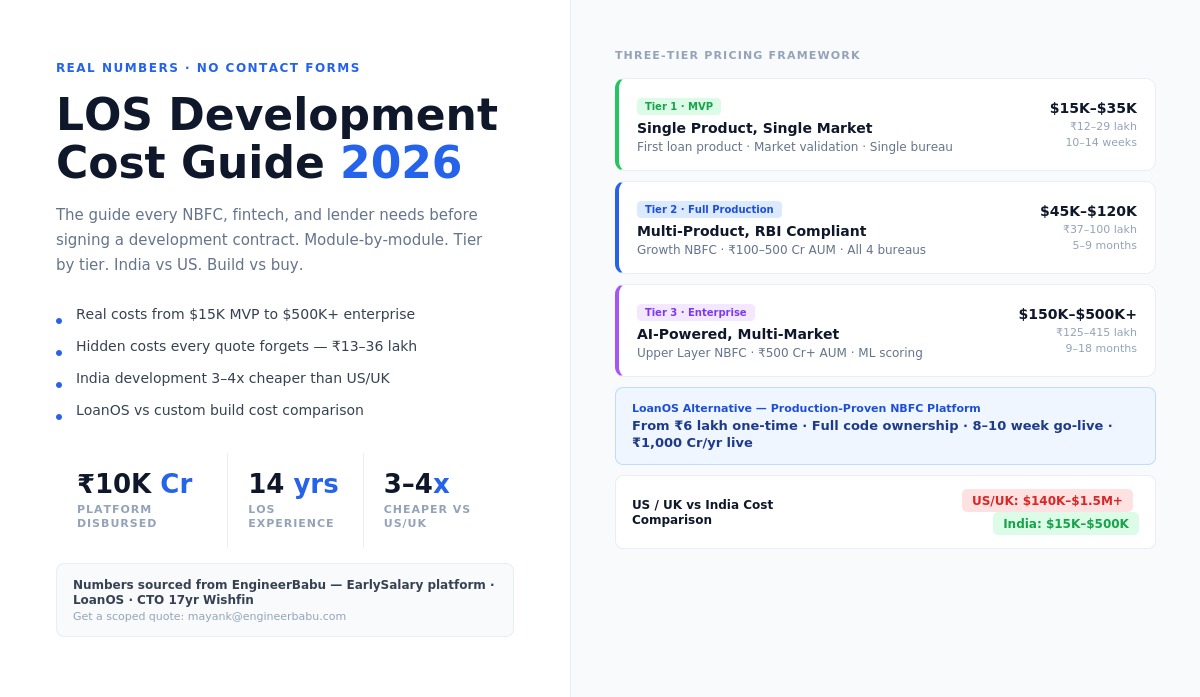
Before the module breakdown, the tier framework. Every LOS falls into one of three tiers. The tier determines the total cost more than any individual feature decision.
What it covers: Borrower application intake, one loan product, Aadhaar eKYC + PAN verification, single credit bureau integration, basic rules engine, eSign, direct disbursement trigger, and basic operational dashboard.
What it doesn’t cover: Account Aggregator, multi-bureau sequencing, advanced credit scoring, co-lending module, DSA portal, multi-product support, regulatory reporting (CRILC).
Who it’s for: An NBFC or fintech launching a first loan product to validate the market before full investment. A DSA upgrading from manual processing. A lender testing a new loan product before full platform integration.
Cost range: $15,000–$35,000 (₹12–29 lakh) built in India. $45,000–$90,000 built in the US or UK.
Timeline: 10–14 weeks.
What it covers: Everything in Tier 1 plus Account Aggregator framework, all 4 bureau integrations with intelligent sequencing, configurable credit rules engine (no-code policy updates), GSTN income verification, maker-checker underwriting workflows, KFS generation, DLA-compliant direct fund flows, NACH mandate origination, co-lending module (basic), DSA/channel partner portal, mobile borrower app (Flutter), NPA/SMA classification, CRILC reporting, WhatsApp Business integration.
Who it’s for: A growth-stage NBFC scaling from ₹100 crore to ₹500+ crore AUM. A fintech lender building a production digital lending platform for the India market. An NBFC moving from an off-the-shelf platform to a custom system they own.
Cost range: $45,000–$120,000 (₹37–100 lakh) built in India. $150,000–$400,000 built in the US or UK.
Timeline: 5–9 months.
What it covers: Everything in Tier 2 plus production ML credit scoring models (trained on the lender’s own data), advanced co-lending module with full automated reconciliation, OCEN integration for embedded lending, multi-state or multi-country compliance rules engine, collections AI (propensity model, collections routing), API gateway for third-party embedded lending, analytics platform (portfolio health, NPA prediction, vintage analysis), and full DevOps/SRE setup for 99.9% uptime SLA.
Who it’s for: An Upper Layer NBFC with ₹500+ crore AUM. A fintech planning to embed lending into a non-finance platform. A lender operating across India + one or more international markets.
Cost range: $150,000–$500,000+ (₹125 lakh–₹415 lakh) built in India. $500,000–$1.5M+ built in the US or UK.
Timeline: 9–18 months.
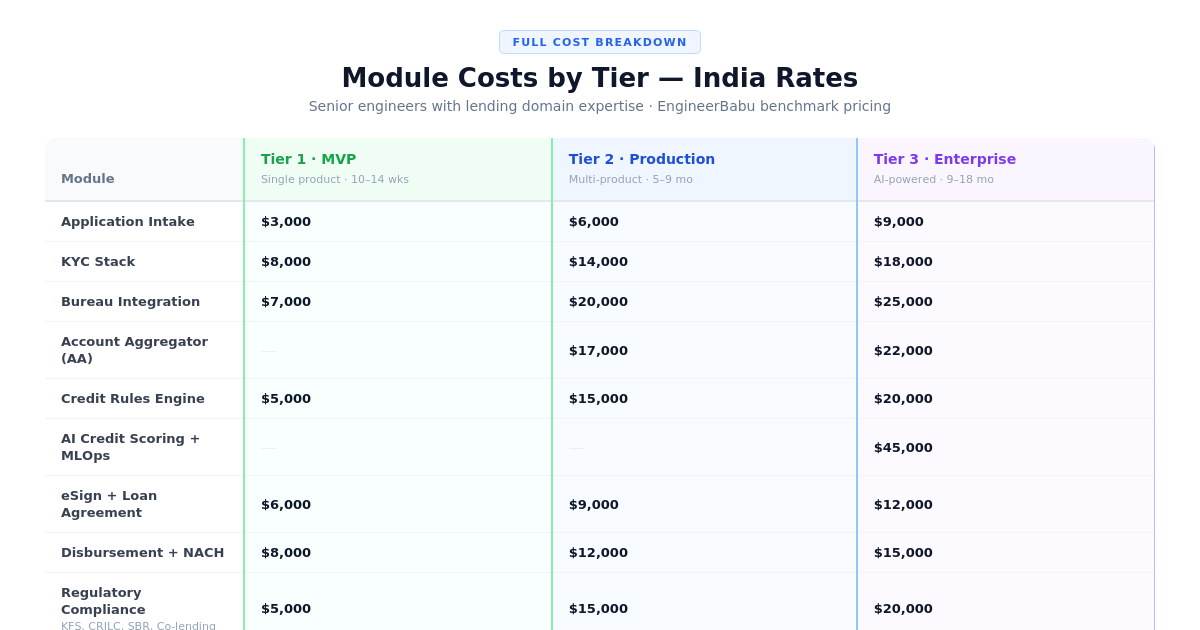
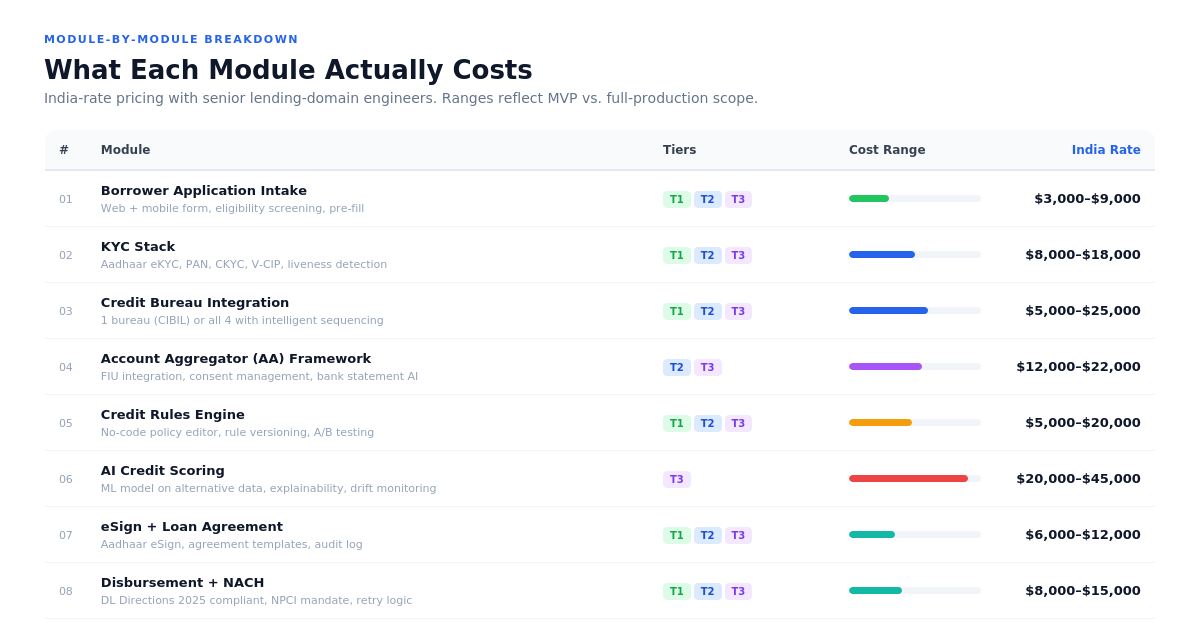
This is the breakdown nobody publishes. Each module’s cost is stated for India-based development at EngineerBabu rates, the benchmark is senior engineers with lending domain expertise, not offshore commodity rates.
What it includes: Web and mobile application form, real-time field validation, loan product selection, returning borrower pre-fill, initial eligibility screening, application reference number generation.
Cost: $3,000–$7,000
What drives it up: Multi-channel intake (web + app + DSA portal + branch interface). Multi-language support. Complex loan product selection logic with dynamic form rendering per product type.
What drives it down: Single channel. Single loan product. Standard form structure.
What it includes: Aadhaar eKYC (UIDAI API, OTP and biometric), PAN verification (ITD API), CKYC registry lookup (CERSAI), Video KYC (V-CIP) for fully digital lending, OCR-based document upload fallback, liveness detection, address verification.
Cost: $8,000–$18,000
What drives it up: V-CIP (video KYC) adds significant complexity, session management, recording infrastructure, storage compliant with RBI audit requirements. Multiple fallback paths (Aadhaar OTP → biometric → V-CIP → physical upload) each add development and testing cost. Liveness check integration with third-party providers (HyperVerge, IDfy, Signzy).
What drives it down: Aadhaar OTP-only for standard personal loans. Single KYC path. No video KYC requirement.
Critical note: UIDAI authorisation for Aadhaar eKYC takes 4–8 weeks. Apply in week 1 of the project. The KYC module cannot go live without UIDAI production credentials, a common cause of LOS launch delays.
What it includes: CIBIL consumer credit report API, bureau response parsing and normalisation, credit score extraction, tradeline analysis, derogatory flag detection, audit log per bureau call.
Single bureau (CIBIL): $5,000–$10,000 All 4 bureaus (CIBIL + Experian + Equifax + CRIF) with intelligent sequencing: $15,000–$25,000
What drives it up: Each bureau has different API format, different authentication method, different response schema, different error handling. Intelligent sequencing logic (hit bureau A first, hit bureau B only if thin-file) requires business rules configuration. Production certification for each bureau takes 4–8 weeks and must be run in parallel.
Hidden cost: Bureau API calls have a per-hit unit cost. At ₹15–30 per hit, high-volume lenders pay ₹5–20 lakh annually in bureau costs. Sequencing logic and response caching can reduce this by 20–35%.
What it includes: AA gateway integration (Finvu, OneMoney, CAMSFinServ), consent artefact management, FIP data pull (bank statements, investment data, insurance), consent revocation handling, bank statement categorisation (income estimation, expense analysis, EMI obligation detection).
Cost: $12,000–$22,000
What drives it up: Consent management is complex, every consent request must have borrower consent recorded on the AA’s artefact, consent revocation must be handled mid-process, data use must be limited to the purpose stated in consent. Multiple FIP integration adds coverage but adds integration surface. Bank statement AI (ML categorisation of transactions) is the highest cost component.
Critical note: AA FIU (Financial Information User) registration takes 4–8 weeks. Apply week 1. This is now the preferred income verification method under the RBI Digital Lending Directions 2025, plan for it, not as an optional module.
What it includes: Rules editor UI (no-code policy configuration for credit team), rule definition language (eligibility criteria, score thresholds, DTI/FOIR limits, negative list checks), rule testing against historical applications, version control and rollback, audit trail for every policy version applied.
Cost: $10,000–$20,000
What drives it up: No-code configurability requires significant frontend and backend engineering, the rules editor is itself a product. Rule testing environment (ability to run a new policy against historical data before activating it) adds substantial complexity. Multi-product rules (different credit policy per loan product) multiplies configuration surface.
What drives it down: If the credit team accepts a simplified rules interface (basic threshold configuration, not a full expression language), cost is at the lower end.
Why this module matters more than its cost: A rules engine that requires developer involvement for every credit policy change adds ₹2–5 lakh per policy update cycle in delayed implementation costs. At EarlySalary’s volume, thousands of daily decisions, the ability to iterate credit policy in hours rather than weeks was worth more than the module itself.
What it includes: ML model for thin-file borrowers using GST data, bank statement transaction patterns, and behavioral signals. Model training on historical application and repayment data. Model deployment as a microservice. Explainability layer (reason codes per decision). Model monitoring for drift.
Cost: $20,000–$45,000
What drives it up: Model training requires labelled historical data, if the lender is new and has no loan performance data, the team uses industry datasets with transfer learning, which adds model development cost. GSTN API integration is a separate integration cost (₹3–5 lakh). Explainability layer (required by RBI for fair lending) adds engineering complexity.
Google AI Accelerator 2024 advantage: Production ML for lending credit scoring is a core capability. The models the team builds aren’t generic logistic regression — they’re production models trained on Indian lending data that handle thin-file borrowers, self-employed income estimation, and early-warning NPA signals. This is what got the team selected for Google AI Accelerator.
What it includes: Loan agreement template management (product-specific templates), dynamic field population (loan amount, rate, tenure, borrower details), Aadhaar-based eSign (NSDL/CDSL), OTP-based eSign fallback (Digio/Leegality/SignDesk), document storage with signing event audit log.
Cost: $6,000–$12,000
What drives it up: Multiple eSign providers for redundancy. Complex loan agreement templates with conditional clauses. Agreement version management. Bulk agreement generation for co-lending structures.
What it includes: Direct disbursement trigger (IMPS/NEFT/RTGS from NBFC’s account to borrower’s verified account, compliant with DL Directions 2025), NACH mandate registration (NPCI, in NBFC’s name), mandate status tracking, disbursement confirmation receipt, failed disbursement retry logic.
Cost: $8,000–$15,000
What drives it up: NACH mandate origination via NPCI requires direct NPCI integration or a bank-as-intermediary model. NPCI connectivity has lead times and technical certification requirements. Failed disbursement handling (incorrect account details, closed accounts) requires manual review queue and retry workflow. Co-lending disbursement (split payment to borrower, with portion from bank partner and portion from NBFC) is significantly more complex.
Critical note: NACH mandate application to NPCI takes 4–6 weeks. Apply week 1. Mandates must be in the NBFC’s name per DL Directions 2025, not in a vendor’s name.
What it includes: KFS (Key Fact Statement) generation in RBI-specified format, cooling-off period enforcement, DLA registration support (documentation for CIMS portal), CRILC submission data generation, SBR-aware NPA/SMA classification, basic provisioning calculation.
Cost: $10,000–$20,000
What drives it up: Multi-SBR-layer support (if the NBFC is Middle Layer or above, provisioning calculations differ). Automated CRILC submission pipeline (SFTP/API to RBI portal). Co-lending regulatory reporting (loan-level split data per RBI co-lending guidelines).
What it includes: Loan officer application queue, manual review workflow, disbursement approval workflow, portfolio dashboard (active loans, NPA, collections rate), bureau cost tracking, agent performance (for DSA models).
Cost: $8,000–$15,000
| Module | MVP (Tier 1) | Full Production (Tier 2) | Enterprise (Tier 3) |
| Application intake | $3,000 | $6,000 | $9,000 |
| KYC stack | $8,000 | $14,000 | $18,000 |
| Bureau integration | $7,000 | $20,000 | $25,000 |
| AA framework | — | $17,000 | $22,000 |
| Credit rules engine | $5,000 | $15,000 | $20,000 |
| AI credit scoring | — | — | $35,000 |
| eSign + agreement | $6,000 | $9,000 | $12,000 |
| Disbursement + NACH | $8,000 | $12,000 | $15,000 |
| Regulatory compliance | $5,000 | $15,000 | $20,000 |
| Ops dashboard | $5,000 | $12,000 | $20,000 |
| Mobile borrower app | — | $18,000 | $25,000 |
| DSA portal | — | $12,000 | $18,000 |
| Co-lending module | — | $15,000 | $30,000 |
| AI scoring + ML ops | — | — | $45,000 |
| DevOps + infra | $3,000 | $8,000 | $20,000 |
| Total (India rates) | ~$50,000 | ~$173,000 | ~$334,000 |
| Total (US/UK rates) | ~$140,000 | ~$480,000 | ~$900,000+ |
Note: Ranges vary based on specific product requirements, integration complexity, and team composition. These are representative mid-points, scoping conversations produce exact figures.
CIBIL production certification: 4–8 weeks, ₹2–5 lakh in certification fees. UIDAI Aadhaar production access: 4–8 weeks, compliance requirements. NACH NPCI connectivity: 4–6 weeks, bank intermediary or direct. AA FIU registration: 4–8 weeks.
None of these appear in a development quote. All of them affect your go-live date. Total hidden cost: ₹5–15 lakh in fees, 4–8 weeks in lead time if not started on day 1.
RBI Digital Lending Directions updated. New SBR provisioning circular issued. Bureau API version updated. Each update requires engineering work. Budget ₹5–15 lakh annually for regulatory compliance maintenance. Off-the-shelf platforms handle this for you on a custom build, it’s your responsibility.
If the lender is moving from an existing system (spreadsheet, off-the-shelf LOS), borrower data, loan records, and repayment history must be migrated. Poorly done migrations corrupt the loan ledger. Good migration requires mapping, validation, and parallel running. Cost: ₹3–8 lakh, often not quoted upfront.
Not a development cost, an operational cost. At ₹15–30 per bureau hit, ₹10–50/month subscription fees per bureau, a lender doing 5,000 applications/month pays ₹75,000–₹1,50,000 monthly in bureau costs. This compounds significantly at scale. Sequencing logic (only hit additional bureaus if needed) and caching (reuse recent reports within validity window) reduce this meaningfully but someone has to build that logic.
Production LOS requires AWS Mumbai for RBI data localisation. At Tier 1 scale: ₹30,000–₹60,000/month. At Tier 2 scale with high availability: ₹80,000–₹1,50,000/month. At Tier 3 with multi-AZ, auto-scaling, WAF, and SOC 2-compliant logging: ₹2,00,000–₹5,00,000/month. Not in the development quote.
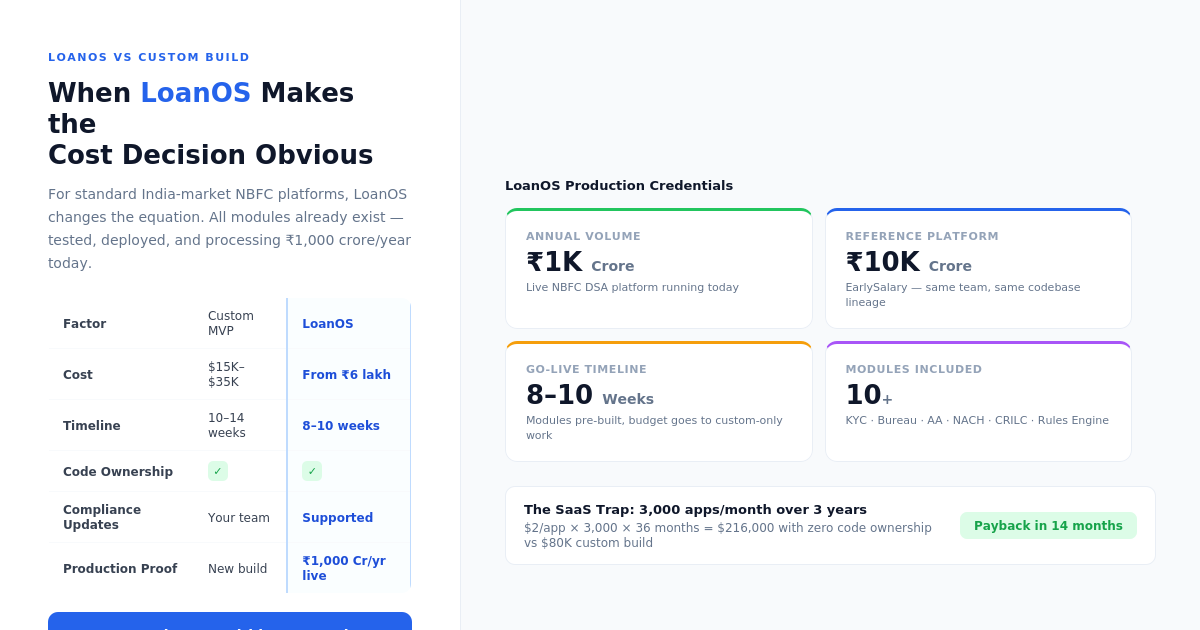
For lenders building a standard NBFC lending platform, single or multi-product personal or business loans, India market, RBI compliant, LoanOS changes the cost equation.
LoanOS is the team’s own production-proven modular platform. Every module described above already exists in LoanOS as a tested, deployed, operational module. The ₹10,000 crore EarlySalary platform refined these modules. LoanOS operates at ₹1,000 crore/year proving they work at scale.
LoanOS pricing:
LoanOS vs. custom Tier 1 comparison:
| Factor | Custom MVP | LoanOS |
| Cost | $15,000–$35,000 | From ₹6 lakh (~$7,200) |
| Timeline | 10–14 weeks | 8–10 weeks |
| Code ownership | Full | Full (ownership models) |
| Compliance updates | Your responsibility | Supported |
| Production proof | New build | ₹1,000Cr/yr live |
For non-standard products, proprietary credit models, multi-market builds, or enterprise scale requiring custom integrations, custom build extends from the LoanOS base, adding only what’s truly custom.
This is the fastest path to production for most NBFCs: deploy LoanOS as the platform foundation, customise what’s specific to the lender’s business.
Email mayank@engineerbabu.com to get a scoped quote for your specific LOS within a week.
| Factor | Custom Build (India) | SaaS LOS (LendFoundry/TurnKey) | LoanOS |
| Upfront cost | $15K–$500K | $0–$50K setup | ₹6 lakh one-time |
| Ongoing cost | Cloud infra only | $2,000–$20,000/month license | ₹29,500/month or zero (ownership) |
| Per-application cost | Infra only | $0.50–$5 per application | None |
| Code ownership | Full | None | Full (ownership model) |
| Customisation | Unlimited | Platform-constrained | Core modules fixed, extensions available |
| Compliance updates | Your team | Vendor-managed | Supported |
| Proprietary credit model | ✅ | ❌ | ✅ |
| India-Stack depth | Configurable | Pre-built | Production-proven |
| Go-live timeline | 10 weeks–18 months | 4–12 weeks | 8–10 weeks |
The SaaS trap: A mid-size NBFC doing 3,000 applications/month on a SaaS LOS at $2 per application pays $6,000/month, $72,000/year for the privilege of not owning the code. Over 3 years, that’s $216,000 in licensing fees for a platform where the lender has no equity, no IP, and no ability to implement proprietary credit models that differentiate their lending from competitors.
The custom build at $80,000 pays back in under 14 months versus a $2/application SaaS model at 3,000 applications/month.
Drives costs UP:
Drives costs DOWN:
40–60% lower cost than US or UK development at equivalent quality. Not because the team is cheaper but because Indore’s cost of living is lower than San Francisco’s and the engineering quality is the same.
The CTO’s 17 years at Wishfin means the team doesn’t spend the first 6 weeks learning what a NACH mandate is, how CIBIL certification works, or what the RBI inspection team looks for in an audit trail. Every project starts with full domain context. That context saves 4–6 weeks of discovery cost on every LOS build.
LoanOS as a starting point further compresses cost, the modules that take 3 months to build from scratch are deployed in 3 weeks from LoanOS. The build budget goes into what’s genuinely custom.
Google AI Accelerator 2024 production ML capabilities mean the AI credit scoring module is not a research prototype. It is production-deployable code built by a team that does this for a living.
The numbers above are representative ranges. Specific numbers require a 30-minute conversation about:
30 minutes produces a scoped proposal within a week.
Mayank Pratap | Co-founder, EngineerBabu | engineerbabu.com ₹10,000Cr Platform · LoanOS ₹1,000Cr/yr Live · CTO 17yr Wishfin · Google AI Accelerator 2024 · CMMI Level 5 · 4 Unicorn Clients · Backed by Vijay Shekhar Sharma
A single-product MVP LOS for the India market costs $15,000–$35,000 (₹12–29 lakh) built in India. A full multi-product, RBI-compliant production platform costs $45,000–$120,000 (₹37–100 lakh). An enterprise LOS with AI credit scoring, co-lending module, and multi-market compliance costs $150,000–$500,000+. US/UK development costs 3–4x these figures.
AI credit scoring ($20,000–$45,000) and the co-lending module ($15,000–$30,000) are typically the most expensive individual modules. The KYC stack ($8,000–$18,000) and AA framework ($12,000–$22,000) are the next most expensive, largely due to the integration complexity and the number of fallback paths required.
Third-party API certification fees and lead times (UIDAI, CIBIL, NPCI NACH, total ₹5–15 lakh in fees, 4–8 weeks lead time), annual regulatory compliance maintenance (₹5–15 lakh/year), data migration from existing systems (₹3–8 lakh), bureau API running costs (₹75,000–₹1,50,000/month at 5,000 applications/month), and cloud infrastructure (₹30,000–₹5,00,000/month depending on scale).
LoanOS is EngineerBabu’s own modular NBFC lending platform, currently processing ₹1,000 crore annually. It includes production-tested modules for KYC, bureau integration, AA framework, rules engine, eSign, disbursement, NACH, co-lending, and CRILC. Starting from LoanOS reduces Tier 1 development cost to approximately ₹6 lakh (one-time ownership) versus $15,000–$35,000 for a custom MVP build.
Off-the-shelf (LendFoundry, TurnKey Lender, Roopya) is right when standard loan products and no proprietary credit model are needed. Custom build (or LoanOS as foundation) is right when the credit model is proprietary, when products are non-standard, or when SaaS per-application fees become material at scale. A mid-size NBFC at 3,000 applications/month pays $216,000 over 3 years in SaaS licensing — a custom build pays back in under 14 months.
Tier 1 MVP: 10–14 weeks. Tier 2 full production platform: 5–9 months. Tier 3 enterprise with AI scoring: 9–18 months. Critical: CIBIL certification, UIDAI Aadhaar, NACH NPCI, and AA FIU registration must all be initiated on day 1, each takes 4–8 weeks and cannot be expedited.