How to Build a HIPAA-Compliant Patient Portal in the USA: The 2026 Technical Guide


Create engaging, high-performance mobile applications tailored to your business needs. We craft future-ready apps that offer smooth user experiences on all devices.
Build robust and scalable websites and CMS platforms that help you manage content effortlessly. Our development ensures a seamless digital presence.
Launch secure, feature-rich online stores with intuitive shopping experiences. We build tailored eCommerce platforms designed for growth.
Design captivating games with immersive gameplay and stunning graphics. From concept to launch, we build engaging experiences that players love.
Enhance your customer relationships with customized Salesforce implementations. Drive growth and efficiency with smarter CRM solutions.
Harness artificial intelligence and machine learning to automate workflows and gain actionable insights. Our AI transforms data into smart decisions.
Accelerate your software delivery lifecycle with continuous integration, delivery, and infrastructure automation to boost efficiency.
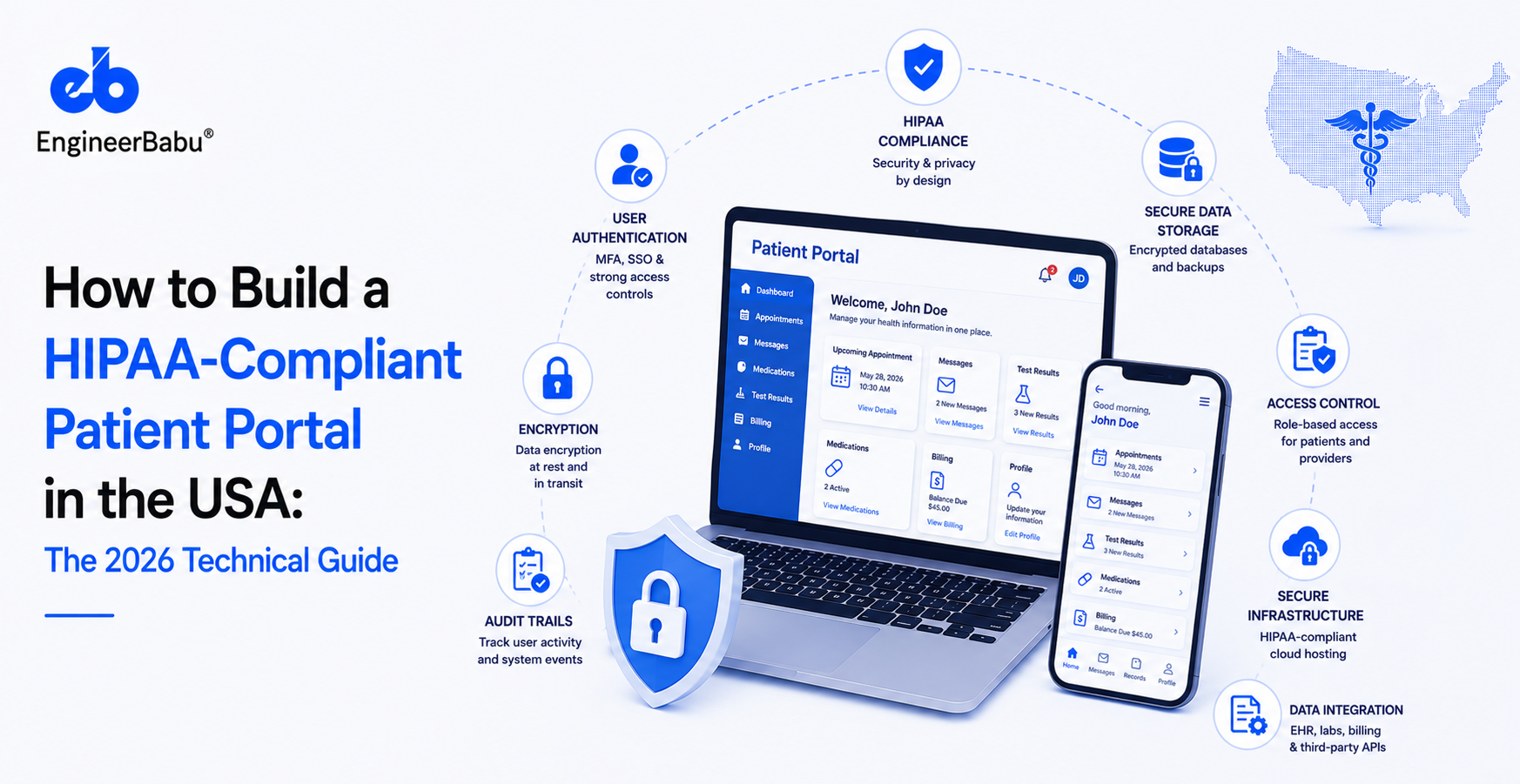
Patient portals are no longer optional for healthcare organizations in the USA. The 21st Century Cures Act, fully enforced since September 2025, mandates that patients can electronically access all of their electronic health information, clinical notes, lab results, medications, imaging reports, care plans, at no cost, without delay, in the format of their choice.
Withholding or delaying access is information blocking, and ONC has enforcement authority with financial penalties.
Before the Cures Act, many patient portals were marketing features, appointment scheduling bolted onto a healthcare website. In 2026, a patient portal is a regulated data access infrastructure. Building one correctly means understanding both the HIPAA compliance layer and the Cures Act interoperability requirements simultaneously.
This guide covers what a compliant patient portal actually requires in 2026, what it costs to build, and where most implementations go wrong.
A HIPAA-compliant patient portal is a secure, authenticated web and mobile application that gives patients electronic access to their protected health information including clinical notes, lab results, medications, immunizations, appointment records, and billing, while maintaining HIPAA security safeguards (encryption, audit logging, RBAC, MFA) and meeting 21st Century Cures Act information blocking requirements.
Under current enforcement, healthcare organizations cannot restrict access to finalized EHI, charge fees for EHI access, or delay sharing finalized results, even if a provider hasn’t yet reviewed them with the patient.
Building a patient portal requires understanding two overlapping regulatory requirements:
Patient portals require multi-factor authentication, this is explicit in HIPAA’s technical safeguards and ONC certification requirements. Standard username/password alone is insufficient for PHI-accessing systems.
Implementation: AWS Cognito (HIPAA-eligible with BAA) or Auth0 Healthcare tier (BAA available) with:
The portal must display all EHI the patient has a right to access under HIPAA, in a usable format, without delay after finalization:
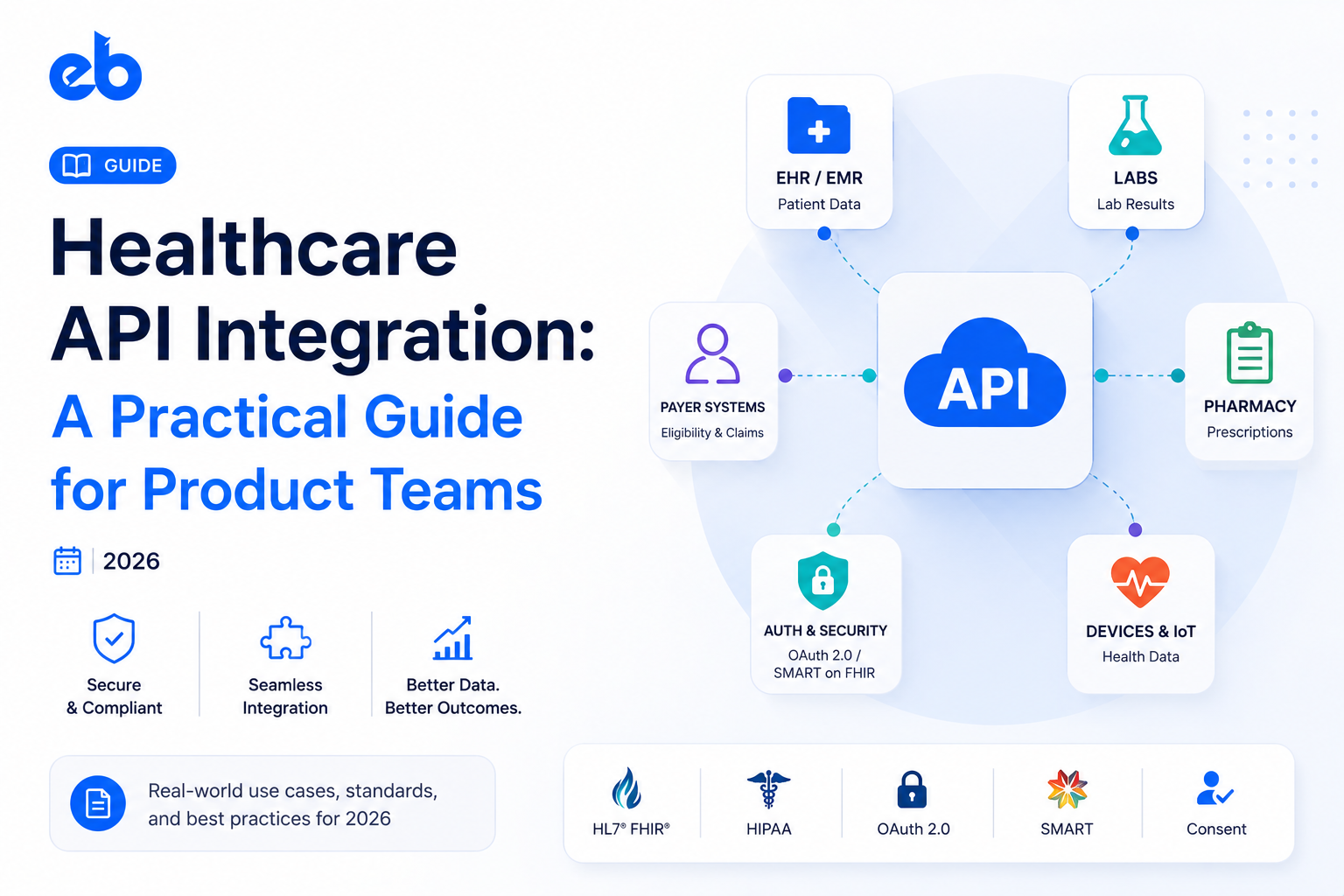
The FHIR integration requirement: This data comes from the underlying EHR via FHIR R4 APIs. A patient portal that only shows data manually entered into the portal is not compliant with Cures Act requirements, the portal must pull finalized EHI from the EHR system in near real time. This means Epic SMART on FHIR, Cerner FHIR APIs, or Athenahealth FHIR APIs depending on your EHR, plus a FHIR normalization layer if you’re connecting to multiple EHRs. (Full Epic FHIR guide: Blog 4)
HIPAA-compliant provider-patient messaging. Standard email is not HIPAA compliant, content must be encrypted in transit and at rest, and vendors must sign BAAs.
Implementation options:
PHI in push notifications: Never. “You have a new message” is acceptable. “Your blood glucose is 340 mg/dL” in a push notification is a HIPAA violation, the notification passes through Apple/Google infrastructure without a BAA. Push notifications trigger the patient to open the authenticated app to see their data.
Online appointment booking: view available slots, schedule new appointments, reschedule, cancel. Automated reminders via SMS/email (Twilio with BAA, reminder content must not include PHI, appointment time and practice name are acceptable; diagnosis or procedure is not).
Integration requirement: Appointment scheduling must write back to the EHR’s scheduling system, not maintain a separate calendar. Epic FHIR Slot and Appointment resources for Epic-connected organizations; Athenahealth scheduling APIs for ambulatory practices.
HIPAA-compliant online payment: view outstanding balances, itemized statements, copay collection, payment plan setup.
Compliance note: Stripe Healthcare (BAA available) is the standard for HIPAA-compliant payment processing. Standard Stripe without the healthcare configuration and signed BAA is not compliant for PHI-adjacent payment flows. Financial records containing procedure codes and diagnosis codes are PHI, the payment interface touching these records requires full HIPAA compliance treatment.
Patient-initiated refill requests routed to the provider. For medication refills: display current medication list, allow patient to request refill, route to provider inbox for approval, transmit to pharmacy via Surescripts e-prescribing.
The Cures Act explicitly requires that patients can authorize third-party applications to access their EHI. Your portal must support SMART on FHIR authorization flows that allow patients to connect their health data to apps of their choice, fitness trackers, care management apps, second-opinion services, research platforms.
Implementation: Implement an OAuth 2.0 authorization server with SMART on FHIR scopes. When a patient authorizes a third-party app, the app receives an access token scoped to that patient’s FHIR resources. This is not optional compliance, it is a core Cures Act interoperability requirement.
Every patient action, every record view, every message sent, every appointment scheduled, every download of EHI, must be logged with user ID, timestamp, action type, and resource accessed. Logs retained for 6 years, stored in a tamper-proof system (AWS CloudTrail), and protected from modification.
Patient access logs are particularly important under the Cures Act: if a compliance question arises about information sharing, the audit trail demonstrates exactly what data was accessed and when.
| Scope | Cost | Timeline |
| Basic portal (appointments, messaging, bill pay) | $30,000–$60,000 | 8–12 weeks |
| Full Cures Act compliant portal with FHIR EHR integration | $60,000–$150,000 | 14–22 weeks |
| Multi-organization portal with SMART on FHIR authorization | $150,000–$350,000 | 20–36 weeks |
| Enterprise health system portal (Epic-connected, multi-site) | $300,000–$1,000,000+ | 24–48 months |
The range is driven primarily by EHR integration complexity. A patient portal that connects to a single Athenahealth practice is a $60,000 project. A portal connecting to Epic across 20 hospital sites with bidirectional scheduling write-back and SMART on FHIR authorization is a multi-year enterprise program.
Author: Mayank Pratap | Co-Founder, EngineerBabu | Google AI Accelerator 2024 · CMMI Level 5
Not technically mandated for all organizations, but the 21st Century Cures Act requires healthcare organizations to provide patients with electronic access to their EHI via standardized APIs. The most practical and operationally efficient way to meet this requirement is a patient portal. Organizations providing EHI only on written request are technically compliant but operationally burdened and at higher risk of information blocking complaints.
No. The Cures Act prohibits charging fees for patient access to their own EHI. Portal access must be free to patients.
Yes. Under the Cures Act, finalized EHI including lab results and clinical notes must be released to the patient portal upon finalization, without delay. Holding results pending physician review is information blocking under current enforcement guidelines.
SMART on FHIR is the authorization framework that allows patients to connect third-party applications to their health data. Cures Act compliance requires supporting patient-directed data sharing via standardized APIs. Your portal must implement an OAuth 2.0 authorization server with SMART on FHIR scopes.
Basic portal (appointments, messaging, bill pay): $30,000–$60,000. Full Cures Act compliant portal with FHIR EHR integration: $60,000–$150,000. Multi-organization portal with SMART on FHIR: $150,000–$350,000. Enterprise Epic-connected portal: $300,000–$1M+.