How to Build a Prior Authorization Automation Platform - CMS-0057-F, Payer APIs, AI Criteria Engine 2026


Create engaging, high-performance mobile applications tailored to your business needs. We craft future-ready apps that offer smooth user experiences on all devices.
Build robust and scalable websites and CMS platforms that help you manage content effortlessly. Our development ensures a seamless digital presence.
Launch secure, feature-rich online stores with intuitive shopping experiences. We build tailored eCommerce platforms designed for growth.
Design captivating games with immersive gameplay and stunning graphics. From concept to launch, we build engaging experiences that players love.
Enhance your customer relationships with customized Salesforce implementations. Drive growth and efficiency with smarter CRM solutions.
Harness artificial intelligence and machine learning to automate workflows and gain actionable insights. Our AI transforms data into smart decisions.
Accelerate your software delivery lifecycle with continuous integration, delivery, and infrastructure automation to boost efficiency.
Prior authorisation costs the US healthcare system $1.3 billion annually. Manual PA costs $10.97 per transaction. Full automation drops it to $5.79. CMS’s Interoperability and Prior Authorization Final Rule (CMS-0057-F) effective January 2026 mandates that Medicare Advantage plans, Medicaid managed care organisations, and QHP issuers respond to standard PA requests within 7 calendar days and urgent requests within 72 hours.
There are approximately 1,100 US payers. Each has its own PA code list, submission portal, clinical criteria, and rules. Only 31% of medical PAs were fully electronic as of the most recent CAQH Index.
The platform that changes this handles commercial medical PAs that require portal logins, phone calls, and judgment not just pharmacy PAs that legacy vendors have automated.
EngineerBabu has built healthcare platforms for Apollo Hospitals, Somnoware (acquired by ResMed), and US digital health clients. Google AI Accelerator 2024. Contact: mayank@engineerbabu.com
Every PA starts with clinical data living in the EHR. The platform integrates via SMART on FHIR to extract what is needed for each PA without re-entry.
What the platform extracts from the EHR:
| Data Element | FHIR Resource | Purpose in PA |
| Patient demographics | Patient | Payer member ID lookup |
| Insurance coverage | Coverage | Which payer, which plan |
| Diagnosis codes | Condition | Medical necessity basis |
| Procedure requested | ServiceRequest | What is being authorised |
| Prior treatment history | MedicationRequest, Procedure | Step therapy documentation |
| Clinical notes | DocumentReference | Supporting clinical evidence |
| Lab results | Observation | Evidence of medical necessity |
The FHIR-integrated PA launch workflow:
This is the most complex component and the one that determines whether the platform reduces denials or just digitises the existing mess.
The criteria engine architecture:
| Layer | What It Does |
| Payer database | Per-payer, per-CPT: Is PA required? What are the clinical criteria? |
| LLM criteria parser | Ingests payer criteria PDFs and extracts structured rules |
| Criteria matcher | Compares patient’s clinical profile against extracted criteria |
| Gap identifier | Lists specific documentation elements missing from the record |
| Documentation prompter | Generates structured questions for the provider |
The LLM criteria parser in detail:
Payer criteria are published in unstructured PDFs and HTML pages that change without notice. The LLM parser:
This nightly update cycle is what eliminates the most common denial cause: submitting against outdated criteria.
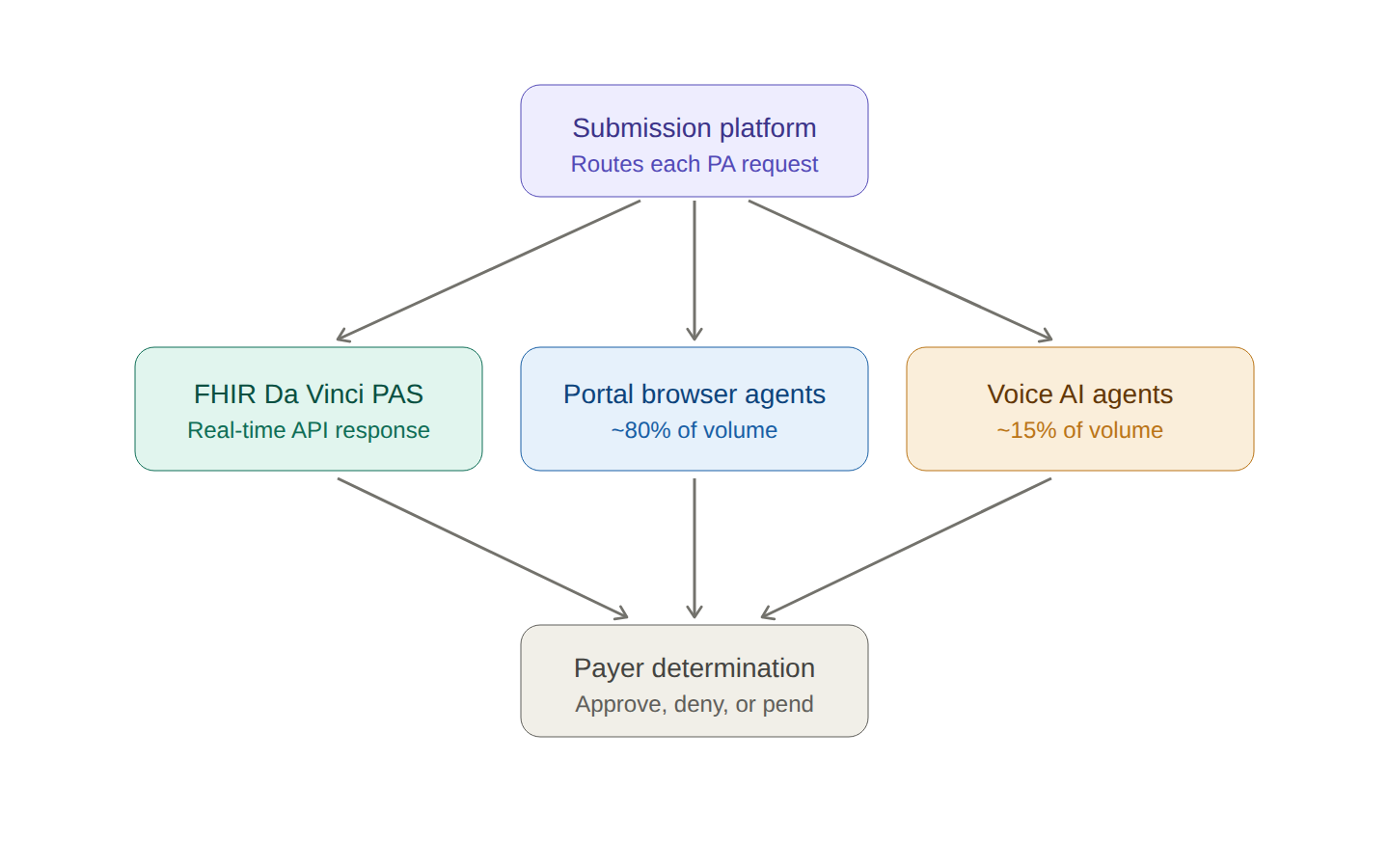
The Da Vinci Prior Authorization Support (PAS) implementation guide defines FHIR R4-based PA submission. The platform submits a structured FHIR Bundle and receives a real-time response, approved, denied, or pended without any portal navigation.
The PAS request bundle:
PAS Request Bundle contains:
– Claim resource (PA request)
– Patient resource
– Coverage resource (insurance)
– Organization resources (provider, payer)
– ServiceRequest (procedure being authorised)
– Condition resources (supporting diagnoses)
– DocumentReference (clinical notes — attached)
Most commercial PA volume still flows through payer-specific web portals. AI browser agents:
Each portal requires a dedicated adapter. Building adapters for the top 50 commercial payers covers approximately 80% of commercial PA volume.
Approximately 15% of commercial medical PAs still require a phone call. AI voice agents:
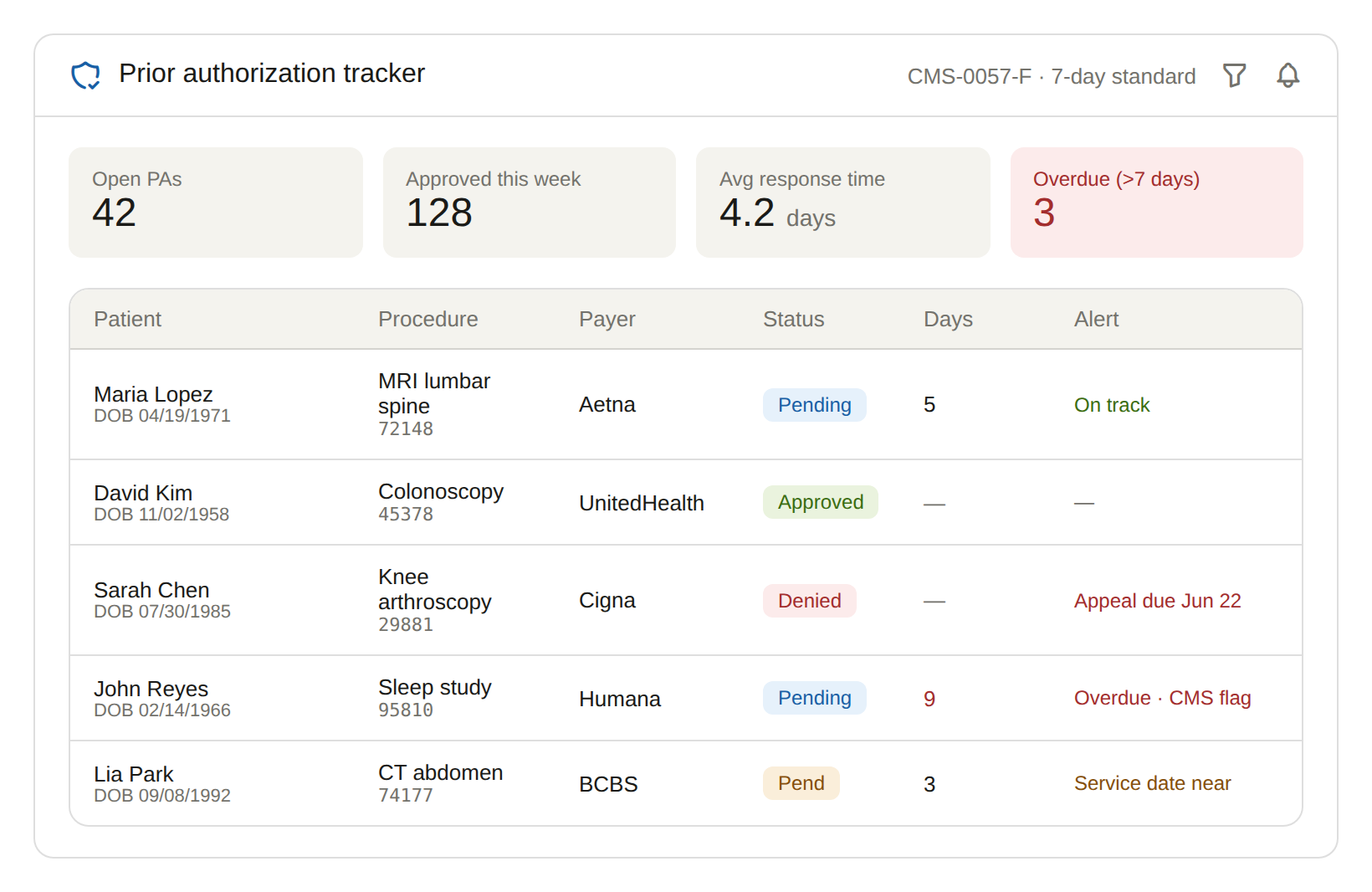
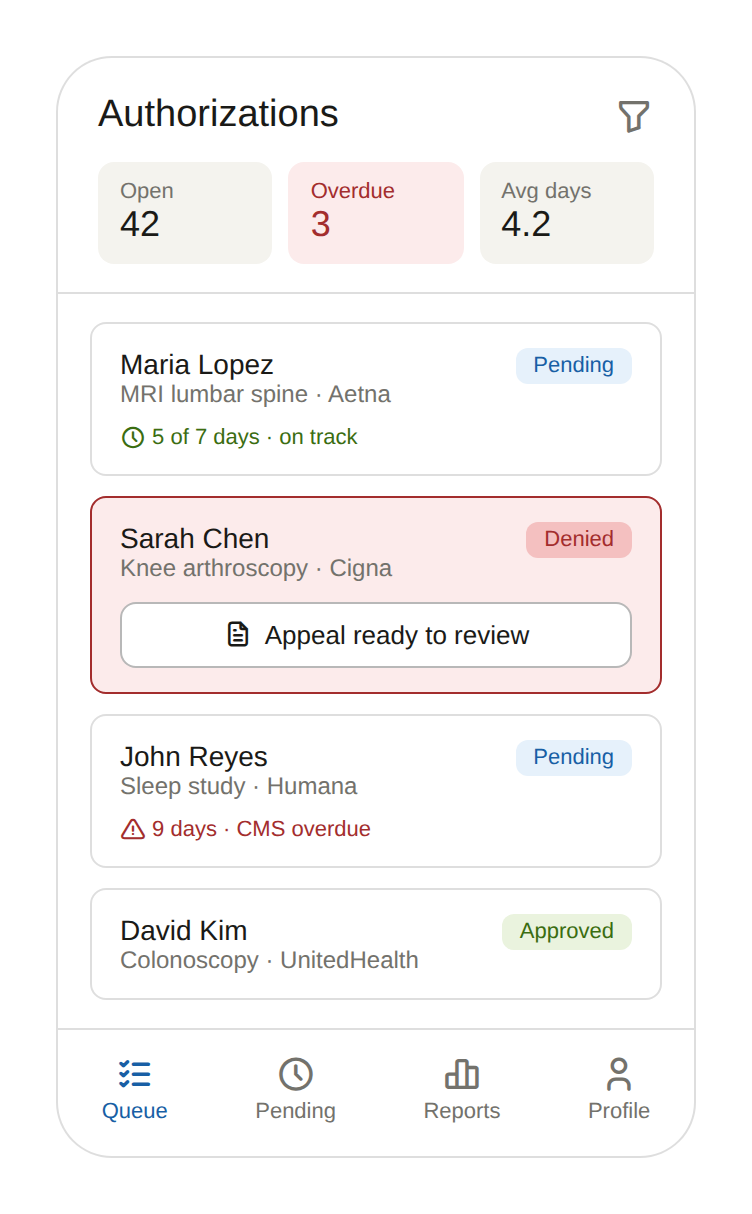
The status dashboard shows every open PA:
| Column | Details |
| Patient | Name + DOB |
| Procedure | CPT code + description |
| Payer | Payer name |
| Submission date | Date PA submitted |
| Current status | Pending / Approved / Denied / Pend / Appealing |
| Days pending | Against CMS-0057-F 7-day mandate |
| Alert | Overdue / Approaching service date / Appeal deadline |
The CMS-0057-F compliance monitoring:
CMS mandates 7-day response for standard PAs from January 2026. The platform:
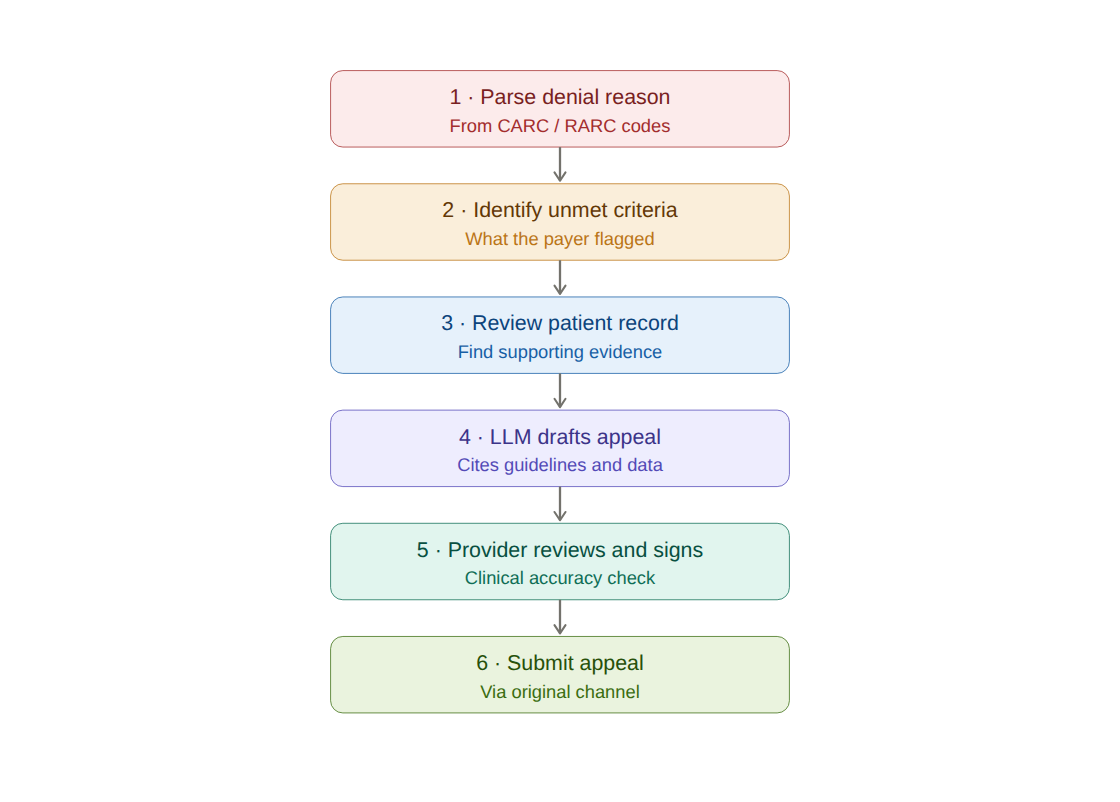
When a PA is denied, the platform:
Appeal letter generation quality:
The LLM is prompted with:
The output is a complete, clinically accurate appeal letter in 2 minutes versus 45 minutes of manual drafting.
| Module | Cost Range (USD) | Notes |
| EHR integration (SMART on FHIR + FHIR R4) | $8K – $15K | Epic, Cerner, athenahealth |
| CDS Hooks integration | $5K – $10K | PA trigger in EHR workflow |
| LLM criteria parser + payer database | $12K – $22K | Nightly update pipeline |
| FHIR Da Vinci PAS implementation | $6K – $12K | Tier 1 payers |
| Portal browser agents (per payer portal) | $2K – $4K each | 50 payer adapters = $100K–$200K |
| Voice AI agents | $8K – $15K | IVR navigation + hold management |
| Status tracking + CMS compliance | $5K – $10K | |
| AI appeal letter generation | $6K – $12K | LLM + clinical prompt engineering |
| Analytics dashboard | $4K – $8K | |
| AWS HIPAA + SOC 2 + VAPT | $6K – $12K | |
| Total (core platform) | $60K – $116K | Without payer portal adapters |
| Total (with 50 payer adapters) | $160K – $316K | Full production PA platform |
Contact: mayank@engineerbabu.com
CMS-0057-F is the CMS Interoperability and Prior Authorization Final Rule. Effective January 1, 2026, it requires Medicare Advantage plans, Medicaid managed care organisations, and Qualified Health Plan issuers to respond to standard prior authorisation requests within 7 calendar days (down from 14) and urgent requests within 72 hours. Payers must also publicly report approval rates, denial rates, appeal overturn rates, and average response times. By January 1, 2027, covered payers must implement FHIR R4-based Prior Authorisation APIs (the Da Vinci PAS implementation guide) enabling electronic submission and real-time responses without portal navigation.
The criteria parser maintains a database covering the top 400 commercial payers by claim volume, representing 85%+ of commercial PA transactions. For each payer, the parser monitors their publicly available clinical policy pages, medical coverage determination documents, and PA code lists. When a change is detected, the changed document is re-ingested through the LLM extraction pipeline, which converts the unstructured clinical criteria into structured rules: eligible diagnoses, step therapy requirements, documentation requirements, and quantity limits. The extracted rules update the payer-specific criteria database. Providers submitting PAs the next morning benefit from current criteria. This continuous update cycle is what differentiates the platform from static PA databases that go stale within weeks of publication.