Healthcare AI Startup Go-to-Market Strategy in the USA: What Actually Works in 2026


Create engaging, high-performance mobile applications tailored to your business needs. We craft future-ready apps that offer smooth user experiences on all devices.
Build robust and scalable websites and CMS platforms that help you manage content effortlessly. Our development ensures a seamless digital presence.
Launch secure, feature-rich online stores with intuitive shopping experiences. We build tailored eCommerce platforms designed for growth.
Design captivating games with immersive gameplay and stunning graphics. From concept to launch, we build engaging experiences that players love.
Enhance your customer relationships with customized Salesforce implementations. Drive growth and efficiency with smarter CRM solutions.
Harness artificial intelligence and machine learning to automate workflows and gain actionable insights. Our AI transforms data into smart decisions.
Accelerate your software delivery lifecycle with continuous integration, delivery, and infrastructure automation to boost efficiency.
Hire app developers ready to turn your ideas into sleek, high-performing mobile apps for any platform.
Bring in frontend pros who craft smooth, beautiful, and user-friendly interfaces that your visitors will love.
Get backend developers who build fast, secure, and reliable systems to keep everything running behind the scenes.
Hire eCommerce developers who build secure, scalable online stores designed to offer seamless shopping and grow your sales.
Get dedicated developers committed to your projects, delivering consistent quality and speed as an extension of your team.
The fastest way to waste two years and $2 million in US healthcare is to build the right product for the wrong buyer.
I’ve watched this pattern consistently: a team builds a genuinely valuable AI healthcare tool, launches with hospital marketing, gets enthusiastic meetings, and then watches deals stall in 14-month procurement cycles. They run out of runway before a single enterprise contract closes.
The US healthcare market is large: $4.8 trillion in annual spend. It is also one of the most complex sales environments on earth: multiple buyer personas (clinical, IT, administrative, finance), long procurement cycles (3–18 months for enterprise), regulatory requirements that vary by product category, and incumbent vendor relationships that are stickier than in any other industry.
This guide is the GTM framework I’d give to a healthcare AI founder before their first sales hire.
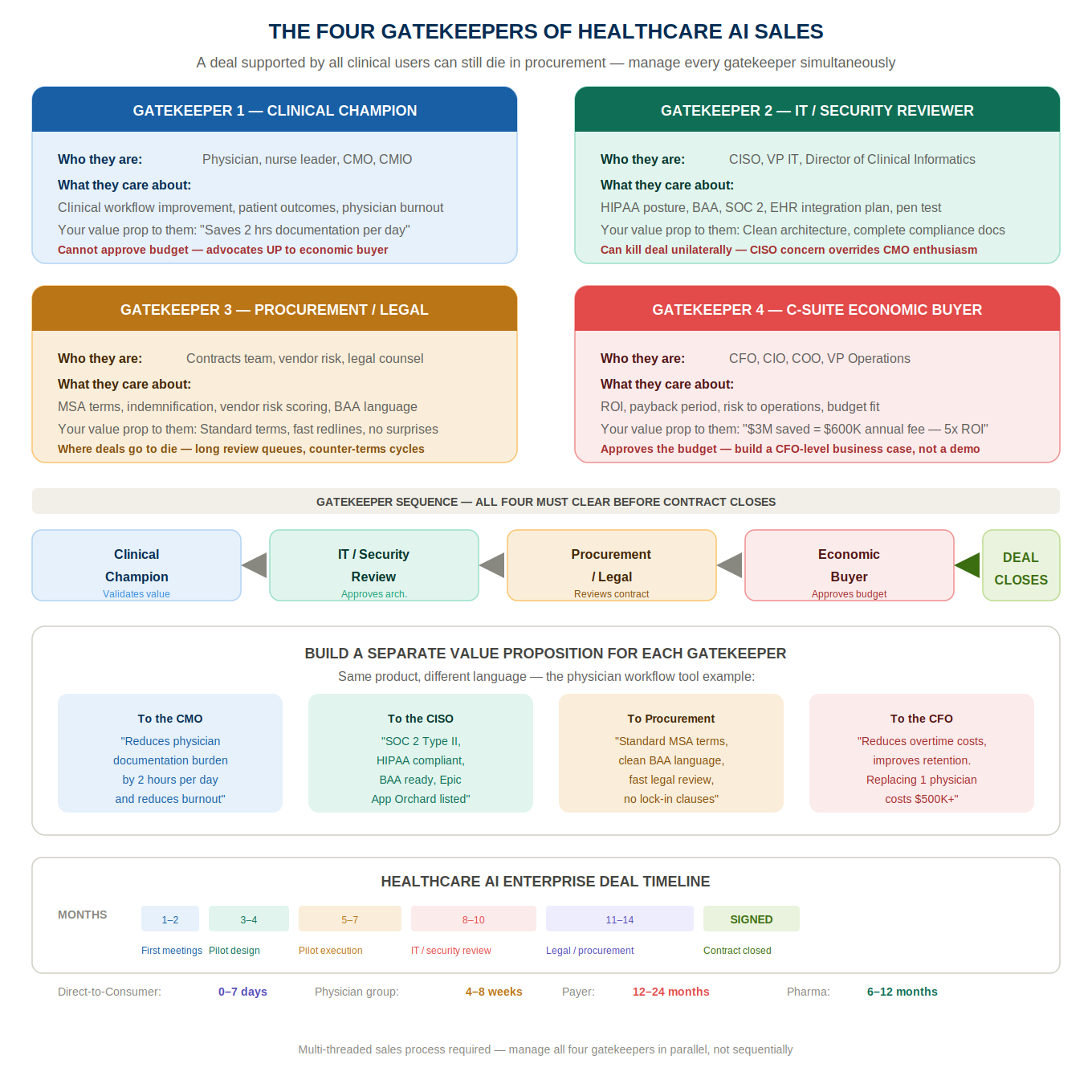
Healthcare AI startup GTM strategy requires navigating four simultaneous gatekeepers that don’t exist in standard B2B SaaS: the clinical champion (who decides if the product is medically useful), the IT/security reviewer (who approves the technical architecture and compliance posture), the procurement/legal team (who reviews contracts and vendor risk), and the C-suite economic buyer (who approves the budget).
A deal can be enthusiastically supported by all clinical users and still die in procurement. Understanding which gatekeeper controls the deal at each stage and what they need is the core GTM skill in US healthcare.
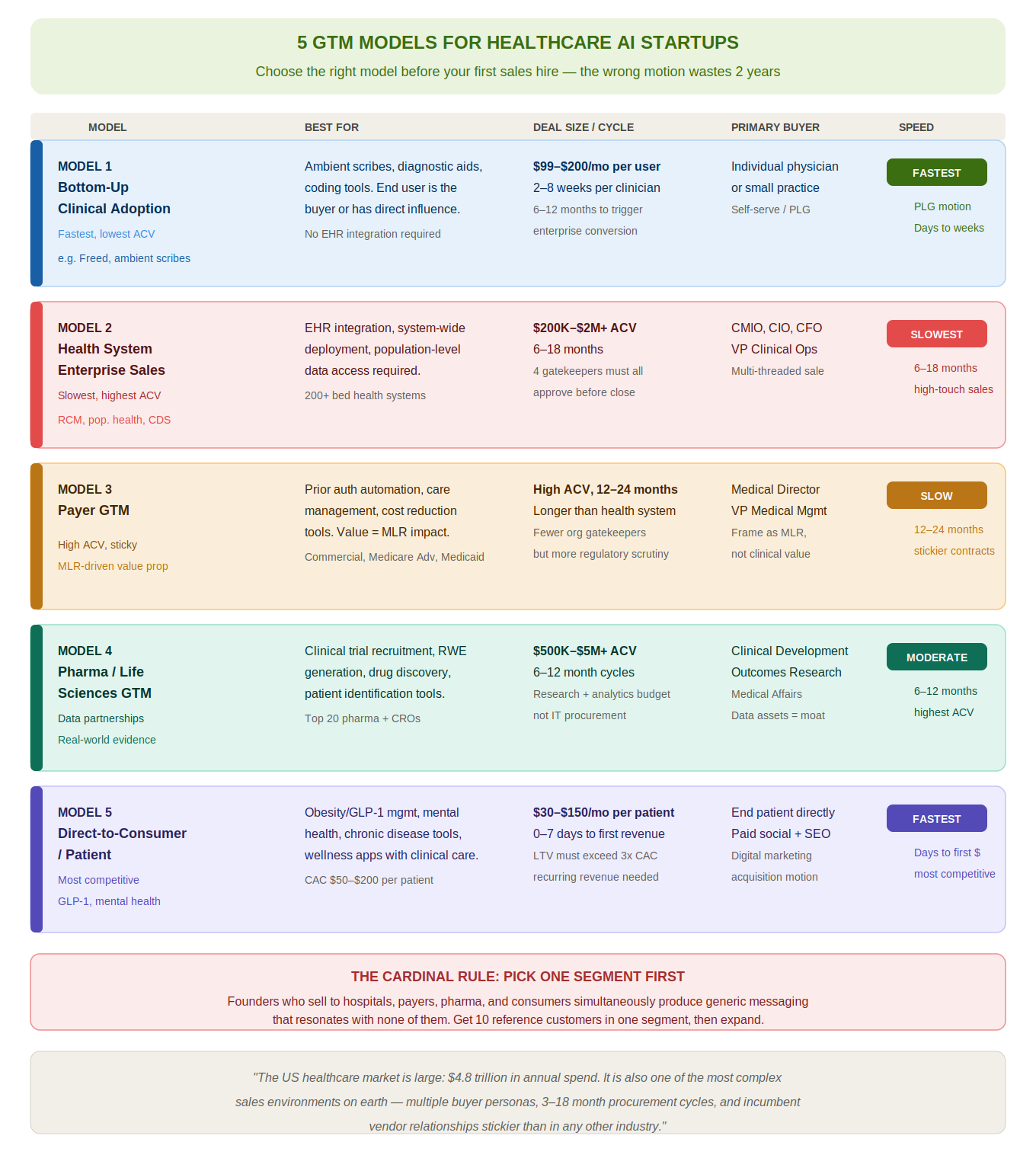
Not all healthcare AI products have the same GTM motion. The right model depends on your product category, target buyer, and competitive positioning.
Best for: AI tools used directly by clinicians: ambient scribes, diagnostic aids, coding tools, clinical communication apps. Products where the end user is the buyer or has purchasing influence.
How it works: Get individual physicians or small practices to adopt (often freemium or low-cost trial), demonstrate clear clinical workflow improvement, accumulate a critical mass of users within a health system that forces enterprise contract discussion from the bottom up.
Example products: Freed, Commure Scribe, Twofold Health, ambient AI scribe tools that physicians could adopt independently before health system contracts were required.
GTM tactics:
Reality check: Bottom-up works for tools where individual adoption generates enough value that physicians pay out of pocket ($99–$200/month). It fails for products that require EHR integration, IT approval, or data access, all of which require health system sign-off regardless of how many individual users want it.
Best for: AI platforms requiring EHR integration, system-wide deployment, or access to population-level data. RCM AI, population health, clinical decision support, prior authorization automation.
How it works: Target CMIOs, CIOs, and VP-level clinical operations leaders at health systems 200+ beds. Land a pilot (often paid, sometimes unpaid), prove ROI in 3–6 months, expand to enterprise contract.
Deal timelines: 6–18 months from first meeting to signed contract. Typical ACV: $200,000–$2,000,000+.
The gatekeeper sequence:
Each gatekeeper must be specifically managed. A clinical champion who loves your product cannot move it past a CISO who has concerns about your BAA posture. Build a multi-threaded sales process.
Key GTM tactics:
Best for: AI that reduces medical costs, prior authorization automation, clinical decision support that reduces unnecessary procedures, care management tools for high-risk populations, fraud detection.
How it works: Target Medical Directors and VPs of Medical Management at commercial insurers, Medicare Advantage plans, and Medicaid managed care organizations. Value proposition framed in medical loss ratio (MLR) improvement, not clinical workflow efficiency.
Deal characteristics: Longer than health system deals (12–24 months), but higher ACV potential and stickier contracts. Payers have fewer organizational gatekeepers than hospitals but more regulatory scrutiny.
Key metrics payer buyers care about:
Best for: AI tools for clinical trial recruitment, real-world evidence generation, genomics analysis, drug discovery support, patient identification for investigational studies.
How it works: Target Clinical Development, Outcomes Research, and Medical Affairs at top 20 pharmaceutical companies plus CROs (Contract Research Organizations).
Deal characteristics: High ACV ($500K–$5M+ for multi-year data partnerships), 6–12 month sales cycles, procurement through research and analytics budgets rather than IT.
Key differentiator: Real-world patient data with appropriate consent and de-identification architecture. Pharma buyers pay premium for curated, longitudinal, disease-specific datasets connected to outcomes.
Best for: GLP-1/obesity management, mental health, chronic disease management tools, wellness apps that escalate to clinical care.
Fastest time to revenue. Most competitive market.
How it works: Digital marketing (paid social, SEO, content) drives patient acquisition to a consumer-facing health product. Clinical care either embedded in the platform (telehealth + AI coaching) or referred to a partner network.
Viable segments in 2026: GLP-1 weight management (see Blog 9), mental health (anxiety, depression, ADHD), fertility, men’s health (testosterone, hair loss), women’s health (menopause, PCOS).
The unit economics pressure: Customer acquisition cost in consumer health is $50–$200 per patient. Lifetime value must exceed 3× CAC to build a sustainable business. The brands winning in 2026 have LTV driven by longitudinal care management (recurring monthly revenue), not one-time prescription access.
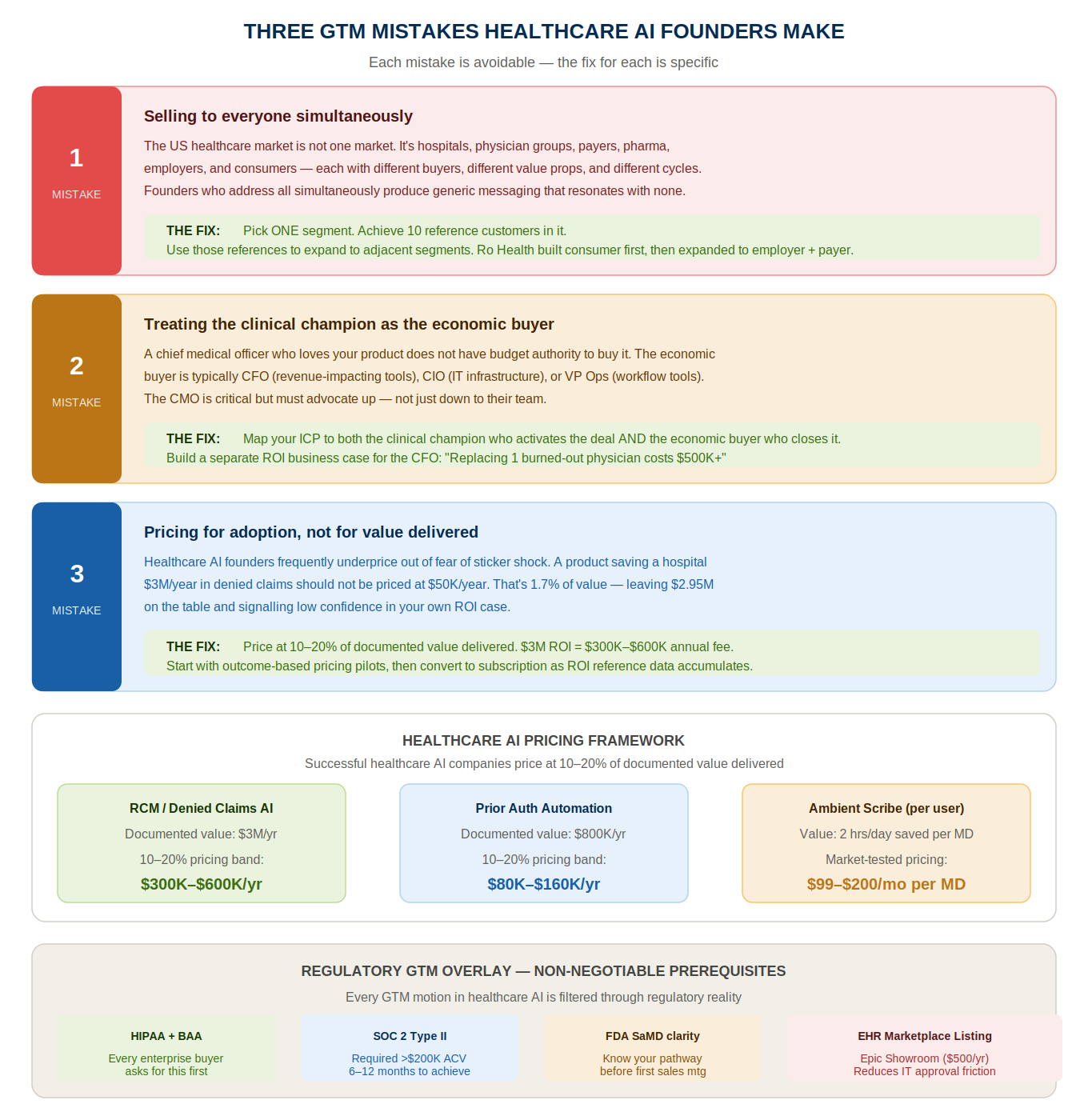
The US healthcare market is not one market. It’s hospitals, physician groups, payers, pharma, employers, and consumers, each with different buyers, different value propositions, different procurement cycles. Founders who try to sell to all of them simultaneously produce generic messaging that resonates with none of them.
The fix: Pick one segment. Achieve 10 reference customers in it. Use those references to expand to adjacent segments. Ro Health built its consumer model first; it’s now expanding into employer and payer channels. They didn’t do it simultaneously.
A chief medical officer who loves your product does not have the budget authority to buy it. The economic buyer in healthcare is typically a CFO (for revenue-impacting tools), CIO (for IT infrastructure), or VP Operations (for workflow tools). The CMO is a critical champion but they need to advocate up to the economic buyer, not just down to their team.
The fix: Map your ICP to both the clinical champion who activates the deal and the economic buyer who closes it. Build a separate value proposition for each. A physician workflow tool’s value proposition to a CMO is “reduces documentation burden and burnout.” The same tool’s value proposition to a CFO is “reduces overtime costs and improves physician retention, which costs $500K to replace.”
Healthcare AI founders frequently underprice because they’re afraid of enterprise sales friction. A product that saves a hospital $3 million per year in denied claims should not be priced at $50,000 per year because the founder is afraid of sticker shock.
The fix: Price as a percentage of value delivered. Most successful healthcare AI companies price at 10–20% of documented value, which for a $3M ROI product is $300K–$600K annually. Start with outcome-based pricing pilots (price tied to measured results) to build confidence in the ROI case, then convert to subscription as reference data accumulates.
In healthcare AI sales, one signed reference account is worth more than any marketing campaign.
Enterprise healthcare buyers are deeply risk-averse. They have been burned by technology vendors that overpromised and underdelivered. KLAS Research and peer references at conferences (especially HIMSS, ViVE, and HLTH) are the primary trust signals.
How to get your first reference account:
Every GTM motion in healthcare AI is filtered through regulatory reality. Your market access depends on your regulatory classification.
Author: Mayank Pratap | Co-Founder, EngineerBabu | Google AI Accelerator 2024 · CMMI Level 5
Health system enterprise deals: 6–18 months from first meeting to signed contract. Payer deals: 12–24 months. Direct-to-consumer: 0–7 days. Bottom-up clinical adoption: 2–8 weeks per individual user, 6–12 months to trigger enterprise conversion.
At minimum: HIPAA compliance with signed BAAs with all PHI-touching vendors, penetration test report, privacy policy and terms of service, and the ability to complete a standard security questionnaire. SOC 2 Type II report is increasingly required at enterprise deal sizes above $200K. FDA clearance or documented regulatory determination for AI products making clinical recommendations.
Physician groups offer faster sales cycles and lower deal friction. They’re a good market for proving product value and building reference accounts. Hospital health systems offer higher ACVs and stronger reference value for subsequent enterprise sales. Most successful healthcare AI companies start with physician groups or specialty practices, build reference accounts, and use those to move upmarket.
KLAS Research is an independent healthcare IT research firm that tracks vendor performance through structured customer interviews. KLAS rankings and reports are the primary reference tool for enterprise healthcare IT procurement. Appearing in relevant KLAS categories with positive customer satisfaction data significantly accelerates sales cycles.