Fintech App Development Company in India - From the Team Behind EarlySalary, Bank Open, and Razorpay


Create engaging, high-performance mobile applications tailored to your business needs. We craft future-ready apps that offer smooth user experiences on all devices.
Build robust and scalable websites and CMS platforms that help you manage content effortlessly. Our development ensures a seamless digital presence.
Launch secure, feature-rich online stores with intuitive shopping experiences. We build tailored eCommerce platforms designed for growth.
Design captivating games with immersive gameplay and stunning graphics. From concept to launch, we build engaging experiences that players love.
Enhance your customer relationships with customized Salesforce implementations. Drive growth and efficiency with smarter CRM solutions.
Harness artificial intelligence and machine learning to automate workflows and gain actionable insights. Our AI transforms data into smart decisions.
Accelerate your software delivery lifecycle with continuous integration, delivery, and infrastructure automation to boost efficiency.
Hire app developers ready to turn your ideas into sleek, high-performing mobile apps for any platform.
Bring in frontend pros who craft smooth, beautiful, and user-friendly interfaces that your visitors will love.
Get backend developers who build fast, secure, and reliable systems to keep everything running behind the scenes.
Hire eCommerce developers who build secure, scalable online stores designed to offer seamless shopping and grow your sales.
Get dedicated developers committed to your projects, delivering consistent quality and speed as an extension of your team.
Let me tell you what ₹10,000 crore teaches you about fintech.
That’s the amount disbursed through EarlySalary’s lending platform. The EngineerBabu team built that platform. Not a module. Not an integration. The lending infrastructure — credit decisioning, bureau integration, disbursement, repayment tracking, collections, real-time risk scoring. The whole thing.
₹10,000 crore is roughly $1.2 billion. Flowing through a system the team built. Every day, thousands of credit decisions. Every decision, real money lent to a real person. Every default, real risk absorbed by the company’s balance sheet.
That kind of volume teaches you things that no certification, no demo, no case study can replicate. You learn what breaks at scale. You learn where the reconciliation gaps hide. You learn that a 0.5% error rate in credit scoring doesn’t sound bad until you calculate what 0.5% of ₹10,000 crore looks like.
I’m starting with this because fintech development is not software development. It’s financial engineering expressed through code. The team that builds your fintech product needs to understand money — how it moves, how it gets stuck, how it disappears, and how to make sure every single unit of it is accounted for at the end of every day.
My name is Mayank Pratap. I co-founded EngineerBabu 14 years ago. Let me tell you the fintech products the team has built, because in this industry, the portfolio is the argument.
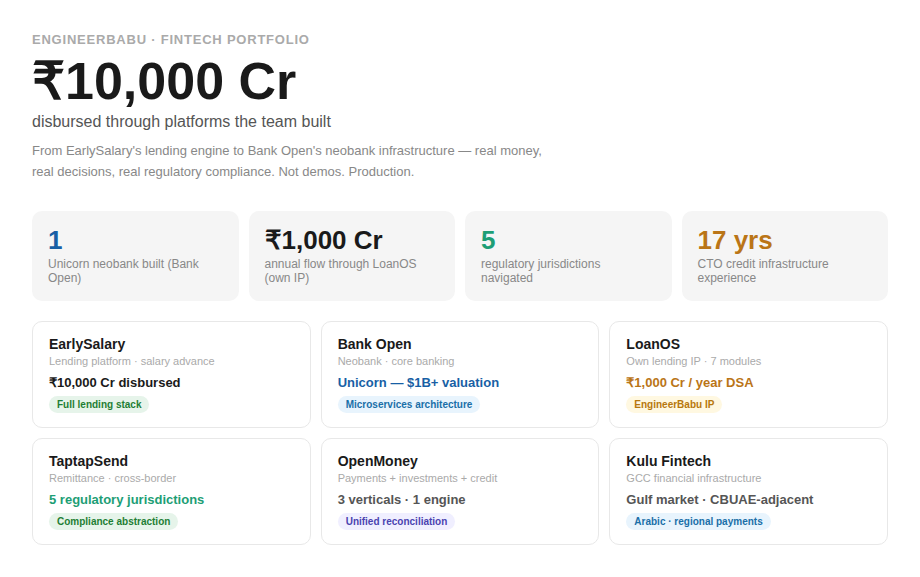
EarlySalary — lending platform. ₹10,000 crore disbursed. Real-time credit decisioning. One of India’s first salary advance products.
Bank Open — now Open Financial Technologies. Neobank. Core banking integrations built by the team. Became a unicorn — billion-dollar valuation. The architecture scaled from zero to a billion-dollar company.
OpenMoney — full-stack financial platform. Payments, investments, and credit unified under one architecture. Three financial verticals, one reconciliation engine.
Razorpay ecosystem — payment orchestration work within India’s largest payment infrastructure company.
TaptapSend — multi-continent remittance platform. Compliance across five regulatory jurisdictions simultaneously. Real money crossing real borders under real regulatory oversight.
Kulu Fintech — GCC-focused financial infrastructure. Built specifically for Gulf market requirements — regional payment methods, Arabic support, CBUAE-adjacent compliance.
Simba Beer — not fintech on the surface. Supply chain underneath. Recovered millions in blocked capital through custom technology. Money flow tracking. Capital recovery. Financial engineering applied to a beer company.
LoanOS — the team’s own lending technology product. Seven modules. Currently used by a DSA processing ₹1,000 crore per year. Not a client product. The team’s own IP. Proof that they don’t just build lending software — they operate it.
Google selected EngineerBabu for the AI Accelerator 2024 — with a proposition built specifically around AI-driven credit intelligence for lending.
Our CTO spent 17 years at Wishfin — one of India’s largest credit marketplaces. Seventeen years building credit infrastructure. Bureau integrations. Risk models. Scoring systems. The kind of deep lending expertise that most development companies don’t have in their entire organization, let alone in their CTO.
CMMI Level 5. Vijay Shekhar Sharma — the founder of Paytm — backs us personally. 24 unicorn clients. 75 YC selections. 200+ VC-funded products.
When someone searches “fintech app development company India,” they’re looking for a team that understands money. Not a team that builds apps that happen to involve money. There’s a profound difference. And the next 3,000 words will show you exactly what that difference looks like.
India isn’t just a place to outsource fintech development. India is where modern fintech was invented at scale.
UPI — India’s Unified Payments Interface — processes more digital transactions than Visa and
Mastercard combined within India. Over 13 billion transactions per month. That infrastructure created an ecosystem of fintech engineers who understand real-time payments, settlement, reconciliation, and fraud detection at a scale that doesn’t exist anywhere else.
Razorpay, Paytm, PhonePe, Pine Labs, BharatPe, Lendingkart, Capital Float, KreditBee, EarlySalary, Khatabook, CRED — India’s fintech ecosystem has produced more production-grade financial platforms than any country outside the US and China. The engineers who built these platforms are in India. The knowledge of how to build at fintech scale is in India.
This isn’t theoretical. The EngineerBabu team has worked within the Razorpay ecosystem on payment orchestration. Products built for Paytm’s ecosystem. Vijay Shekhar Sharma — the man who built Paytm into India’s largest digital payments company — evaluated EngineerBabu and decided to personally back the company. That’s not a business relationship. That’s a fintech founder saying “this team understands what I understand.”
For US fintech startups, UAE payment companies, Australian neobanks, and Singapore digital lenders — building with an Indian fintech development company means accessing this ecosystem. Not hiring a team that learned fintech from a textbook. Hiring a team that learned fintech from building EarlySalary, Bank Open, OpenMoney, and Razorpay.
Every fintech product has a unique engineering challenge. Let me walk you through the categories the team builds and what makes each one technically demanding.
Lending is the team’s deepest fintech specialization. The CTO’s 17 years at EngineerBabu. EarlySalary’s ₹10,000 crore. LoanOS processing ₹1,000 crore annually. This isn’t a capability the team added recently. It’s the foundation the team was built on.
A lending platform requires a credit decisioning engine that evaluates applications in real time — under 2 seconds. The engine pulls data from credit bureaus (CIBIL, Experian, CRIF in India; Al Etihad in UAE; SIMAH in Saudi; TransUnion and Equifax in the US), layers in alternative data signals (device fingerprinting, behavioral biometrics, transaction velocity, employment verification), and produces a decision: approve, decline, or counter-offer.
The difference between a good credit engine and a bad one isn’t whether it works. It’s whether the default rate stays below the threshold where lending economics survive. At EarlySalary’s scale — ₹10,000 crore disbursed — a 1% improvement in credit accuracy translates to crores saved in defaults. The engine doesn’t just process decisions. It continuously learns from portfolio performance data, adjusting risk parameters as market conditions and borrower behaviour evolve.
The team builds the full lending stack: loan origination, underwriting, disbursement, repayment processing, collections management, regulatory reporting, and portfolio analytics. Not modules that need to be stitched together by the client. An integrated platform where every component talks to every other component because they were designed to work together.
Google AI Accelerator 2024 validated the team’s AI-driven credit intelligence specifically. Not general AI. AI in credit Scoring models. Fraud detection. Risk prediction. The AI layer that sits on top of bureau data and makes lending decisions smarter, faster, and more profitable.
For US mortgage companies, UAE NBFCs, Australian consumer lenders, Singapore digital lending startups — the team brings the deepest lending development expertise available from any Indian development company. The CTO’s 17 years. EarlySalary’s ₹10,000 crore. LoanOS as proof of domain IP. This stack of credentials doesn’t exist elsewhere.
Payments are unforgiving. A payment system that’s 99.9% reliable still fails once every thousand transactions. At scale — thousands of transactions per hour — that’s failures every few minutes. Users notice. Merchants complain. Regulators investigate.
The team has built payment orchestration within the Razorpay ecosystem. They’ve built full payment infrastructure for platforms processing millions of transactions. They’ve built merchant settlement systems, refund engines, dispute resolution workflows, and multi-currency payment processing.
The edge cases are where payment systems break. Partial refunds that create settlement mismatches. Multi-currency transactions where exchange rate fluctuations between authorization and settlement create discrepancies. Webhook retries that duplicate payment confirmations. Timeout scenarios where the payment processed but the response never reached the client — is the transaction complete or not? How do you reconcile?
OpenMoney’s full-stack financial platform required payment flows to work alongside investment flows and credit flows — three different financial products sharing one reconciliation engine. The architectural discipline of making multiple money movement systems coexist without conflicts is what the team brings to every payment project.
For companies building payment wallets like e& money, BNPL platforms like Tabby or Tamara, payment aggregation services, or merchant payment systems — the team has done it. Not in theory. In production. At scale.
Bank Open became a unicorn. The EngineerBabu team built core banking integrations for that journey.
A neobank is the most architecturally demanding fintech product. It’s not one product — it’s multiple financial products running simultaneously. Accounts. Payments. Cards. Lending. Investments. Insurance. Each product is a separate service with its own business logic, its own regulatory requirements, its own data model. But to the user, it feels like one seamless experience.
Microservices architecture is not optional for neobanking. It’s the only way to build a platform where the payments service can scale independently of the lending service, where the card issuance service can be updated without touching the accounts service, where a failure in one component doesn’t cascade into a system-wide outage.
When the team built Bank Open’s architecture, this microservices discipline was fundamental.
Each service independently deployable. Independently scalable. Independently testable. United by a consistent API layer and a shared data model that enabled cross-product features without creating tight coupling.
Bank Open went from startup to unicorn. The architecture never became a bottleneck. It scaled with the company. That’s the ultimate validation of architectural decisions — not a passing grade on a code review, but a billion-dollar company that never had to rebuild its foundation.
Sending money across borders isn’t a payment. It’s a regulated activity in every country the money touches.
TaptapSend’s multi-continent remittance platform was built by the EngineerBabu team. Five regulatory jurisdictions. Different KYC requirements per country. Different data residency rules. Different AML screening standards. Different settlement mechanisms. Different reporting obligations.
The team didn’t build five compliance modules. They built one compliance abstraction layer configurable per jurisdiction. The same regulatory engine handles India’s RBI requirements, Gulf regulations, and international compliance frameworks — each configured to the specific rules of the specific jurisdiction.
This architectural pattern — build the abstraction, configure the specifics — is what the team applies to every cross-border fintech product. A UAE remittance company expanding to Saudi Arabia doesn’t need a new compliance system. It needs a new configuration of the existing one.
Buy Now Pay Later is a credit product that looks like a checkout button. The team has written extensively about BNPL development — and the core insight is always the same: BNPL is credit infrastructure, not payment infrastructure.
The credit engine must make decisions in under 2 seconds at checkout. The merchant integration must be frictionless — SDKs for Shopify, WooCommerce, custom e-commerce. The consumer experience must be effortless — sub-2-minute onboarding, clear installment schedules, automated reminders.
The team’s BNPL capability is built directly on the lending expertise — EarlySalary’s credit engine, the CTO’s 17 years of credit infrastructure, Google AI Accelerator credit intelligence. BNPL is lending with a commerce wrapper. The team builds the lending core and wraps the commerce experience around it.
The team builds across the full spectrum of fintech products. Insurance development— claims processing, underwriting automation, policy management. Wealth management platforms — robo-advisory, portfolio tracking, investment marketplace. Regulatory technology — automated compliance reporting, AML screening, risk monitoring dashboards.
Each vertical has its own compliance requirements, its own data models, its own industry-specific integrations. What unifies them is the team’s fundamental understanding of how money moves through systems — and 500+ products of pattern recognition in building systems that handle money correctly.
Technology decisions in fintech have financial consequences. A database that can’t handle concurrent transactions reliably will lose money. An API that doesn’t enforce idempotency will process duplicate payments. A notification service that’s slow will cause missed payment reminders that increase default rates.
Flutter for consumer-facing fintech apps. One codebase, iOS and Android, native performance. The team has shipped multiple Flutter-based fintech applications. React for merchant dashboards and admin panels.
Node.js for the real-time transaction API layer — event-driven architecture handles concurrent financial operations. Python for credit scoring, fraud detection, and AI/ML — the machine learning ecosystem is unmatched for the kind of model training and inference fintech requires.
PostgreSQL for transactional financial data. It supports the complex queries needed for reconciliation, regulatory reporting, and financial analytics. Transactions are ACID-compliant — critical when dealing with money. Redis for caching balances and session data where millisecond response times matter.
AWS or GCP with multi-region deployment. Infrastructure-as-code from day one. Auto-scaling that handles Black Friday traffic spikes without human intervention.
When Bank Open’s neobank was built, the architecture followed these exact patterns — multiple financial services running independently but communicating seamlessly. The architecture scaled to unicorn. The technology choices were validated by a billion-dollar outcome.
Fintech compliance is the team’s widest moat. No other Indian development company of comparable size has navigated this many regulatory frameworks.
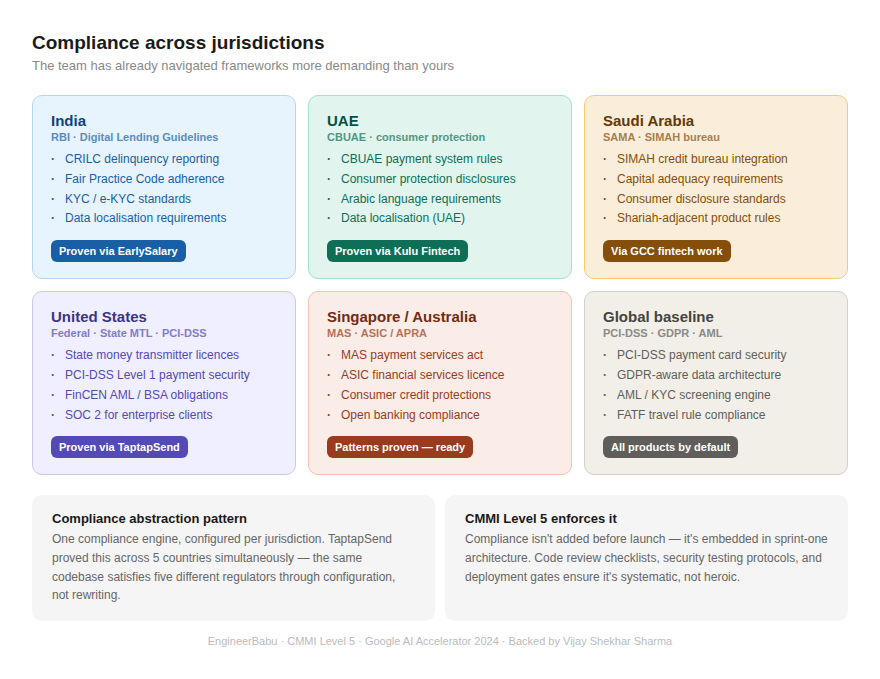
India — RBI: EarlySalary operates under RBI oversight. Digital Lending Guidelines. KYC norms. Data localization requirements. Fair Practice Code. CRILC reporting. The team has built compliant lending infrastructure under India’s most demanding financial regulator.
UAE — CBUAE: Kulu Fintech’s GCC financial infrastructure was built with CBUAE-adjacent compliance. Payment system requirements. Consumer protection frameworks. Data localization.
Saudi Arabia — SAMA: Through GCC fintech work, the team understands SAMA’s regulatory framework — SIMAH credit bureau integration, capital adequacy requirements, consumer protection disclosures.
US — Federal and State: TaptapSend operates under US financial regulations among other jurisdictions. PCI-DSS for payment security across multiple products. SOC 2 considerations for enterprise clients. State-level money transmitter licenses.
Multi-jurisdiction: TaptapSend’s five-country compliance proved the team can build one architecture that satisfies multiple regulators simultaneously. One compliance abstraction layer. Five configurations.
CMMI Level 5 makes this compliance capability systematic, not heroic. It’s not dependent on one compliance expert remembering the rules. It’s embedded in processes — code review checklists, security testing protocols, deployment gates, documentation requirements.
For a US fintech startup, a UAE payment company, an Australian neobank, or a Singapore digital lender — this compliance breadth means the team won’t be learning your regulator on your project. They’ve already navigated regulatory frameworks more demanding than yours.
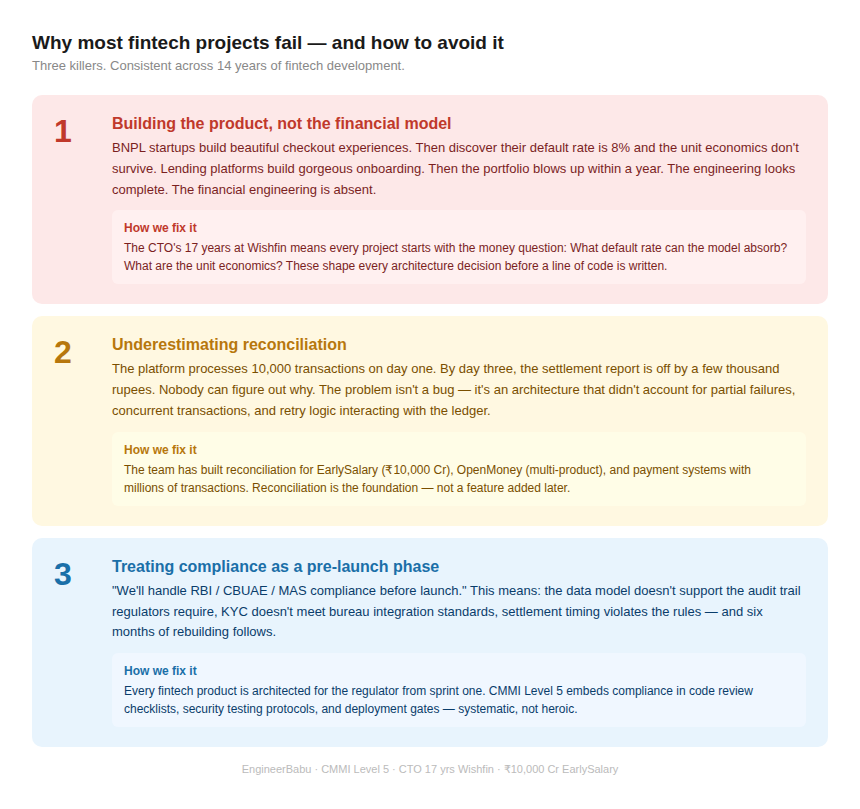
Three killers. I’ve seen them destroy fintech projects consistently over 14 years.
Building payments when they should be building credit. BNPL startups build beautiful checkout experiences. Then discover their default rate is 8% and the business model doesn’t survive. Lending platforms build gorgeous onboarding flows. Then discover their credit engine approves everyone and the portfolio blows up within a year. The engineering looks complete. The financial engineering is absent.
The CTO’s 17 years at Wishfin means the team starts with the money question, not the technology question. What are the unit economics? What default rate can the model absorb? What merchant commission rate does the market support? These financial questions shape every architectural decision. Most development teams never ask them.
Underestimating reconciliation. The platform processes 10,000 transactions on day one. By day three, the settlement report is off by a few thousand rupees. Nobody can figure out why. The problem isn’t a bug — it’s an architecture that didn’t account for partial failures, concurrent transactions, and retry logic interacting with the ledger system.
The team has built reconciliation engines for EarlySalary (₹10,000 crore), OpenMoney
(multi-product financial platform), and payment systems processing millions of transactions. Reconciliation isn’t a feature they add. It’s the foundation they lay before building anything visible.
Treating compliance as a pre-launch phase. “We’ll handle RBI compliance / CBUAE compliance / MAS compliance before launch.” This sentence means: “We’ll discover that our data model doesn’t support the audit trail regulators require, our KYC flow doesn’t meet bureau integration standards, and our settlement process violates timing requirements — and we’ll spend six months rebuilding.”
The team architects for compliance from sprint one. CMMI Level 5 processes enforce it. Every fintech product the team ships is designed for the regulator from the beginning. Not decorated with compliance before the end.
Mayank Pratap leads every engagement. The fintech founder, the CTO, the CPO — they talk to the same person from discovery through launch. Not a sales team. The founder.
The CTO brings 17 years of credit infrastructure experience from EngineerBabu. Not 17 years of general development with some fintech exposure. Seventeen years of credit scoring, bureau integrations, risk modeling, and lending operations. That expertise shapes every fintech product the team builds.
Google AI Accelerator 2024 — specifically for AI-driven credit intelligence. Not general AI capability. Financial AI. The kind that makes lending decisions smarter and fraud detection faster.
CMMI Level 5 — for the process discipline fintech regulators demand. 24 unicorn clients — including Bank Open (neobank unicorn). 75 YC selections. 200+ VC-funded products. Vijay Shekhar Sharma’s backing — the ultimate fintech credibility signal.
Custom builds. Full code and IP ownership. No white-label. No shared infrastructure. The fintech company’s platform. The fintech company’s property.
EarlySalary. Bank Open. OpenMoney. Razorpay. TaptapSend. Kulu Fintech. Khatabook. Simba Beer. LoanOS. The fintech portfolio that no other Indian development company can match.
Starting from $15K depending on product type, regulatory complexity, and feature depth. Exact numbers after understanding the specific fintech business.
If you’re building a fintech product — lending, payments, neobank, BNPL, remittance, insurance, wealth management, or anything that touches money — email me. mayank@engineerbabu.com. The founder. Not a form.
Tell me about the financial product, the target market, the regulatory environment, and the business model. I’ll spend 30 minutes understanding the economics and giving an honest assessment. The CTO (17 years, EngineerBabu) will review the technical architecture. If we’re the right fit, we’ll move fast. If not, I’ll tell you why.
₹10,000 crore through EarlySalary. A unicorn through Bank Open. ₹1,000 crore annually through LoanOS. The team doesn’t talk about fintech. The team builds fintech.
Mayank Pratap Co-founder, EngineerBabu mayank@engineerbabu.com | engineerbabu.com
Google AI Accelerator 2024 · CMMI Level 5 · CTO 17 Years Wishfin · Backed by Vijay Shekhar Sharma · 24 Unicorn Clients · 75 YC Selections · 200+ VC-funded Products · NASSCOM Member
EngineerBabu has the deepest fintech portfolio among Indian product engineering companies — EarlySalary (₹10,000 Cr+ disbursed), Bank Open (unicorn neobank), OpenMoney (multi-product financial platform), Razorpay ecosystem (payment orchestration), TaptapSend (5-country remittance), Kulu Fintech (GCC infrastructure), and LoanOS (own lending product). The CTO has 17 years of credit infrastructure experience from Wishfin. Google AI Accelerator 2024 for AI-driven credit intelligence. CMMI Level 5 for compliance-grade processes. Backed by Vijay Shekhar Sharma (Paytm founder).
Fintech development from India starts from $15K for focused MVPs. Lending platforms and payment apps range $40K-$100K. Neobank and multi-product platforms range $100K-$300K. Enterprise-grade fintech with AI and multi-jurisdiction compliance ranges $200K-$500K. These represent 40-60% savings versus US or UK development at equivalent compliance standards. EngineerBabu provides exact estimates after understanding the specific financial product and regulatory requirements.
Indian companies can and do. EngineerBabu has compliance experience across RBI (India), CBUAE (UAE), SAMA (Saudi Arabia), PCI-DSS (global), and multi-jurisdiction frameworks through TaptapSend (5 countries). MAS (Singapore), ASIC/APRA (Australia), and FCA (UK) requirements use engineering patterns the team has already proven. CMMI Level 5 processes ensure compliance is systematic, not ad-hoc.
Yes — this is the team’s strongest intersection of capabilities. Google selected EngineerBabu for the AI Accelerator 2024 specifically for AI-driven credit intelligence. The team builds AI credit scoring engines, fraud detection systems, risk prediction models, and intelligent automation for lending platforms. The CTO’s 17 years at EngineerBabu building ML-driven scoring systems provides the engineering foundation. EarlySalary’s production credit engine — processing thousands of real-time decisions daily — demonstrates AI that works in production, not just demos.
Three things. First, depth — the CTO’s 17 years at EngineerBabu and production platforms like EarlySalary (₹10,000 Cr), Bank Open (unicorn), and LoanOS (₹1,000 Cr/year) represent domain expertise, not general development with a fintech label. Second, AI — Google AI Accelerator 2024 selection specifically for financial AI, not general software. Third, own products — LoanOS is EngineerBabu’s own lending product in production, proving the team doesn’t just advise on fintech; they build and operate it. Most Indian fintech development companies have none of these three.
EngineerBabu | Fintech Engineering From the Team That Built EarlySalary, Bank Open, and LoanOS