Choose the Right Fintech App Development Company in USA


Create engaging, high-performance mobile applications tailored to your business needs. We craft future-ready apps that offer smooth user experiences on all devices.
Build robust and scalable websites and CMS platforms that help you manage content effortlessly. Our development ensures a seamless digital presence.
Launch secure, feature-rich online stores with intuitive shopping experiences. We build tailored eCommerce platforms designed for growth.
Design captivating games with immersive gameplay and stunning graphics. From concept to launch, we build engaging experiences that players love.
Enhance your customer relationships with customized Salesforce implementations. Drive growth and efficiency with smarter CRM solutions.
Harness artificial intelligence and machine learning to automate workflows and gain actionable insights. Our AI transforms data into smart decisions.
Accelerate your software delivery lifecycle with continuous integration, delivery, and infrastructure automation to boost efficiency.
Hire app developers ready to turn your ideas into sleek, high-performing mobile apps for any platform.
Bring in frontend pros who craft smooth, beautiful, and user-friendly interfaces that your visitors will love.
Get backend developers who build fast, secure, and reliable systems to keep everything running behind the scenes.
Hire eCommerce developers who build secure, scalable online stores designed to offer seamless shopping and grow your sales.
Get dedicated developers committed to your projects, delivering consistent quality and speed as an extension of your team.
Last month, a Series B founder in San Francisco walked me through his vendor proposal. $1.2M for a lending app MVP. 14 month timeline. 32 people allocated.
I told him to walk away.
Not because the vendor was bad. Because they were building the wrong thing. The proposal had 47 features. His actual product needed 11.
This is the pattern I keep seeing. Founders evaluating a fintech app development company in USA without a framework for what they actually need.
They get sold scope they don’t require, on tech stacks that don’t fit, by teams optimized for billable hours instead of product outcomes.
After reviewing the architecture of close to 80 lending, neobanking, and payments products in the last 36 months, I can tell you exactly where these projects fall apart. It’s never the feature you’d expect.
When the EngineerBabu team built the original lending stack behind EarlySalary, which now processes more than ₹10,000 crore in disbursements, the first decision wasn’t about features. It was about which 80% of features to delete from the initial roadmap.
That single call saved them roughly nine months and an estimated $2M in burn.
EngineerBabu is a CMMI Level 5 product engineering company. Backed by Vijay Shekhar Sharma, selected into the Google AI Accelerator’s top 20 globally in 2024, with 500+ shipped products across 20+ countries.
We take 20 projects a year. Everyone is founder-led. This piece is what I’d tell you on a discovery call, written down. Let’s learn how to choose the right fintech app development company in USA.
A fintech app development company in USA is a product engineering firm that designs, builds, and maintains regulated financial applications for US-based banks, lenders, neobanks, payments startups, and embedded finance platforms.
The work covers core architecture, KYC/AML compliance, payment rails integration, ledger design, fraud detection, and ongoing SOC 2 audit readiness.
That’s the textbook answer. Here’s the operating reality.
A real fintech partner does four things that generic dev shops don’t. They tell you which features to cut. They argue with you about your data model.
They build for the regulator you’ll meet in year two, not the user you’re chasing in week one. And they know which third-party providers will silently break your roadmap.
If your shortlist of fintech app developers can’t speak fluently about Section 1033, FedNow, Reg E, and the difference between BaaS and embedded finance, you’re hiring a website agency that knows the word “fintech.”
The US fintech market is projected to reach $66.82 billion in 2026, growing from $58.01 billion in 2025, per Mordor Intelligence.
That’s roughly a 15% CAGR in a regulated, compliance-heavy market.
KPMG’s Pulse of Fintech H2 2025 reports US fintech investment hit $56.6 billion across 1,977 deals in 2025, up from $42.4 billion the year before.
AI-driven fintech alone pulled in $16.8 billion.
Translation: there’s capital. The constraint is execution.
Most founders who reach out aren’t actually choosing between vendors. They’re choosing between three completely different products and don’t know it yet.
I’ll give you a real example. Last quarter a founder told me he wanted a “fintech app.” Twenty minutes in, his actual ask was a Plaid-powered budgeting tool.
Two weeks later his co-founder joined a call and described a lending product with credit bureau pulls and loan servicing. They were funding two different companies under one name.
Most CTOs I talk to underestimate compliance work by 3-4x.
KYC alone, done properly with identity verification, document liveness, OFAC screening, and PEP checks, is a 6 to 10 week build with vendors like Persona, Alloy, Sumsub, or Onfido.
The implementation cost for those identity stacks alone runs $15,000 to $30,000 just to get wired up, and that’s before you’ve underwritten a single applicant.
The second hidden problem is the regulator. Your product roadmap should include the OCC, the CFPB, the FDIC, and your state DFI before it includes a referral program. Not as a footnote. As a primary input to architecture.
The third problem is timeline math. Founders pitch their board a 16-week MVP. Their fintech partner quotes 24 weeks. Both are wrong.
A compliant lending or neobanking MVP is 7 to 9 months end-to-end if you’re disciplined, 12 to 14 if you let scope drift. I’ve seen exactly one shipped in 16 weeks. It didn’t survive its SOC 2 audit.
This is the section most blogs skip. So let me go deep.
Most teams treat the ledger as an afterthought, a table inside their main Postgres database. I’d pick a separated, double-entry ledger from day one, often on dedicated infrastructure.
Tools like Tigerbeetle, Fragment, or a custom double-entry schema on PostgreSQL with strict immutability are the right starting point. Once you’ve shipped on a sloppy ledger, every reconciliation bug for the next two years comes from that decision.
For a fintech MVP development, I’d pick a modular monolith. The standard answer is microservices and cloud-native everything.
The honest answer is that a modular monolith on AWS or GCP, with clean domain boundaries, ships 3-4 months faster and is easier to audit.
You break it into services later, when load and team size demand it. I’ve watched two seed-stage fintechs burn $400K each on microservices premature optimization.
For most US fintech work, the EngineerBabu team builds today, the default is React Native or Flutter on the client, Node.js or Go on the API layer, PostgreSQL for transactional data, Redis for sessions and rate limiting, Kafka or RabbitMQ where event streaming is genuinely needed.
Swift and Kotlin are native for products where biometric flows, hardware security module access, or sub-100ms latency matter.
ACH is cheap and slow. RTP is fast and bank-limited. FedNow is the new default for real-time use cases but coverage is still expanding into 2026.
Wire transfer is expensive and irreversible. Card rails through Stripe Issuing or Marqeta cost more but unlock interchange revenue.
Pick the rail that matches your unit economics, not the one your competitor uses.
Unit, Treasury Prime, Synctera, Bond, Increase, Column. Each routes through different sponsor banks with different risk appetites, different fee structures, and different latency profiles. Changing this in year two is brutal.
Persona, Alloy, Socure, Sentilink, Sardine. Each one is strong in a different vector. Sardine excels at session-level fraud and behavioral biometrics.
Socure leads in identity verification for thin-file consumers. Alloy is the orchestration layer most teams adopt by year two.
AWS dominates US fintech for one boring reason: their compliance documentation is the most mature. GCP is competitive on data and ML.
Azure shows up in enterprise B2B fintech. Multi-region active-active is overkill for an MVP.
Single-region with cross-AZ failover and tested disaster recovery is enough until you cross $50M in processed volume.
You don’t bolt compliance onto a product. You build the product around it.
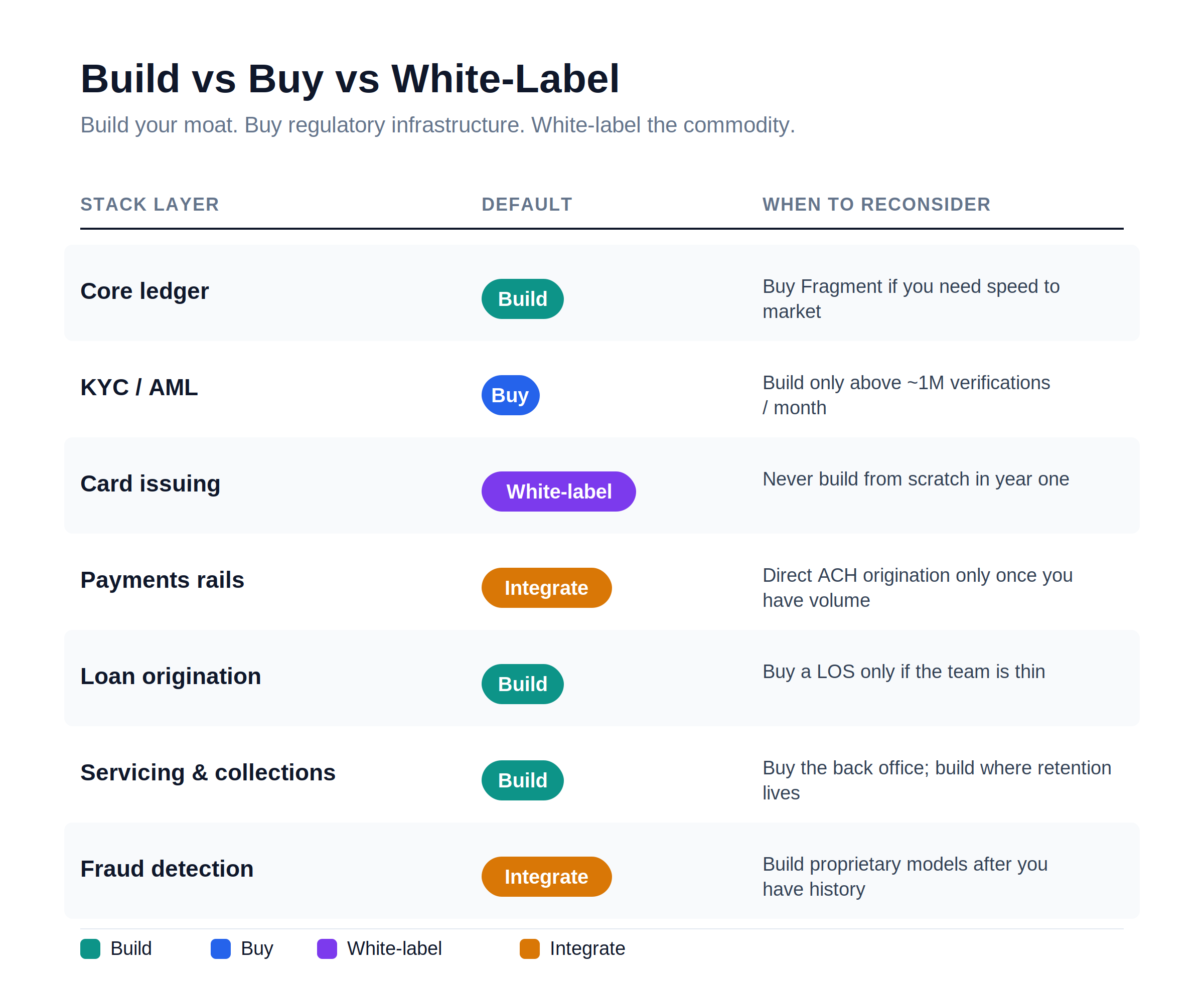
The non-negotiable list for a US-facing fintech in 2026 includes PCI DSS, where card data is in scope, SOC 2 Type II within 12 months of launch, GLBA for any consumer financial data, and CCPA with applicable state privacy laws.
It also includes a BSA/AML program with a designated compliance officer, OFAC sanctions screening, FCRA compliance for any credit bureau use, and ECOA/Regulation B if you’re making lending decisions.
If you’re working with a sponsor bank under a BaaS arrangement, expect to inherit their compliance manual and answer to their audit cadence.
I’ve sat in audits where a perfectly built app failed because the vendor couldn’t produce evidence of access reviews from 11 months ago.
Most fintech app development companies in USA quote compliance as a phase. It isn’t. It’s a layer that runs through every commit.
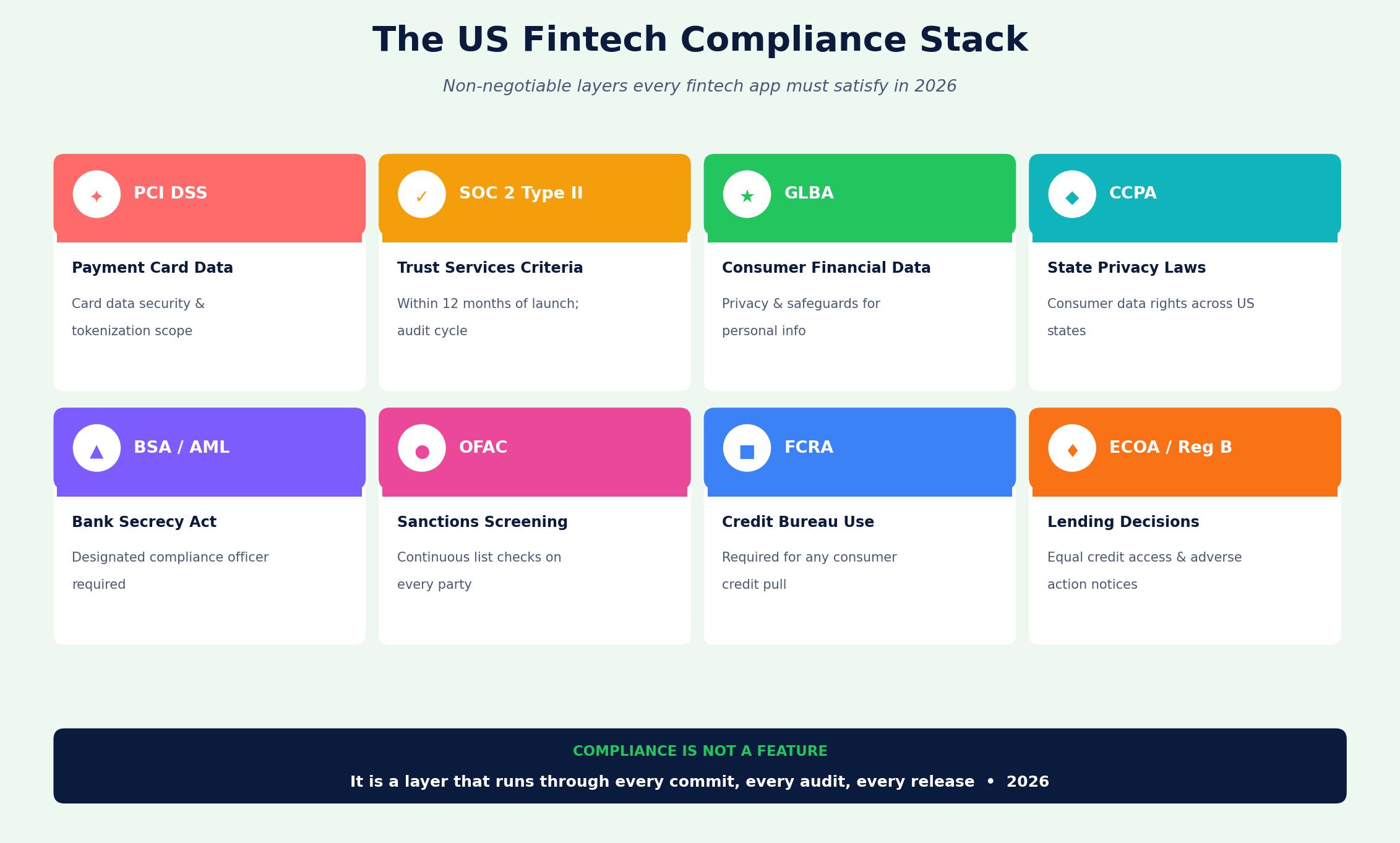
Here’s the framework I’d use if I were on your side of the table. Eight questions, in order.
Ask for read-only access to a sandbox or a recorded walkthrough of a shipped product. Anyone can mock screens.
Not the project manager. Not the sales lead. The person whose Slack messages I’ll read at 2am during a P0.
A vendor that’s been through three Synctera or Unit audits knows what evidence to retain. A vendor that hasn’t will learn at your expense.
If they say “we’ll figure it out in discovery,” walk.
Or your client’s last three reports they helped prepare.
If they can’t articulate change order process clearly, you’re signing a blank check.
Fintech work compounds. A team with 18 month average tenure builds better systems than a team with 7 month churn.
This is the most important question. A fintech partner whose business model rewards them for saying yes to everything is a liability.
The EngineerBabu team takes 20 projects a year. We say no to roughly 60 a year. Most of them for reasons the founder didn’t want to hear. That ratio matters.
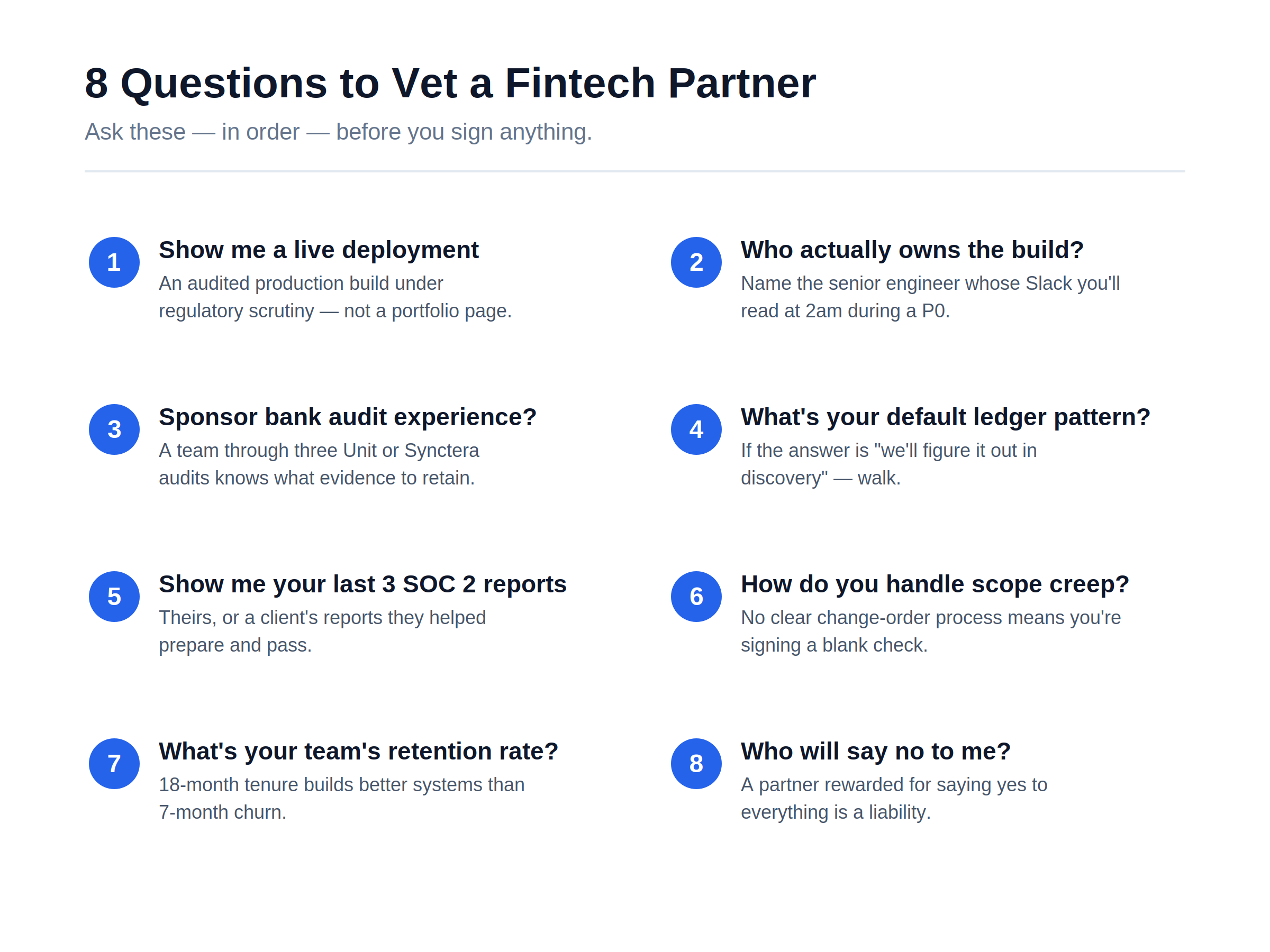
Most founders ask “build or buy.” The real question is what to build, what to buy, what to white-label, and what to integrate. Different parts of your stack belong in different categories.
| Layer | Default Choice | When to Reconsider |
| Core ledger | Build (custom double-entry on Postgres or Tigerbeetle) | Buy from Fragment if you need speed to market and can accept lock-in |
| KYC/AML | Buy/integrate (Persona, Alloy, Socure) | Build only if you’re doing 1M+ verifications/month |
| Card issuing | White-label (Marqeta, Lithic, Stripe Issuing) | Never build from scratch in year one |
| Payments rails | Integrate via Stripe, Modern Treasury, Increase | Direct ACH origination only after you have volume to justify |
| Loan origination | Build the workflow, integrate the bureaus | Buy a LOS only if you’re a thin team and product-velocity isn’t the moat |
| Servicing & collections | Build for differentiation, buy for back office | Most lenders underinvest here. It’s where retention lives. |
| Fraud detection | Integrate (Sardine, Sentilink, Alloy) | Build proprietary models only after you have transaction history |
The shortcut: build what is your competitive moat. Buy what is regulatory infrastructure. White-label what is commodity.
The biggest mistake I see is treating the engineering vendor like a contractor rather than a co-architect. Founders bring a finished spec and ask for a build estimate. The good vendors will push back on the spec.
The bad ones will quote it and ship a product the founder regrets six months later.
The second mistake is hiring on price. The US hourly rate for fintech engineering runs $80 to $150 per hour with American firms, $30 to $70 per hour with offshore or nearshore teams, per Andersen Lab’s 2026 cost analysis.
The arbitrage looks obvious. It rarely works without a senior product partner inside the relationship. A $35/hr engineer with no fintech context produces $200/hr cleanup invoices.
The third mistake is underestimating the maintenance budget. Industry baseline is 15-20% of build cost annually.
For a regulated fintech app post-launch, the honest number is 25-35% in year one because of audit prep, regulatory updates, and the inevitable rebuild of whatever the MVP cut corners on.
The fourth mistake is shipping without an incident playbook. Your first PCI scope outage, your first OFAC false positive that locks a real customer out, your first ACH return spike. These will happen in the first 18 months.
A vendor that hasn’t pre-built playbooks for them is going to ask you what to do at 11pm on a Tuesday.
The fifth mistake, and this is the one that costs the most money, is launching without a real data architecture. Your transaction data, your ledger data, your KYC artifacts, your audit logs.
If these are scattered across three databases without a clean event log, your year-two reconciliations will eat an engineer full time.
A few patterns I haven’t seen in any other article.
The first 90 days post-launch is when most fintech apps quietly break. Not visibly. Quietly. Reconciliation drift starts. Webhook retries pile up. Sponsor bank reports stop matching internal numbers by small amounts.
The team that built it has moved to the next sprint. The team that owns it doesn’t know what to look for. I’d recommend a 90 day post-launch hardening phase with the original build team, every time.
The team that ships fastest is rarely the team that argues least. The EngineerBabu team’s best lending deployments came from projects where the founder and our tech lead disagreed openly in the first three weeks.
The worst projects were the ones where everyone said yes early.
The OpenMoney build, a neobank with integrated mutual fund flows, taught us that the hardest engineering work in fintech is not the new flow.
It’s the migration. Moving live users between custodians, between ledgers, between KYC vendors. That’s where senior engineering pays for itself.
The Khatabook pivot from bookkeeping into fintech demonstrated something else. The data you collected for one product becomes the underwriting signal for the next.
Founders who design their data model for optionality outperform founders who design for the current SKU.
The Simba Beer project taught me that fintech patterns leak into adjacent industries. Real-time field intelligence with AI inventory management software development uses the same event-driven architecture, the same ledger discipline, the same audit trail logic as a payments platform.
Good fintech develops good systems engineering with regulatory teeth.
The LoanOS platform, a 7-module lending system covering origination, underwriting, servicing, collections, accounting, reporting, and a borrower portal, took 11 months end to end with a senior team of 14.
That’s the honest number for a full-stack lending platform built compliantly. Anyone quoting you four months is selling you a demo.
Cost ranges I trust, after cross-referencing my own quotes with Andersen Lab’s 2026 fintech cost study and Interexy’s breakdown.
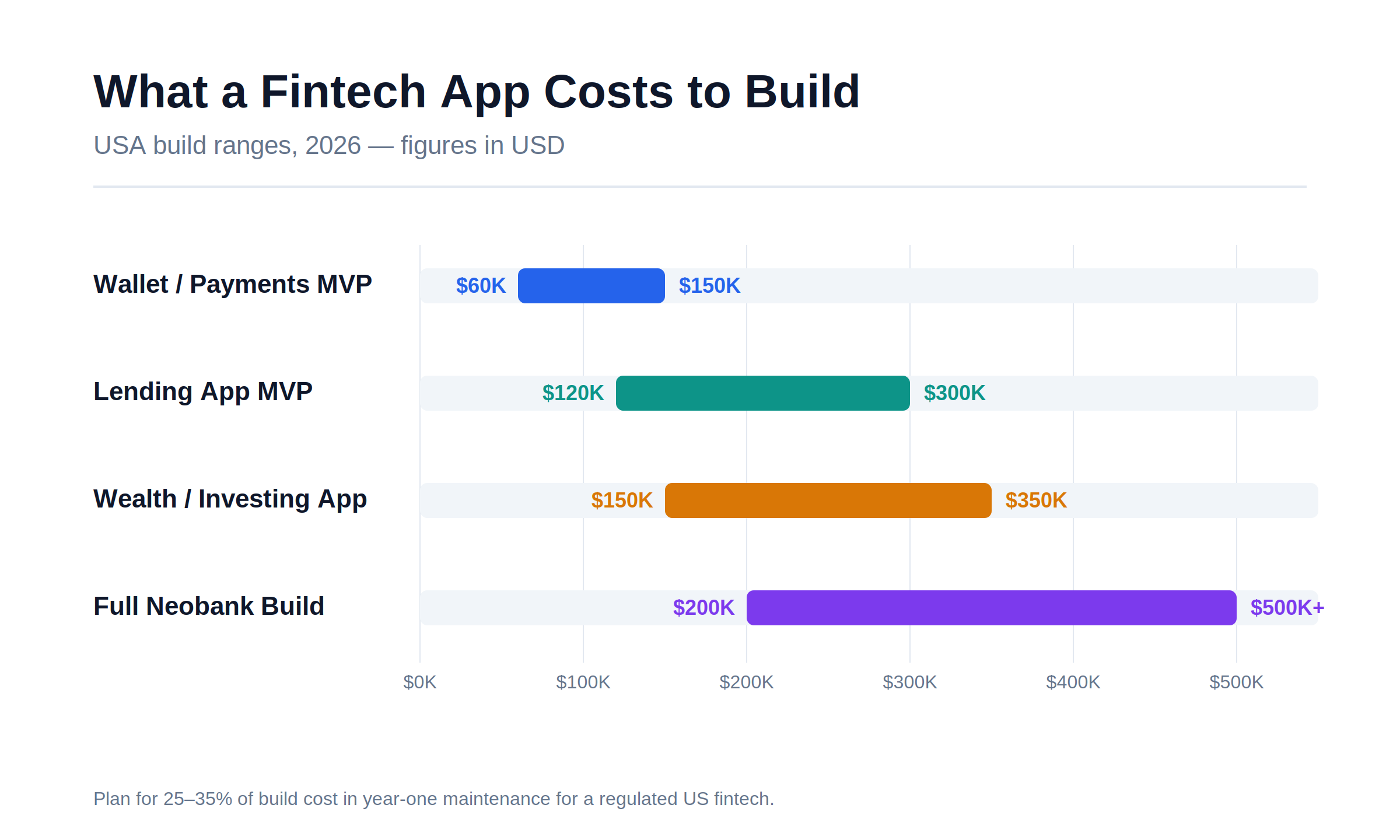
A basic wallet or payments MVP lands at $60,000 to $150,000. A lending app MVP, with bureau integration and a working LOS, is $120,000 to $300,000. A wealth or investing app sits at $150,000 to $350,000.
A full neobank build with card issuance, deposit accounts, and a sponsor bank integration is $200,000 to $500,000 minimum, and that’s optimistic.
Discovery and product architecture eat 5-10% of budget. UI and UX is 15-20%. Core development is 45-55%. QA, security testing, and pen testing run 15-20%. Deployment, infrastructure setup, and SOC 2 prep close out the remaining 5-10%.
Ongoing maintenance is 25-35% of initial cost in year one for a regulated US fintech, dropping to 15-20% by year three once you’ve absorbed your first major audit cycle.
Watch the hidden line items. KYC and identity verification implementation is $15,000 to $30,000 by itself. Sponsor bank legal and compliance setup is another $50,000 to $150,000 depending on the partner. SOC 2 Type II audit and remediation is $40,000 to $80,000 the first year.
If you’re evaluating a fintech app development company in USA and want to talk through the architecture decisions before you commit to a vendor, I’m usually the one on those calls.
No sales team, no qualifying intake form, no follow-up sequence.
Send me your scope, your shortlist, or the proposal you’re nervous about.
I’ll respond within 48 hours, usually with three to five specific things I’d push back on in your current plan. If we’re a fit, we’ll talk.
If we’re not, you’ll still walk away with a sharper brief for whichever team you choose.
Mayank Pratap is the Co-founder of EngineerBabu, a CMMI Level 5 product engineering company that has delivered 500+ products across 20+ countries, including 200+ VC-funded builds and 75 Y Combinator-selected products.
EngineerBabu was selected into the Google AI Accelerator’s top 20 globally in 2024, is backed by Vijay Shekhar Sharma (founder of Paytm), participates in the Harvard Innovation Labs ecosystem, and is a NASSCOM member recognized as one of LinkedIn’s Top 20 Startups in India.
Mayank has been building technology products for 14 years and leads every client engagement personally. EngineerBabu takes 20 projects a year, all founder-led, all from referrals.
Reach him at mayank@engineerbabu.com
Evaluate four things: shipped production deployments under regulatory scrutiny, named senior engineers who’ll actually own your build, demonstrated experience with sponsor bank audits, and a willingness to say no to bad scope.
References from active CTOs matter more than logos. Ask for a recorded technical walkthrough of a comparable live product before signing anything.
Expect $60,000 to $150,000 for a wallet or payments MVP, $120,000 to $300,000 for a lending app, and $200,000 to $500,000+ for a full neobank build. US hourly rates run $80 to $150, offshore $30 to $70.
Plan for 25-35% of build cost annually in year-one maintenance, per Andersen Lab’s 2026 analysis.
A disciplined fintech MVP takes 7 to 9 months end to end for lending or neobanking, 4 to 6 months for a focused payments or wallet product.
Anything quoted under 4 months for a regulated product is either descoped beyond usefulness or skipping compliance work that will surface during your SOC 2 audit.
No. Many US fintechs use distributed teams with senior US-based product and compliance leadership paired with offshore or nearshore engineering.
What matters is jurisdictional clarity for data residency, signed BAAs and security agreements, and a vendor that can pass your sponsor bank’s vendor risk review.
Geography matters less than process maturity.
Look for SOC 2 Type II on the vendor itself, ISO 27001 as a baseline, CMMI Level 3 or 5 for process discipline, and demonstrable experience with PCI DSS, GLBA, and BSA/AML implementations.
The EngineerBabu team operates at CMMI Level 5 specifically because fintech audits require evidence of mature engineering process, not just secure code.