How to Build a BNPL App Like Tabby — The Definitive Guide for Decision-Makers


Create engaging, high-performance mobile applications tailored to your business needs. We craft future-ready apps that offer smooth user experiences on all devices.
Build robust and scalable websites and CMS platforms that help you manage content effortlessly. Our development ensures a seamless digital presence.
Launch secure, feature-rich online stores with intuitive shopping experiences. We build tailored eCommerce platforms designed for growth.
Design captivating games with immersive gameplay and stunning graphics. From concept to launch, we build engaging experiences that players love.
Enhance your customer relationships with customized Salesforce implementations. Drive growth and efficiency with smarter CRM solutions.
Harness artificial intelligence and machine learning to automate workflows and gain actionable insights. Our AI transforms data into smart decisions.
Accelerate your software delivery lifecycle with continuous integration, delivery, and infrastructure automation to boost efficiency.
Hire app developers ready to turn your ideas into sleek, high-performing mobile apps for any platform.
Bring in frontend pros who craft smooth, beautiful, and user-friendly interfaces that your visitors will love.
Get backend developers who build fast, secure, and reliable systems to keep everything running behind the scenes.
Hire eCommerce developers who build secure, scalable online stores designed to offer seamless shopping and grow your sales.
Get dedicated developers committed to your projects, delivering consistent quality and speed as an extension of your team.
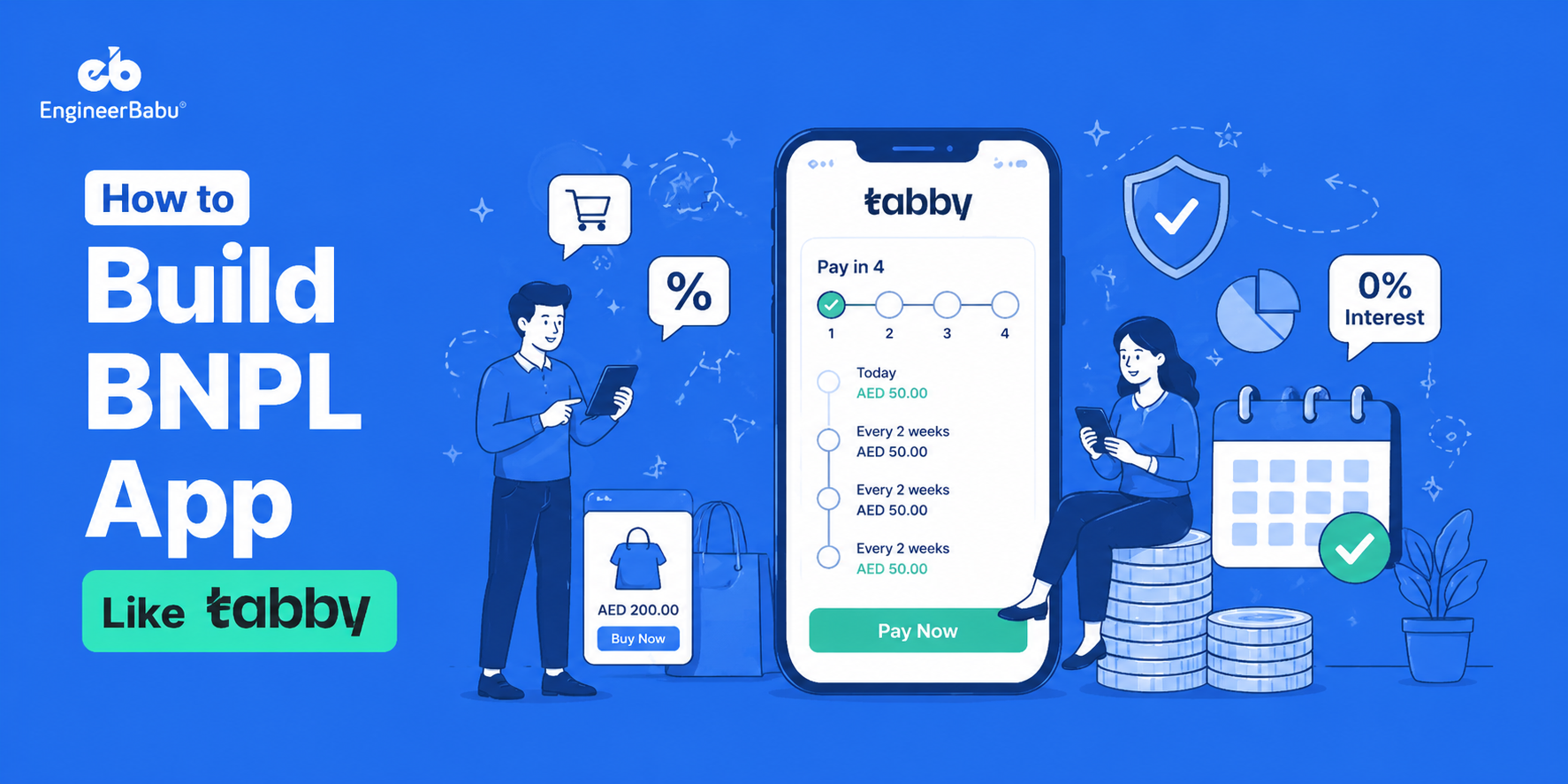
I need to tell you something before we start.
I’ve read every blog about BNPL app development on the internet. The feature lists. The tech stack tables. The vague cost ranges. They’re all written by content teams who’ve never shipped a fintech product. They copy each other. They say nothing.
This one is different. I’m writing this myself.
My name is Mayank Pratap. I co-founded EngineerBabu 14 years ago. I’ve been building technology products since — not managing from a corner office. Building. Sitting in product calls at midnight. Debugging payment gateway failures at 2 AM. Reviewing architecture decisions that determine whether a platform handles 100 users or 10 million.
I’ll tell you who we’ve built for, because that’s the fastest way to establish whether you should keep reading.
EarlySalary — one of India’s first salary advance platforms. We built the lending infrastructure. That platform has disbursed over ₹10,000 crore. Khatabook — the bookkeeping app that scaled to tens of millions of Indian SMEs and evolved into a financial services platform. OpenMoney — a full-stack financial platform unifying payments, investments, and credit under one architecture. Bank Open (now Open Financial) — a neobank. We built core banking integrations for a company that went on to become a unicorn.
Razorpay’s ecosystem — we’ve worked on payment orchestration layers within it. TaptapSend
— a multi-continent remittance platform operating across five regulatory jurisdictions. Kulu Fintech — GCC-focused financial infrastructure. AloPay — a digital wallet and payment platform for the Afghan market. BURQ — a logistics platform in the US where fintech meets operations.
And those are just the fintech names. We’ve shipped products for Paytm’s ecosystem. For Adani Group. For Simba Beer — where we recovered millions in blocked capital through custom technology. For Apollo Hospitals, Manipal, Shalby, CHL Hospitals, ResMed, and 1MG in healthcare.
24 of our clients became unicorns. 75 were selected by Y Combinator. 200+ were VC-funded.
Google selected us for the AI Accelerator 2024. CMMI certified us at Level 5 — the highest level. Vijay Shekhar Sharma — the man who built Paytm — backs us personally. LinkedIn named us a Top 20 Startup in India. NASSCOM lists us as a member.
I’m telling you all of this not to impress you. I’m telling you so that when I explain what it actually takes to build a BNPL platform that works in production — you know it’s coming from someone who’s been on the other side of that problem. Repeatedly.
Now. Let’s talk about Tabby.
Most people think Tabby is a payments company.
It’s not.
Tabby is a real-time credit company that happens to look like a checkout button.
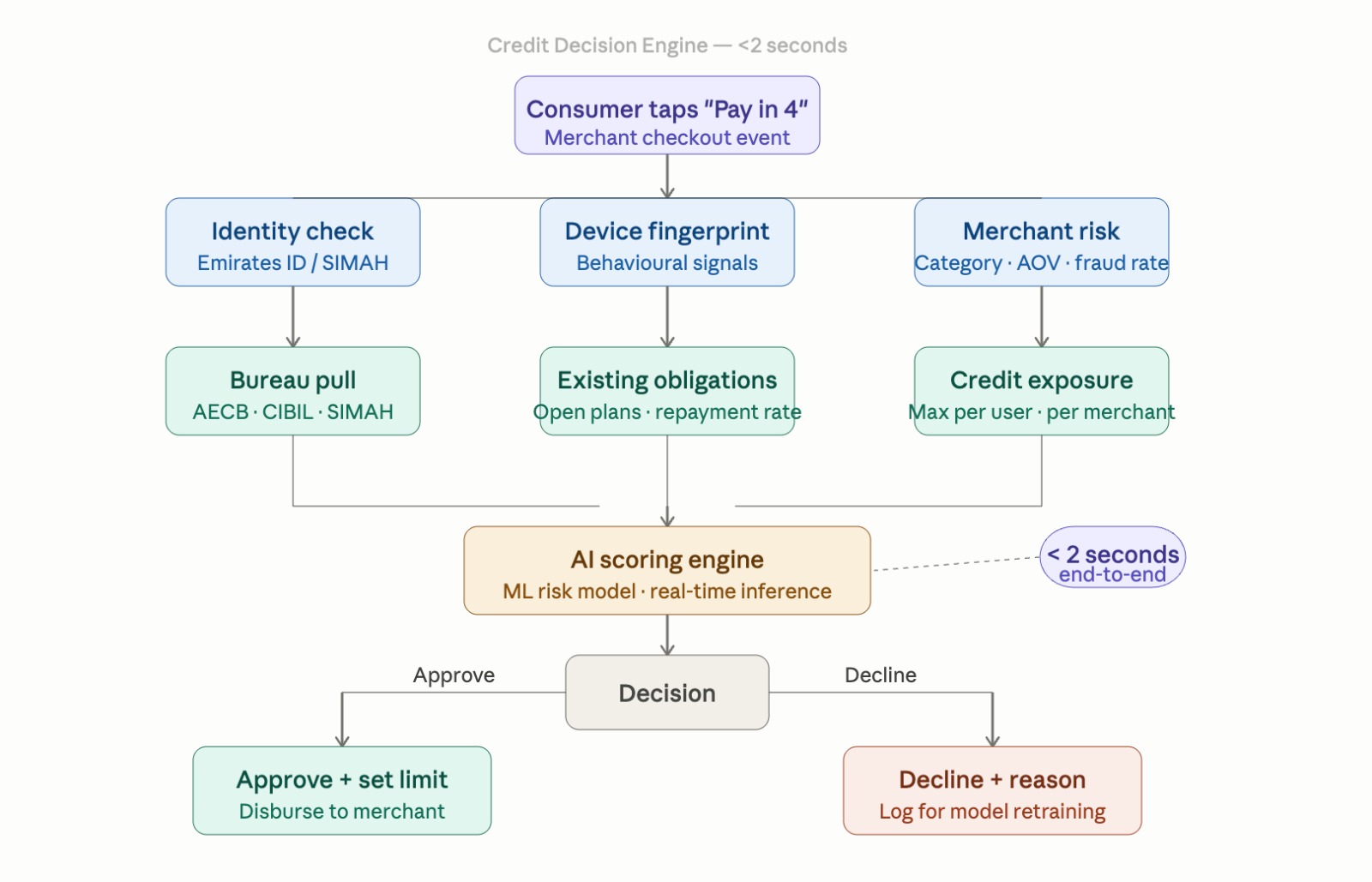
Every time a consumer taps “Pay in 4,” Tabby runs a credit decision in under 2 seconds. It evaluates identity, credit history, device signals, behavioral patterns, merchant risk category, and transaction amount — then decides whether to extend credit. The consumer sees a smooth checkout. Behind that checkout is one of the most sophisticated credit engines in the Middle East.
The global BNPL market crossed $309 billion in transaction volume in 2024. It’s projected to reach $750 billion by 2028. In the GCC alone, the segment is growing at over 30% year-on-year. Credit card penetration in the UAE sits below 30%. In Saudi Arabia, even lower. But smartphone penetration in both countries exceeds 95%.
That gap — high digital adoption, low traditional credit access — is exactly where BNPL thrives. It’s the same gap that made EarlySalary possible in India. The same gap that Kulu Fintech is exploiting in the GCC. The same structural opportunity that keeps showing up in every emerging market we work in.
But here’s what the market reports don’t tell you.
Most BNPL startups that launched between 2021 and 2023 are already dead. They raised money. They built apps. They signed merchants. And they died. Not because the market wasn’t there. Because they built payment apps when they should have built credit infrastructure.
That distinction is everything.
Every blog gives you a feature checklist. I’ll give you the things that actually determine whether your BNPL product survives its first year.
A BNPL credit decisioning engine must work in real time — under 2 seconds per transaction. It pulls data from credit bureaus (Al Etihad in the UAE, SIMAH in Saudi, CIBIL in India), layers in alternative data signals (device fingerprinting, behavioral biometrics, transaction velocity), and produces a decision: approve, decline, or offer a reduced amount.
Get this wrong and your default rates eat you alive. Interest-free installments leave zero margin for bad credit decisions. A 5% default rate in BNPL isn’t a problem — it’s a death sentence.
Our CTO spent 17 years at Wishfin — one of India’s largest credit marketplaces — building exactly this kind of infrastructure. Credit scoring systems that evaluated millions of applications. Risk models that balanced approval rates against portfolio health. Bureau integrations that returned data in milliseconds.
When we built EarlySalary’s lending platform, the credit engine was the product. Everything else — the app, the dashboard, the notifications — was interface. The engine determined who got approved, for how much, and at what risk level. That engine processes thousands of decisions daily, and it’s been doing it for years without blowing up the company’s balance sheet.
When Google selected us for the AI Accelerator 2024, our proposition was built around AI-driven credit intelligence for lending. Not a pivot. A formalization of what we’d already been building for a decade.
The credit engine isn’t a feature. It IS the product. If your BNPL app development partner doesn’t understand this, find a different partner.
Your consumers don’t find you through an app store. They find you at checkout. That means your merchant integration determines your distribution.
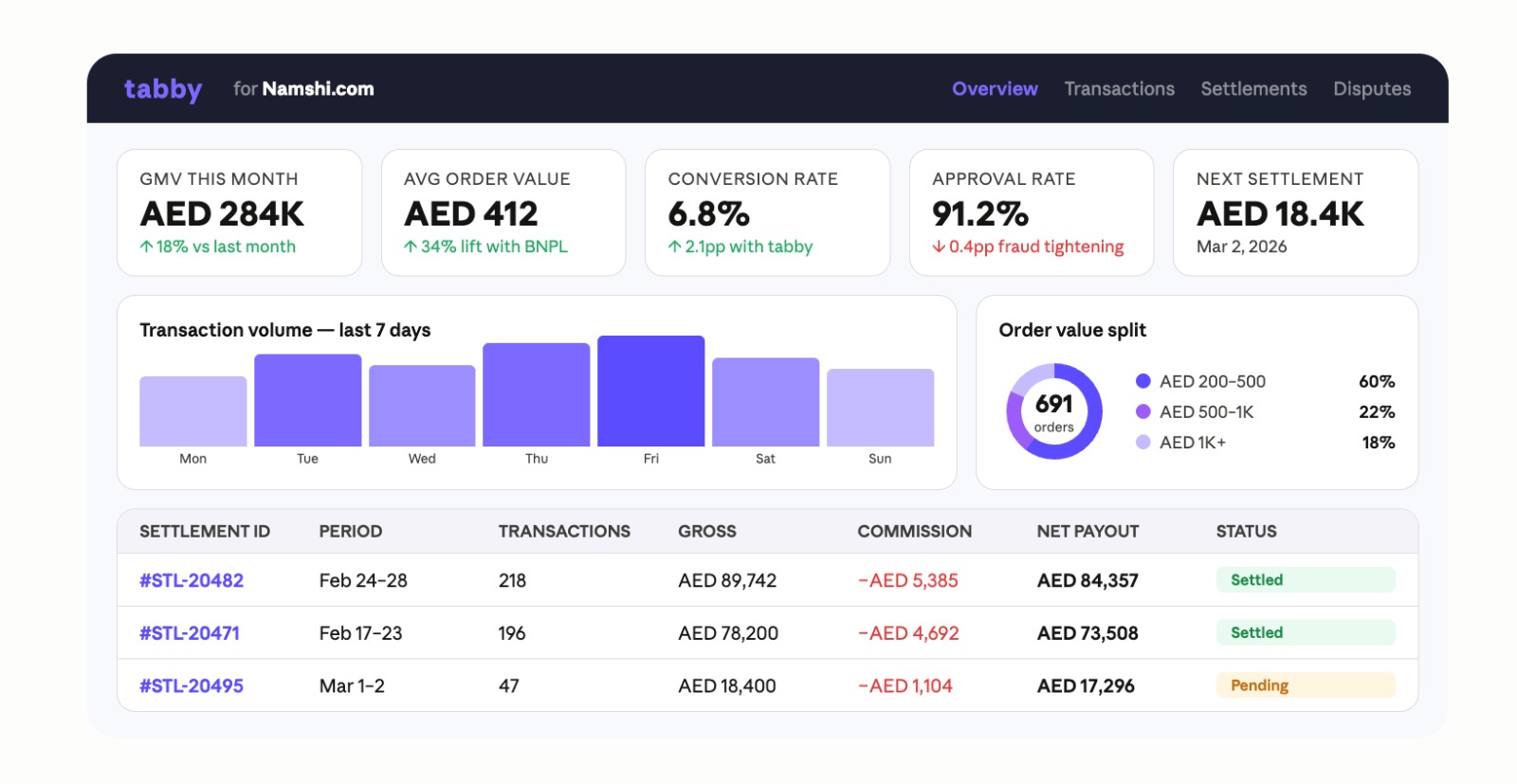
This means pre-built plugins for Shopify, WooCommerce, and Magento. JavaScript SDK for custom e-commerce. RESTful APIs with proper documentation. Webhook support for real-time transaction status. A sandbox environment for merchant developers.
We’ve built payment orchestration and integration layers across multiple products — including work within the Razorpay ecosystem. We built AloPay’s entire payment infrastructure from scratch — wallet top-up, QR payments, money transfers, agent networks, merchant settlement. For a market (Afghanistan) where the infrastructure didn’t exist and we had to build every layer.
When you’ve built payment systems for markets that have nothing — no existing rails, no standard APIs, no established gateways — building for the UAE or Saudi feels almost luxurious by comparison. You have Stripe. You have Adyen. You have functioning credit bureaus. The challenge isn’t access to infrastructure — it’s integrating it correctly.
The edge cases are where payment integrations break. Partial refunds that create settlement mismatches. Multi-currency transactions that fail silently. Webhook retries that duplicate payments. You don’t find these in documentation. You find them at 1 AM when a merchant’s settlement report doesn’t reconcile. We’ve found them all. Repeatedly.
Here’s where most BNPL development projects go wrong. They treat compliance as a phase. Something to handle before launch. A checklist.
Compliance isn’t a phase. It’s architecture.
PCI-DSS for card data security. CBUAE in the UAE. SAMA in Saudi Arabia. RBI in India. FCA in the UK. AML and KYC requirements in every jurisdiction. Data localization rules that determine where your servers physically sit.
When we built TaptapSend’s remittance platform, we handled compliance across five regulatory jurisdictions simultaneously. Different KYC requirements. Different data residency rules. Different reporting obligations. One unified architecture that satisfied all of them. That’s not a feature you bolt on — it’s a structural decision that informs every layer of the system from database schema to API design.
When we built HIPAA-compliant healthcare platforms for Apollo Hospitals, Manipal, and ResMed, we learned something that applies directly to fintech: regulated software isn’t harder to build. It’s harder to build wrong and then fix. If you design for compliance from day one, it costs the same. If you retrofit compliance into an existing system, it costs 3-5x more and delays your launch by months.
EngineerBabu holds CMMI Level 5 certification — the highest maturity level in the Capability Maturity Model Integration framework. Our processes, security practices, and quality assurance have been independently audited. When your BNPL platform faces a regulatory audit — and it will — the difference between CMMI Level 5 engineering and ad-hoc development is the difference between passing on the first attempt and spending six months in remediation.
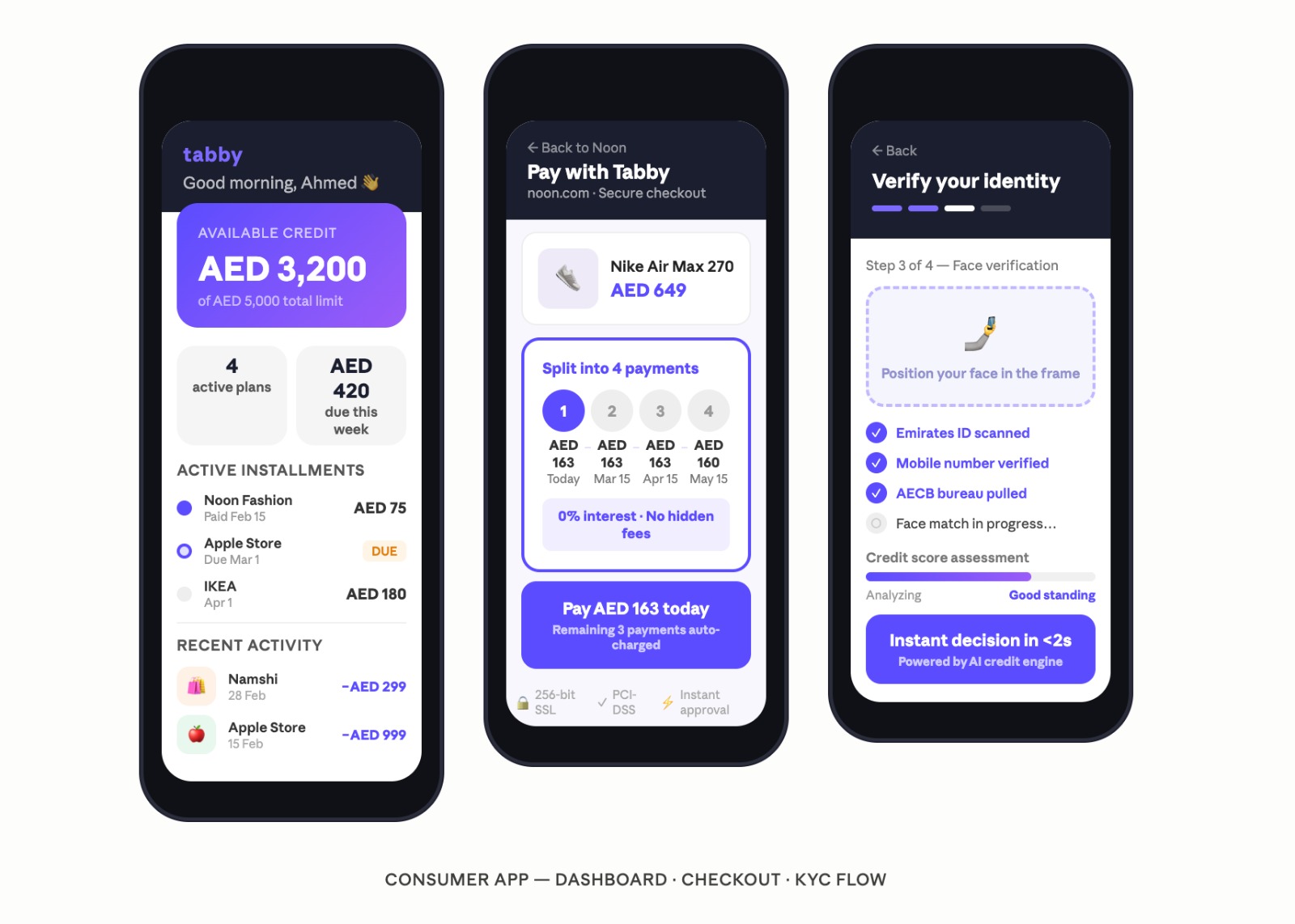
KYC onboarding under 2 minutes. Document scanning with OCR. Facial verification. Real-time identity checks.
A home screen that shows available limit, active installments, upcoming payments, transaction history — without making the user think.
This sounds simple. It’s not.
When Khatabook scaled to tens of millions of users across India, we learned what consumer fintech UX actually means at scale. It means your app works on a ₹8,000 phone on a 3G connection. It means your onboarding flow completes even when the user loses connectivity mid-way and comes back. It means every screen loads in under a second because if it doesn’t, you’ve lost them.
That discipline — making complex financial workflows feel effortless on the worst possible device in the worst possible network conditions — carries directly into BNPL app development. Tabby’s conversion rate at checkout is industry-leading because the experience removes friction. Every additional screen, every unnecessary input field costs you conversion percentage points that compound into millions in lost transaction volume.
I’m not going to give you a generic tech stack list. I’m going to tell you the decisions that matter specifically for a buy now pay later platform — and why each one matters.
Flutter for the consumer app. One codebase, iOS and Android, native performance. We’ve shipped Flutter-based fintech applications across multiple projects — including AloPay’s complete payment platform. Flutter is mature enough for production financial products.
React for the merchant dashboard. Merchants live in browsers, not app stores.
Node.js for the API layer and real-time transaction processing. Python for the credit scoring engine — because Python’s machine learning ecosystem is unmatched for the model training and inference a credit engine requires.
PostgreSQL for transactional data. Redis for caching. A data warehouse — Redshift or BigQuery — for analytics and credit model tuning.
AWS or GCP. Microservices from day one. Your credit scoring service shouldn’t fail because your notification service is overloaded.
When we built Bank Open’s neobank platform, the architectural challenge was identical — multiple financial services running independently but communicating seamlessly. Credit, payments, accounts — each a separate service, each independently scalable, all sharing a unified data layer. Bank Open went on to become a unicorn. The architecture scaled with them.
That same microservices approach applies directly to BNPL. Your payment processing, credit decisioning, merchant settlement, consumer app backend, and notification services are separate concerns. Build them that way.
I could show you a methodology diagram. Discovery → Design → Develop → Deploy. Every company has one. They all look identical. They tell you nothing about what actually happens.
Let me tell you what actually happens.
When we built EarlySalary’s lending platform, we didn’t start with the credit engine. We started with the default data. Before writing any scoring logic, we analyzed repayment patterns, identified signals that predicted default, and built the model around actual behavior — not theoretical risk parameters. That foundation is why the platform has sustained ₹10,000 crore in disbursals without blowing up.
Same principle for BNPL. We start with your economics. What merchant commission rate does your market support? What default rate can your unit economics absorb? What’s the average transaction size? These numbers shape the product architecture in ways that are ruinously expensive to change later.
When TaptapSend needed compliance across five countries, we didn’t build five compliance modules. We built one compliance abstraction layer configurable per jurisdiction. When Kulu Fintech needed GCC-specific infrastructure, we built with regional specifics — Arabic language support, regional payment methods, local regulatory requirements — baked in from the start. Not added later.
When we built Simba Beer’s technology platform, the problem wasn’t fintech on the surface — it was supply chain. But underneath, the challenge was identical: tracking money flow, recovering blocked capital, ensuring every transaction reconciled. We recovered millions for them. That financial engineering mindset — where did the money go, how do we get it back, how do we make sure it flows correctly — applies to every BNPL system we build.
The pattern across all these projects is the same: understand the money first, build the technology second. Most development teams do it backwards. That’s why most BNPL projects fail.
We ship MVPs in 8-12 weeks. Not because we rush. Because we’ve done this enough times that we know what to build first, what to defer, and what to skip entirely. Pattern recognition from 500+ shipped products is the most valuable asset an engineering team can bring to a fintech project.
I’ve seen three consistent killers. In 14 years of building fintech, these three things destroy more projects than bad code ever will.
Underestimating compliance. A team builds a beautiful app. Smooth checkout. Clever animations. They launch. Then they discover their data architecture doesn’t support the audit trail regulators require. Or their KYC flow doesn’t meet bureau integration standards. Or their payment settlement process violates timing requirements. The fix isn’t a patch — it’s a rebuild. Six months of work, discarded.
We don’t retrofit compliance. We’ve built regulated platforms for healthcare (HIPAA — Apollo, Manipal, ResMed, 1MG), for cross-border finance (TaptapSend across five jurisdictions), for lending (EarlySalary under RBI oversight), and for emerging market payments (AloPay in Afghanistan). Compliance is architecture for us. Not an afterthought.
Treating credit like payments. Payments are binary — succeed or fail. Credit is a spectrum. The question isn’t whether to approve — it’s how much risk each approval carries. Teams that build BNPL like a payment product end up with approval rates that are either too high (and defaults kill them) or too low (and growth stalls). The credit engine needs continuous tuning based on portfolio performance data. It’s not a feature you ship. It’s a system you operate. Our CTO operated these systems for 17 years at Wishfin. That operational intelligence is in our DNA.
Building for features instead of unit economics. A BNPL platform with every feature Tabby has — but with unit economics that don’t work — is a beautifully designed way to lose money. Merchant commission minus defaults minus operations must be positive at scale. We’ve seen teams build incredible products that lose money on every transaction. When you’ve built 200+ products for VC-funded companies, you develop an instinct for which features drive revenue and which ones just feel good in a demo.
I lead this company personally. When you start a BNPL development project with EngineerBabu, you’re talking to me — not a sales team, not an account manager, not a business development executive. I’ve been in every product meeting, every architecture review, every difficult conversation about scope and trade-offs for 14 years. Vijay Shekhar Sharma didn’t back a company. He backed a team he’d watched build things.
We build custom BNPL platforms from scratch — your product, your brand, your IP. Complete code ownership transferred to you. No white-label. No shared infrastructure. A product built specifically for your market and your business model. When you work with us, you walk away owning everything — every line of code, every architecture document, every deployment script. It’s your product. We just build it.
Our CTO brings 17 years of credit infrastructure experience from Wishfin. Your credit scoring engine won’t be built by developers learning fintech on your dime. It’ll be built by people who’ve been living in this domain for nearly two decades.
Google AI Accelerator 2024 means the AI layer — credit scoring, fraud detection, risk modeling — is at the cutting edge. Not because we claim it. Because Google validated it.
CMMI Level 5 means every line of code, every deployment, every security practice follows internationally audited processes. Your compliance team will thank you.
24 unicorn clients. 75 Y Combinator selections. 200+ VC-funded products. 500+ total projects shipped. EarlySalary. Khatabook. OpenMoney. Bank Open. Razorpay. TaptapSend. Kulu Fintech. AloPay. BURQ. Simba Beer. Adani Group. Apollo Hospitals. Manipal. ResMed. 1MG.
We take 20 projects a year. No marketing. No outbound sales team. Every client comes from a referral. That should tell you something about the quality of what we deliver.
BNPL app development starting from $15K depending on scope, market complexity, and feature depth. I’ll tell you exactly what your product requires after I understand your business. Not before.
Here’s what I want you to do.
Email me. mayank@engineerbabu.com. Not a form. Not a chatbot. Me.
Tell me about your market. Your users. Your merchants. The regulatory environment. I’ll spend 30 minutes understanding your business and telling you honestly — does building a BNPL product make sense for you? What will it take? What should you build first?
No pitch deck. No pressure. No 47-slide presentation.
Just a conversation between two people who care about building great fintech products. I’ve helped build over 200 of them. I’d be happy to help with yours.
Mayank Pratap Co-founder, EngineerBabu mayank@engineerbabu.com | engineerbabu.com
Google AI Accelerator 2024 · CMMI Level 5 · Backed by Vijay Shekhar Sharma · 24 Unicorn Clients · 75 YC Selections · 200+ VC-funded Products · LinkedIn Top 20 Startups India · NASSCOM Member
BNPL app development starts from $15K depending on scope, market complexity, compliance requirements, and feature depth. A focused MVP for one market sits at the lower end. Multi-market platforms with AI-driven risk engines scale from there. We give exact numbers after understanding your specific business.
We ship BNPL MVPs in 8-12 weeks — credit decisioning, consumer app, merchant dashboard, payment integration, and compliance for your primary market. Full platforms with multi-market support take longer depending on scope.
Flutter for cross-platform mobile. React for merchant web dashboards. Node.js and Python backend. PostgreSQL database. AWS or GCP cloud. Stripe, Adyen, or Checkout.com for payment processing. We select specific tools based on your market and scale requirements.
UAE requires CBUAE compliance, PCI-DSS, Emirates ID integration, and Al Etihad Credit Bureau connectivity. Saudi requires SAMA compliance and SIMAH integration. Both require AML/KYC frameworks and data protection compliance. We architect compliance from day one — never as a retrofit.
Yes. We build custom BNPL platforms from scratch — tailored to your market, your merchants, your compliance requirements, and your business model. Full stack including credit engine, consumer app, merchant integration, compliance layer, and admin dashboard. We don’t do white-label. We build your product, for your business, and hand over complete code and IP ownership. Our experience with EarlySalary, Bank Open, and LoanOS means we understand both the technology and the unit economics of building lending products that work.
———————————————————————————–
EngineerBabu | Product Engineering for Fintech That Moves Real Money