How Much Does It Cost to Hire Software Developers in India? The Honest Answer


Create engaging, high-performance mobile applications tailored to your business needs. We craft future-ready apps that offer smooth user experiences on all devices.
Build robust and scalable websites and CMS platforms that help you manage content effortlessly. Our development ensures a seamless digital presence.
Launch secure, feature-rich online stores with intuitive shopping experiences. We build tailored eCommerce platforms designed for growth.
Design captivating games with immersive gameplay and stunning graphics. From concept to launch, we build engaging experiences that players love.
Enhance your customer relationships with customized Salesforce implementations. Drive growth and efficiency with smarter CRM solutions.
Harness artificial intelligence and machine learning to automate workflows and gain actionable insights. Our AI transforms data into smart decisions.
Accelerate your software delivery lifecycle with continuous integration, delivery, and infrastructure automation to boost efficiency.
Hire app developers ready to turn your ideas into sleek, high-performing mobile apps for any platform.
Bring in frontend pros who craft smooth, beautiful, and user-friendly interfaces that your visitors will love.
Get backend developers who build fast, secure, and reliable systems to keep everything running behind the scenes.
Hire eCommerce developers who build secure, scalable online stores designed to offer seamless shopping and grow your sales.
Get dedicated developers committed to your projects, delivering consistent quality and speed as an extension of your team.
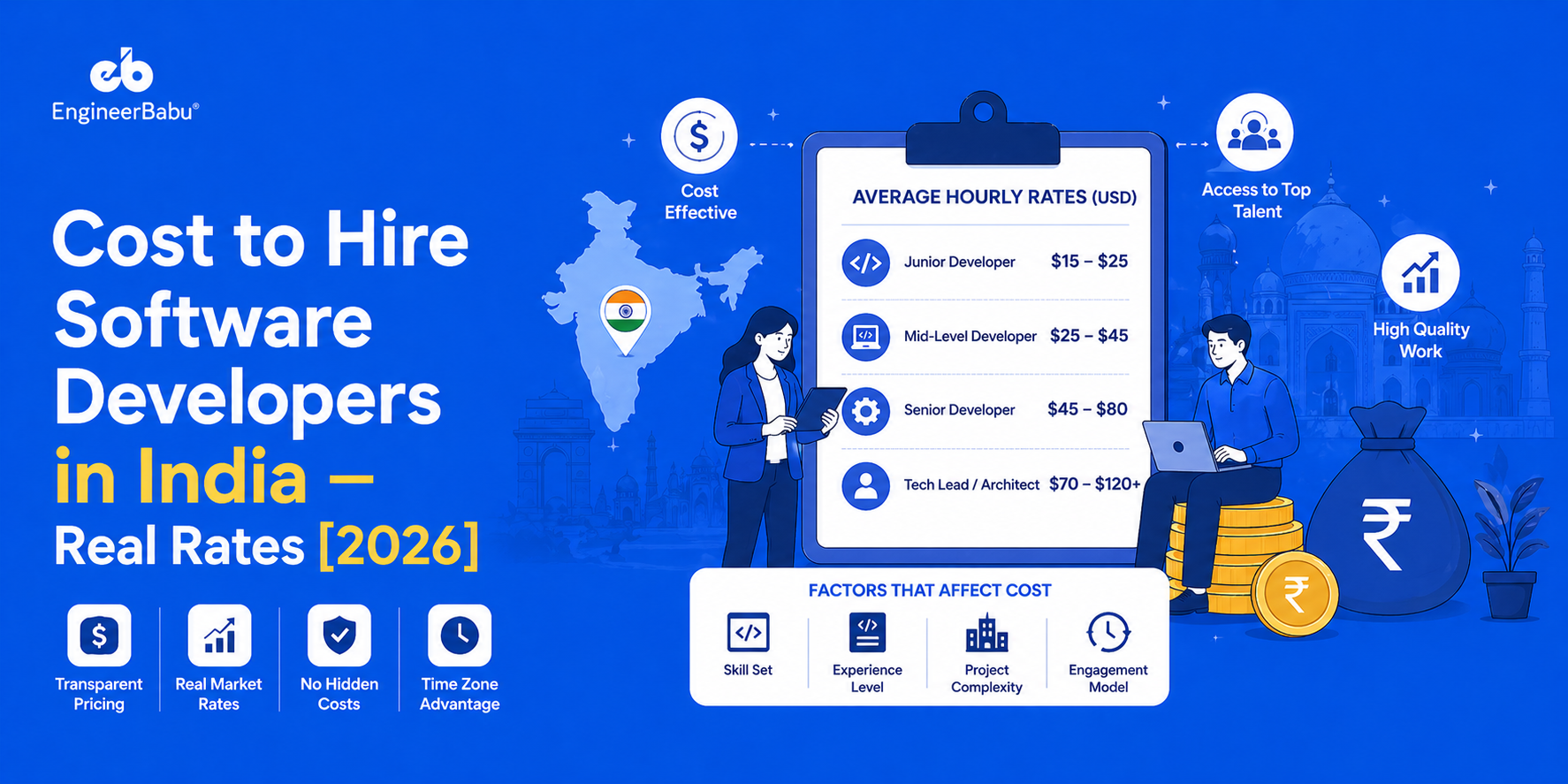
Every blog about Indian developer costs gives you the same thing. A table with hourly rates. $15-$40/hour for junior. $25-$60 for mid-level. $50-$100 for senior. Neat, clean, and almost entirely useless.
Useless because the table tells you nothing about what you’ll actually spend. It doesn’t tell you that the $15/hour developer will take three times as long as the $50/hour developer. It doesn’t tell you that the project quoted at $20,000 by one company and $60,000 by another might deliver the same result — or the cheaper one might deliver something that needs to be rebuilt entirely. It doesn’t tell you that the real cost of software development has almost nothing to do with hourly rates.
I know this because I’ve been on both sides of this pricing conversation for 14 years.
My name is Mayank Pratap. I co-founded EngineerBabu. The team has shipped 500+ products. 200+ for VC-funded companies. 75 for Y Combinator-selected startups. 4 clients that became unicorns. We also built and run Supersourcing — a B2B IT staffing platform that connects global companies with Indian developers. So I price development projects daily, and I price individual developers daily. I see what companies charge, what developers earn, and what clients actually end up spending by the time a product ships.
I’m going to give you the real numbers. Not inflated to make India look expensive. Not deflated to make it look cheap. The actual cost landscape in 2026, with enough context to make smart decisions about your project.
Before I give you numbers, I need to explain why the numbers you’ve seen elsewhere are misleading.
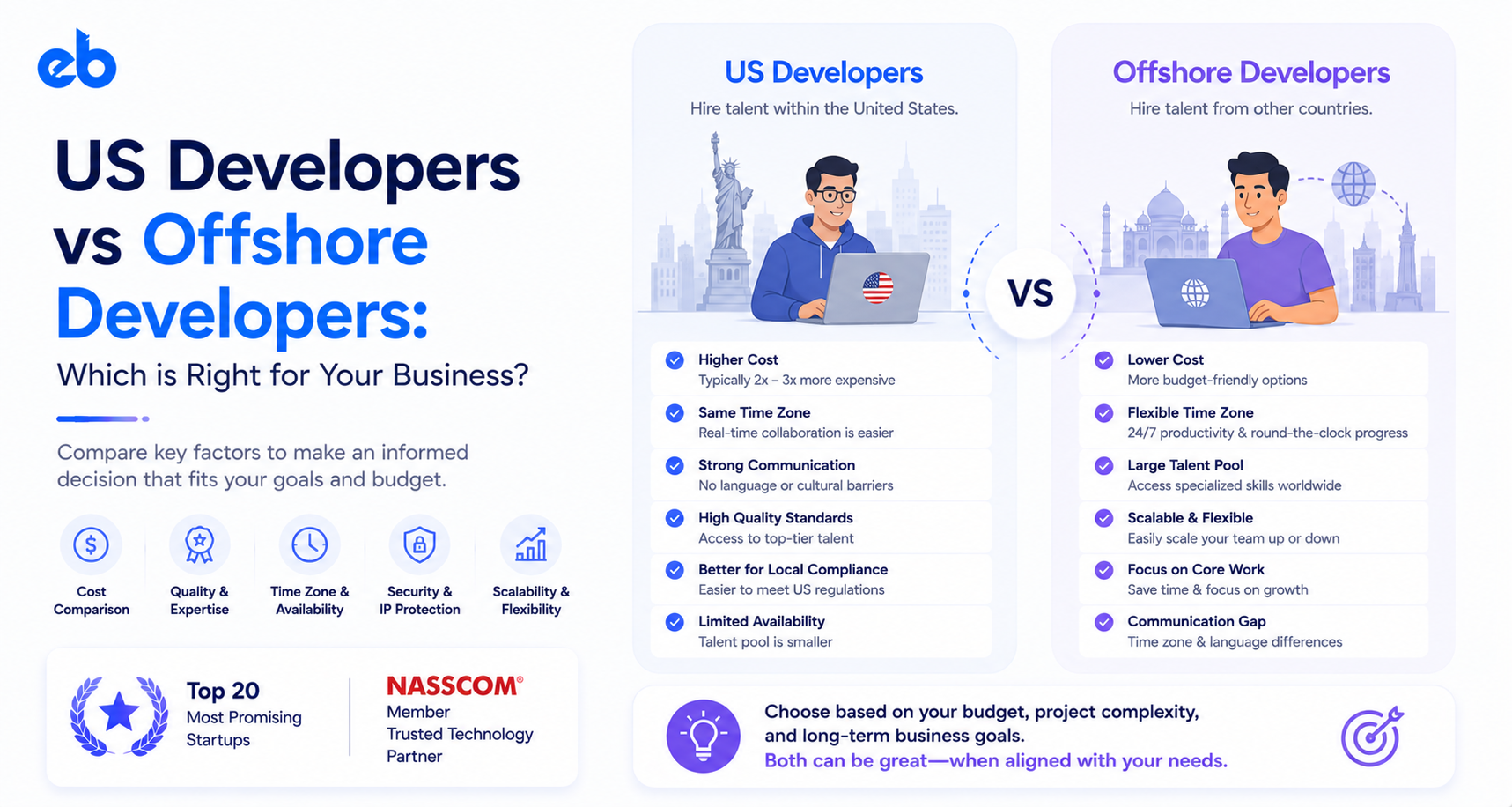
The standard comparison goes: US developer costs $150/hour, Indian developer costs $30/hour, you save 80%. Simple math. Wrong conclusion.
Here’s why.
A US developer at $150/hour typically has 8-15 years of experience, works at a company with established processes, has built production systems before, and can make architectural decisions independently. A $30/hour Indian developer might have 2-3 years of experience, work at a company with minimal processes, and need significant guidance to make sound technical decisions.
The real comparison isn’t $150 vs $30. It’s: what does it cost to get the same outcome?
An experienced Indian team — one with CMMI Level 5 processes, a CTO with 17 years of domain expertise, and a track record of 500+ shipped products — doesn’t charge $30/hour. They charge $40-$80/hour. And they deliver outcomes comparable to US teams at 40-60% lower cost.
A cheap Indian team at $15-$25/hour delivers something that might look finished but breaks under real usage, real users, and real compliance requirements. The savings evaporate when you spend the next six months fixing, rebuilding, and re-testing.
The EngineerBabu team has taken over projects from cheaper vendors more times than I can count. The pattern is always the same. A client hired a $15/hour team. Saved money upfront. Spent more than they would have originally when the product failed in production and needed to be rebuilt.
The cheapest bid is usually the most expensive project.
Let me break this down by what you’re actually buying. Not hourly rates in isolation — but what those rates translate to in terms of real project outcomes.
India’s developer market in 2026 has three distinct tiers. Understanding which tier you’re hiring from determines your project outcome more than any other factor.
These are companies with international certifications (CMMI Level 3-5), named enterprise clients, and verifiable track records of shipping complex products. Developer rates: $40-$80/hour. These companies don’t sell hours — they sell outcomes. Their senior engineers have 8-15 years of experience, often in specific domains like fintech, healthcare, or AI. They’ve built products that handle millions of users, billions in transactions, regulated data across multiple jurisdictions.
EngineerBabu operates in this tier. Google AI Accelerator 2024. CMMI Level 5. Products like EarlySalary (₹10,000 Cr+ disbursed), Bank Open (unicorn neobank), Khatabook (tens of millions of users). When clients pay premium Indian rates, they’re paying for pattern recognition from 500+ shipped products — which means fewer wrong turns, faster delivery, and architecture that doesn’t need to be rebuilt after launch.
Good technical skills, some process maturity, limited domain specialization. Developer rates: $25-$45/hour. These companies deliver well on clearly specified projects. They struggle with ambiguity — if your requirements aren’t crystal clear, the output won’t be either. They typically lack compliance experience for regulated industries.
Minimal process, junior teams, portfolio of small projects. Developer rates: $12-$25/hour. These are fine for simple websites, WordPress customizations, or small utility apps. They are not equipped for complex software, regulated industries, or products that need to scale.
The rate you pay determines the tier you hire from. The tier you hire from determines your project outcome. This isn’t elitism — it’s 14 years of empirical observation.
Hourly rates are abstract. Let me translate them into what actual products cost to build with a quality Indian team.
Starting from $15K. A focused product with core functionality, clean architecture, and deployment readiness. The EngineerBabu team build and ships MVP development in 8-12 weeks. At this price point, you’re getting architecture designed by engineers who’ve built 500+ products — which means the MVP is designed to evolve into a full product, not thrown away and rebuilt.
What $15K-$40K gets you: a mobile app (Flutter, cross-platform) with 10-15 core screens, a backend API layer, basic user authentication, core business logic, a simple admin panel, deployment on cloud infrastructure, and 2 months of post-launch support. This is the range where most startups — including many of the 75 YC-selected projects the team has built — start.
$40K-$100K. A full product with multiple user roles, third-party integrations (payment gateways, APIs, bureaus), compliance requirements, and production-grade infrastructure. This is the range for fintech products, healthcare platforms, e-commerce marketplaces, and SaaS applications.
When OpenMoney’s full-stack financial platform was built — unifying payments, investments, and credit under one architecture — the engineering depth fell in this range. When TaptapSend’s multi-country remittance platform was built with compliance across five jurisdictions — that’s this range. Products that handle real money, real data, real regulatory oversight.
$100K-$300K+. Complex systems with AI/ML components, multi-country compliance, advanced security, high-availability architecture, and integration with enterprise systems. When the team built EarlySalary’s lending platform — a system that has sustained ₹10,000 crore in disbursals with real-time credit decisioning processing thousands of decisions daily — that’s this range. When Bank Open’s neobank infrastructure was built — core banking integrations for a company that became a billion-dollar unicorn — that’s this range.
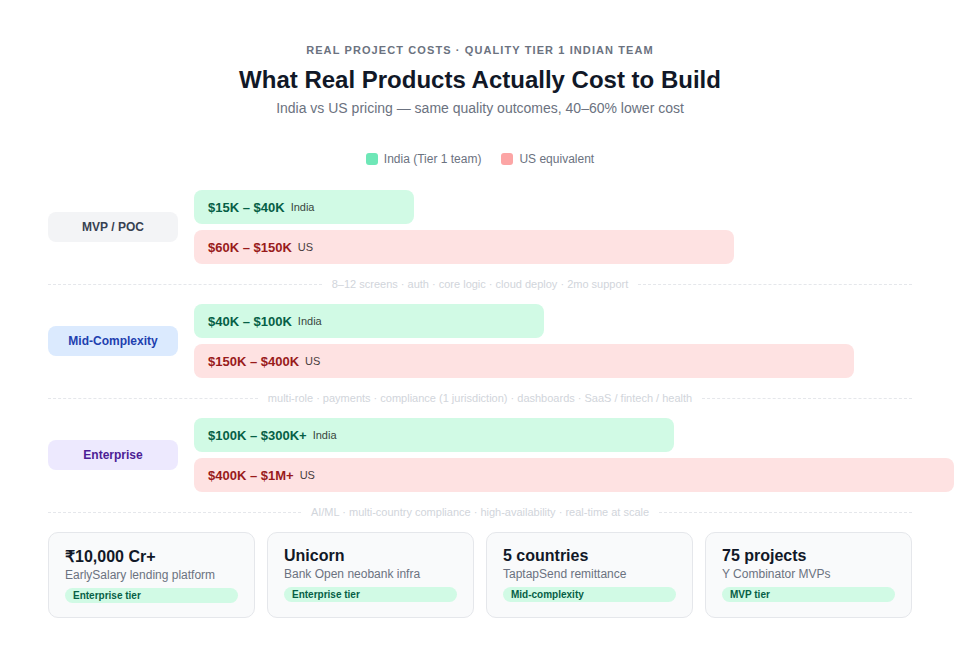
The same product categories, priced with local teams:
MVP: $60K-$150K in the US. $50K-$120K in the UK. $45K-$100K in UAE/Dubai. $40K-$80K in Australia. $35K-$70K in Singapore.
Mid-complexity: $150K-$400K in the US. Similar ranges in UK and UAE. Australia and Singapore slightly lower.
Enterprise: $400K-$1M+ in the US. The math is clear.
India delivers the same outcomes at 40-60% lower cost. Not because the talent is cheaper in absolute terms — but because the cost of living in Indore, Bangalore, or Pune is a fraction of San Francisco, London, or Dubai. The engineering quality isn’t discounted. The real estate, the salaries in purchasing-power terms, the operational costs — those are where the savings come from.
This is why 4 of the EngineerBabu team’s clients became unicorns. They didn’t succeed because they spent less. They succeeded because they spent intelligently — getting world-class engineering at India pricing, and investing the savings in growth, marketing, and market expansion.
How you structure the engagement matters as much as what you pay. The wrong model for your situation creates friction that no amount of talent can overcome.
You define the scope. The company quotes a price. They deliver. You pay.
This works when the requirements are crystal clear, the scope is bounded, and the product is well-defined. MVP builds often work well as fixed-price. The client knows exactly what they want. The team knows exactly what to build. The price is known upfront. No surprises.
The EngineerBabu team has done hundreds of fixed-price projects. The key is the scoping phase — getting the requirements detailed enough that the price is honest, not artificially low to win the deal and then inflated through change requests later. CMMI Level 5 processes mean the scoping is rigorous. What’s in scope is documented. What’s out of scope is documented. Changes are managed through a formal process, not informal scope creep.
Starting from $15K for MVPs. Exact pricing after understanding the specific project.
You hire a team — 2-5 developers, a project manager, a QA engineer — and they work exclusively on your product. You pay a monthly fee. The team operates as an extension of your in-house team.
This works when the product is evolving continuously, requirements change frequently, and you need a long-term partnership rather than a one-time delivery. Post-MVP scaling, ongoing product development, and enterprise platforms typically use this model.
Supersourcing — the B2B staffing platform Mayank co-founded — operates exactly this model. Dedicated Indian developers placed with global companies, managed with structured processes, working on overlapping timezone hours. The model works because it combines India’s cost advantage with the continuity and commitment of an in-house team.
Monthly cost for a dedicated team depends on composition. A 3-person team (senior full-stack developer + mid-level developer + QA) from a Tier 1 company runs $8,000-$15,000/month. The same team from a Tier 2 company: $5,000-$10,000/month. From a Tier 3 shop: $3,000-$6,000/month. The tier difference matters. Enormously.
You pay for actual hours worked. The rate is fixed. The scope is flexible. You add features, remove features, change direction — and pay for the hours consumed.
This works for projects with high uncertainty — R&D, AI/ML exploration, early-stage products where the path isn’t clear. The risk is that without a defined scope, costs can escalate unpredictably.
The EngineerBabu team uses time-and-material for AI projects and complex integrations where the scope genuinely can’t be defined upfront. When the Google AI Accelerator work was happening — exploring AI-driven credit intelligence for lending — the scope was inherently exploratory. Fixed-price would have been dishonest. T&M allowed the team to explore, prototype, validate, and pivot without artificial scope constraints.
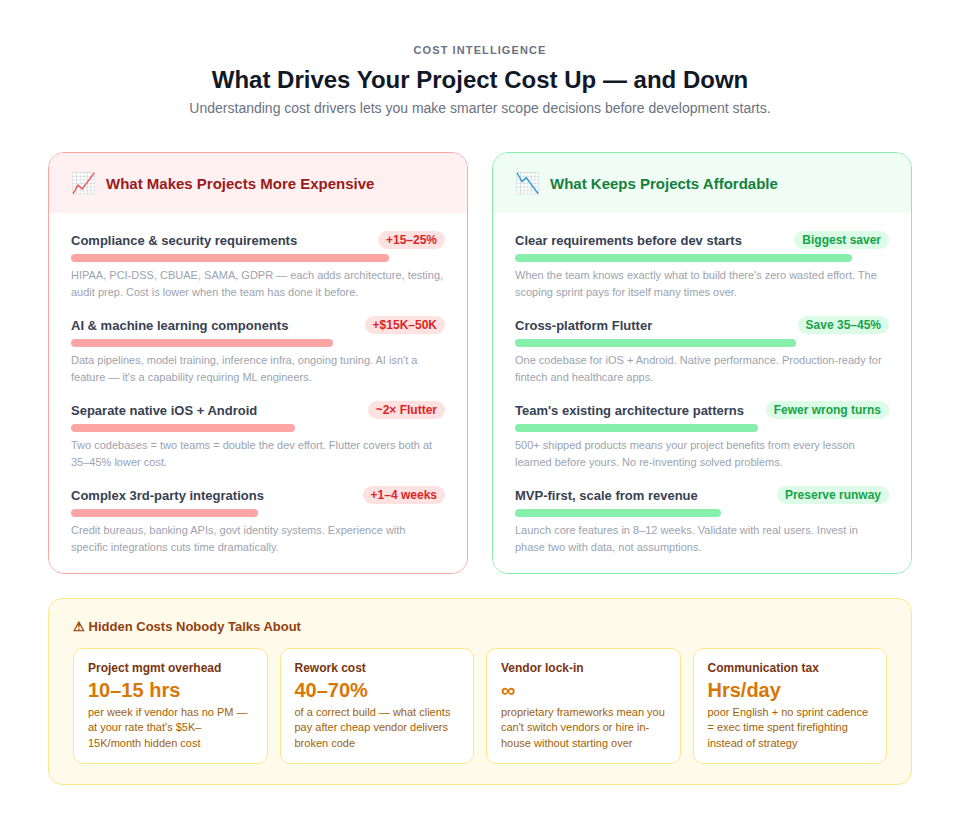
Understanding cost drivers helps you make smarter decisions about what to include in phase one versus what to defer.
Compliance and security requirements. A HIPAA-compliant healthcare platform costs more than a non-regulated app — not because the features are different, but because the architecture, testing, documentation, and audit preparation add engineering effort. PCI-DSS for payment platforms. GDPR for EU data handling. CBUAE for UAE fintech. SAMA for Saudi. Each compliance layer adds 15-25% to the base development cost.
The EngineerBabu team has built compliant systems across all of these frameworks — HIPAA for Apollo and ResMed, PCI-DSS for payment platforms, CBUAE/SAMA through Kulu Fintech, multi-jurisdiction compliance for TaptapSend. The cost of compliance is lower when the team has done it before because there’s no learning curve. A team that’s doing HIPAA for the first time will charge you for their education.
AI and machine learning components. AI isn’t a feature you add — it’s a capability that requires data pipelines, model training, inference infrastructure, and ongoing tuning. An AI-powered credit scoring engine — like what the team built for EarlySalary — requires ML engineers, data scientists, and production AI infrastructure. This adds $15K-$50K to a project depending on complexity.
Google AI Accelerator 2024 selection means the EngineerBabu team builds AI efficiently — they’re not figuring out AI architecture from scratch on your project. They’ve already solved the infrastructure patterns.
Multi-platform development. Separate native iOS and Android apps cost roughly 2x what a cross-platform Flutter app costs. The team recommends Flutter for most projects — one codebase, both platforms, native performance. When the savings are real and the trade-offs are minimal, the team recommends the cheaper path. Not every company does.
Third-party integrations. Every payment gateway, credit bureau, government API, CRM, ERP, or external service adds integration engineering time. Simple integrations (Stripe, Firebase): a few days. Complex integrations (credit bureaus, banking APIs, government identity systems): weeks. The team has integrated with Razorpay, Stripe, Adyen, CIBIL, Experian, SIMAH, Emirates ID, SADAD, and dozens of others. Experience with specific integrations dramatically reduces the time and cost.
Clear requirements before development starts. The single biggest cost reducer. When the team knows exactly what to build, there’s no wasted effort. The scoping phase that EngineerBabu runs before every project isn’t overhead — it’s the most cost-effective investment in the entire engagement.
Cross-platform frameworks. Flutter saves 35-45% compared to separate native development. The team has shipped multiple Flutter fintech and healthcare apps. The framework is production-ready for complex applications.
Leveraging the team’s existing architecture patterns. When you’re the 500th product a team ships, your project benefits from every architectural decision the team learned from the previous 499. The credit engine architecture that worked for EarlySalary informs the one built for new lending clients. The microservices pattern that scaled Bank Open informs every new platform architecture. This pattern recognition is the most valuable cost-reducer in outsourcing — and it’s something you only get from high-volume, experienced teams.
Starting with MVP, scaling from revenue. The team ships MVPs in 8-12 weeks. Launch with core features. Get real users. Generate revenue or validate the model. Then invest in phase two with data, not assumptions. This approach has helped 75 YC-selected startups and 200+ VC-funded companies launch efficiently.
Let me tell you what the other cost blogs conveniently omit.
If the vendor doesn’t provide strong project management, you’ll spend 10-15 hours per week managing the team yourself. At your hourly rate as a CTO or VP Engineering, that’s $5,000-$15,000/month in hidden cost. EngineerBabu includes project management with CMMI Level 5 processes — the client doesn’t manage sprints. They review demos every two weeks and make product decisions. The process runs itself.
A cheap team that delivers code requiring 3-6 months of rework costs more than a quality team that delivers production-ready code. The EngineerBabu team has taken over failed projects from lower-cost vendors repeatedly. The rework cost is typically 40-70% of what a correct initial build would have cost. The client pays twice.
Some Indian companies use proprietary frameworks, shared codebases, or architecture that only their team can maintain. When the client wants to switch vendors or bring development in-house, they discover they’re locked in. The EngineerBabu model is complete code and IP ownership transfer. No white-label. No shared infrastructure. No proprietary dependencies. The client’s product is the client’s property — every line of code, every document, every deployment script.
Not financial costs — time costs. A team with poor English, no structured communication, and no proactive status updates will consume executive attention that should be spent on strategy, not firefighting. When the team has strong English (EngineerBabu operates with clients in 15+ countries), structured sprint cadences, and founder involvement in key decisions — the communication cost drops to near zero.
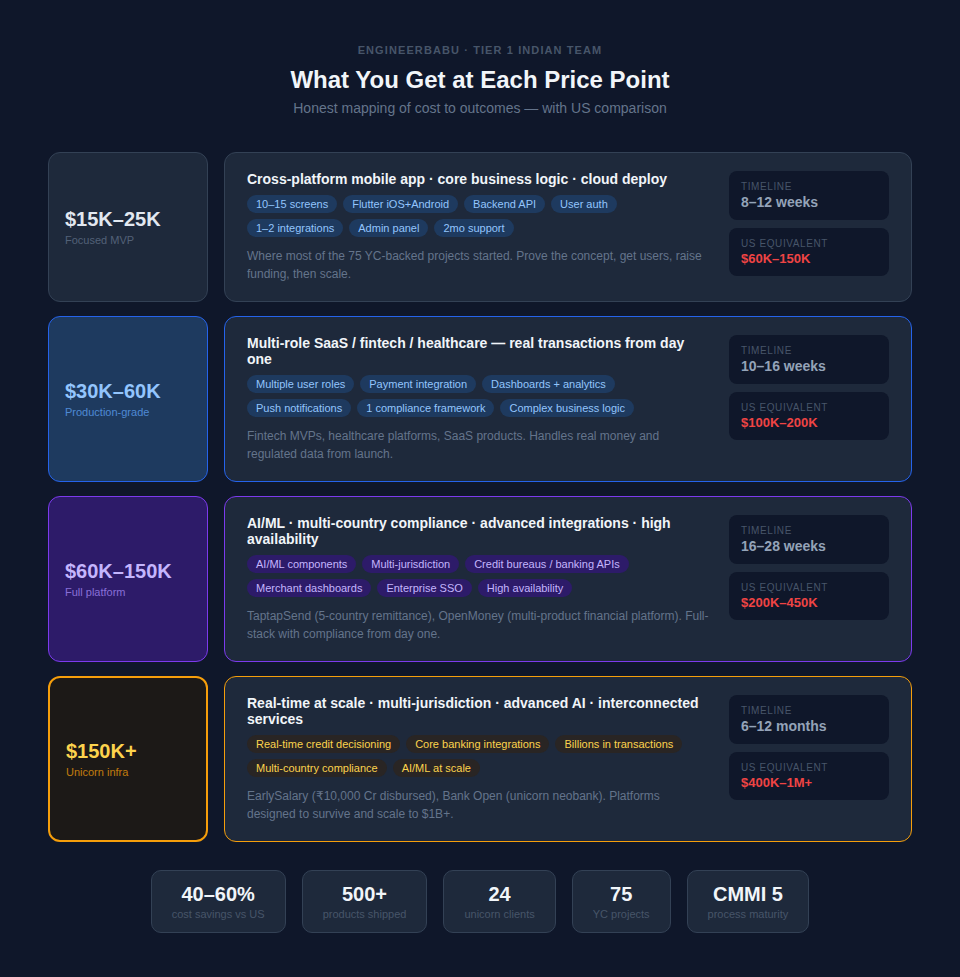
Let me map price to outcome so you know exactly what to expect.
At $15K-$25K with a quality Tier 1 Indian team: A focused MVP. Mobile app (Flutter, cross-platform) with core functionality. Backend API. User authentication and basic roles. 1-2 third-party integrations. Cloud deployment. Clean architecture designed to scale. 8-12 weeks delivery. This is where most YC-backed startups the team has built started — prove the concept, get users, raise funding, then scale.
At $30K-$60K with a quality Tier 1 team: A production-grade product. Multiple user roles. Payment integration. Dashboard and analytics. Push notifications. More complex business logic. Compliance for one regulatory framework. This is the range for most fintech MVPs, healthcare platforms, and SaaS products that need to handle real transactions from day one.
At $60K-$150K with a quality Tier 1 team: A full platform. AI/ML components. Multi-country compliance. Advanced integrations (credit bureaus, banking APIs, government systems). High-availability architecture. Merchant or enterprise dashboards. This is where products like TaptapSend (5-country remittance) and OpenMoney (multi-product financial platform) sit.
At $150K+ with a quality Tier 1 team: Enterprise-grade infrastructure. Real-time processing at scale. Multiple interconnected services. Advanced AI/ML. Multi-jurisdiction compliance. Products like EarlySalary’s lending platform (₹10,000 Cr) and Bank Open’s neobank architecture (unicorn) represent this level.
The same products built in the US would cost 2-3x these numbers. The quality is equivalent. The cost difference is structural — cost of living, operational costs, market dynamics — not a reflection of talent quality.
Mayank Pratap leads the company personally. Whether the client is in San Francisco, Dubai, Sydney, or Singapore — the founder is involved from architecture to launch. Not during sales only. Throughout the project.
Custom builds. Full code and IP ownership. No white-label. No vendor lock-in. Everything belongs to the client.
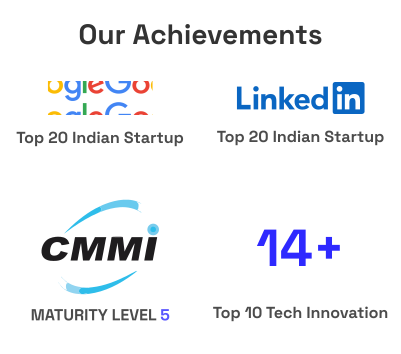
The CTO brings 17 years of financial infrastructure experience from Wishfin. Google AI Accelerator 2024 for validated AI capabilities. CMMI Level 5 for audited processes. 4 unicorn clients for scale experience. 75 YC selections for startup velocity. 200+ VC-funded products for investor-grade engineering.
150+ engineers. Clients across 15+ countries. Products serving millions of users. Billions of rupees in transactions. Regulated data in healthcare, finance, and enterprise.
Starting from $15K. Exact numbers after understanding the specific project. The team doesn’t quote before understanding the business — because an honest quote requires honest scoping.
Every project is different. A fintech MVP targeting the UAE market has different cost drivers than an AI healthcare platform for the US market. A marketplace app has different architecture needs than an enterprise SaaS product.
Email me at mayank@engineerbabu.com. Tell me what you’re building, who it’s for, and what market you’re targeting. I’ll give you a real number within a week — not a range so wide it’s meaningless, but a specific estimate based on the team’s experience building similar products.
No pitch deck. No pressure. No hidden fees. Just an honest conversation about what your product will cost and what it will take to build it right.
Mayank Pratap Co-founder, EngineerBabu mayank@engineerbabu.com | engineerbabu.com
Google AI Accelerator 2024 · CMMI Level 5 · Backed by Vijay Shekhar Sharma · 4 Unicorn Clients · 75 YC Selections · 200+ VC-funded Products · LinkedIn Top 20 Startups India · NASSCOM Member
Indian developer rates range from $12-$80/hour depending on experience, company tier, and domain specialization. Tier 1 companies with certifications like CMMI Level 5 and international track records charge
$40-$80/hour. Tier 2 mid-market companies charge $25-$45/hour. Budget shops charge $12-$25/hour. EngineerBabu operates in Tier 1 — the outcome-to-cost ratio is highest because the team’s 500+ product experience eliminates rework and wrong turns.
App development in India starts from $15K for a focused MVP with a quality Tier 1 team. Mid-complexity products (fintech, healthcare, SaaS) typically range $40K-$100K. Enterprise-grade platforms range $100K-$300K+. These represent 40-60% savings compared to US, UK, or UAE development at equivalent quality. EngineerBabu provides exact estimates after understanding the specific project scope.
Hourly rates in India range from $12 to $80+ per hour in 2026. The rate depends on the developer’s experience level, domain specialization, and the company’s process maturity. Senior AI/ML engineers at CMMI Level 5 companies like EngineerBabu command $50-$80/hour. Mid-level full-stack developers at quality companies range $30-$50/hour. Junior developers at budget shops start at
$12-$20/hour. The critical insight is that lower hourly rates often result in higher total project costs due to rework.
40-60% cheaper for equivalent quality outcomes. A product that costs $200K to build with a US team typically costs $60K-$100K with a quality Indian team like EngineerBabu. The savings come from India’s lower cost of living and operational costs, not lower talent quality. Google AI Accelerator 2024, CMMI Level 5, and 4 unicorn clients demonstrate that India’s top-tier companies deliver at a quality level that matches or exceeds many US, UK, and Australian firms.
Get multiple quotes but compare scope, not just price. Ask for detailed scope documents — not one-line estimates. Verify the company’s past work with real, live products. Check for CMMI certification or equivalent process evidence. Ask who specifically (by name and experience level) will work on your project. Confirm complete code and IP ownership in the contract. EngineerBabu provides detailed scoping before quoting, transfers 100% code ownership, and involves the founder and CTO (17 years Wishfin experience) personally in every project.
EngineerBabu | Product Engineering for Companies That Build for the World