How to Automate Loan Approval Workflows in Your Lending App


Create engaging, high-performance mobile applications tailored to your business needs. We craft future-ready apps that offer smooth user experiences on all devices.
Build robust and scalable websites and CMS platforms that help you manage content effortlessly. Our development ensures a seamless digital presence.
Launch secure, feature-rich online stores with intuitive shopping experiences. We build tailored eCommerce platforms designed for growth.
Design captivating games with immersive gameplay and stunning graphics. From concept to launch, we build engaging experiences that players love.
Enhance your customer relationships with customized Salesforce implementations. Drive growth and efficiency with smarter CRM solutions.
Harness artificial intelligence and machine learning to automate workflows and gain actionable insights. Our AI transforms data into smart decisions.
Accelerate your software delivery lifecycle with continuous integration, delivery, and infrastructure automation to boost efficiency.
Hire app developers ready to turn your ideas into sleek, high-performing mobile apps for any platform.
Bring in frontend pros who craft smooth, beautiful, and user-friendly interfaces that your visitors will love.
Get backend developers who build fast, secure, and reliable systems to keep everything running behind the scenes.
Hire eCommerce developers who build secure, scalable online stores designed to offer seamless shopping and grow your sales.
Get dedicated developers committed to your projects, delivering consistent quality and speed as an extension of your team.
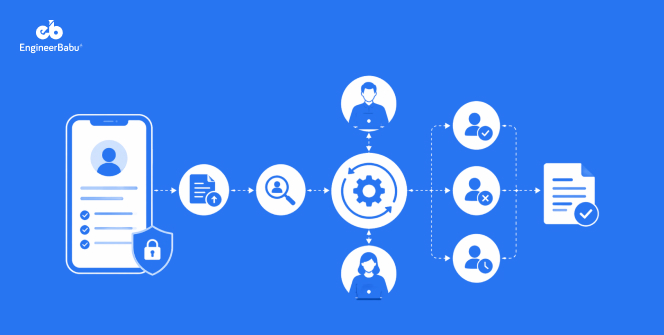
The idea of waiting days for a loan decision is quickly becoming outdated. Today’s digital lending platforms operate in real time, an application can be reviewed, approved, and funded within hours, often without a single manual touchpoint.
That’s what modern lending apps are already doing.
And, the shift is massive. According to ET Edge Insights, automated lending platforms can reduce loan processing time from several days to just minutes while also cutting operational costs. That gap between legacy lenders and automated platforms is only widening.
If you’re building or upgrading a lending app, learning how to automate loan approval workflows is no longer optional. It’s the infrastructure that determines whether your product can scale. Here’s how to do it properly.
Automation here doesn’t just mean speeding up paperwork. It means replacing sequential, human-dependent steps with a system that collects data, evaluates risk, makes decisions, and triggers downstream actions.
A fully automated loan approval workflow handles document ingestion, identity verification, creditworthiness assessment, fraud detection, decision logic, and borrower communication.
The goal is straight-through processing for clean applications, with human review reserved for edge cases only. Let’s now look at the steps to automate loan approval workflows.
The fastest way to build broken automation is to automate a broken process. Before writing a single line of code, document every step your current approval flow involves.
Where does data go after collection? What triggers a manual review? Where do delays actually happen?
Most lending teams discover that most of the processing time is lost to document chasing, manual bureau pulls, and incomplete applications. Those are your highest-leverage targets. Map the full flow first, then identify which steps can be replaced with API development, rule engines, or ML models.
Automation breaks down when data arrives in inconsistent formats. Replace static PDF forms with dynamic digital forms that validate inputs in real time. Use conditional logic so applicants only see fields relevant to their loan type, which reduces drop-off and improves data quality before it enters your pipeline.
For document processing, integrate an OCR engine that extracts structured data from bank statements, salary slips, and ID documents automatically. Modern OCR tools identify document types, pull specific fields like monthly income, and flag inconsistencies between declared information and what documents actually show.
Manual KYC is one of the biggest bottlenecks in loan approval. Integrate automated KYC providers that handle government ID verification, liveness detection, and face matching in real time.
For Indian lending apps, DigiLocker lets borrowers share verified Aadhaar and PAN data directly. For US-based apps, providers like Persona or Jumio cover driver’s licenses and passports.
A well-built API layer connects your lending app to these KYC providers instantly, pulls the verification result, and updates application status in seconds. Borrowers verified in under two minutes stay in the flow. Those who wait drop off.
Set up direct API integrations with bureaus like Equifax, Experian, or CIBIL so scores pull automatically on submission. No manual pulls, no delays.
Beyond bureau scores, connect to open banking APIs that surface income patterns, spending behavior, and existing EMI obligations that a score alone won’t reveal.
For thin-file borrowers with limited credit history, bank transaction data is often the only reliable signal you have. Build your data layer to aggregate all of this into a unified applicant profile before your decisioning engine evaluates anything.
Rules give you explainability, regulatory compliance, and a predictable baseline before machine learning enters the picture.
Your rule engine should encode lending policy in executable logic: reject below a credit score threshold, flag if debt-to-income exceeds 45%, auto-approve if all verification passes and the loan amount is within a set ceiling.
Rules must be configurable without a code deployment. Risk teams adjust thresholds frequently, so build an admin interface for non-technical staff.
Working with an experienced lending software development company at this stage prevents expensive architecture rework down the line.
A rule engine catches known bad cases. A machine learning model catches patterns your rules don’t anticipate. Train a risk scoring model on historical loan performance data using features like bureau attributes, income-to-loan ratio, payment history, employment stability, and behavioral signals from the application itself.
The model outputs a probability-of-default score alongside your rule-based decision. For borderline cases, the ML score tips the outcome.
Start with logistic regression or gradient boosting for explainability, and retrain at minimum quarterly. A proper ML development process gives your platform a risk edge that tightens over time.
Fraud checks must run in parallel with credit evaluation, not after it. Sequential checks add unnecessary minutes to a process that should take seconds.
Set up automated fraud signals on application submission: identity mismatches, device fingerprinting for duplicate identities, velocity checks for multi-channel applications, and bank statement anomalies like large sudden deposits before submission.
AI development tools in modern fraud detection analyze these signals and generate a risk score in under a second. Applications crossing the fraud threshold route to manual review regardless of credit quality.
A decision engine that doesn’t communicate clearly creates a poor borrower experience even when the technology works. Automate notifications at every status change: application received, verification in progress, decision made.
For approvals, send the offer with a clear next step. For declines, send a reason code that satisfies regulatory disclosure requirements without exposing your full decisioning logic.
The acceptance flow for approved applications should be fully digital. E-signature, disbursement trigger, and repayment schedule delivery all happen in the same session.
Document requests should specify exactly what’s missing, not send a generic follow-up message that frustrates borrowers.
Full automation handles clean applications, but your workflow needs a structured path for cases that don’t fit clean rules.
Build a review queue that surfaces flagged applications with every relevant data point pre-loaded: credit report, fraud score, income verification status, rule outcomes, and ML score in one view.
Reviewers make decisions without logging into five different systems. Track which application types land in the queue most often. If the same edge case keeps appearing, it signals either a new rule to add or a gap in your model’s training data to address.
An automated workflow you’re not measuring is a black box. Instrument every stage and track auto-approval rate, average processing time, decline rate by reason code, and default rate by approval channel.
These numbers show exactly where your automation performs and where it breaks down.
Set up anomaly alerts so a sudden drop in auto-approval rate gets flagged before it affects your portfolio. Lending operations that compound the most improvement treat this as a continuous product function, not a one-time technical build.
Building a system that can automate loan approval workflows end to end requires careful technology choices at every layer. The wrong call in one area creates bottlenecks that slow down the entire pipeline.
React Native is the standard for cross-platform mobile, giving you a single codebase across iOS and Android without performance trade-offs. For the borrower web portal and admin dashboard, a React-based web app gives ops teams fast browser-based access.
The mobile app development experience directly affects application completion rates, so invest in a clean, low-friction intake flow. Design matters here as much as functionality.
Node.js handles the event-driven, asynchronous workloads that loan processing demands. Python with Django REST Framework or FastAPI is a strong alternative, particularly if your team is building the ML layer in Python and wants to keep the stack consistent.
A microservices architecture works well here because each stage of the workflow, KYC, credit pull, fraud check, decisioning, can be scaled, updated, and monitored independently.
For rule management, Drools is a mature enterprise-grade option. Teams building on tighter timelines often opt for a custom-built rules service that’s lighter and easier to expose through an internal admin UI.
The ML scoring layer sits separately, typically a Python service using scikit-learn or XGBoost, and communicates with the decisioning engine via internal API calls. Keeping the two separate makes it easier to swap out the model without touching business logic.
PostgreSQL handles transactional data, loan records, and application history. Its relational structure is well-suited to the audit trail requirements that regulators expect. MongoDB is useful for flexible, schema-light data like document metadata and provider profiles.
Redis handles session state and caching during active application flows, which keeps response times fast under concurrent load. Even when multiple applications hit the system simultaneously.
Your integration surface is wide. Credit bureau APIs for automated score pulls. KYC providers for identity verification. Open banking APIs like Plaid or Finbox for bank data aggregation. E-signature tools like DocuSign or Leegality for loan agreement execution.
Payment rails for disbursement. Each of these needs to be wired through a stable API development layer with retry logic, error handling, and response logging built in from the start.
Every decision your system makes needs to be logged with its inputs, rule outcomes, and model scores. This serves two purposes: it gives your risk team visibility to improve the system, and it gives you the audit trail that regulators require.
Tools like Datadog or a custom logging service work well here. Set up alerting on key metrics so anomalies surface before they become portfolio-level problems.
Most teams building a lending app for the first time underestimate how many integration points and compliance constraints are packed into a working automated loan approval workflow.
The gap between a prototype that demos well and a system that handles 10,000 applications a month without breaking is significant.
EngineerBabu has built lending and fintech products across the full spectrum, from early-stage MVPs for alternative lenders to production-grade platforms for established NBFCs and digital banks.
If you’re starting from scratch, the MVP development approach EngineerBabu follows gets a working automated workflow into production in a fraction of the time. If you’re modernizing an existing system, the team knows which parts of a legacy lending stack to replace first and how to migrate without disrupting active loan books.
When you automate loan approval workflows correctly, the result is a system that’s faster for borrowers, cheaper to operate, and more consistent in risk decisions than any manual process.
The challenge isn’t technology. It’s sequencing the build correctly, integrating data sources cleanly, and building the discipline to monitor and improve once you’re live.
The lenders who get this right aren’t just faster. They’re building a structural cost and risk advantage that compounds over time.
A basic automation covering KYC, credit bureau integration, and a rule-based decision engine typically takes three to five months to build. A full implementation with ML scoring, fraud detection, and a monitoring layer runs six to ten months depending on integration complexity.
Yes, if built correctly. Your decisioning engine needs to log every input and output, provide explainable decline reasons, and maintain audit trails. Work with legal counsel familiar with lending regulations in your jurisdiction before going live.
Most practitioners recommend at least 10,000 labeled loan outcomes, preferably with 12 to 24 months of repayment data, before training a production model. Below that threshold, a well-tuned rule engine is more reliable than an ML model.
Yes. Many KYC and bureau integrations are pay-per-call with no heavy upfront cost. Start with rule-based automation and add ML scoring once your loan volume justifies the training data investment.