AI in Loan Underwriting: How It Works in Modern Lending Apps


Create engaging, high-performance mobile applications tailored to your business needs. We craft future-ready apps that offer smooth user experiences on all devices.
Build robust and scalable websites and CMS platforms that help you manage content effortlessly. Our development ensures a seamless digital presence.
Launch secure, feature-rich online stores with intuitive shopping experiences. We build tailored eCommerce platforms designed for growth.
Design captivating games with immersive gameplay and stunning graphics. From concept to launch, we build engaging experiences that players love.
Enhance your customer relationships with customized Salesforce implementations. Drive growth and efficiency with smarter CRM solutions.
Harness artificial intelligence and machine learning to automate workflows and gain actionable insights. Our AI transforms data into smart decisions.
Accelerate your software delivery lifecycle with continuous integration, delivery, and infrastructure automation to boost efficiency.
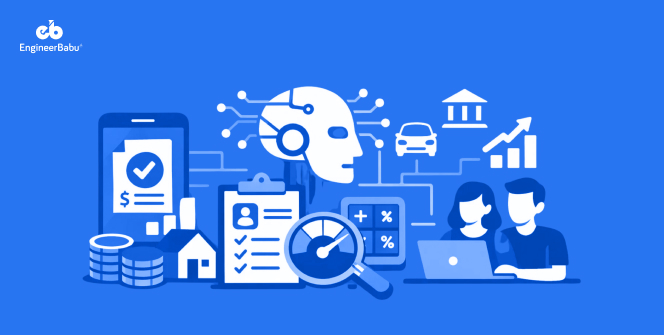
A loan application that once sat on a desk for two weeks can now get a decision in under two minutes. That’s not an exaggeration. That’s what AI in loan underwriting actually looks like in production today.
And the shift is happening fast. According to a KPMG survey covering 2,900 organizations across 23 countries, 71% of financial institutions are already running AI in production or actively piloting it.
The holdouts are becoming the exception, not the norm.
For lending apps specifically, AI isn’t just accelerating approvals. It’s changing how risk gets measured, how fraud gets caught, and how borrowers with limited credit histories finally get a fair shot.
This blog breaks down exactly how AI in loan underwriting works inside modern lending apps, step by step.
Before understanding what AI changes, it helps to see what it’s replacing.
In a traditional underwriting workflow, a loan officer manually pulls credit reports, reviews tax returns, verifies employment, checks debt-to-income ratios, and flags anything unusual.
For a personal loan, this might take a few days. For a commercial loan, it can stretch to two or three weeks.
The bigger problem isn’t just speed. It’s consistency and coverage. Two underwriters can look at the same application and reach different conclusions.
And if a borrower doesn’t have a strong credit history, say a freelancer or a first-time borrower, the rigid scoring model simply doesn’t have enough signal to work with. They get declined, even when they’re a solid risk.
This is precisely the gap that AI in loan underwriting closes.
With these capabilities in place, modern lending apps can break underwriting into specialized components. Each area leverages AI to refine decision-making, improve accuracy, and enhance borrower experience.
The moment a borrower submits an application, the AI system begins collecting and verifying data from multiple sources simultaneously. This includes traditional inputs like credit bureau data but also pulls from bank account transactions, utility payment history, mobile wallet activity.
AI-powered document verification reads and extracts information from uploaded pay stubs, tax forms, and bank statements automatically. This eliminates the manual data entry step entirely and significantly reduces the chance of errors during intake.
This is where AI fundamentally differs from legacy models. Traditional scoring systems like FICO work from a fixed formula applied to a limited set of data points. AI-driven credit models, by contrast, can analyze up to 10,000 data points per borrower, compared to just 50 to 100 in traditional scoring systems.
Platforms like Upstart and SoFi already factor in education history, career trajectory, income growth patterns, and repayment consistency across non-traditional accounts.
Machine learning models are also adaptive. They improve over time by learning from approved loans, repayment outcomes, and default patterns. The more data flows through, the sharper the model gets.
Once data is collected and verified, the AI generates a risk score based on the full picture of the borrower’s financial behavior. This isn’t just a single number.
Modern systems produce a layered risk profile that flags specific concerns, such as irregular income patterns or unusual spending behavior in the weeks before an application.
This layered output helps underwriters focus their attention where it actually matters. Routine, low-risk applications can be approved automatically.
Fraudulent applications have become more sophisticated, and rule-based systems are increasingly failing to catch them. AI detects fraud by identifying behavioral anomalies during the application process itself.
For example:
AI-powered fraud detection has shown 50% higher accuracy compared to rule-based methods, according to industry data from Docsumo.
Beyond the credit decision itself, AI also handles the compliance layer. This includes anti-money laundering checks, KYC verification, and regulatory rules that vary by geography.
Natural language processing reads unstructured content in uploaded documents, extracts relevant fields, and cross-references them against policy rules automatically.
This step is critical for lending apps operating across multiple markets. A compliant decision in one state may require different documentation in another. AI systems built with compliance logic can handle these variations at scale without needing separate human review queues for each jurisdiction.
AI in loan underwriting isn’t a deploy-and-forget system. The models need ongoing retraining as borrower behavior evolves, as new fraud tactics emerge, and as economic conditions shift.
Every approved or declined loan feeds back into the model, which refines its predictions accordingly.
This feedback loop is what separates a well-maintained AI underwriting system from one that becomes stale and inaccurate within a year.
Lenders who invest in continuous model monitoring see sustained or improving performance, while those who neglect it often face degrading accuracy.
The numbers behind AI in loan underwriting aren’t theoretical. AI can reduce time-to-decision from 20 to 30 days down to just 2 to 24 hours.
For lending apps specifically, this speed creates a compounding advantage. Faster decisions mean lower dropout rates during application. Lower dropout rates mean more conversions.
Better risk models mean fewer bad loans on the books. The business case tends to compound quickly once implementation is done correctly.
You can read more about how this plays out in specific lending workflows in our post on the role of AI in automating B2B loan approvals.
Getting AI in loan underwriting right isn’t just a data science problem. It’s an architecture, integration, and compliance challenge at the same time. Here’s what a structured approach looks like.
AI models perform only as well as the data they’re trained on. Before any model gets built, the underlying data infrastructure needs to be clean, consistent, and well-governed.
This means defining data standards for intake, validating sources, and ensuring historical loan data is properly labeled with outcomes.
Building the actual underwriting models involves machine learning for risk scoring, anomaly detection for fraud, and NLP for document processing. These models need to be trained on representative historical data and evaluated not just for accuracy but for fairness.
Depending on the complexity of the product, AI development teams may also incorporate generative AI components for automated borrower communication or explainability layers that produce human-readable reasoning for each decision.
A lending app doesn’t operate in isolation. The AI underwriting layer needs to connect with credit bureaus, KYC providers, payment gateways, and banking data aggregators.
Well-designed API development ensures these integrations are reliable, secure, and fast enough to support real-time decision-making without introducing bottlenecks.
Compliance can’t be added as an afterthought. The CFPB has made clear that AI-based lending decisions carry the same fair lending obligations as manual ones. Courts have held that algorithmic tools can produce disparate impact liability if they systematically disadvantage protected groups.
Building compliance checks into the model architecture from the start is far more effective than retrofitting them later.
After deployment, the real work begins. Performance dashboards should track key metrics like approval rates, default rates, time-to-decision, and model drift.
If a model’s predictions start diverging from actual outcomes, it’s time to retrain with newer data. This monitoring loop is non-negotiable for any production-grade underwriting system.
It’s worth being specific about what AI in loan underwriting actually is and isn’t. It’s not just workflow automation that moves tasks from one queue to another faster. The real value is in the quality of the risk model itself.
A well-trained underwriting model doesn’t just replicate what a human underwriter would decide. It finds patterns across thousands of variables that no human could process in parallel, and it does so consistently every time.
That consistency is part of what regulators increasingly expect, and it’s part of what gives lenders genuine confidence in the decisions their system is producing.
If you’re thinking about building or improving a lending platform, understanding AI in loan lending apps more broadly is a good starting point before narrowing into the underwriting layer specifically.
AI in loan underwriting has moved well past the pilot stage. It’s running at scale in some of the largest lending platforms in the world, and it’s being adopted by smaller fintechs to compete on speed and accuracy without proportional cost increases.
The lending apps that get this right will have a genuine structural advantage, not just in speed but in the quality of the borrowers they can serve and the risk they can accurately price. The ones that delay are competing with one hand behind their back.
If you’re planning to build a lending platform or add AI capabilities to an existing one, the technical architecture and regulatory requirements are complex enough that getting the right development partner matters. So it’s better to partner with a professional lending software development company like EngineerBabu.
EngineerBabu has worked across fintech verticals and can help you move from concept to compliant, production-ready system.
AI in loan underwriting is the use of machine learning, predictive analytics, and automation to evaluate loan applications. It assesses borrower risk using a much wider range of data than traditional credit scoring systems.
AI automates data collection, document verification, risk scoring, and compliance checks simultaneously. Decisions that once took days are completed in minutes because no manual handoffs are needed at each step.
Yes, if the training data reflects historical biases, the model can reproduce them at scale. This is why fair lending testing and regular audits are built into responsible AI underwriting implementations.
Not entirely. Most systems route routine applications through fully automated decisions and send complex or borderline cases to human reviewers. The human underwriter focuses on judgment calls rather than processing.
AI can use transaction history, utility payments, rent history, mobile wallet activity, income flow patterns, and in some cases, behavioral signals from the application process itself.