AI in Ecommerce: Use Cases, Costs and How to Get Started


Create engaging, high-performance mobile applications tailored to your business needs. We craft future-ready apps that offer smooth user experiences on all devices.
Build robust and scalable websites and CMS platforms that help you manage content effortlessly. Our development ensures a seamless digital presence.
Launch secure, feature-rich online stores with intuitive shopping experiences. We build tailored eCommerce platforms designed for growth.
Design captivating games with immersive gameplay and stunning graphics. From concept to launch, we build engaging experiences that players love.
Enhance your customer relationships with customized Salesforce implementations. Drive growth and efficiency with smarter CRM solutions.
Harness artificial intelligence and machine learning to automate workflows and gain actionable insights. Our AI transforms data into smart decisions.
Accelerate your software delivery lifecycle with continuous integration, delivery, and infrastructure automation to boost efficiency.
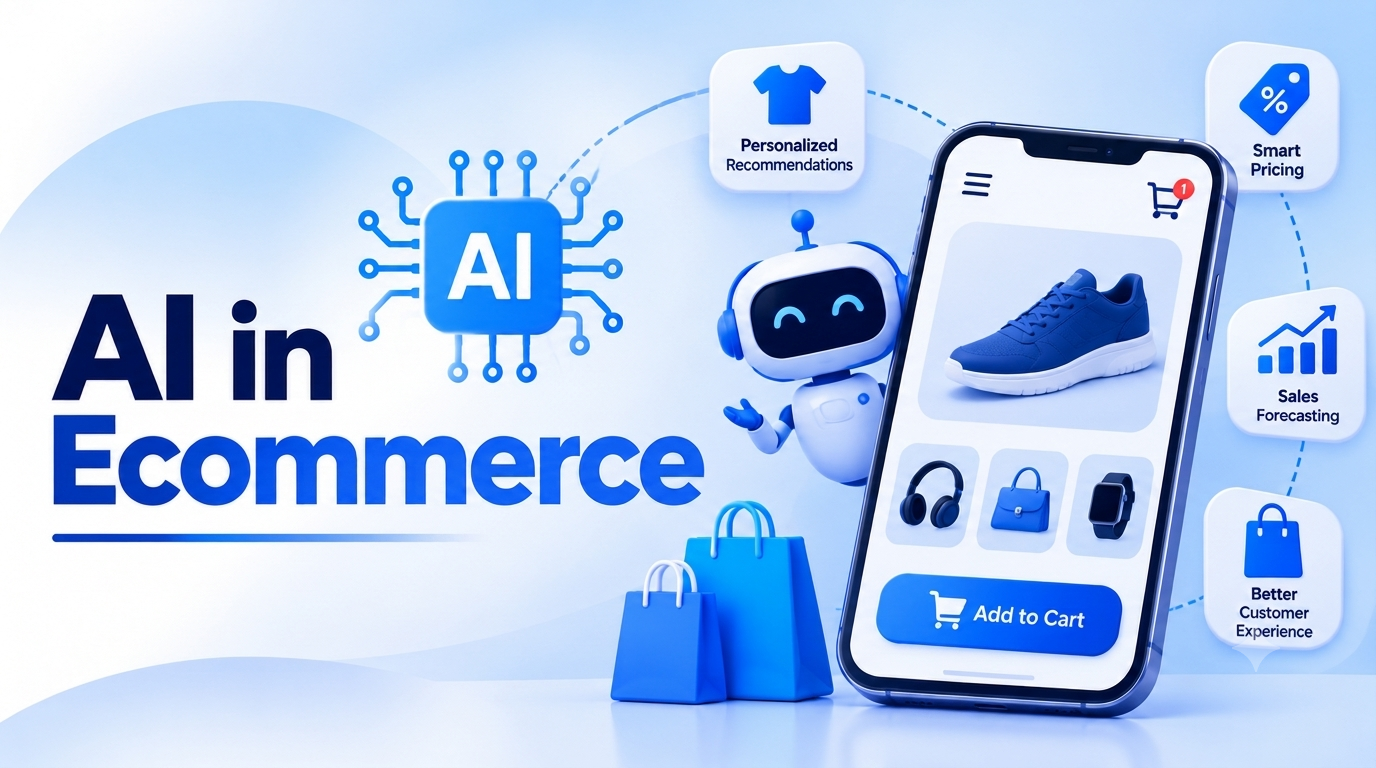
Most online stores already run AI in ecommerce without calling it that. The search bar that understands “jacket warm enough for Chicago.” The reorder nudge that lands the week you run out.
The size guidance that kills a return before it happens. What changed this year is who the technology serves. Shoppers now bring their own assistants to the buying decision, and those assistants read your catalog first.
This guide covers where AI in ecommerce earns money today, what each use case costs, and how to ship a first model fast.
TL;DR
AI in ecommerce means using machine learning models to make store decisions that used to need a person. Which product surfaces first. Which price holds a margin. How many units sit in which warehouse before a demand spike.
The models learn from your clickstream, orders, returns and support tickets, so accuracy improves as the store grows.
That separates AI in ecommerce from the rules engines most platforms shipped with. A rule says show bestsellers to everyone. A model says show this shopper the mid-price running shoe, because her browsing pattern returns the premium pair often.
Shoppers changed their first move. Many now ask an assistant before opening a store, and that assistant decides which brands make the shortlist. Salesforce projects AI-driven recommendations will influence more than one in five holiday orders, with $75.8 billion in AI-influenced Cyber Week spending (Salesforce, November 2026).
Two things follow. Your catalog must be readable by machines, not only by humans. And teams already running AI in ecommerce pilots are building a data advantage that compounds every quarter.
Model access is not the moat, since everyone rents similar models at similar prices. The edge in AI in ecommerce belongs to whoever has eighteen months of clean, labeled customer behavior.
Revenue-side use cases change what shoppers see and what they pay. They live at the front of the store, where a small conversion lift compounds across every session. These three AI in ecommerce use cases deliver the clearest returns for most catalogs.
Site search quietly loses more revenue than any other storefront feature. Shoppers type intent, not SKUs, and keyword matching returns nothing for “something warm for a January trip.” Vector search fixes that by matching meaning instead of strings, so typos, synonyms and full questions resolve correctly.
Teams planning to build an ecommerce app should scope this layer in from the start. Search is usually the fastest AI in ecommerce win, because the traffic already exists.
Static “customers also bought” widgets treat a first-time visitor and a loyal buyer identically. Behavioral models weigh session context, past returns, price sensitivity and stock position before choosing what to show.
The practical win is not a bigger cart alone. It is fewer items bought and sent straight back, which is where margin disappears. Recommendations are the AI in ecommerce feature most stores already own and least often tune.
Dynamic pricing earned a bad reputation because early versions simply chased competitors downward. Modern AI in ecommerce pricing models optimize contribution margin, factoring shipping cost, return probability and inventory age per SKU.
Brands with heavy promo calendars pair this with trade promotions management software so discounts get measured against real incremental lift. Set floor prices before anything goes live.
Cost-side use cases rarely get the demo, but they usually fund the rest of your AI in ecommerce program. They work on inventory, labor and loss, where savings are easy to prove. Each pays back on a shorter cycle than most teams expect.
Overstock and stockouts are one failure measured from opposite ends. Models trained on seasonality, promo history and regional buying patterns forecast at SKU and location level, not category level.
Most teams adding demand forecasting software tighten safety stock within two planning cycles. This is the AI in ecommerce use case that shows up in working capital before revenue.
The old chatbot answered FAQs and routed everything else to a queue. A modern AI customer service agent reads order history, checks carrier status, issues a refund and updates the record without a handoff.
That changes support economics during peak season, when hiring temporary agents is slow and costly. Keep human escalation one click away, because the AI in ecommerce failure shoppers hate is a loop with no exit.
Rules-based screening blocks good customers and misses coordinated attacks. AI in ecommerce risk models score each transaction on device, velocity, address history and return patterns, then act in milliseconds.
Serial return abuse hides inside otherwise healthy order numbers, so score customers, not only orders.
None of this works on a messy catalog. You first need consistent product attributes, clean category trees, deduplicated SKUs and an event stream that captures what shoppers actually do. Most delayed projects stall here, not at the modeling stage.
A working AI in ecommerce stack has four layers. A data layer unifying orders, behavior and inventory. A feature layer turning raw events into usable signals. A serving layer fast enough for a page load. And a measurement layer, where data analytics services prove whether any of it moved a number.
Teams with in-house engineers often own the first two layers and bring in machine learning development support for the rest. That split keeps domain knowledge inside the company.
A narrow first build beats a broad roadmap that never ships. The goal of cycle one is a single measurable number moving, not a platform. These four steps keep AI in ecommerce projects out of pilot purgatory.
Choose a metric your team reviews weekly, like search exit rate, contact rate per thousand orders or stockout frequency. Avoid anything needing new tracking, because instrumentation work will eat the quarter.
Write down today’s baseline and the lift you would accept as success from AI in ecommerce. Agreeing that threshold upfront is what prevents a six-month argument about whether the pilot worked. One metric, one owner, one review date.
Export your catalog and audit it honestly. Count missing attributes, duplicate SKUs, inconsistent sizing fields and products filed in the wrong category. Most mid-size catalogs have gaps in a third of their records, and every gap becomes a bad recommendation later.
Clean only the attributes your chosen use case consumes, since a full cleanup can take months. This step is unglamorous, and it shapes AI in ecommerce results more than model choice ever will.
Platform-native features are the fastest path for standard search and recommendations. Custom models earn their cost when your catalog, margins or logistics are unusual enough that generic logic misprices things.
Many teams blend both, buying the commodity layer and putting AI development effort where the business is genuinely different. Decide per use case, never as a blanket policy. The useful question is what a vendor cannot know about your customers.
Launch to a slice of traffic with a real holdout group, not a before-and-after that seasonality will corrupt. Run it through a full buying cycle, which for most catalogs means three to six weeks.
Pipe results into a business intelligence dashboard your merchandising team can read without an analyst. If the number moved, widen traffic in steps. If it did not, you learned that in weeks.
The ranges below reflect what mid-market teams pay for a first production use case, not a demo.
| Use case | Typical first build | Main ongoing cost |
| Semantic site search | $15,000 to $40,000 | Vector hosting and reindexing |
| Recommendation engine | $25,000 to $70,000 | Retraining and inference calls |
| Demand forecasting | $35,000 to $90,000 | Data pipeline upkeep |
| Support automation | $20,000 to $60,000 | Per-conversation model usage |
Two costs get missed in nearly every AI in ecommerce estimate. Data cleanup usually runs 20% to 30% of the build and arrives before anything visible ships. Model usage also scales with traffic, so a successful AI in ecommerce launch raises the monthly bill.
Teams scoping AI chatbot development should budget on peak-season conversation volume, not an average month.
Most failed programs were not technically wrong. They were scoped, staffed or measured in a way that made success impossible to prove. These three appear in post-mortems constantly.
A model that never talks to your warehouse management system will promote products you cannot ship. Pull operations in early, because inventory truth is an input to AI in ecommerce, not an afterthought.
A forecast that gains two accuracy points but never changes a purchase order has delivered nothing. Tie every model to a decision somebody makes, and name the person who makes it.
Without a control group, a good quarter and a good model look identical in the dashboard. You will not know what to fund next, which is how promising pilots die at budget time.
The next shift already shows in traffic logs. Adobe found AI-referred traffic to US retail sites grew 393% year over year in Q1 2026, and converted 42% better than other channels (Adobe, 2026).
That traffic behaves differently. It arrives with intent already formed, filtered by a model that parsed your product pages first. Structured data, accurate specs and clear availability signals are now conversion assets, not SEO housekeeping. Winning AI in ecommerce traffic starts with pages machines can parse cleanly.
Further out, assistants will handle reorders and comparison shopping themselves. Retailers working with an AI agent development company are testing this on low-risk flows like replenishment.
Run several together and AI in ecommerce becomes a multi-agent AI system, with separate agents handling discovery, pricing checks and order placement under shared guardrails.
If you want AI in ecommerce running in production rather than a strategy deck, this is where EngineerBabu fits. The team audits your catalog and event data, then picks the use case with the shortest path to a measurable number.
Delivery runs on a CMMI Level 5 process with senior engineers staying on the project.
The work spans ecommerce development, data engineering and generative AI development for search, support and merchandising. EngineerBabu was selected into the Google AI Accelerator and has supported 200+ VC-funded products.
AI in ecommerce rewards teams who start narrow and measure properly. The stores pulling ahead did not pick better models. They cleaned their product data, shipped one use case against one number, and compounded from there.
Pick the metric that annoys you most this quarter and build for that. Ready to scope your build? Talk to the EngineerBabu team about AI in ecommerce.
Yes, if you start with search or support rather than custom models. Platform-native features cost little, need no data science team, and usually show measurable results within the first month.
Roughly six months of clean order and behavior data is a workable floor. Below that, use pre-trained features, since custom models trained on thin data produce confident but unreliable predictions.
No, it changes what they spend time on. Models handle ranking and repricing at SKU level, while merchandisers set strategy, guardrails and the brand rules those models follow.
Site search usually pays back quickest, often within weeks. The traffic already exists, the failure is easy to measure, and no extra acquisition spend is needed to see the lift.
Keep personal identifiers out of model inputs, use vendors offering zero-retention terms, and log every automated decision. Regional privacy rules apply fully, regardless of which model made the call.