How to Build a Healthcare Credentialing Platform - CAQH Integration, PSV Automation, Payer Enrollment 2026


Create engaging, high-performance mobile applications tailored to your business needs. We craft future-ready apps that offer smooth user experiences on all devices.
Build robust and scalable websites and CMS platforms that help you manage content effortlessly. Our development ensures a seamless digital presence.
Launch secure, feature-rich online stores with intuitive shopping experiences. We build tailored eCommerce platforms designed for growth.
Design captivating games with immersive gameplay and stunning graphics. From concept to launch, we build engaging experiences that players love.
Enhance your customer relationships with customized Salesforce implementations. Drive growth and efficiency with smarter CRM solutions.
Harness artificial intelligence and machine learning to automate workflows and gain actionable insights. Our AI transforms data into smart decisions.
Accelerate your software delivery lifecycle with continuous integration, delivery, and infrastructure automation to boost efficiency.
A physician joining a new practice cannot see a single insurance patient until credentialed with every payer the practice contracts with, a process involving verification of medical degree, residency, board certifications, state licences, DEA registration, malpractice history, and hospital privileges across multiple primary sources.
Average credentialing time: 90 to 150 days. During this time, the physician cannot be billed for insurance patients, costing the practice $50,000 to $150,000 in lost billing per month of delay.
A credentialing platform reduces this to 30 to 45 days.
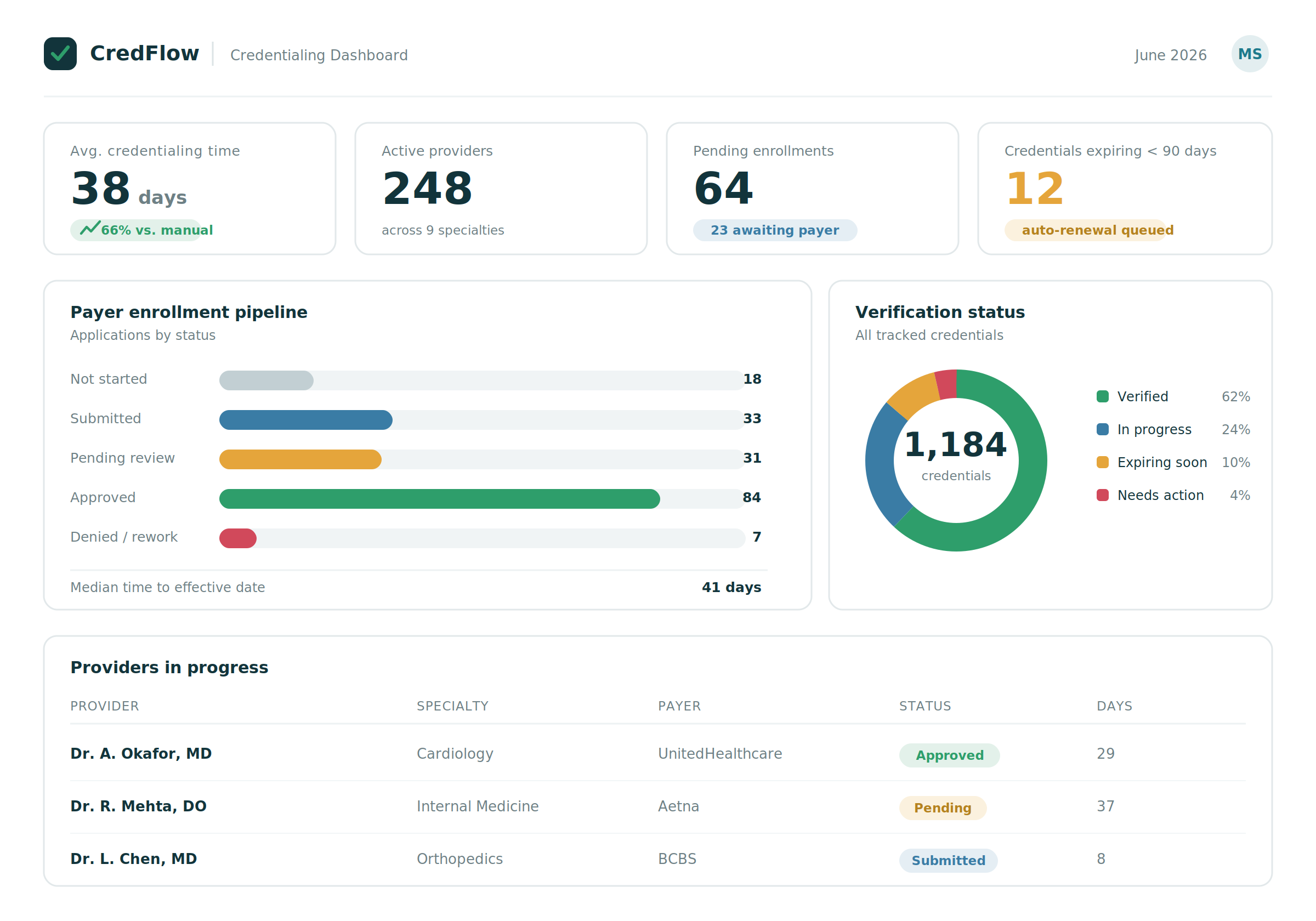
Provider credentialing is one of the most time-consuming administrative processes in healthcare. Before a physician can treat insured patients or submit claims, every payer must verify the provider’s education, licenses, certifications, work history, malpractice coverage, and regulatory standing.
Most organizations still rely on spreadsheets, emails, paper forms, and manual follow-ups, leading to delays that directly impact revenue.
A healthcare credentialing platform automates credential collection, primary source verification (PSV), CAQH profile management, payer enrollment, and ongoing compliance monitoring.
By integrating with regulatory databases and payer portals, practices, hospitals, and MSOs can shorten enrollment timelines, reduce administrative workload, maintain continuous compliance, and accelerate provider onboarding.
| Benefit | Impact |
| Faster provider onboarding | Reduce credentialing timelines from 90–150 days to as little as 30–45 days. |
| Automated primary source verification | Verify licenses, certifications, and exclusions directly from authoritative sources in minutes. |
| Centralized provider records | Maintain a single, secure profile with all documents, credentials, and expiration dates. |
| Simplified CAQH management | Automatically synchronize provider information and manage 120-day re-attestations. |
| Improved payer enrollment | Track enrollment status across Medicare, Medicaid, and commercial payers from one dashboard. |
| Continuous compliance | Monitor licenses, DEA registrations, NPDB reports, and exclusion lists with automated alerts. |
| Reduced revenue delays | Enable providers to begin billing sooner by minimizing credentialing bottlenecks. |
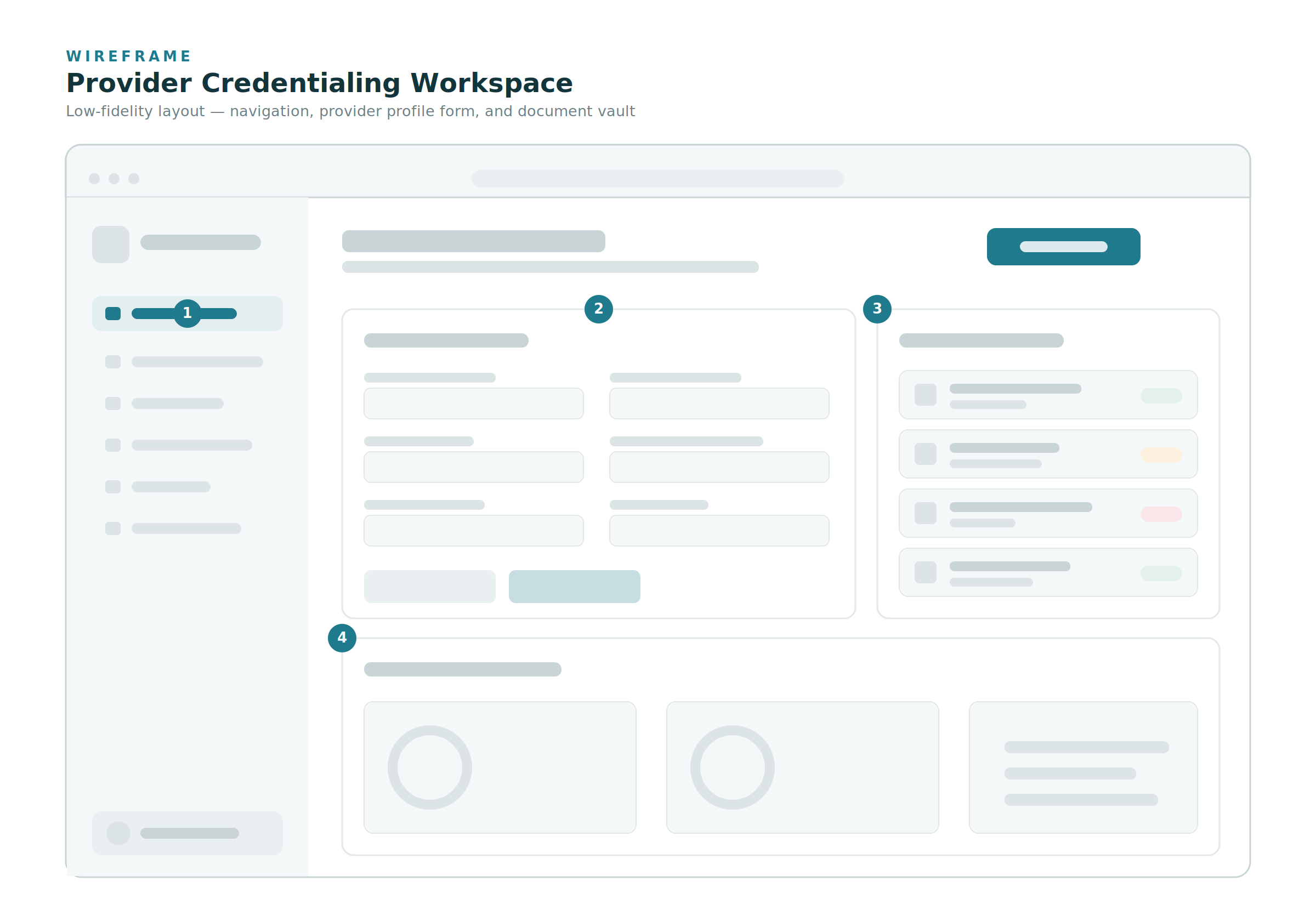
The provider profile:
| Category | Fields |
| Personal | Name, DOB, SSN (encrypted), NPI |
| Education | Medical school, graduation date, degree |
| Training | Residency, fellowship – program, specialty, dates |
| Licensure | State medical licences – state, number, expiry, status |
| DEA | DEA registration number, schedule, state, expiry |
| Board certification | Board, specialty, cert date, expiry |
| Malpractice | Current carrier, policy number, limits, prior claims |
| CAQH number | Universal provider identifier |
Document vault with expiry tracking:
| Document | Alert Timing |
| State medical licence | 90 days before expiry |
| DEA certificate | 90 days before expiry |
| Board certification | 12 months before expiry |
| Malpractice certificate | 60 days before expiry |
| BLS/ACLS certifications | 60 days before expiry |
When a document expires, all payers requiring it receive an updated version automatically through the CAQH API or direct payer portal update.
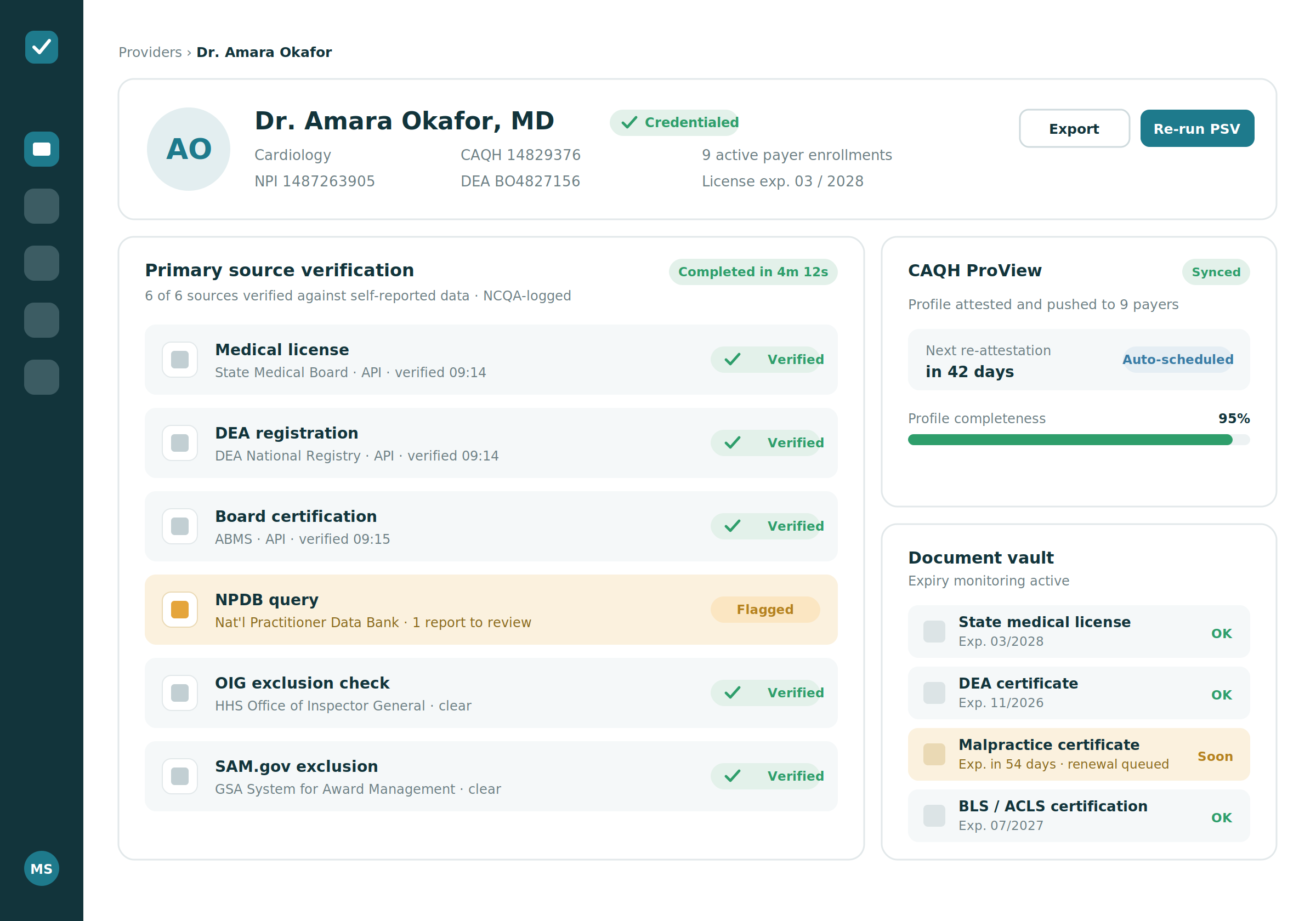
PSV sources and integrations:
| Credential | Primary Source | Integration |
| Medical licence | State Medical Board | API integration (most states) |
| DEA registration | DEA National Registration System | API query |
| Board certification | ABMS | ABMS API |
| NPDB | National Practitioner Data Bank | NPDB API |
| OIG exclusion | HHS Office of Inspector General | OIG API |
| SAM.gov exclusion | GSA System for Award Management | API query |
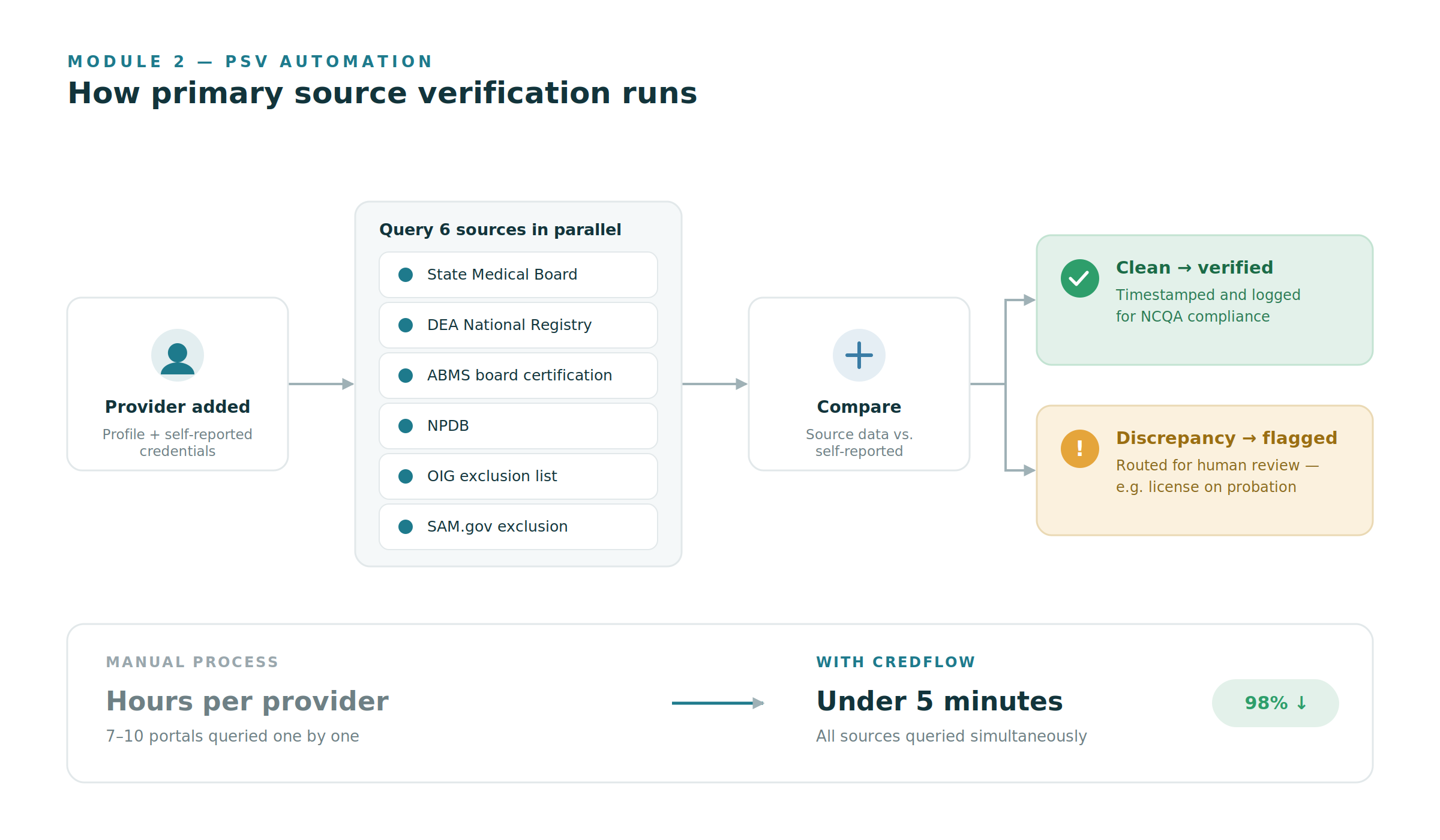
PSV automation workflow:
When a provider is added, PSV runs automatically:
PSV that previously required manual queries to 7 to 10 sources completes in under 5 minutes.
CAQH ProView is used by most commercial payers to collect and verify provider information. A provider who completes their CAQH profile makes it available to hundreds of payers.
The CAQH integration enables:
| Function | How It Works |
| Profile pre-population | CAQH data imported to pre-fill provider record |
| Profile maintenance | Changes in platform pushed to CAQH automatically |
| Re-attestation reminders | CAQH requires re-attestation every 120 days – platform automates |
| Payer authorisation | Providers authorise specific payers via the platform |
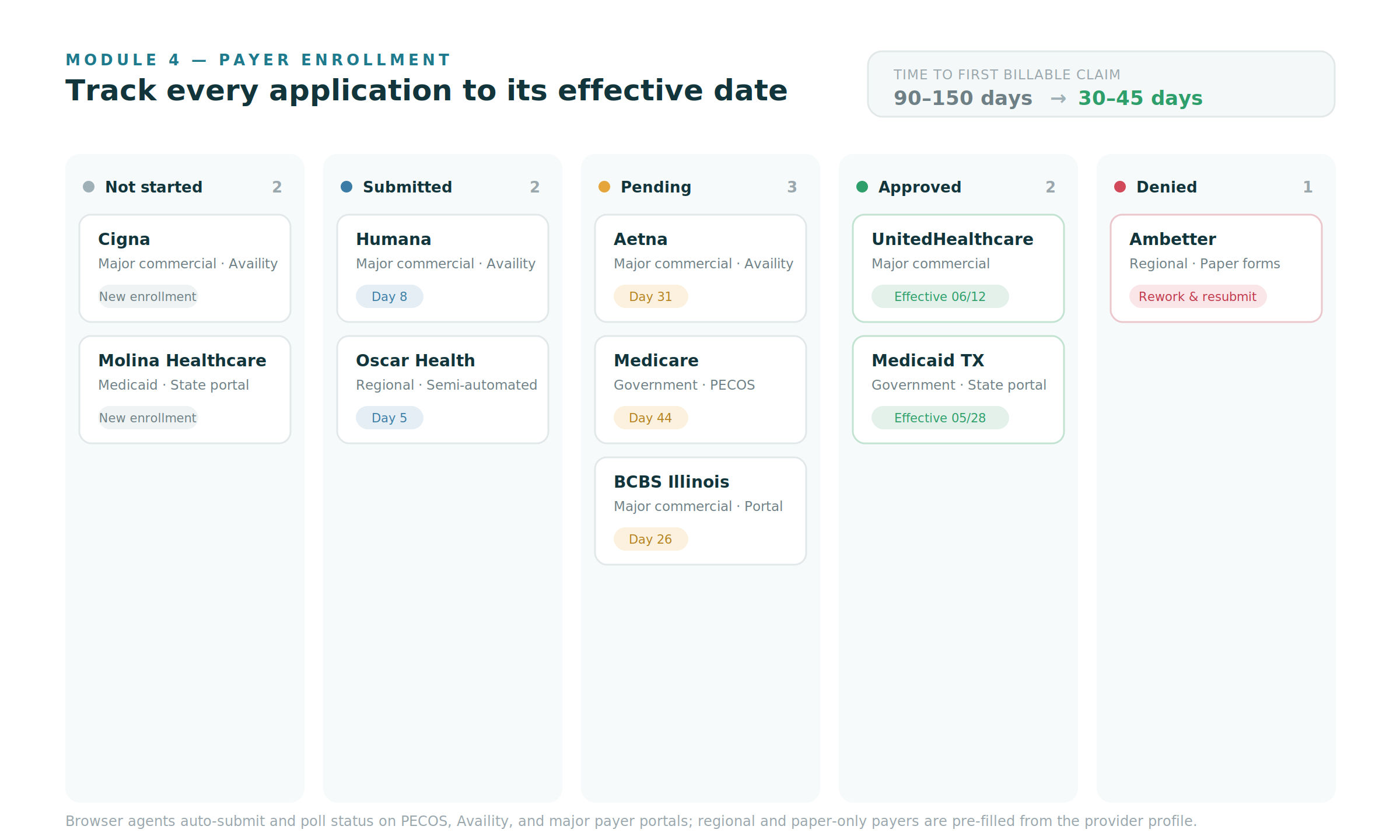
The payer enrollment tracker:
| Column | Content |
| Payer | Payer name |
| Application type | New enrollment / Re-credentialing |
| Submission date | Date submitted |
| Status | Not started / Submitted / Pending / Approved / Denied |
| Days pending | Elapsed since submission |
| Expected completion | Based on payer’s typical timeline |
| Effective date | Date provider can start billing |
Automation by payer tier:
| Tier | Portal | Automation |
| Medicare/Medicaid | PECOS / Medicaid portals | Browser agent automation |
| Major commercial (UHC, Aetna, BCBS) | Availity / payer portals | Browser agent + status checking |
| Regional commercial | Variable | Semi-automated – forms pre-filled |
| Smallest payers | Paper only | Paper forms pre-filled from profile |
Monthly and quarterly automated checks:
| Check | Frequency | Alert Trigger |
| State licence status | Monthly | Any status change (probation, suspension) |
| NPDB query | Every 2 years | Any new action reported |
| OIG exclusion | Monthly | Exclusion added |
| SAM.gov exclusion | Monthly | Exclusion added |
| DEA status | Quarterly | Any status change |
| Module | Cost Range (USD) | Notes |
| Provider profile + document vault | $6K – $12K | |
| PSV automation (7+ primary source APIs) | $10K – $20K | Per source $1K–$3K |
| CAQH ProView API integration | $5K – $10K | |
| Payer enrollment tracker + workflow | $8K – $15K | |
| Browser agents for payer portal submission | $2K – $4K each | |
| Hospital privileging workflow | $6K – $12K | |
| Ongoing monitoring engine | $5K – $10K | |
| Re-credentialing cycle management | $4K – $8K | |
| AWS + HIPAA + VAPT | $5K – $10K | |
| Total | $51K – $101K | Full credentialing platform |
Contact: mayank@engineerbabu.com
Manual provider credentialing slows onboarding, delays insurance billing, and increases administrative overhead.
By automating document collection, primary source verification (PSV), CAQH integration, payer enrollment, and compliance monitoring, healthcare organizations can reduce credentialing timelines, improve accuracy, and help providers start seeing patients sooner.
If you are searching for the best partner, you are at the right place.
EngineerBabu builds secure, HIPAA-compliant healthcare software with features like CAQH integration, PSV automation, payer enrollment workflows, document management, and EHR integrations.
So, planning to build a healthcare credentialing platform?
Contact Mayank Pratap Singh at mayank@engineerbabu.com to discuss your requirements and get a custom development estimate.
CAQH ProView is a universal credentialing database used by the majority of US commercial payers to collect and verify provider information. A provider who completes their CAQH profile makes that information available to over 1,000 health plans through the CAQH API. Rather than completing separate enrollment applications for each payer, the provider maintains one profile that feeds multiple payers simultaneously. A credentialing platform integrating with CAQH API can pre-populate provider records, push updates automatically, and automate the 120-day re-attestation requirement.
Primary source verification (PSV) is confirming credentials directly with the issuing source not from the provider’s self-reported documents. NCQA requires PSV for medical licensure, board certification, DEA registration, NPDB queries, and OIG exclusion. PSV catches discrepancies, a licence on probation, board certification that lapsed. PSV automation via API integrations with primary sources reduces manual query time from hours to minutes per provider.
Traditional provider credentialing typically takes between 90 and 150 days, depending on payer response times, document completeness, and verification requirements. A credentialing platform accelerates the process by automating document collection, primary source verification, CAQH synchronization, and payer enrollment tracking, helping many organizations reduce onboarding time to 30–45 days.
Credentialing platforms are valuable for hospitals, physician groups, multispecialty practices, ambulatory surgery centers (ASCs), community health centers, telehealth providers, dental service organizations (DSOs), management services organizations (MSOs), accountable care organizations (ACOs), and healthcare staffing agencies. Any organization responsible for onboarding and maintaining provider credentials can improve efficiency through automation.
Credentialing doesn’t end after initial enrollment. The platform continuously monitors license expirations, DEA registrations, board certifications, malpractice insurance, NPDB reports, and federal exclusion lists such as OIG and SAM.gov. Automated reminders, recurring verification workflows, and compliance dashboards help organizations stay audit-ready while reducing the risk of credential lapses that could interrupt patient care or reimbursement.