How to Build a Care Coordination Platform - Care Plans, Referral Management, Transitional Care 2026


Create engaging, high-performance mobile applications tailored to your business needs. We craft future-ready apps that offer smooth user experiences on all devices.
Build robust and scalable websites and CMS platforms that help you manage content effortlessly. Our development ensures a seamless digital presence.
Launch secure, feature-rich online stores with intuitive shopping experiences. We build tailored eCommerce platforms designed for growth.
Design captivating games with immersive gameplay and stunning graphics. From concept to launch, we build engaging experiences that players love.
Enhance your customer relationships with customized Salesforce implementations. Drive growth and efficiency with smarter CRM solutions.
Harness artificial intelligence and machine learning to automate workflows and gain actionable insights. Our AI transforms data into smart decisions.
Accelerate your software delivery lifecycle with continuous integration, delivery, and infrastructure automation to boost efficiency.
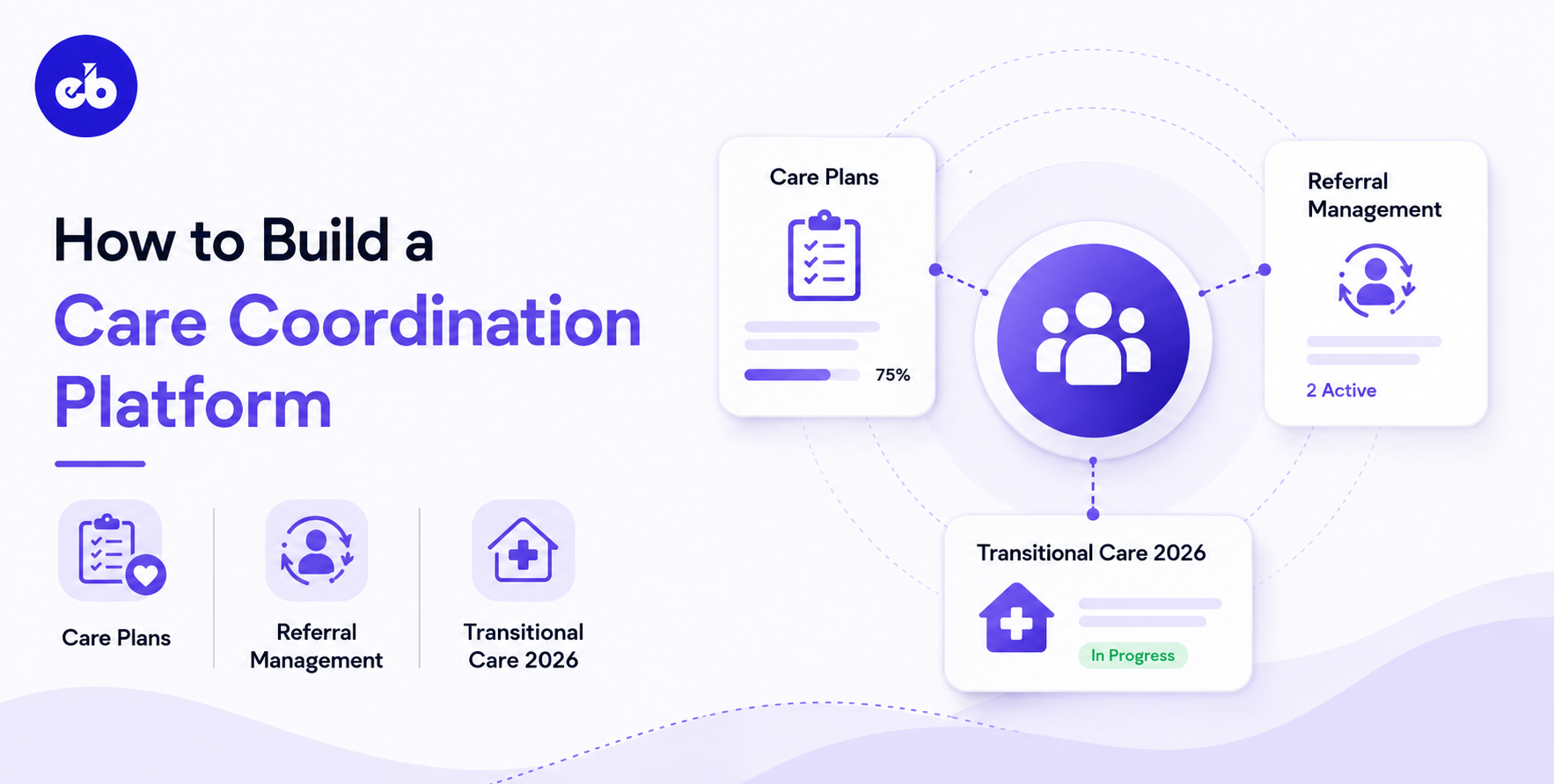
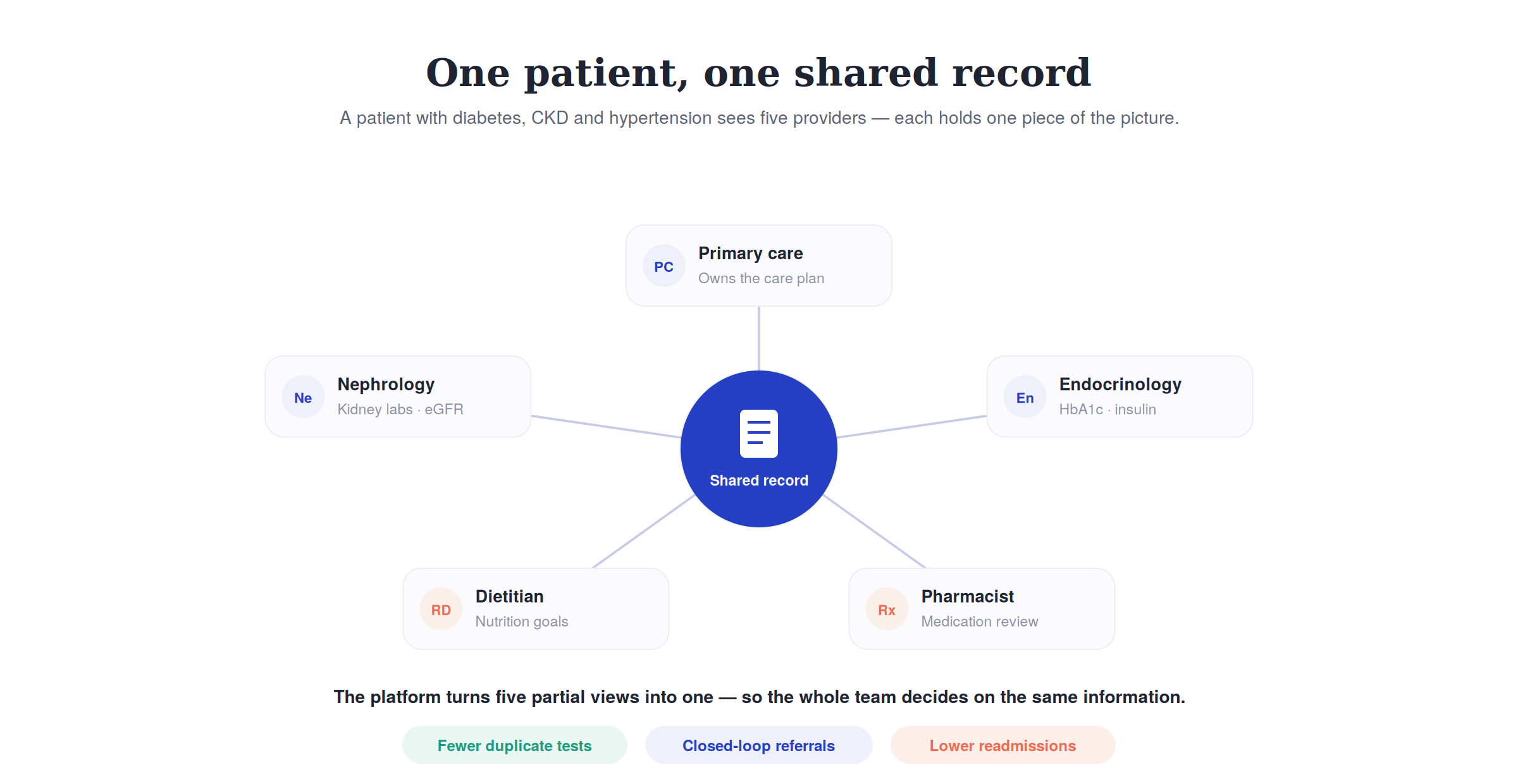
A patient with diabetes, hypertension, and chronic kidney disease sees a PCP, nephrologist, endocrinologist, dietitian, and pharmacist. Each provider has a piece of the picture. None has the full picture.
Care Coordination Software Development is the technology layer that gives every provider visibility into what every other provider is doing. Let’s learn more about it.
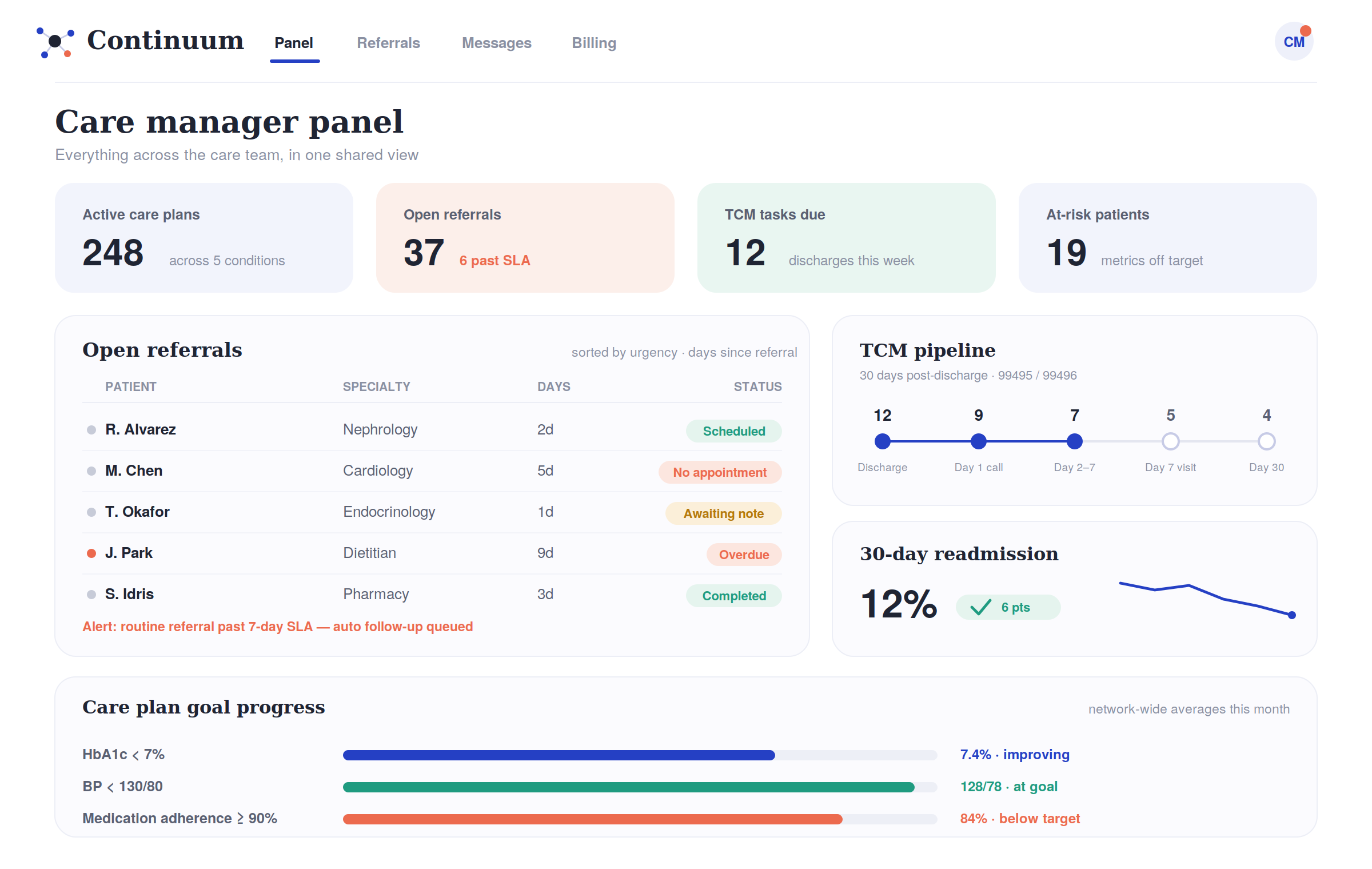
Healthcare is becoming increasingly collaborative. Patients with chronic conditions often receive treatment from multiple physicians, specialists, care managers, pharmacists, and allied health professionals.
Without a centralized coordination system, important information can be delayed, duplicated, or lost, resulting in medication errors, missed follow-ups, unnecessary hospital readmissions, and poor patient outcomes.
A care coordination platform connects every member of the patient’s care team through a shared digital workspace. Care plans, referrals, medication updates, clinical diagonosis, and patient progress are synchronized in real time, enabling providers to make informed decisions based on the latest clinical information.
| Benefit | Impact |
| Unified patient record | Every provider works from the same up-to-date care information. |
| Better patient outcomes | Coordinated interventions improve chronic disease management and reduce complications. |
| Lower readmission rates | Timely follow-ups and transitional care reduce avoidable hospitalizations. |
| Faster communication | Secure messaging replaces phone calls, emails, and fax-based coordination. |
| Improved referral completion | Closed-loop referrals ensure patients complete specialist visits and providers receive consultation notes. |
| Increased reimbursement | Automated workflows support CMS programs such as Transitional Care Management (TCM). |
| Enhanced patient engagement | Patients stay informed through access to care plans, appointments, education, and secure messaging. |
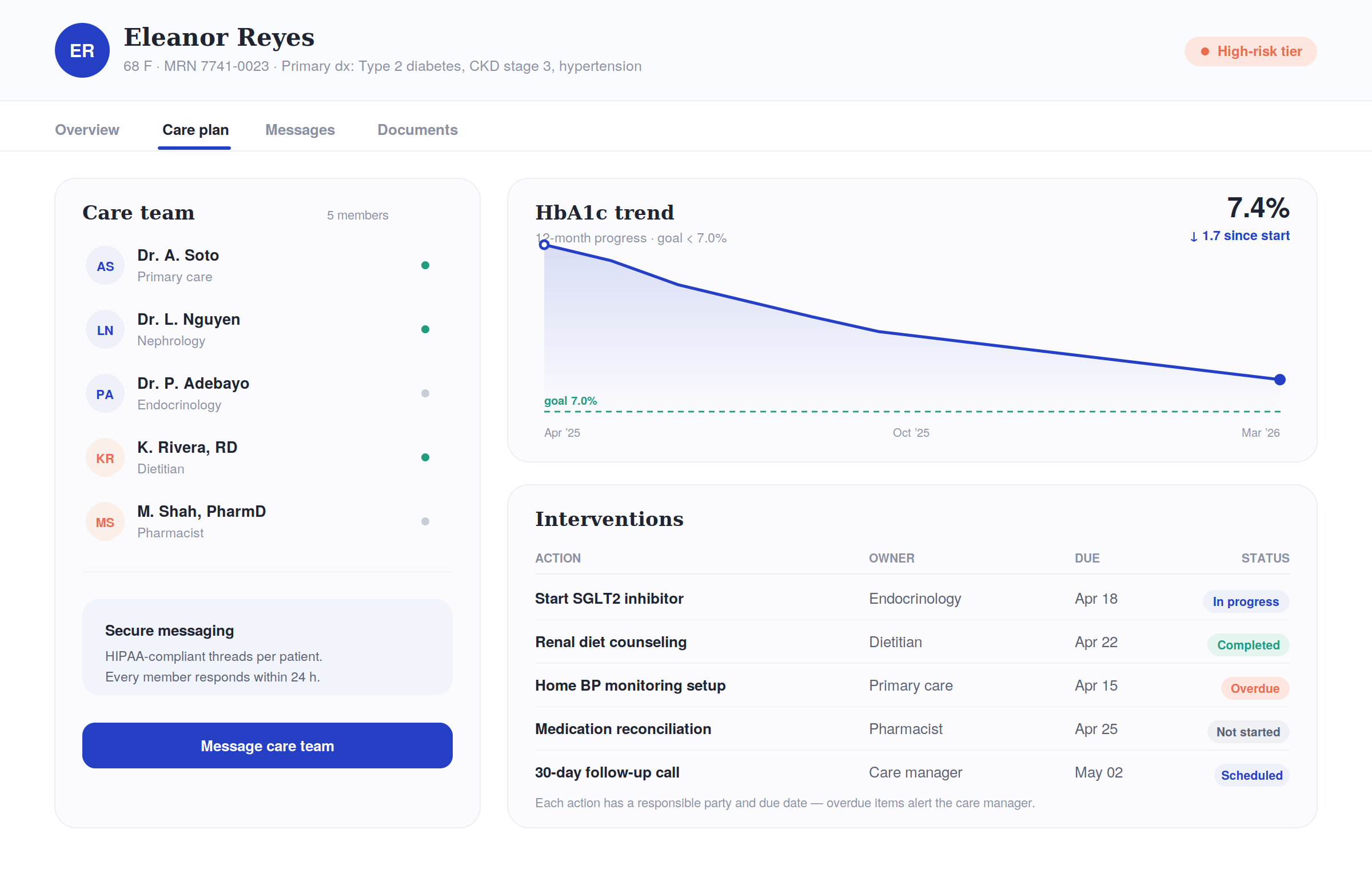
Care plan structure:
| Element | Content |
| Patient profile | Demographics, primary diagnosis, risk tier |
| Care team | All providers with role and contact |
| Health goals | Measurable outcomes (HbA1c < 7%, BP < 130/80) |
| Interventions | Specific actions with responsible party and due date |
| Status | Not started / In progress / Completed / Overdue |
Progress tracking:
Each care plan goal has a progress view showing the patient’s metric trend over time, HbA1c plotted over 12 months, blood pressure by week. When trending wrong, an alert goes to the care manager.
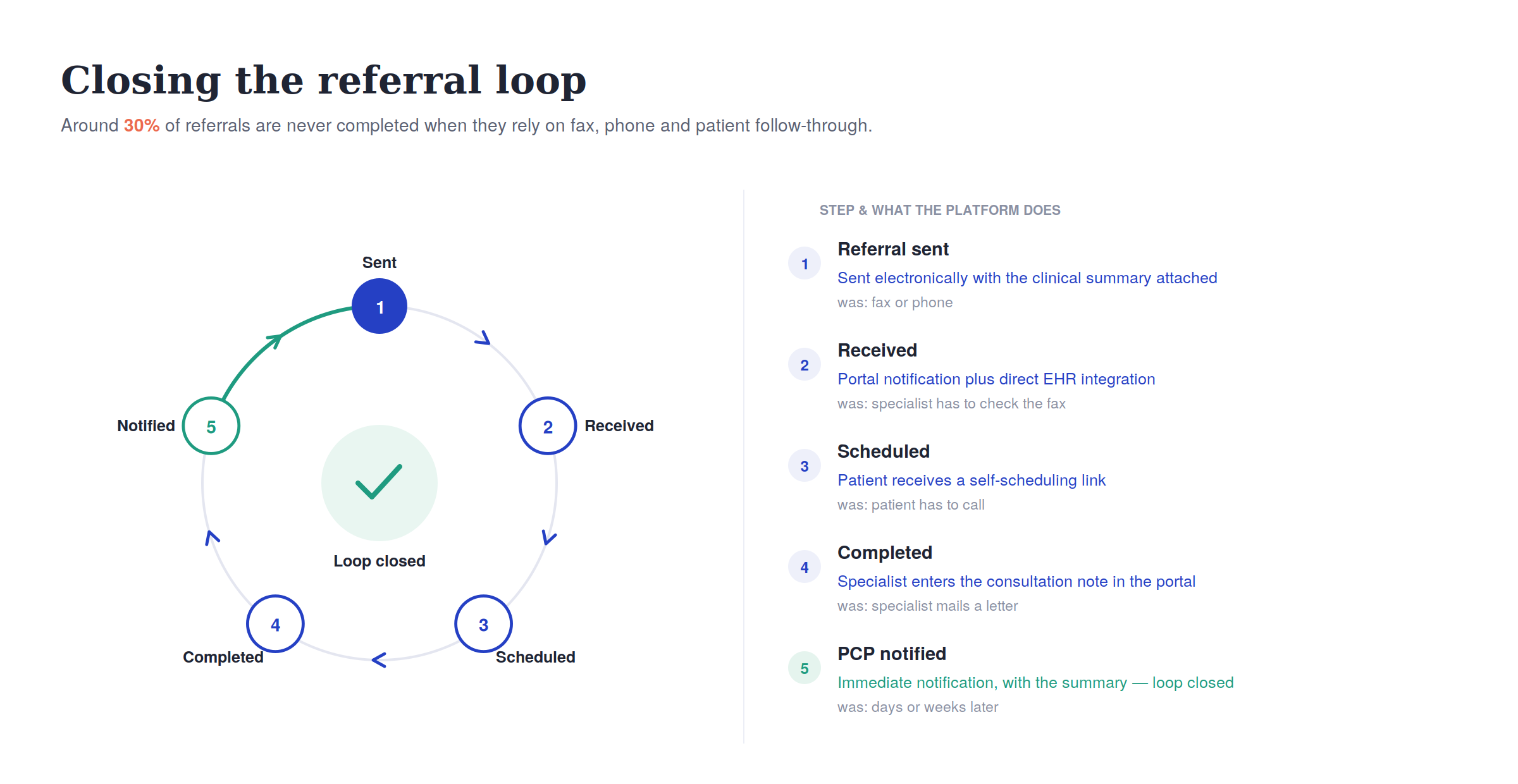
The closed-loop referral workflow:
| Step | Traditional | Platform |
| Referral sent | Fax or phone | Electronic with clinical summary attached |
| Received | Specialist checks fax | Portal notification + EHR integration |
| Scheduled | Patient calls | Patient receives scheduling link |
| Completed | Specialist sends letter | Specialist enters consultation note |
| PCP notified | Days/weeks later | Immediate notification with summary |
The referral tracking dashboard:
All open referrals sorted by urgency and days since referral. Alert if no appointment scheduled after 7 days (routine) or 48 hours (urgent).
Care team messaging features:
CMS reimbursement for TCM:
| Code | Description | 2026 Rate |
| 99496 | High complexity, office visit within 7 days | ~$268 |
| 99495 | Moderate complexity, office visit within 14 days | ~$194 |
TCM workflow:
| Day | Action |
| Discharge day | ADT notification → TCM task created → care manager assigned |
| Day 1 | Non-physician contact: care manager calls patient, reviews medications |
| Day 2–7 | Physician review of discharge summary, medication reconciliation |
| Day 7 | Office visit scheduled and attended (required for 99496 billing) |
| Day 30 | 30-day follow-up, readmission risk re-evaluation |
Medication reconciliation:
Pre-admission medication list vs discharge medication list, side-by-side comparison highlighting changes, additions, discontinuations. Drug-drug interaction flags. Routes interactions to prescriber before patient leaves hospital.
| Feature | Details |
| Care plan access | Patient sees their goals, interventions, progress |
| Appointment management | Schedule, reschedule, view all upcoming care team appointments |
| Secure messaging | Message any care team member – 24-hour response SLA |
| Health data entry | Patient-entered symptoms, vitals, medication adherence |
| Educational content | Condition-specific education tied to care plan goals |
| Module | Cost Range (USD) | Notes |
| Care plan builder + template library | $8K – $15K | Evidence-based templates |
| Care plan progress tracking + alerts | $5K – $10K | |
| Referral management + closed-loop | $8K – $15K | Specialist portal included |
| HIPAA care team messaging | $6K – $12K | Episode threading |
| TCM workflow + ADT integration | $8K – $15K | HL7 v2 ADT |
| Medication reconciliation | $6K – $12K | Drug interaction database |
| Patient engagement portal | $8K – $15K | |
| EHR integration (FHIR R4) | $8K – $15K | Bidirectional |
| TCM billing automation | $4K – $8K | 99495/99496 |
| AWS HIPAA + SOC 2 + VAPT | $6K – $12K | |
| Total | $67K – $129K | Full care coordination platform |
Contact: mayank@engineerbabu.com
A closed-loop referral is one where the referring provider receives confirmation that the specialist appointment was completed and a copy of the consultation findings. Studies show 30% of primary care referrals are never completed. Most practices fail because they rely on fax, phone, and patient self-reporting, all unreliable. A platform closes the loop electronically: the specialist portal records appointment scheduling and completion, the consultation note flows back to the PCP’s dashboard automatically, and unresolved referrals trigger automated follow-up.
TCM (Transitional Care Management) services are CMS-reimbursed services for managing patients in the 30 days following hospital, skilled nursing facility, or inpatient rehabilitation discharge. The platform automates: the trigger (ADT notification of discharge), workflow assignment to the care manager, contact documentation, and billing claim generation, turning a manual coordination process into an automated revenue stream.
The platform integrates with leading Electronic Health Record (EHR) systems using standards such as HL7 FHIR R4 and HL7 v2. This enables bi-directional exchange of patient demographics, medications, allergies, laboratory results, referrals, clinical notes, and care plans without requiring providers to enter the same information multiple times.
Patients managing conditions like diabetes, hypertension, heart failure, COPD, or chronic kidney disease often receive care from multiple specialists. The platform ensures every provider has access to the same care plan, monitors progress toward clinical goals, sends alerts when patient metrics worsen, and helps coordinate timely interventions. This leads to better medication adherence, fewer missed appointments, and reduced preventable hospitalizations.
Yes. All patient and provider communications are protected using HIPAA-compliant encryption, role-based access controls, audit logs, and secure authentication. Messages remain within the platform rather than being sent through unsecured email or text messaging, ensuring Protected Health Information (PHI) is handled according to regulatory requirements.