How to Build a Value-Based Care Analytics Platform - Risk Stratification, HEDIS, MIPS/MACRA 2026


Create engaging, high-performance mobile applications tailored to your business needs. We craft future-ready apps that offer smooth user experiences on all devices.
Build robust and scalable websites and CMS platforms that help you manage content effortlessly. Our development ensures a seamless digital presence.
Launch secure, feature-rich online stores with intuitive shopping experiences. We build tailored eCommerce platforms designed for growth.
Design captivating games with immersive gameplay and stunning graphics. From concept to launch, we build engaging experiences that players love.
Enhance your customer relationships with customized Salesforce implementations. Drive growth and efficiency with smarter CRM solutions.
Harness artificial intelligence and machine learning to automate workflows and gain actionable insights. Our AI transforms data into smart decisions.
Accelerate your software delivery lifecycle with continuous integration, delivery, and infrastructure automation to boost efficiency.
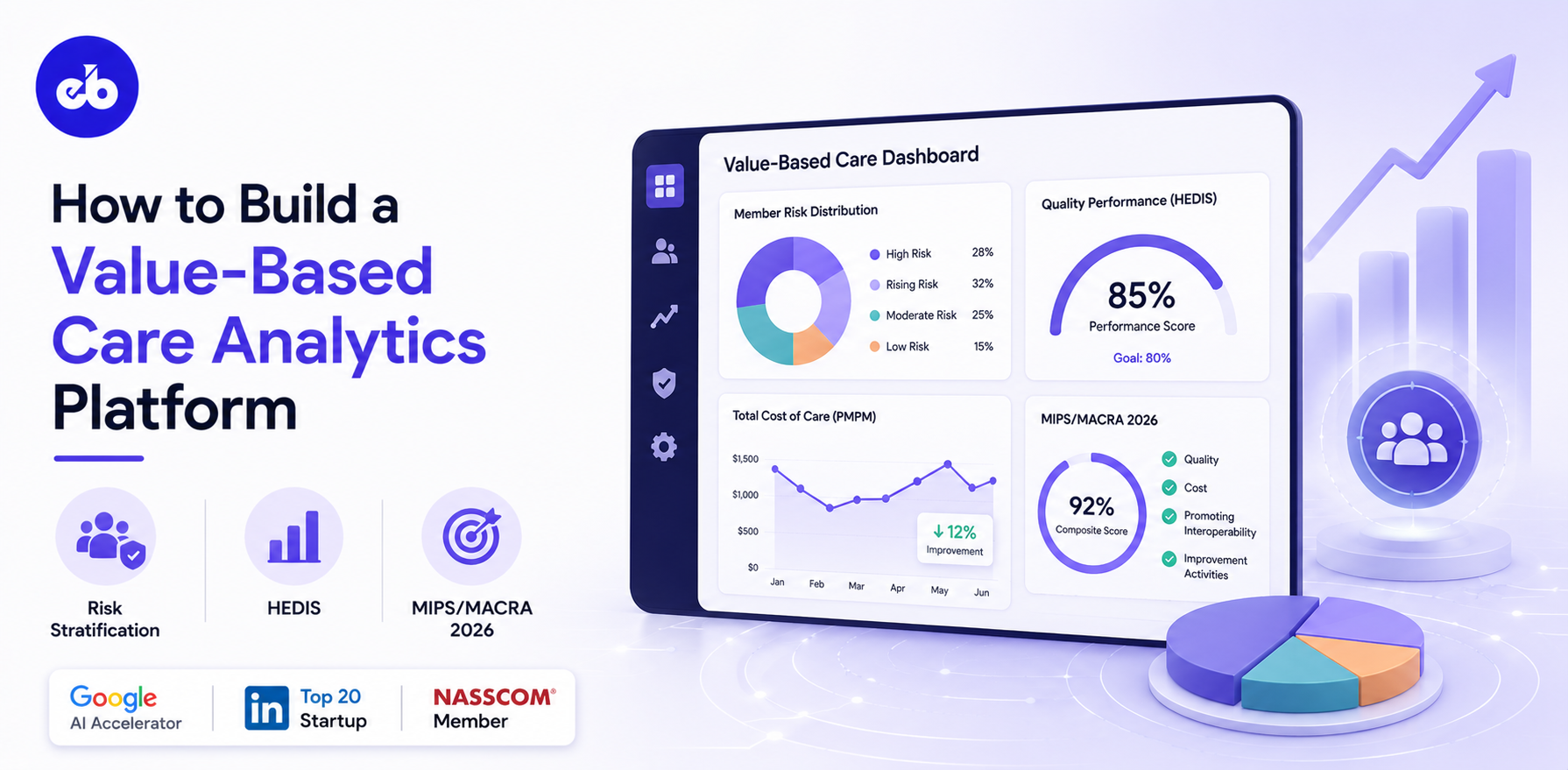
Over 60% of US healthcare payments are now tied to quality or value metrics. For providers. physician groups, ACOs, hospital systems, this shift changes the technology requirement fundamentally. In a fee-for-service world, you need billing software.
In value-based care, you need analytics that identifies which patients are at highest risk, which quality measures you are failing, and how you are performing against your VBC contract targets.
Healthcare reimbursement is rapidly moving from volume-based payments to value-based care (VBC), where providers are rewarded for improving patient outcomes while controlling costs.
Success under VBC contracts depends on identifying high-risk patients early, closing care gaps, improving quality measure performance, and reducing avoidable hospitalizations.
Achieving these goals requires more than an Electronic Health Record (EHR). Organizations need a centralized analytics platform that combines clinical, claims, pharmacy, and social determinants of health (SDOH) data to deliver actionable insights for care teams and administrators.
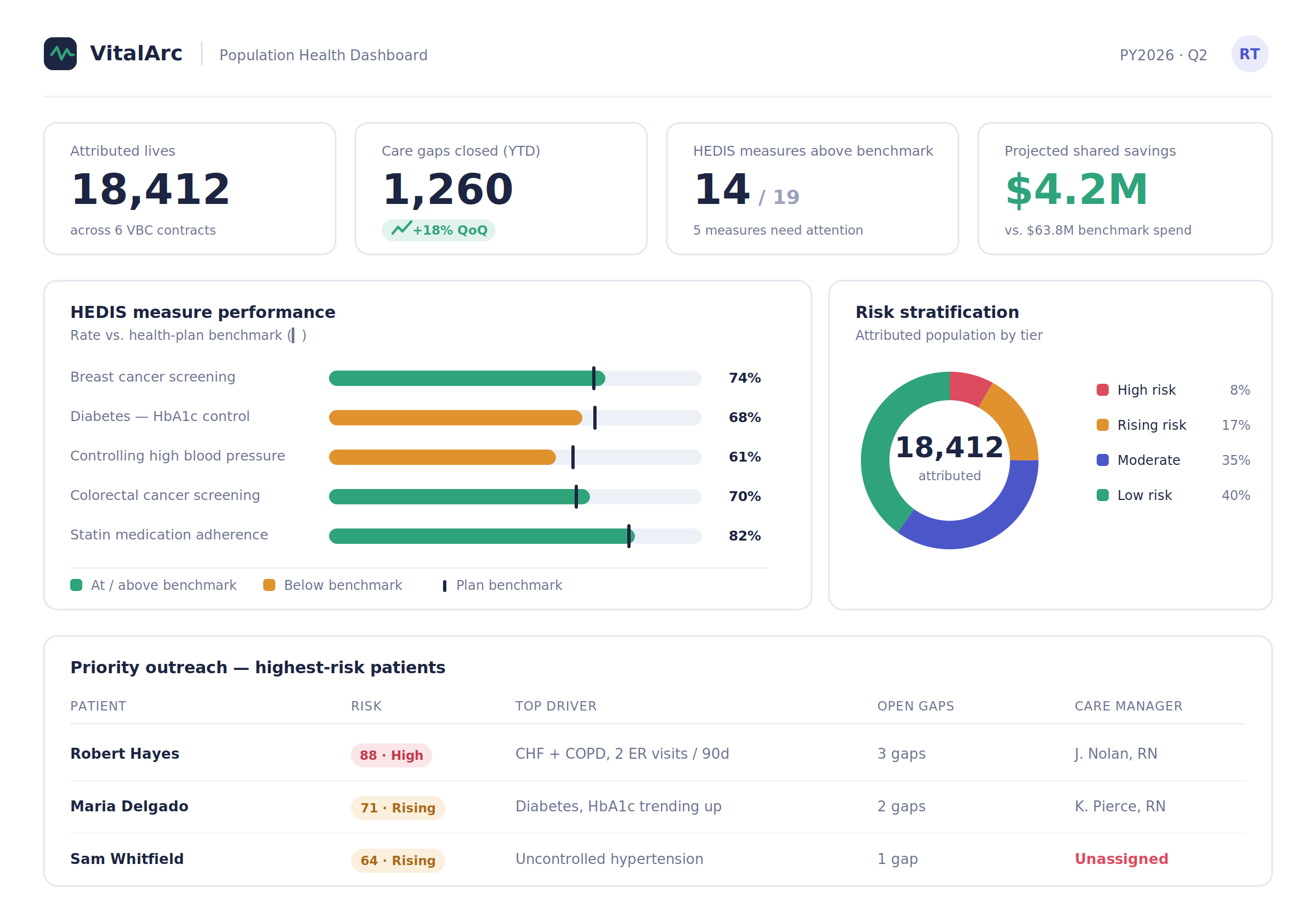
| Capability | Benefit |
| Unified healthcare data | Consolidates EHR, claims, pharmacy, lab, and SDOH data into a single view. |
| Risk stratification | Identifies high-risk patients for proactive care management. |
| Quality measure tracking | Monitors HEDIS, MIPS, and other performance metrics in real time. |
| Care gap identification | Highlights preventive and chronic care opportunities before they affect quality scores. |
| Financial performance analytics | Tracks contract performance, shared savings, and reimbursement projections. |
| Population health management | Enables care teams to prioritize interventions across patient populations. |
| Compliance-ready reporting | Simplifies reporting for CMS, NCQA, and value-based payment programs. |
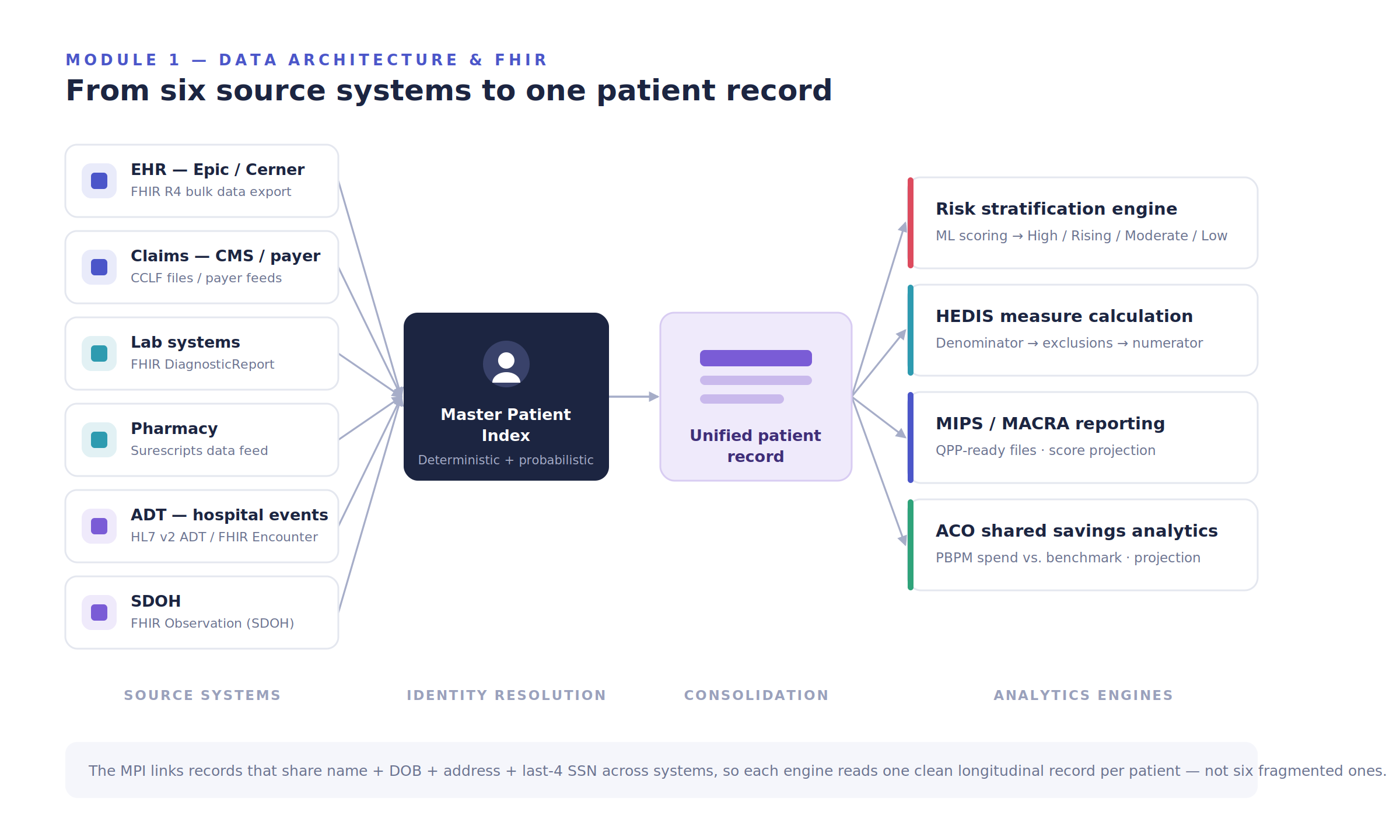
Data sources:
| Source | Data Elements | Integration Method |
| EHR (Epic/Cerner/athena) | Clinical encounters, diagnoses, procedures, vitals, labs | FHIR R4 bulk data export |
| Claims (CMS/commercial payer) | All-payer claims, cost data, utilisation patterns | CCLF files (CMS) or payer feeds |
| Lab systems | Lab results, trending, abnormal flags | FHIR DiagnosticReport |
| Pharmacy | Medication fills, adherence, NDC codes | Surescripts data feed |
| ADT | Hospital events – care coordination trigger | HL7 v2 ADT or FHIR Encounter |
| SDOH | Housing, food, transportation, social isolation | FHIR Observation (SDOH) |
Master Patient Index (MPI):
Patients appear in different systems with different identifiers. The MPI resolves these into a single platform patient record using deterministic and probabilistic matching (name + DOB + address + last 4 SSN).
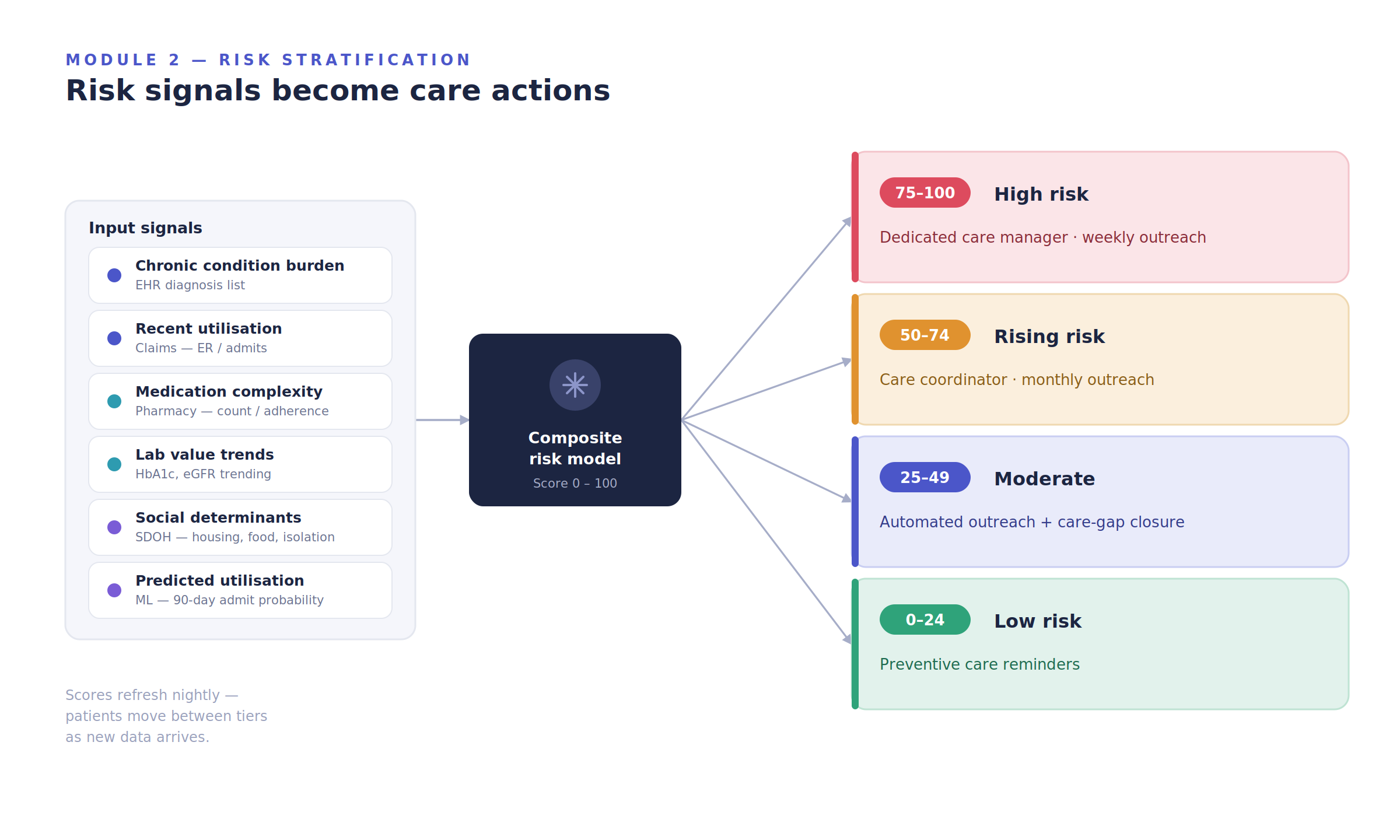
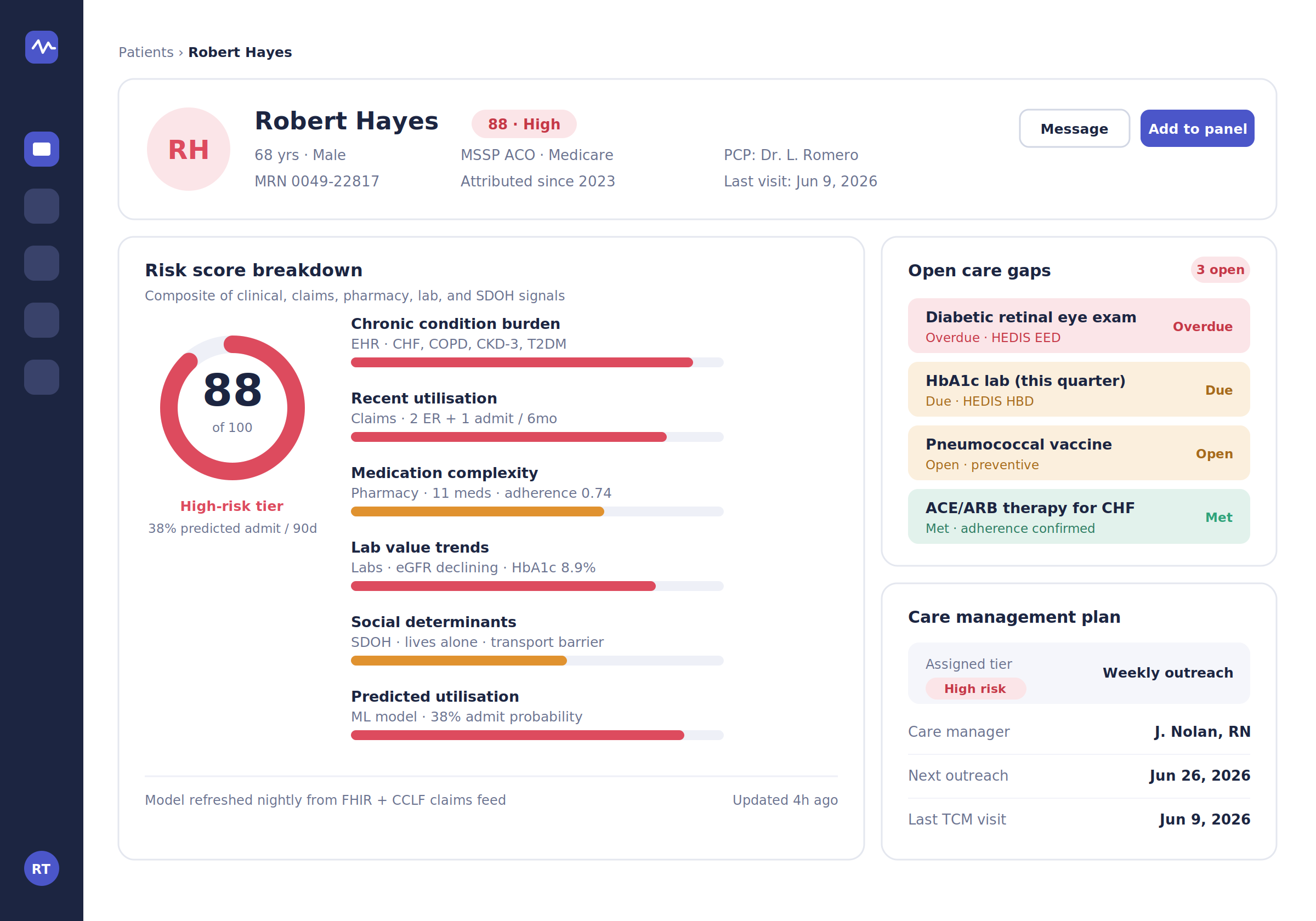
Risk score components:
| Component | Data Source | Signal |
| Chronic condition burden | EHR diagnosis list | Number and severity of conditions |
| Recent utilisation | Claims data | ER visits, hospitalisations in last 6 months |
| Medication complexity | Pharmacy data | Number of medications, adherence |
| Lab value trends | Lab data | HbA1c trend, eGFR trend |
| Social determinants | SDOH data | Housing instability, food insecurity |
| Predicted utilisation | ML model | Probability of hospitalisation in next 90 days |
Risk tier assignment:
| Score | Tier | Care Management |
| 75–100 | High risk | Dedicated care manager, weekly outreach |
| 50–74 | Rising risk | Care coordinator, monthly outreach |
| 25–49 | Moderate | Automated outreach + care gap closure |
| 0–24 | Low | Preventive care reminders |
The calculation architecture:
For each HEDIS measure, for each patient, for each measurement year:
Performance benchmark comparison:
MIPS categories:
| Category | Weight | What It Measures |
| Quality | 30% | Performance on 6+ quality measures |
| Cost | 30% | Per-beneficiary spending vs benchmark |
| Improvement activities | 15% | Care coordination and patient safety |
| Promoting interoperability | 25% | Meaningful use of certified EHR |
The MIPS reporting module:
The ACO analytics module tracks:
| Metric | Purpose |
| Per-beneficiary per-month spend | Track against spending benchmark |
| Benchmark vs actual spend | Project shared savings position |
| Utilisation decomposition | Identify high-cost drivers by service category |
| Attribution tracking | Ensure attribution is correct |
| Quality score | Performance on 5 mandatory ACO quality measures |
Financial projection view:
At any point in the performance year, the platform projects end-of-year shared savings based on year-to-date spend trends, seasonal adjustment factors, and historical regression-to-mean patterns.
| Module | Cost Range (USD) | Notes |
| FHIR bulk data ingestion pipeline | $10K – $20K | Multi-source, CMS CCLF + EHR |
| Master Patient Index (MPI) | $6K – $12K | |
| Risk stratification ML model | $10K – $18K | Training + serving |
| Care gap identification engine | $8K – $15K | HEDIS + contract-specific |
| MIPS/MACRA quality reporting | $10K – $18K | QPP submission-ready |
| ACO shared savings analytics | $8K – $15K | |
| Provider performance scorecard | $5K – $10K | |
| Population health dashboard | $6K – $12K | |
| AWS HIPAA + SOC 2 + VAPT | $6K – $12K | |
| Total | $69K – $132K | Full VBC analytics platform |
Contact: mayank@engineerbabu.com
As healthcare shifts toward value-based reimbursement, having access to accurate, real-time analytics is becoming essential for improving patient outcomes and maximizing contract performance.
A robust VBC analytics platform enables providers to identify high-risk patients, close care gaps, track quality measures, and make data-driven decisions that improve both clinical and financial results.
If you’re planning to build a Value-Based Care analytics platform with capabilities like FHIR integration, risk stratification, HEDIS and MIPS reporting, population health dashboards, or ACO shared savings analytics, EngineerBabu can help.
Our team develops secure, HIPAA-compliant healthcare software tailored to the needs of providers, health systems, and digital health companies.
Get in touch with Mayank Pratap Singh at mayank@engineerbabu.com to discuss your project and receive a customized development estimate.
The minimum viable data set requires two sources: EHR clinical data (diagnoses, procedures, labs, medications, vital signs, accessed via FHIR R4 bulk export) and claims data (all-payer claims showing the patient’s full care utilisation across all providers). Claims data is essential because patients see multiple providers, the EHR only shows what happened within the practice. For ACO analytics, CMS provides CCLF files monthly. Commercial VBC programs provide similar payer feeds. Risk stratification accuracy improves significantly when claims, clinical, pharmacy, and SDOH data are all integrated.
HEDIS (Healthcare Effectiveness Data and Information Set) is the most widely used set of quality measures in the US, maintained by NCQA. Over 227 million Americans are enrolled in health plans that report HEDIS data. Health plans use HEDIS performance to set VBC contract targets, calculate pay-for-performance bonuses, and evaluate network providers. For an ACO or large physician group with VBC contracts, HEDIS performance directly determines financial outcomes, practices above benchmark earn bonuses; practices below may face penalties.
A VBC analytics platform consolidates clinical, claims, pharmacy, and operational data to help healthcare organizations measure quality, identify high-risk patients, close care gaps, and track financial performance under value-based payment models. It provides the insights needed to improve outcomes while meeting payer contract requirements.
These platforms are ideal for Accountable Care Organizations (ACOs), Independent Physician Associations (IPAs), hospitals, physician groups, clinically integrated networks, health systems, and organizations participating in Medicare Shared Savings Program (MSSP), MIPS, or commercial value-based care contracts.
Predictive analytics uses historical and real-time patient data to identify individuals at higher risk of hospitalization, disease progression, or poor medication adherence. This allows care teams to intervene earlier, reduce avoidable costs, improve patient outcomes, and increase performance on value-based care quality measures.