Vehicle Loan Software Development


Create engaging, high-performance mobile applications tailored to your business needs. We craft future-ready apps that offer smooth user experiences on all devices.
Build robust and scalable websites and CMS platforms that help you manage content effortlessly. Our development ensures a seamless digital presence.
Launch secure, feature-rich online stores with intuitive shopping experiences. We build tailored eCommerce platforms designed for growth.
Design captivating games with immersive gameplay and stunning graphics. From concept to launch, we build engaging experiences that players love.
Enhance your customer relationships with customized Salesforce implementations. Drive growth and efficiency with smarter CRM solutions.
Harness artificial intelligence and machine learning to automate workflows and gain actionable insights. Our AI transforms data into smart decisions.
Accelerate your software delivery lifecycle with continuous integration, delivery, and infrastructure automation to boost efficiency.
An NBFC offering two-wheeler loans came to the team after a portfolio audit revealed a fraud pattern their technology hadn’t caught.
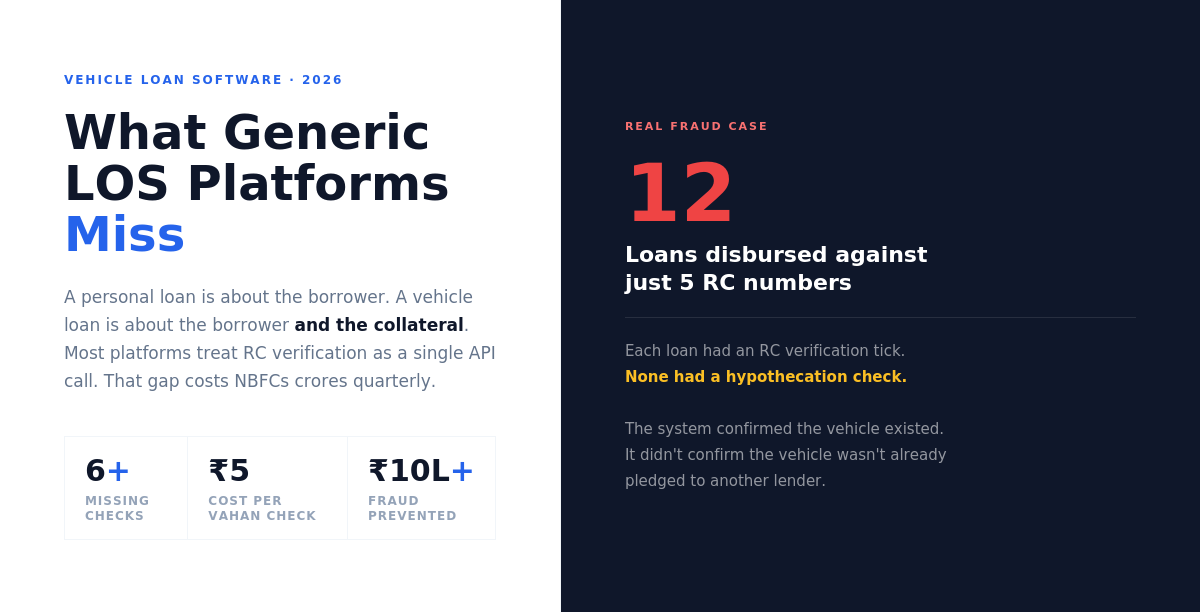
Twelve loans in a single district had been disbursed against the same five vehicle registration numbers. The RC numbers were genuine, looked up from the Vahan database but the same vehicles were used as collateral for multiple loans across multiple lenders, exploiting the fact that hypothecation removal from the VAHAN record (requiring the lender to file an NOC with the RTO after loan closure) had been missed by the original lender’s system.
Each of those twelve loans had an RC verification tick in the system. None of them had a hypothecation check. The verification confirmed the vehicle existed. It didn’t confirm the vehicle wasn’t already pledged to another lender.
Vehicle loan fraud in India costs NBFCs and banks crores quarterly. The VAHAN database has the data to prevent most of it. The problem is that most generic loan origination systems treat RC verification as a single API call that returns a pass/fail, rather than a structured collateral verification workflow that checks ownership, hypothecation status, insurance validity, fitness certificate (for commercial vehicles), and blacklist/stolen status.
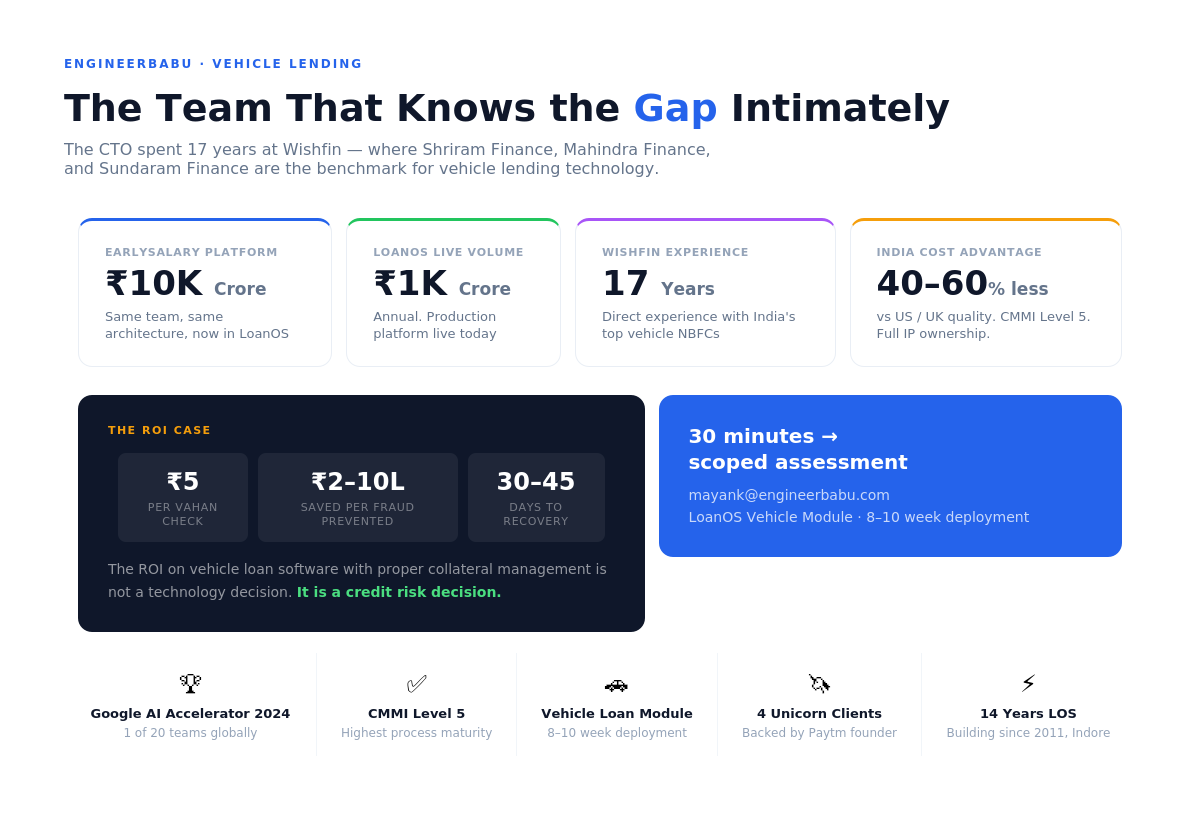
I co-founded EngineerBabu 14 years ago. The CTO spent 17 years at Wishfin, where vehicle finance NBFCs, Shriram Finance, Mahindra Finance, Sundaram Finance are among the most sophisticated users of lending technology in India. The team has built vehicle financing technology including NBFC platforms with dedicated vehicle loan modules. LoanOS covers vehicle loans as a standard product category.
This guide is about what makes vehicle loan software different and what generic LOS platforms consistently miss.
Email: mayank@engineerbabu.com to scope your vehicle loan platform.
A personal loan is essentially unsecured. The credit assessment is about the borrower.
A vehicle loan is secured. The credit assessment is about the borrower AND the collateral. The vehicle is the security. If the borrower defaults, the lender repossesses and sells the vehicle to recover the outstanding amount. The quality of the collateral assessment directly determines the lender’s recovery rate.
This changes the software requirements fundamentally:
None of these requirements appear in a standard personal loan LOS.
VAHAN is India’s National Vehicle Registration database, maintained by the Ministry of Road Transport and Highways. Every vehicle registered in India has a VAHAN record.
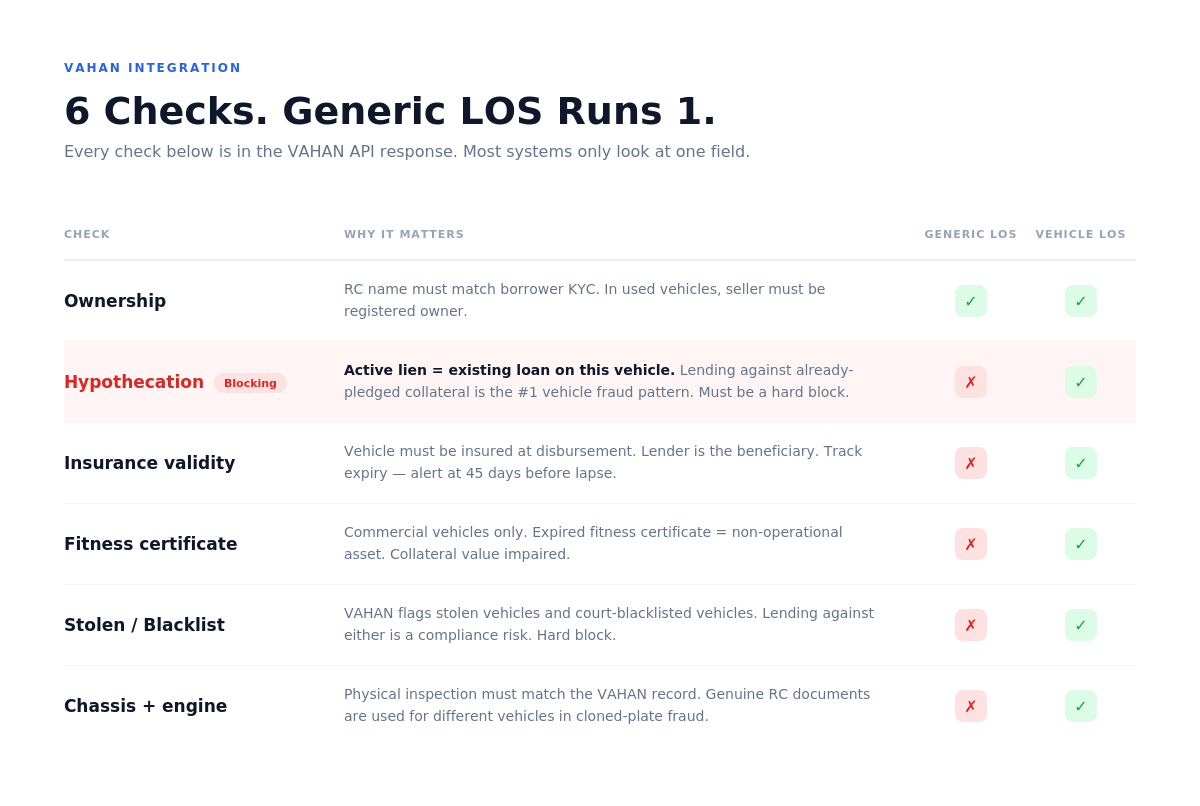
The record includes owner details, registration date, chassis and engine number, fuel type, registration authority (RTO), fitness certificate status (for commercial vehicles), insurance validity, permit status, and critically, hypothecation details.
The VAHAN API (accessed through authorised providers, HyperVerge, AuthBridge, IDSPay, Masters India, Eko) returns structured JSON with sub-3-second response time at scale.
After disbursement, the lender must create a hypothecation charge on the vehicle’s RC to record the lender’s security interest.
This involves two steps:
CERSAI registration, the lender registers the hypothecation on the Central Registry of Securitisation Asset Reconstruction and Security Interest of India (CERSAI). This creates a public record of the lender’s security interest, preventing subsequent lenders from taking the vehicle as collateral without discovering the existing charge.
RTO hypothecation entry, the borrower (or the lender’s field agent) submits a Form 34 to the RTO with the lender’s NOC, causing the hypothecation to appear on the RC itself. This is the record that appears when any other lender or buyer checks the vehicle’s VAHAN record.
The vehicle loan system must:
Failure to register the hypothecation is the gap that enabled the fraud pattern described in the opening: without a CERSAI or VAHAN hypothecation record, the vehicle can be pledged to multiple lenders simultaneously.
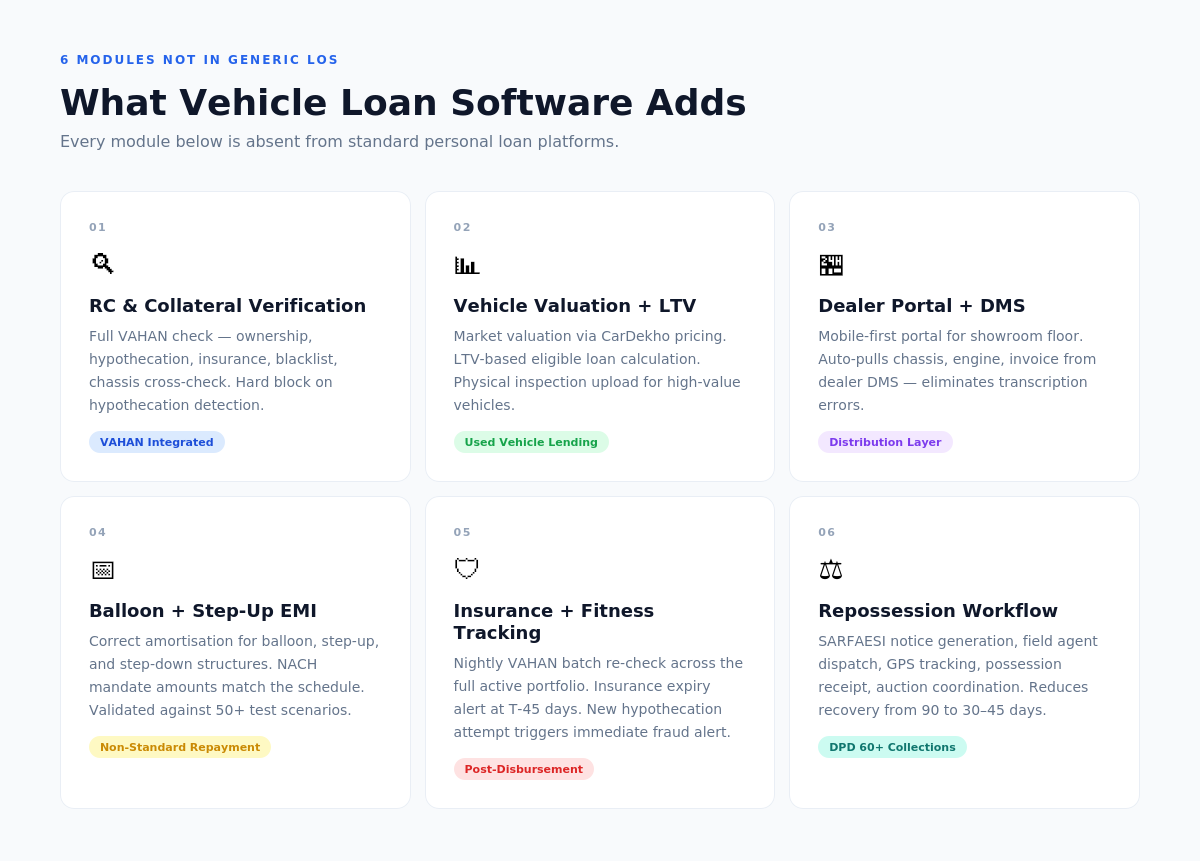
Vahan API integration with ownership check, hypothecation status, insurance validity, fitness certificate (commercial), blacklist/stolen check, and chassis/engine number verification. Automated blocking on hypothecation detection. Manual review queue for partial matches. Audit log for every Vahan API call.
For used vehicle lending, the loan amount must not exceed the LTV limit applied to the vehicle’s current market value. Valuation sources: Kelley Blue Book equivalent for India (CarDekho, Car&Bike pricing), lender’s internal valuation rules by vehicle age and category, physical inspection report upload for high-value vehicles.
LTV enforcement: The system calculates the eligible loan amount based on: (vehicle valuation × LTV ratio), any existing hypothecation amount. Loan amounts above the LTV limit require credit committee approval.
Dealers submit loan applications for customers at the showroom. The dealer portal must be mobile-accessible (the showroom floor is not a desktop environment), fast for high-volume dealers during weekend sales events, and connected to the loan processing queue in real time.
Dealer DMS integration: Major dealerships use Dealer Management Systems (DMS), CDK Global, Tata Motors DMS, Maruti Suzuki’s dealer portal. The vehicle loan system must pull vehicle details (chassis number, engine number, invoice value, registration details) directly from the DMS to eliminate manual re-entry and transcription errors at the point of application.
Vehicle loans, particularly commercial vehicle and used vehicle loans often use non-standard repayment structures:
The vehicle loan software must calculate, display, and manage all three repayment structures correctly, the amortisation schedule, the NACH mandate amount schedule, and the NPA/DPD tracking must all account for the non-standard repayment pattern.
Post-disbursement, the vehicle loan system maintains a monitoring schedule for every active loan:
This batch monitoring process run nightly across the entire portfolio is the ongoing collateral management function. It is not in any generic LOS. It is the function that catches fraud signals early (new hypothecation attempt on an active loan’s collateral) and compliance risks (insurance lapse).
When a vehicle loan reaches DPD 60 (60 days past due), the repossession process begins. The workflow:
The recovery rate on vehicle loan defaults depends heavily on how quickly and correctly the repossession and auction process is executed. The system that automates and tracks this process reduces recovery timeline from 90 days to 30–45 days.
Vehicle loan software development starts from $20,000 for MVP development (single vehicle category, new vehicle, standard EMI, Vahan + bureau + basic collateral management).
Full platform (multi-vehicle category, used + new, balloon/step-up EMI, dealer DMS integration, insurance tracking, Vahan nightly monitoring, repossession workflow): $50,000–$110,000 (₹42–92 lakh) built in India.
Timeline: MVP in 12–16 weeks. Full multi-category platform in 5–8 months. Critical: CERSAI integration certification and NPCI NACH application must start week 1.
LoanOS vehicle loan module: standard vehicle loan product deployable in 8–10 weeks, with Vahan integration, NACH, and basic collateral management already built.
LoanOS vehicle loan module live. CTO 17yr Wishfin knows Shriram Finance, Mahindra Finance, and Sundaram Finance’s technology requirements from direct market experience. Google AI Accelerator 2024 production ML for vehicle value prediction, collections propensity, and insurance lapse detection. CMMI Level 5. Full IP ownership. 40–60% lower cost than US/UK equivalents.
The NBFC with twelve fraudulent loans discovered its collateral verification gap in a portfolio audit. The cost of the fraud was fixed. The reputational cost with the investors who funded the portfolio was harder to quantify.
A Vahan hypothecation check costs under ₹5 per loan. Preventing a single fraudulent vehicle loan saves ₹2–10 lakh in recovery costs. The ROI on a vehicle loan system with proper collateral management is not a technology decision, it is a credit risk decision.
30 minutes. Honest assessment of your vehicle loan product requirements and what the technology needs to cover.
Mayank Pratap | Co-founder, EngineerBabu | engineerbabu.com LoanOS Vehicle Loan Module · CTO 17yr Wishfin · Google AI Accelerator 2024 · CMMI Level 5 · ₹10,000Cr Lending Platform · 4 Unicorn Clients · Backed by Vijay Shekhar Sharma
Technology platform for auto/vehicle lending covering the complete lifecycle: borrower and collateral verification (Vahan API, hypothecation check), credit assessment and LTV calculation, eSign, disbursement, CERSAI hypothecation registration, NACH-based EMI collection, post-disbursement insurance and RC monitoring, and repossession/recovery workflow for defaults.
VAHAN is India’s national vehicle registration database. The Vahan API returns ownership details, hypothecation status (existing liens), insurance validity, fitness certificate status, and blacklist/stolen flag. In vehicle lending, hypothecation status is a blocking check, lending against already-hypothecated collateral is the most common vehicle loan fraud pattern.
After vehicle loan disbursement, the lender registers the security interest on CERSAI (Central Registry of Securitisation Asset Reconstruction and Security Interest) and creates the RTO hypothecation entry via Form 34. This creates a public record of the lender’s lien, preventing the borrower from pledging the same vehicle to another lender.
Balloon payment: standard EMIs for the loan tenure with a large final payment representing residual value (common in commercial vehicle leasing). Step-up EMI: lower early EMIs increasing over time (common for young borrowers expecting income growth). Step-down EMI: higher early EMIs decreasing over time (common in used vehicle lending). The LMS must calculate the correct amortisation schedule and NACH mandate amounts for each structure.
Nightly batch process re-checks the Vahan record for every active loan in the portfolio, hypothecation status (any new hypothecation attempt), insurance validity (lapse detection), and fitness certificate status (commercial vehicles). System alerts on anomalies within 24 hours of detection.
MVP (single vehicle category, new vehicle, standard EMI): 12–16 weeks. Full multi-category platform with used vehicle, balloon/step-up EMI, dealer DMS integration, and repossession workflow: 5–8 months. LoanOS vehicle loan module: 8–10 weeks for standard deployment.