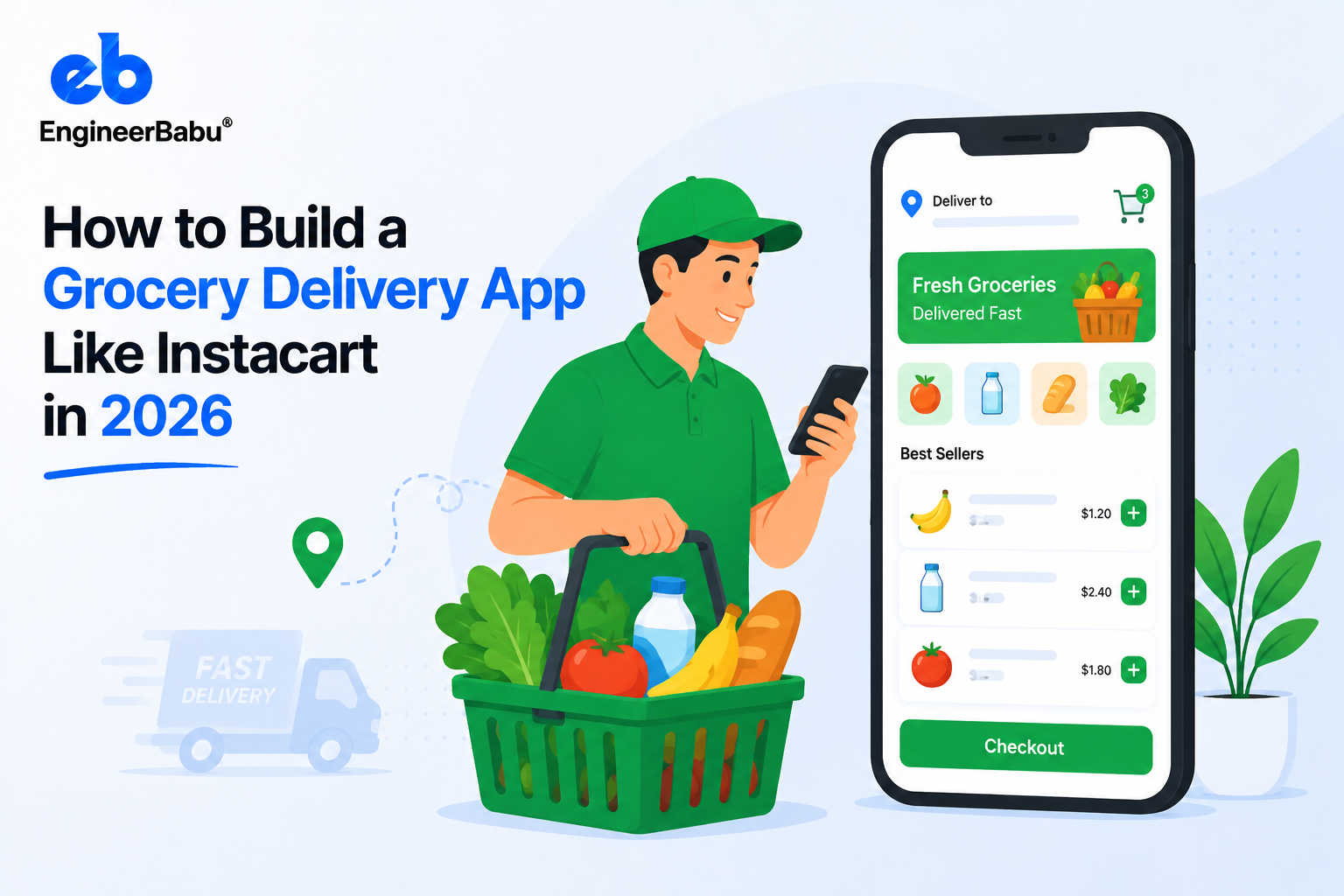
How to Build a Grocery Delivery App Like Instacart in 2026


Create engaging, high-performance mobile applications tailored to your business needs. We craft future-ready apps that offer smooth user experiences on all devices.
Build robust and scalable websites and CMS platforms that help you manage content effortlessly. Our development ensures a seamless digital presence.
Launch secure, feature-rich online stores with intuitive shopping experiences. We build tailored eCommerce platforms designed for growth.
Design captivating games with immersive gameplay and stunning graphics. From concept to launch, we build engaging experiences that players love.
Enhance your customer relationships with customized Salesforce implementations. Drive growth and efficiency with smarter CRM solutions.
Harness artificial intelligence and machine learning to automate workflows and gain actionable insights. Our AI transforms data into smart decisions.
Accelerate your software delivery lifecycle with continuous integration, delivery, and infrastructure automation to boost efficiency.
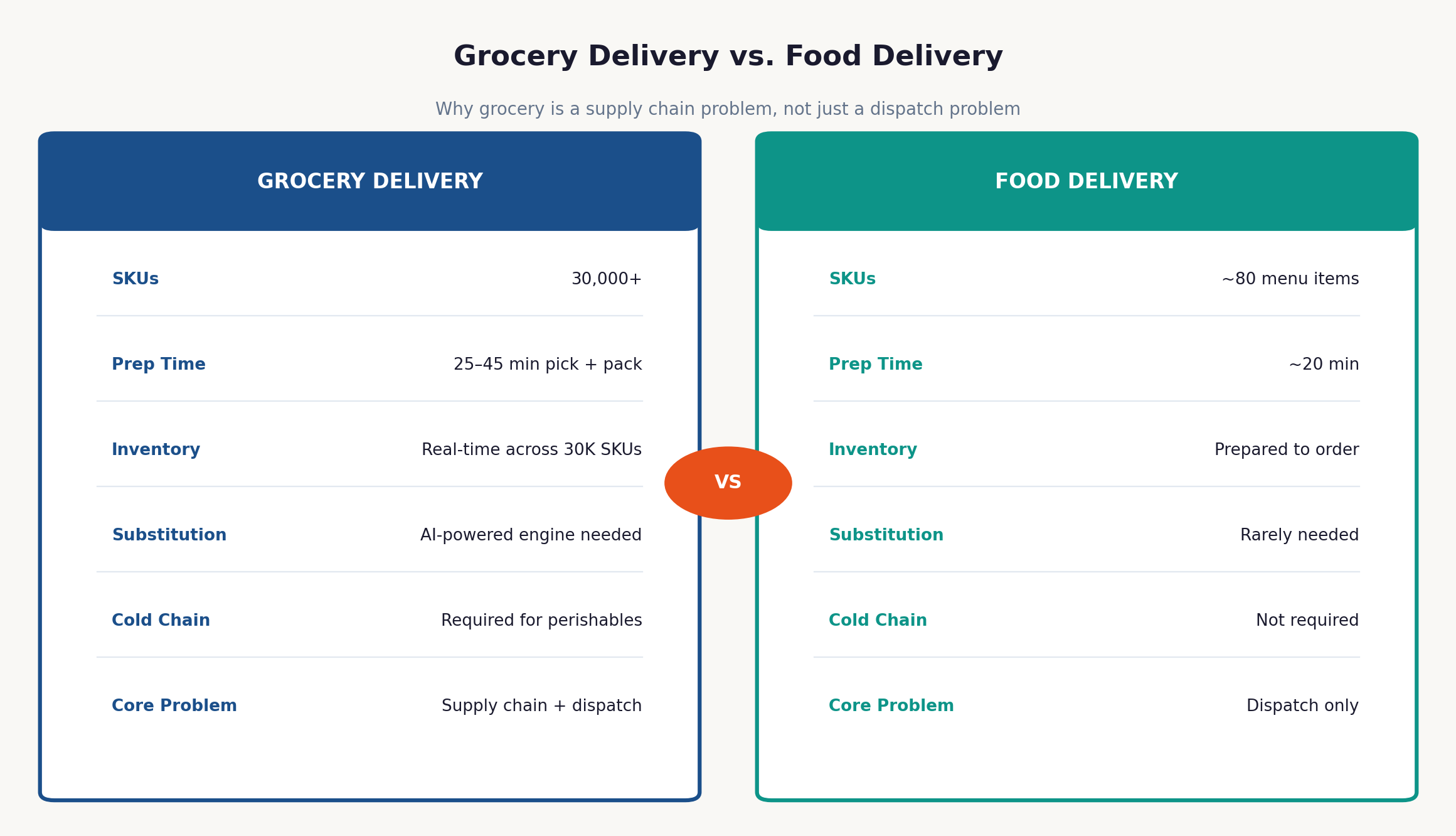
A restaurant has 80 menu items. A grocery store has 30,000 SKUs.
A restaurant prepares food to order. A grocery store picks items from shelf inventory that may or may not be available.
A restaurant delivery goes from one location. Grocery orders often consolidate items from multiple aisles, sometimes multiple store sections with different temperature requirements.
A restaurant order takes 20 minutes. A grocery order with 40 items takes 25 minutes to pick, 10 minutes to pack, and must maintain a cold chain for perishables during both.
The customer who orders a chicken breast and finds out at delivery that it was substituted with turkey is not a happy customer. The customer who orders oat milk and receives regular milk because the shopper couldn’t find the right product has a dietary problem, not just a preference problem.
I co-founded EngineerBabu 14 years ago. The team has built supply chain intelligence for Simba Beer India’s No.1 premium craft beer where AI-powered inventory management recovered millions in blocked working capital. The demand forecasting, real-time inventory management, and substitution logic that made that system work are directly applicable to grocery delivery. Same engineering patterns, different domains.
Food delivery is a dispatch problem. Grocery delivery is a supply chain problem with a dispatch layer on top. Every engineering challenge in this guide flows from that distinction.
If you’re ready to build email mayank@engineerbabu.com
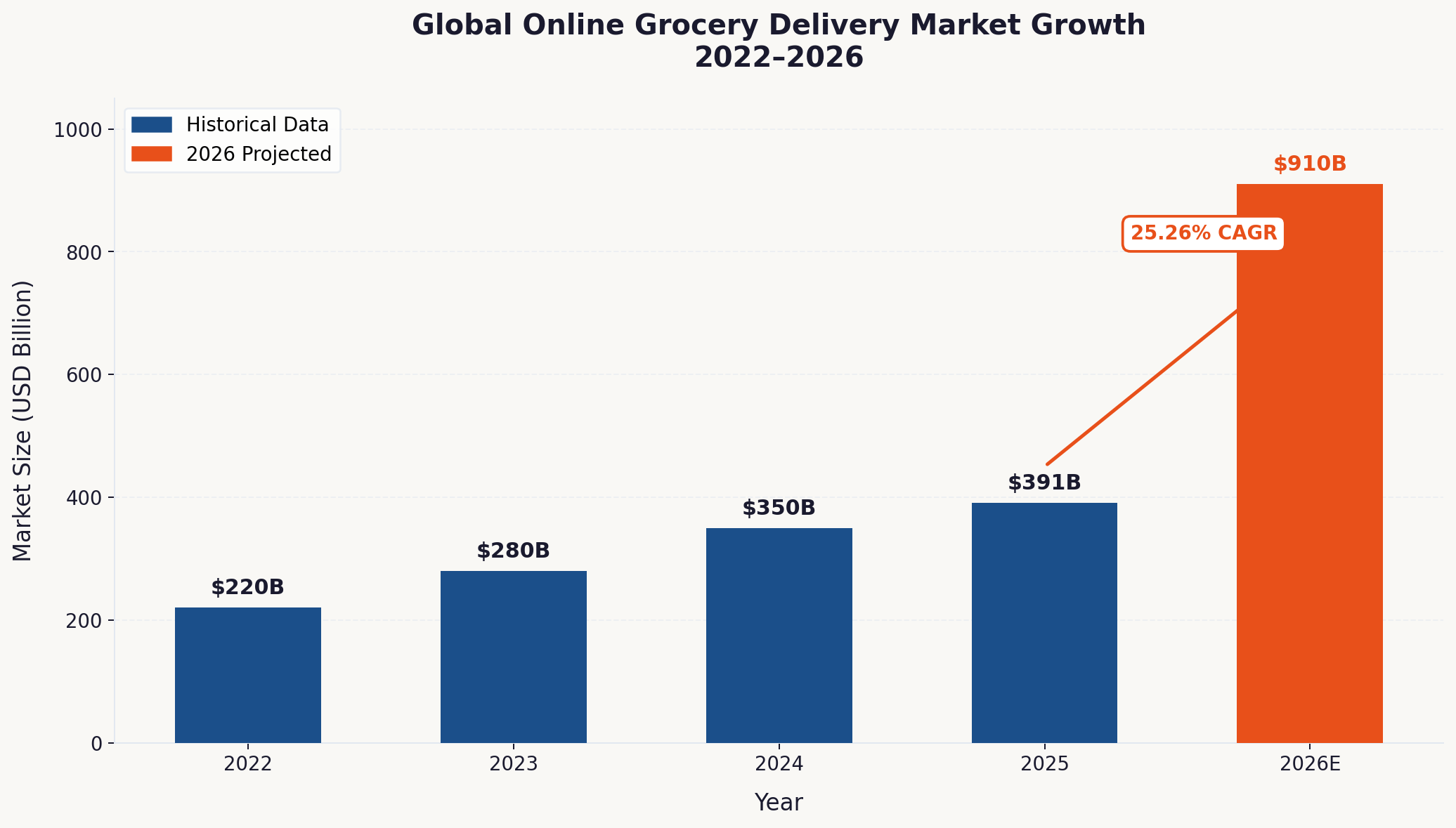
The global online grocery delivery market was valued at $910 billion in 2026, growing from $391 billion in 2025 at a CAGR of 25.26%, one of the fastest-growing segments in global commerce. Instant delivery services (10–30 minute delivery) are growing at 17.92% CAGR, outpacing every other delivery model.
In the US, 51.8% of American adults bought groceries online in 2024. 148.4 million Americans shop for groceries online. The $363 billion US online grocery market in 2026 is growing at 8.29% annually.
India targeted 5,500 dark stores by FY 2026. Blinkit (Zomato’s quick commerce division) reported 97% year-over-year growth in Gross Order Value in FY24.
The opportunity is structural. Traditional grocery retail is shifting digital faster than any previous retail category shift. The dark store / quick commerce model microwarehouses positioned for 10–30 minute delivery is winning in urban markets globally. Asia-Pacific is the fastest-growing geography at 20.95% CAGR through 2031.
But here’s what those numbers obscure: grocery delivery has the worst unit economics in on-demand delivery. Last-mile delivery for a basket of perishables requires cold chain infrastructure, careful picking, and handling that restaurant delivery doesn’t. The platforms that survive are the ones that get the operations architecture right, demand forecasting, inventory management, and AI-powered substitution, not just the consumer experience.
A grocery delivery app is a platform connecting customers with grocery retailers or dark stores for same-day or instant delivery of household essentials and perishables. Unlike restaurant delivery, it requires real-time inventory integration across thousands of SKUs, intelligent substitution when items are out of stock, cold chain integrity from picker to customer, and demand forecasting sophisticated enough to pre-position inventory at the right dark store for the right time window.
The single biggest technical challenge in grocery delivery that food delivery doesn’t have: real-time inventory accuracy across 30,000+ SKUs.
When a customer orders boneless chicken breast from Store A, the platform needs to know not to estimate whether that specific product is currently available on the shelf. Restaurant menus have 80 items and update a few times a day. A grocery store’s inventory changes continuously: items sell through, deliveries arrive, products are damaged, special promotions deplete stock faster than forecasted.
Solving this requires either:
POS integration direct connection to the grocery retailer’s point-of-sale system, which updates inventory counts with every scan. Accurate, but requires the retailer to have a modern POS with API access. Many Indian retailers and small grocery chains don’t.
Dark store model: the platform owns or operates the warehouse (dark store), controls its own inventory, and updates in real time. This is why Blinkit, Zepto, and Swiggy Instamart built dark stores rather than relying on existing retailer inventory. When you control the inventory, you know exactly what’s available.
Picker-reported availability the shopper app prompts the picker to confirm item availability at the start of each pick sequence. Combined with ML-based availability prediction (this SKU has sold out at this store at this time on previous Fridays), the platform builds real-time inventory awareness without formal POS integration.
The team’s recommendation: for platforms aggregating from multiple retailers, start with picker-reported availability plus ML prediction. For dark store models, build full warehouse management system integration. The architecture choice determines the substitution quality downstream.
When an item is unavailable, the substitution decision determines whether the customer feels served or cheated.
This is where AI creates genuine competitive differentiation in grocery delivery.
Rule-based substitution (what most first-version platforms build): substitute with the same brand, different size. Or the same size, different brand. These rules work for commodity items (same brand in a different pack size) and fail completely for items where the substitution changes a meal plan (customer ordered gluten-free pasta, substitution is regular pasta cannot be substituted).
ML-based substitution (what winning platforms use): train a model on customer behaviour data which substitutions customers accepted vs. rejected in the past, which customers have dietary restrictions (inferred from ordering patterns), what attributes define “acceptable substitution” for each item category.
The substitution model the team builds:
Item attribute graph every SKU is tagged with attributes: category, brand, pack size, dietary properties (vegan, gluten-free, organic), price tier. Substitutions are suggested based on attribute similarity, not just category matching.
Customer preference history customers who consistently reject price-tier upgrades get different substitution suggestions than customers who always accept them. Dietary restriction signals from order history are weighted heavily (never substitute dairy for non-dairy for a customer who has never ordered dairy).
Explicit customer preferences during checkout, customers can set substitution preferences: always allow, never allow, always call me, or always refund.
Picker confirmation the picker sees the AI-suggested substitution and must explicitly confirm before adding it to the order. They can override with a different item or flag as unavailable with no substitution.
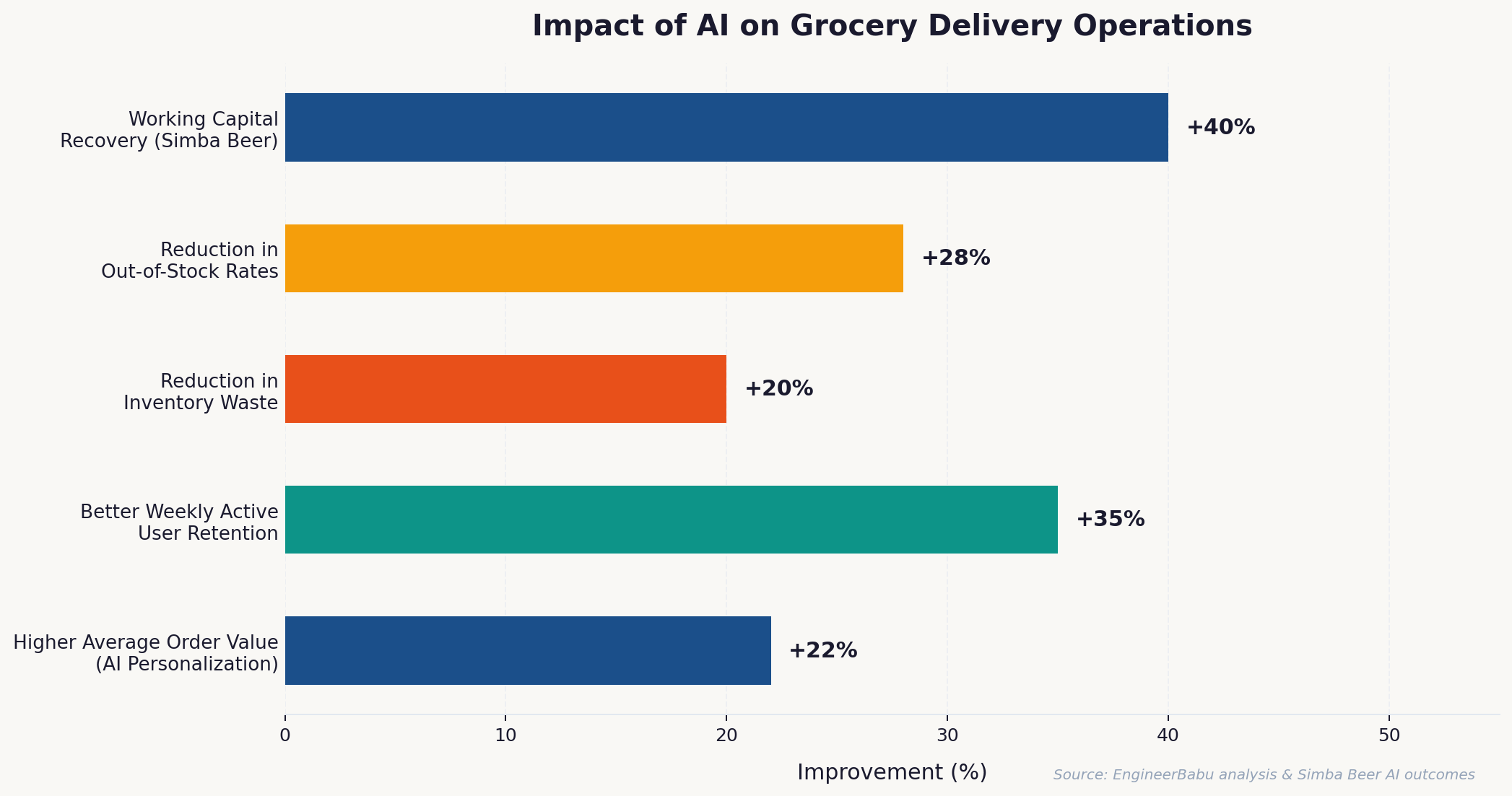
Platforms with AI personalization report 18–25% higher average order values and 35% better weekly active user retention compared to non-personalized apps. The substitution engine is the primary driver of both metrics.
Perishable items, fresh produce, dairy, meat, and frozen goods require temperature integrity from the moment they leave the shelf to the moment they arrive at the customer’s door.
This is an engineering and operations problem:
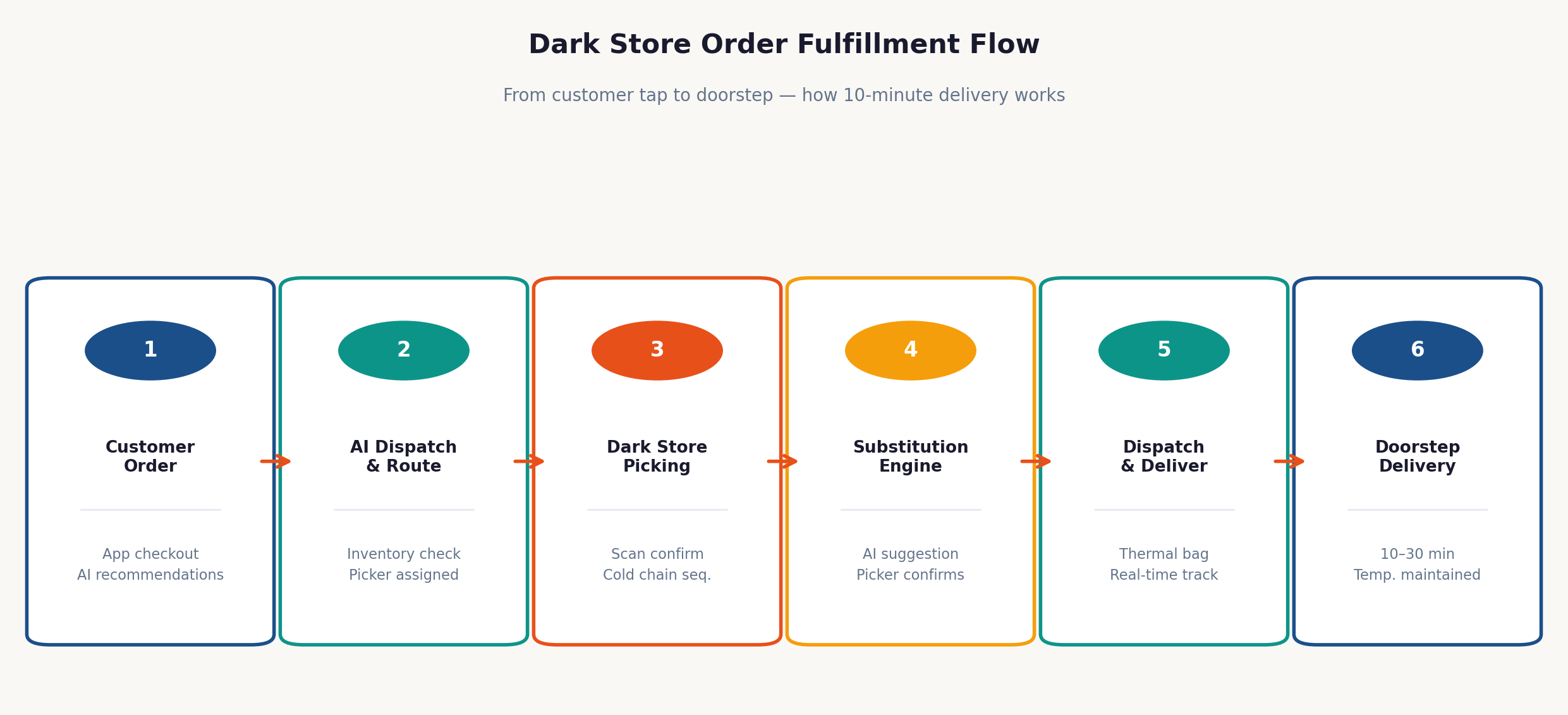
Dark store zone management the warehouse has temperature zones (ambient, chilled, frozen). The pick sequence must be optimised to pick ambient items first, chilled items second, and frozen items last minimising the time each item spends outside its temperature zone before the order is consolidated.
Pick routing the order management system generates a pick route that respects zone sequencing, not just shortest-path optimisation. A route that picks frozen items from the back of the store before walking past ambient items for 200 metres and back to packing loses cold chain integrity.
Delivery partner cold bags the app must track whether the assigned delivery partner is equipped with thermal bags appropriate for the order’s temperature requirements. Assigning a delivery partner without cold bags to an order with frozen items is a cold chain failure.
Temperature exception logging the picker app logs when cold chain exceptions occur (cold item held outside refrigeration above a threshold duration). This creates an audit trail and surfaces training needs.
The Simba Beer supply chain AI the team built required temperature compliance tracking at every stage of the cold chain from brewery to distributor to retailer. The same logging and exception management patterns apply directly to grocery cold chain engineering.
Dark store grocery delivery (Blinkit, Zepto, Gopuff model) and aggregator grocery delivery (Instacart, BigBasket model) require fundamentally different platform architectures.
Aggregator model (platform connects customer to existing stores):
Dark store model (platform operates microwarehouses):
The dark store model enables 10-minute delivery. The aggregator model typically delivers in 30–60 minutes. In urban markets, 10-minute delivery has become the consumer expectation for quick commerce.
The dark store model requires a warehouse management system as a core platform component. The team builds WMS for dark store platforms that includes: inbound receiving, put-away slot assignment, inventory level tracking, reorder trigger automation, and pick route optimization. This is the engineering that makes fast delivery economically viable.
The Simba Beer supply chain AI built by the team is the direct reference point here.
Simba Beer was losing money on dead stock beer cases sitting in distributor warehouses beyond their optimal window, capital blocked in inventory that moved slower than forecast. The AI system predicted per-SKU, per-location demand with enough accuracy to right-size inventory at each distribution point, recovering millions in blocked working capital.
Grocery delivery has the identical problem at the dark store level. A dark store that overstocks strawberries on a rainy Monday writes off perishable inventory. A dark store that understocks bottled water on a hot Friday fails to fulfill demand during the highest-revenue window of the week.
The production demand forecasting model the team builds:
Historical order data per-SKU, per-hour, per-day-of-week, per-weather-condition sales patterns from the platform’s own order history.
External signals include weather (heat drives water and cold drinks, rain increases order volume generally), local events (sports matches, concerts, public holidays), and promotional calendars.
Substitution data which items are frequently substituted suggests which items run out predictably. If bottled water substitutions spike every Friday, the dark store needs more bottled water on Thursday.
Lead time awareness replenishment orders must be placed with sufficient lead time for delivery. The model must account for supplier lead times when generating reorder triggers.
AI demand forecasting reduces inventory waste by 20% and cuts delivery costs by reducing out-of-stock rates. These are not aspirational numbers; they’re derived from the Simba Beer AI outcomes and consistent with what the broader industry reports for AI-powered grocery operations.
The delivery driver in food delivery has one job: go to the restaurant, pick up the food, deliver it. The navigation is complex.
The grocery picker has a completely different job: navigate a store or warehouse with 30,000 SKUs, pick the right items in the right quantities with the right product attributes (the customer ordered full-fat milk, not semi-skimmed), manage substitutions when items aren’t available, maintain cold chain sequencing, pack items correctly (cold items together, fragile items on top), and hand off to the delivery partner.
The picker app requirements:
Optimised pick route the app displays items in the sequence that minimises walking distance within the store layout. The store layout must be mapped and maintained (when the store rearranges, the pick routes update).
Barcode scan confirmation the picker scans the barcode of each picked item to confirm they’ve taken the correct product. This prevents the wrong-brand or wrong-size errors that generate refund requests.
Substitution workflow when a scan fails (item not found), the app presents the AI substitution suggestion, allows the picker to accept or choose an alternative, and logs the decision.
Weight-variable items sold by weight (produce, meat from the deli counter) require the picker to weigh the item and update the order total based on actual weight. The app must support weight capture and price recalculation.
Handoff to delivery partner the app notifies the delivery partner when the order is packed, supports handoff confirmation (delivery partner scans the packed bags’ QR code), and initiates the delivery assignment in the dispatch engine.
Most grocery delivery platforms in 2026 support both instant delivery (10–45 minutes) and scheduled delivery (choose a 2-hour window).
These are not the same product with different timers. They require different operational architectures:
Instant delivery order triggers immediate dispatch. Dark store model required (can’t pick 40 items from a live retail store in 15 minutes with other customers in the way). Limited SKU range (typically 2,000–5,000 fast-moving items). Strict delivery radius.
Scheduled delivery order is held until a batch processing window. Multiple orders going to the same neighbourhood can be batched for route optimisation. Wider SKU range. Larger basket sizes (weekly grocery shop, not top-up purchase). Retailer stores are viable (sufficient prep time for staff to pick before delivery window).
The platform needs to route incoming orders to the correct fulfillment model based on delivery type, item availability (items not available in the dark store route to scheduled delivery from the retailer), and customer location relative to dark stores.
Flutter (customer app + picker app) + React Native (retailer/store management tablet) + Next.js (admin, ops, dark store WMS)
Node.js NestJS (order orchestration, dispatch) + Python (demand forecasting, substitution AI, route optimization)
PostgreSQL + Redis + Kafka
PostgreSQL for orders, inventory records, SKU catalogue, and fulfillment history. Redis for real-time dark store inventory state (updated with every pick and every inbound delivery). Kafka for the event stream connecting order placement to pick queue to dispatch to delivery tracking.
Google Maps Platform (routing) + custom pick route engine (store layout)
Payments: Razorpay (India) + Stripe (international)
Cold chain: IoT temperature sensors in dark stores (optional, for full dark store operations)
The Simba Beer supply chain AI built by the team recovered millions in blocked working capital through demand forecasting and inventory intelligence. The same engineering patterns SKU-level demand forecasting, reorder trigger automation, and substitution prediction are now applied to grocery delivery builds.
The team builds dark store WMS platforms with inbound receiving, put-away routing, pick route optimisation, and demand-driven replenishment. The AI layer runs demand forecasting on historical order patterns, weather data, and promotional calendars.
The key insight from the Simba Beer build: inventory problems that look like operational problems are usually data problems. The distributor who was losing money on dead stock wasn’t making operational mistakes. They were making decisions on forecast data that was 30 days stale. Real-time inventory intelligence, updated daily, changed the decision quality entirely.
The same insight applies to grocery dark stores. The dark store that understocks strawberries on a sunny Saturday doesn’t have an operations problem, it has a forecasting problem. The team builds the forecasting system alongside the operational platform.
CTA #2 The team can scope your grocery delivery architecture within a week. mayank@engineerbabu.com
Platform launches showing items as available based on catalogue data, not real-time stock. First week: 30% of orders have at least one out-of-stock item discovered by the picker. Customer refunds spike. Trust collapses.
The fix: Real-time inventory infrastructure (POS integration, dark store WMS, or picker-confirmed availability) before launch. Never show “available” without a live signal.
Substitution engine substitutes regular pasta for gluten-free pasta. The customer has celiac disease. Platform receives a medical complaint. Trust collapse is permanent for that customer and everyone they tell.
The fix: Dietary attribute tagging on every SKU. Dietary-property-aware substitution rules. Customer explicit no-substitute preferences. The attribute graph is built before the substitution engine.
Delivery partner picks frozen items first, walks 15 minutes around the store, packs frozen and ambient together. Frozen items arrive above temperature. The cold chain failure becomes a food safety issue.
The fix: Temperature-zone-aware pick sequencing in the picker app. Cold items picked last. Handoff bag assignment tracked in the dispatch system.
Dark store opens with 2,000 SKUs based on a general grocery category mix. Actual demand pattern is completely different from the general category mix (the neighbourhood is predominantly vegan; oat milk sells 10x faster than dairy milk). Dead stock in dairy, frequent out-of-stocks in plant alternatives.
The fix: Demand forecasting from day 1 of operation, updated weekly. SKU mix adjusted based on actual order data within the first 30 days. The Simba Beer AI model pattern applied to dark store inventory management.
White-label grocery platform: Faster to market, generic substitution logic, no dark store WMS. Right for retailers wanting a digital channel for their existing store without custom operations optimization.
Custom build: Required for any platform competing on speed (dark store model), AI substitution quality, demand forecasting, or proprietary inventory management. The cold chain, substitution engine, and demand forecasting are the competitive moat. White-label solutions provide neither.
Grocery delivery app development starts from $15K for a production MVP customer app (browse, order, track), picker app (pick list, barcode scan, substitution workflow), basic dispatch, and payment processing.
Full platforms dark store WMS, AI substitution engine, demand forecasting, cold chain tracking, scheduled and instant delivery scoped based on fulfillment model (dark store vs. aggregator), SKU count, and market.
Timeline: MVP in 14–18 weeks. Full dark store platform with WMS and AI forecasting in 7–12 months.
40–60% cost savings vs US/UK. Simba Beer supply chain AI directly applicable. Full IP ownership.
The Simba Beer supply chain AI demand forecasting, inventory intelligence, millions recovered is the direct reference. Same patterns applied to grocery.
500+ products across 20 countries. BURQ US logistics. Multiple marketplace builds. Google AI Accelerator 2024 production AI for demand forecasting and substitution models.
Mayank leads personally. CMMI Level 5. 4 unicorn clients. Full IP ownership.
An FMCG brand came to the team losing money on dead stock in their distribution network. The AI inventory system predicted per-SKU demand at each distribution point, automated reorder triggers, and recovered millions in blocked working capital.
The same system, adapted for grocery dark stores, prevents the dead stock and out-of-stock cycles that make quick commerce economically unviable.
30 minutes. Honest assessment of your fulfillment model, your inventory approach, and what a profitable grocery delivery platform actually requires.
Building a platform connecting customers with grocery retailers or dark stores for same-day or instant delivery with real-time inventory across 30,000+ SKUs, AI-powered substitution, cold chain integrity, demand forecasting, and dispatch.
Food delivery is a dispatch problem (restaurant prepares food, driver delivers it). Grocery delivery is a supply chain problem: real-time inventory accuracy across thousands of SKUs, item substitution when products are unavailable, cold chain integrity for perishables, and demand forecasting to pre-position inventory. Every technical challenge is harder.
A dark store (ghost store/microwarehouse) is a fulfillment facility optimised for order picking, not retail browsing. No physical customers. Designed for fast pick-and-pack with optimised aisle layouts and temperature-controlled zones. Dark stores enable 10-30 minute delivery because all items are in a compact, pick-optimised location rather than spread across a live retail store.
The system that suggests alternative products when the ordered item is out of stock. Naive substitution uses same-brand different-size rules. AI-powered substitution uses item attribute graphs, customer preference history, and dietary restriction signals to suggest substitutions that customers actually accept critical for retention and trust.
Historical order data by SKU, time, weather, and promotions is used to predict per-SKU demand at each dark store location for upcoming windows. This drives automated reorder triggers (restock strawberries on Thursday before Friday demand spike) and reduces both dead stock and out-of-stock rates simultaneously.
MVP (customer app, picker app, basic dispatch): 14–18 weeks. Full dark store platform with WMS, AI substitution, and demand forecasting: 7–12 months.
Flutter for customer and picker apps, React Native for retailer tablets, Next.js for admin/WMS, Node.js NestJS for order orchestration, Python for demand forecasting and substitution AI, PostgreSQL + Redis + Kafka for data, Google Maps for routing.