Medical Device Software and FDA Regulations in the USA: What Healthcare App Builders Need to Know in 2026


Create engaging, high-performance mobile applications tailored to your business needs. We craft future-ready apps that offer smooth user experiences on all devices.
Build robust and scalable websites and CMS platforms that help you manage content effortlessly. Our development ensures a seamless digital presence.
Launch secure, feature-rich online stores with intuitive shopping experiences. We build tailored eCommerce platforms designed for growth.
Design captivating games with immersive gameplay and stunning graphics. From concept to launch, we build engaging experiences that players love.
Enhance your customer relationships with customized Salesforce implementations. Drive growth and efficiency with smarter CRM solutions.
Harness artificial intelligence and machine learning to automate workflows and gain actionable insights. Our AI transforms data into smart decisions.
Accelerate your software delivery lifecycle with continuous integration, delivery, and infrastructure automation to boost efficiency.
Hire app developers ready to turn your ideas into sleek, high-performing mobile apps for any platform.
Bring in frontend pros who craft smooth, beautiful, and user-friendly interfaces that your visitors will love.
Get backend developers who build fast, secure, and reliable systems to keep everything running behind the scenes.
Hire eCommerce developers who build secure, scalable online stores designed to offer seamless shopping and grow your sales.
Get dedicated developers committed to your projects, delivering consistent quality and speed as an extension of your team.
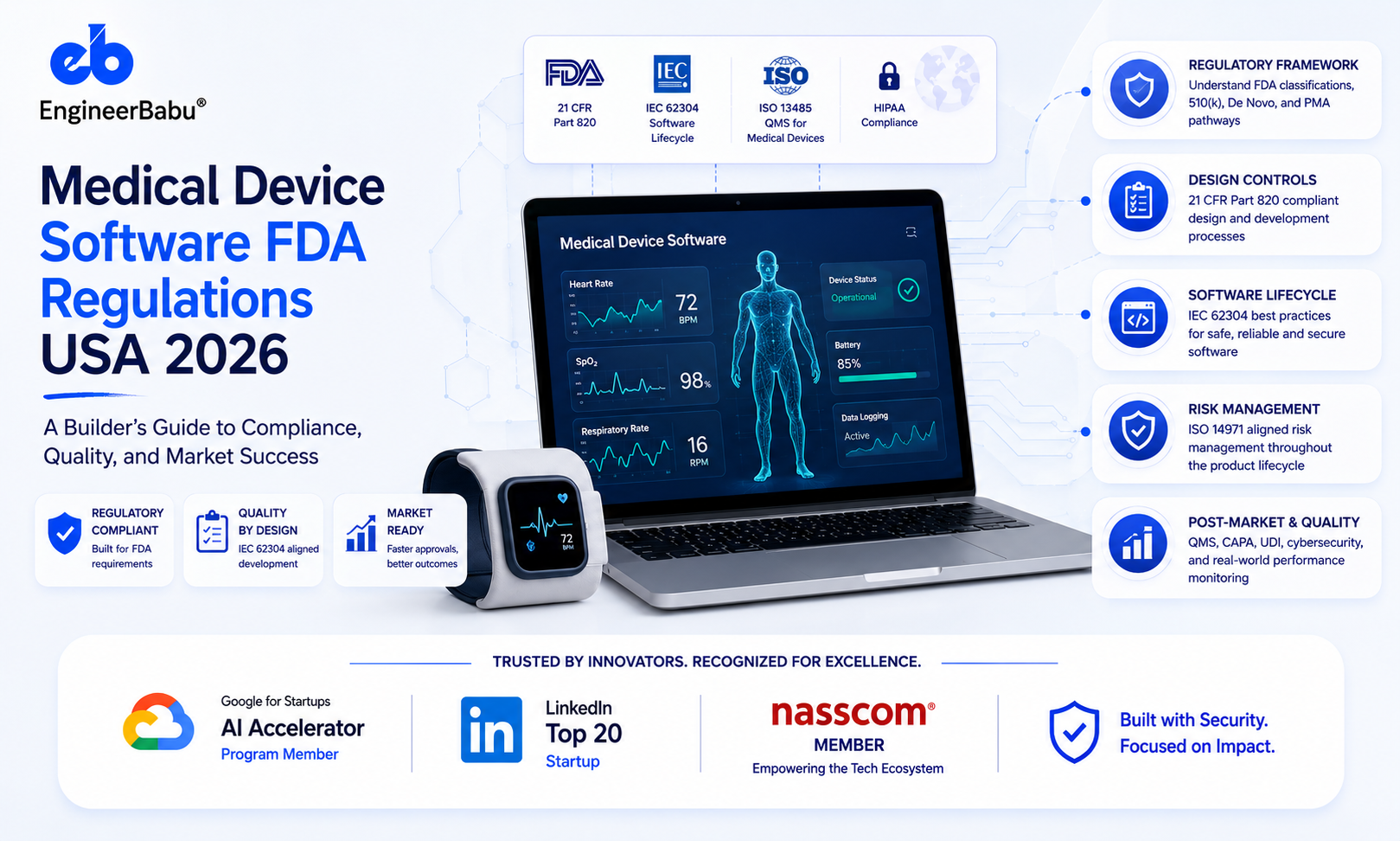
A digital health team spent 18 months building an AI diagnostic tool for dermatology, trained on 500,000 images, achieving 94% sensitivity for melanoma detection, beating dermatologist performance in several study metrics.
They launched to 40 clinical sites, processed 10,000 patient images, and received a warning letter from FDA 6 months later.
The problem wasn’t the AI performance. The problem was the regulatory classification. Their tool was making specific diagnostic recommendations that clinicians relied on for treatment decisions. That made it Software as a Medical Device. They had launched without FDA clearance.
Remediation cost them $2.1 million and 14 months. Two of the 40 clinical sites permanently terminated their contracts rather than wait.
Understanding FDA SaMD classification is not an afterthought for AI healthcare product builders. It is the first conversation.
Software as a Medical Device (SaMD) is software intended to be used for one or more medical purposes that performs these purposes without being part of a hardware medical device.
The FDA defines SaMD as software that: (1) diagnoses, treats, cures, mitigates, or prevents disease in a patient; (2) provides decision support for clinical decisions that are not independently verified by the clinician before acting on them; or (3) is intended to be used in connection with any other medical device. SaMD requires FDA regulatory oversight, either 510(k) clearance, De Novo classification, or PMA depending on the risk level of the intended use.
The FDA uses a risk-based framework adapted from the International Medical Device Regulators Forum (IMDRF) to classify SaMD. Two dimensions determine classification:
The risk category determines the regulatory pathway:
| State of Condition | Treat/Diagnose | Drive Clinical Management | Inform Clinical Management |
| Critical | Category IV (PMA) | Category III (De Novo/510k) | Category II (510k) |
| Serious | Category III (De Novo/510k) | Category II (510k) | Category I (General Controls only) |
| Non-serious | Category II (510k) | Category I | Category I |
Not all healthcare software is SaMD. Understanding the exceptions is as important as understanding the regulation.
The critical nuance of exception 4: The FDA published guidance clarifying that “independent verification” must be genuine. A clinician reviewing an AI recommendation by looking at the same data the AI used and applying their own clinical judgment is independent verification. A clinician accepting an AI recommendation because they trust the algorithm, without independently analyzing the underlying data, is not. This distinction is difficult to engineer and even harder to demonstrate in an audit.
Traditional SaMD regulatory frameworks were designed for static software, a device that does the same thing every time, approved as-is. ML models are different: they learn from new data, potentially changing their behavior post-clearance.
FDA published its AI/ML-Based Software as a Medical Device action plan in 2021 and has been developing a Predetermined Change Control Plan (PCCP) framework that allows AI models to update within pre-approved parameters without re-clearance.
The current status: FDA accepts PCCPs as part of 510(k) submissions, allowing modest performance improvements and retraining on similar data distributions without requiring a new submission.
The post-market surveillance obligation: Once cleared, AI SaMD is subject to FDA post-market surveillance requirements: adverse event reporting, performance monitoring, and real-world evidence collection. For AI model development, this means maintaining outcome tracking infrastructure, connecting model predictions to patient outcomes, monitoring for performance drift, detecting bias in subpopulations.
Ask: Is this software intended to make a diagnostic or therapeutic claim? Is the clinician expected to act on the recommendation without independent verification? Is the condition critical or serious? If yes to any of these, engage FDA regulatory counsel before your first sprint.
If your software provides reference information that clinicians independently verify before acting, and the condition is non-serious, design the product and user experience to genuinely support independent verification. Documentation, UI design, and user training all matter. “The algorithm recommends X” with a one-click accept is closer to the device side. “Here are the factors that suggest X, here is the evidence, you decide” is closer to the non-device side.
FDA’s Pre-Submission program allows companies to request feedback on their regulatory approach before submitting a formal application. For novel AI devices, a Pre-Sub meeting can save 12–24 months by confirming the intended pathway before preparation is complete.
Clinical validation studies, human factors studies, and post-market surveillance infrastructure are not built in the last sprint before FDA submission. They are built into the product from the beginning. The data you collect during development and early deployment becomes the clinical evidence in your 510(k) submission.
Author: Mayank Pratap | Co-Founder, EngineerBabu | Google AI Accelerator 2024 · CMMI Level 5
Only if it qualifies as Software as a Medical Device. Administrative software, wellness apps, EHRs, and decision support software where clinicians independently verify before acting on non-serious conditions are generally not regulated as medical devices. AI systems making specific diagnostic or treatment recommendations in serious or critical clinical contexts likely require FDA clearance.
510(k) clearance demonstrates substantial equivalence to an existing cleared device (the predicate). De Novo classification is for genuinely novel devices without a predicate, the FDA establishes a new device type. 510(k) is faster when a predicate exists; De Novo is the pathway for true innovation.
510(k): 90–180 days for straightforward software devices. De Novo: 12–24 months. PMA: 1–3 years with clinical trials. Pre-Submission program feedback typically takes 60–90 days and can significantly de-risk the formal submission timeline.
A PCCP defines the parameters within which an AI/ML model can be updated after clearance without requiring a new FDA submission. It specifies the allowed changes (retraining on additional data within the same distribution, minor performance optimizations), the performance thresholds that trigger re-review, and the post-market monitoring required to detect unintended performance changes.
If the software qualifies as SaMD and is deployed without clearance, FDA can issue warning letters, require product recall, impose injunctions, and in cases of intentional violations, pursue criminal charges. Civil penalties can reach $15,000 per violation per day. The reputational impact with health system clients, who typically audit their software vendors for FDA compliance is often more immediately damaging than the regulatory action itself.