How to Reduce Claim Denials with AI in the USA: What's Actually Working in 2026


Create engaging, high-performance mobile applications tailored to your business needs. We craft future-ready apps that offer smooth user experiences on all devices.
Build robust and scalable websites and CMS platforms that help you manage content effortlessly. Our development ensures a seamless digital presence.
Launch secure, feature-rich online stores with intuitive shopping experiences. We build tailored eCommerce platforms designed for growth.
Design captivating games with immersive gameplay and stunning graphics. From concept to launch, we build engaging experiences that players love.
Enhance your customer relationships with customized Salesforce implementations. Drive growth and efficiency with smarter CRM solutions.
Harness artificial intelligence and machine learning to automate workflows and gain actionable insights. Our AI transforms data into smart decisions.
Accelerate your software delivery lifecycle with continuous integration, delivery, and infrastructure automation to boost efficiency.
Hire app developers ready to turn your ideas into sleek, high-performing mobile apps for any platform.
Bring in frontend pros who craft smooth, beautiful, and user-friendly interfaces that your visitors will love.
Get backend developers who build fast, secure, and reliable systems to keep everything running behind the scenes.
Hire eCommerce developers who build secure, scalable online stores designed to offer seamless shopping and grow your sales.
Get dedicated developers committed to your projects, delivering consistent quality and speed as an extension of your team.
Healthcare providers in the USA lose an estimated $19.7 billion annually on claim denial management activities. Not lost revenue from denied claims, just the cost of managing them. The denied revenue itself is separate and larger.
The current denial rate across US hospitals: 11.65% initial denial rate, meaning more than one in nine claims is rejected on first submission. For a hospital processing 30,000 claims per month, that’s approximately 3,300 denied claims per month generating up to $188,000 in monthly administrative waste before accounting for revenue that simply never returns. 65% of denied claims are never appealed at all.
The situation in 2026 is more asymmetric than it has ever been: major insurers deploy proprietary AI systems that can flag and deny claims at speeds and scales no human review team can match.
One insurer’s AI system was documented producing denial rates 16 times higher than human reviewers for identical clinical scenarios. Meanwhile, 67% of providers believe AI could improve their claims process, but only 14% currently use it.
That gap, AI-powered payers versus manual-process providers is where revenue is disappearing.
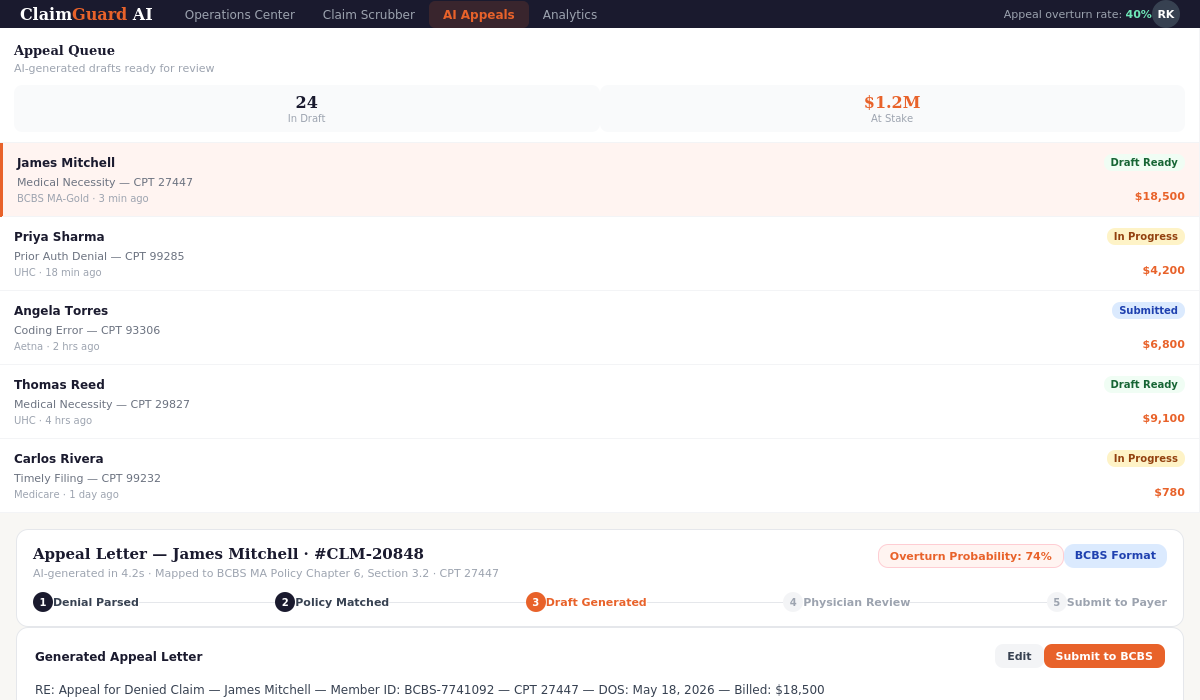
AI development reduces healthcare claim denials through three mechanisms: pre-submission claim scrubbing (identifying errors, missing documentation, and eligibility issues before the claim leaves the system), predictive denial scoring (machine learning models that flag high-risk claims for human review based on historical payer behavior patterns), and automated appeals generation (NLP-driven drafting of medical necessity appeals using clinical documentation from the EHR).
Leading implementations reduce initial denial rates by 30–40% and clean claim rates routinely exceed 95% with mature AI denial prevention programs.
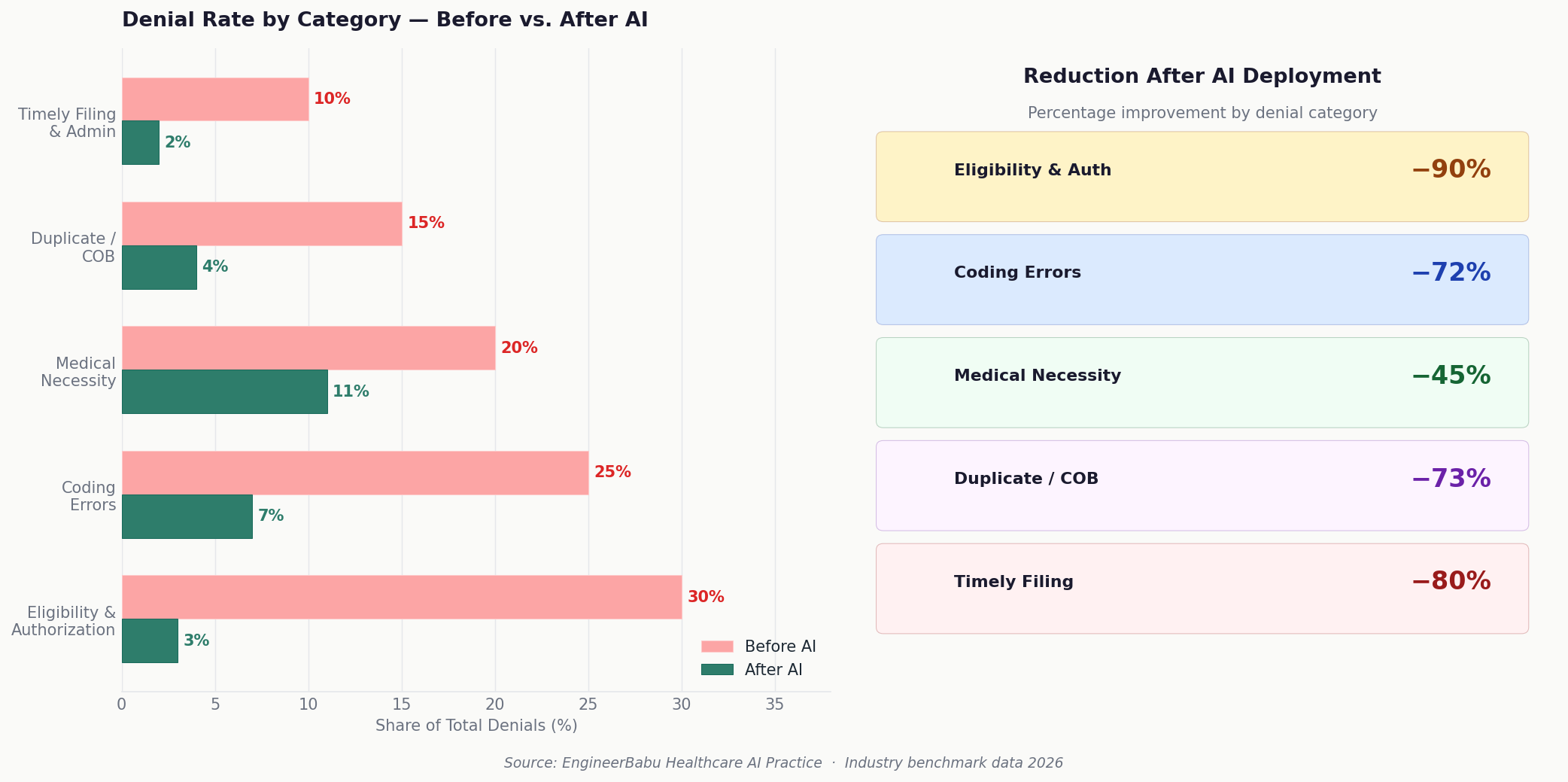
Not all denials are the same problem. AI works differently on each denial category. Understanding the breakdown determines where to invest first.
Patient was ineligible on the date of service. Insurance had lapsed. Wrong payer was billed. Prior authorization was missing or expired.
These are almost entirely preventable with real-time eligibility verification at patient registration and automated PA status checking before the service is delivered. AI solves these at the patient access layer before clinical care is documented, before a claim is generated.
Wrong CPT code. Incorrect ICD-10 specificity. Unbundling violations. E/M level documentation doesn’t match the code billed. NPI mismatches.
AI-powered claim scrubbing against payer edit libraries catches these pre-submission. Natural language processing of clinical documentation suggests correct codes. Computer-assisted coding (CAC) systems extract billable encounters from clinical notes automatically.
The payer’s clinical review, increasingly AI-driven determines the service was not medically necessary given the documented clinical picture. This is the category where payer AI is most aggressively increasing denial rates.
These require a different approach: better clinical documentation from the point of care (ambient AI scribe systems that capture clinical reasoning), AI-assisted Clinical Documentation Improvement (CDI), and automated appeals that cite specific payer policy language against the clinical record.
Claim submitted twice. Primary/secondary payer coordination errors. Same service billed under multiple identifiers.
Rule-based automation handles most of these. AI adds value in identifying patterns where duplicate submissions are systematic rather than random.
Claim submitted after payer’s filing deadline. Missing modifier. Wrong place of service code.
Workflow automation and calendar-based claim submission tracking prevent most of these. AI adds value by monitoring claim status and triggering resubmission workflows before filing windows close.
The highest-performing revenue cycle operations in 2026 don’t just react to denials, they prevent them. Here are the five layers in deployment sequence:
At patient registration, AI systems do more than verify insurance coverage. They model risk: Does this payer-plan combination have a history of denying this procedure? Has this specific patient had prior authorization failures? Is there a coverage gap risk based on enrollment history?
The eligibility check at registration is the cheapest denial prevention point in the entire cycle. AI models running against payer databases and historical claim data can flag high-risk registrations and trigger intervention, obtaining updated insurance information, initiating PA workflows, counseling patients on self-pay options before the service is delivered.
Metrics that move: Clean registration rates, same-day auth completion rates, insurance verification error rates.
AI claim scrubbers validate every claim against a continuously updated library of payer-specific editing rules before submission. This is beyond static rule-based scrubbing, ML models trained on historical payer behavior identify claim characteristics that predict denial even when no explicit rule is violated.
The critical differentiator is the payer edit library. Payer clinical policies change constantly, CMS updates NCCI edits, commercial payers update LCD policies, Medicare Advantage plans update their coverage criteria. Static rule engines go stale. AI systems that continuously ingest payer policy updates and retrain on denial outcomes maintain their accuracy as the payer landscape evolves.
Clean claim rate benchmark: 95%+ for mature AI scrubbing programs. Industry average without AI: 85–90%.
Claim denials from coding errors trace back to the clinical documentation. The fix isn’t in the billing department, it’s at the point of documentation.
AI-powered CDI systems analyze clinical notes in real time and flag documentation gaps that will cause downstream coding problems: missing specificity on a diabetes diagnosis, lack of documented clinical decision-making to support an E/M level, absent physician attestation on a complex care plan.
The CDI system surfaces these gaps while the clinician is still in the encounter or immediately after, when correction is fast and free, rather than after a denial is received weeks later.
Computer-assisted coding systems extract ICD-10 codes and CPT codes from clinical documentation, suggest appropriate E/M levels based on documented elements, and flag potential HCC coding opportunities. The AI isn’t billing, it’s surfacing what the documentation supports.
For claims that pass scrubbing and are submitted, predictive models assess real-time denial probability as the claim moves through adjudication. Claims scoring above a threshold are routed for proactive follow-up before the payer acts.
Thus, allowing providers to supplement documentation, respond to information requests, or initiate peer-to-peer review before a denial is formally issued.
The asymmetry this addresses: payer AI systems flag claims for additional review or automatic denial within hours or days. Manual provider follow-up operates on a weekly or monthly cadence. Predictive scoring that surfaces high-risk in-flight claims and triggers immediate action closes this response time gap.
When denials do occur, AI-powered appeals generation extracts the payer’s denial reason, identifies the applicable clinical policy, pulls relevant clinical documentation from the EHR, and drafts an appeal letter citing specific policy language against specific clinical evidence.
The economics of this layer: manual appeal drafting costs $25–$80 per appeal. The average successful appeal recovers $500–$5,000+ depending on the service. At a 65% initial non-appeal rate, the opportunity cost of not appealing is substantial and it’s largely driven by the administrative burden of drafting appeal letters.
AI-generated appeals that cite payer policy chapter and section, include specific clinical documentation timestamps, and are formatted to the payer’s specific submission requirements achieve materially higher overturn rates than generic appeals.
The denial management equation in 2026 is explicitly adversarial. Payer AI systems are optimizing for denial rates; provider AI systems need to optimize against them.
An AMA survey found 61% of physicians report AI is making prior authorization denials more frequent. One documented insurer’s AI system produced denial rates 16 times higher than human reviewers for identical clinical scenarios. The scale of algorithmic denial, one every 1.2 seconds at one documented payer is only possible with automation.
CMS’s response to this dynamic: starting 2026, payers must publish aggregate approval and denial metrics and provide specific reasons for every AI-assisted denial. This transparency requirement creates an accountability layer, but it doesn’t solve the immediate operational reality for provider billing teams.
What providers need to match this asymmetry:
The hybrid model works: AI handles eligibility, coding scrubbing, claim status monitoring, and appeal drafting. Certified medical coders and clinical documentation specialists handle complex medical necessity denials, payer policy interpretation, and appeals requiring clinical judgment.
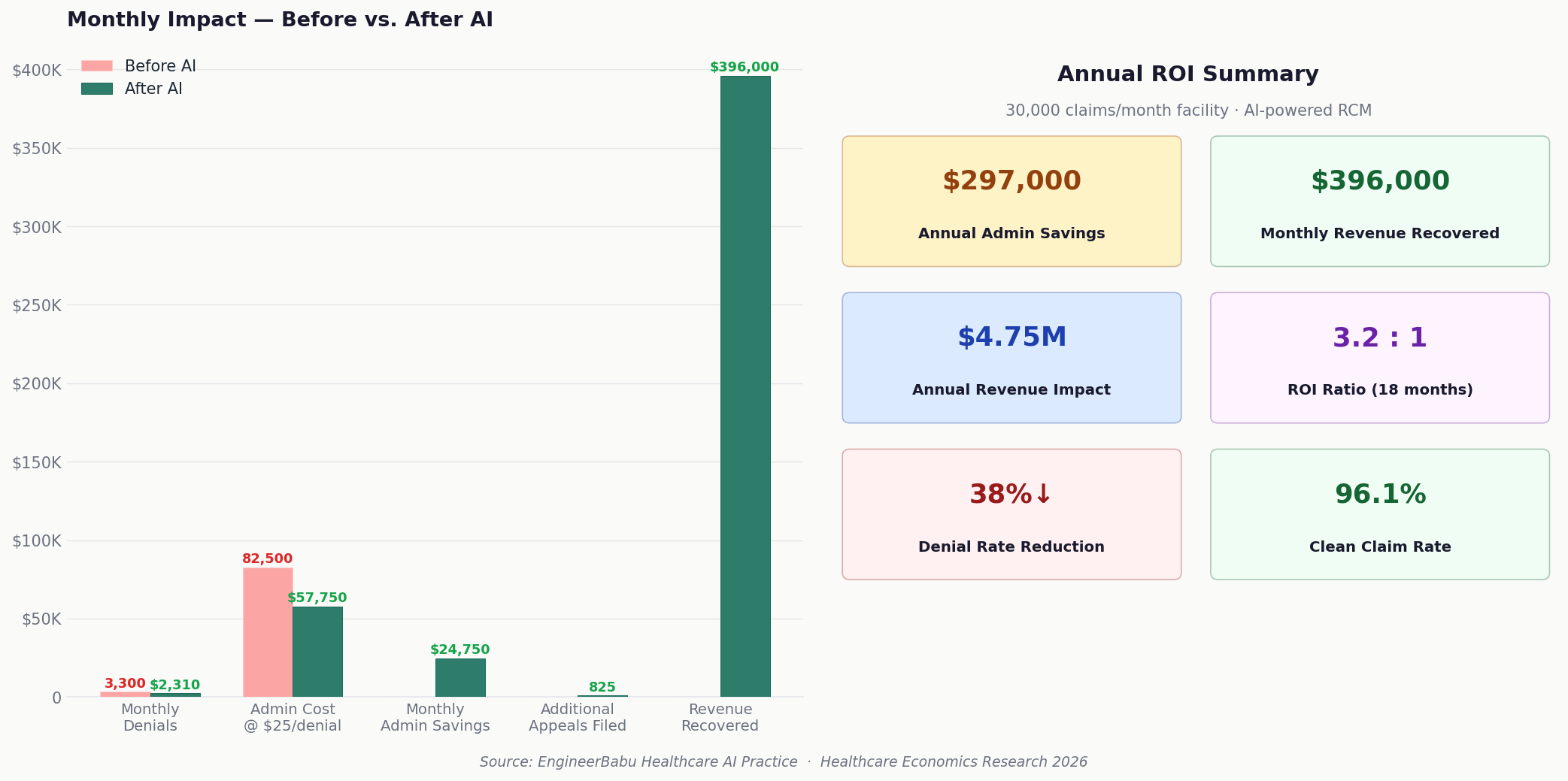
A hospital processing 30,000 claims/month with an 11% denial rate:
| Metric | Before AI | After AI (30% denial reduction) |
| Monthly denial volume | 3,300 | 2,310 |
| Monthly admin cost (@ $25/denial) | $82,500 | $57,750 |
| Monthly admin savings | — | $24,750 |
| Annual admin savings | — | $297,000 |
| Revenue recovery (65% non-appeal → 40%) | Baseline | +25% appeal rate on additional 825 denials |
Assuming average denied claim value of $1,200 and 40% appeal success rate, the additional 825 appeals per month at $1,200 average value with 40% overturn rate recovers approximately $396,000 per month in previously abandoned revenue.
Published benchmarks from predictive denial tools report 30–40% reduction in denial rates and clean claim rates above 95%. Healthcare Economics Research data shows AI-assisted RCM programs generate 3.2:1 ROI within 18 months.
For most health systems and large practices, the build-vs-buy decision in AI denial management:
Buy: Waystar, Availity, Experian Health (ClaimSource with AI Advantage), Change Healthcare, nThrive, R1 RCM, all offer AI-powered denial prevention platforms. Best for organizations that want to deploy quickly without building ML infrastructure.
Build custom AI denial management: For health systems with specific payer mix patterns, specialty workflows, or existing RCM technology that needs AI augmentation, custom ML models trained on your own historical claims data consistently outperform generic models on your specific payer behavior.
The EngineerBabu approach: Python ML pipelines (XGBoost or LightGBM for denial prediction), NLP (GPT-4o or fine-tuned clinical models for appeal generation), FHIR R4 integration for clinical documentation extraction, X12 837/835 for claim and remittance processing.
Author: Mayank Pratap | Co-Founder, EngineerBabu | Google AI Accelerator 2024 · CMMI Level 5
11.65% initial denial rate, more than 1 in 9 claims rejected. 41% of providers face denial rates of 10% or higher. 65% of denied claims are never appealed, representing substantial abandoned revenue.
Leading implementations report 30–40% reduction in denial rates and clean claim rates exceeding 95%. Pre-submission AI scrubbing prevents the largest category of denials before they occur.
Eligibility and authorization issues (~30%), coding errors (~25%), medical necessity denials (~20%), duplicate claims and COB errors (~15%), timely filing and administrative errors (~10%). AI prevention works differently on each category.
$19.7 billion annually in denial management activities industry-wide. Average cost to rework a single denied claim: $25 per claim, rising to significantly higher for complex medical necessity cases.
AI systems that extract ICD-10 and CPT codes from clinical documentation, suggest appropriate E/M levels, and flag HCC coding opportunities. CAC reduces coding errors that cause downstream denials by catching documentation gaps at the point of care rather than after payer rejection.
NLP-driven appeal generation extracts the payer’s denial reason, identifies applicable clinical policy language, pulls relevant clinical documentation from the EHR, and drafts appeal letters citing specific policy evidence. AI appeals achieve higher overturn rates than generic templates by matching payer policy citations to specific clinical documentation.